International Research Journal of Engineering and Technology (IRJET)
e-ISSN: 2395 -0056
Volume: 03 Issue: 02 | Feb-2016
p-ISSN: 2395-0072
www.irjet.net
Level control of Conical Tank Process using ANFIS based Model Reference Adaptive PID controller Sengeni D1, Abraham Lincon S2 1Research Scholar, Dept. of Electronics& Instrumentation, Annamalai University 2Professor, Dept. of Electronics& Instrumentation, Annamalai University, Tamilnadu, India
---------------------------------------------------------------------***---------------------------------------------------------------------
Abstract - This paper describes the design and implementation of ANFIS based Model Reference Adaptive PID controller for a nonlinear Conical Tank Level System (CTLS). The control structure is established on a CTLS. The mathematical model of CTLS is developed and an ANFIS based Model Reference Adaptive PID Controller is proposed for this level system. The result of proposed controller is compared with MRAC-PID and conventional PID to analyze the performance in terms of integral square error and Integral absolute error. The results proved that the efficiency of proposed controller.
tuning of parameters both of the membership functions and the consequents in a Sugeno–type inference system. In this paper the Conical tank level system has been considered as a typical representative of inherently nonlinear system, thus it is an ideal choice for testing the modeling capability of the ANFIS based MRAC algorithm. The main contributions of this paper are the performance of the ANFIS based MRAC control strategy on the model of the conical tank level system through simulation studies. In section 2 the process description of conical tank is given. The MRAC is discussed in section 3.The design and structure of ANFIS control strategy is detailed in section 4.Simulation results are analyzed in section 5. Finally, section 6 is summing up of the entire work.
Key Words: Conical tank, PID controller, ANFIS, MRAC.
1. INTRODUCTION
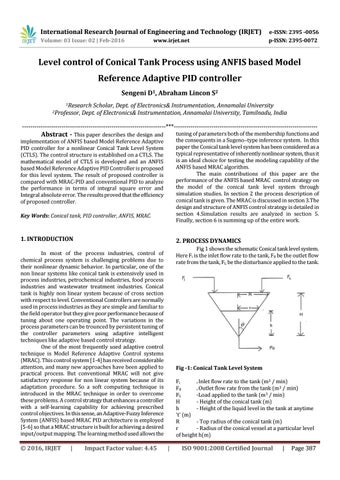
2. PROCESS DYNAMICS Fig 1 shows the schematic Conical tank level system. Here Fi is the inlet flow rate to the tank, F0 be the outlet flow rate from the tank, FL be the disturbance applied to the tank.
In most of the process industries, control of chemical process system is challenging problems due to their nonlinear dynamic behavior. In particular, one of the non linear systems like conical tank is extensively used in process industries, petrochemical industries, food process industries and wastewater treatment industries. Conical tank is highly non linear system because of cross section with respect to level. Conventional Controllers are normally used in process industries as they are simple and familiar to the field operator but they give poor performance because of tuning about one operating point. The variations in the process parameters can be trounced by persistent tuning of the controller parameters using adaptive intelligent techniques like adaptive based control strategy. One of the most frequently used adaptive control technique is Model Reference Adaptive Control systems (MRAC). This control system [1-4] has received considerable attention, and many new approaches have been applied to practical process. But conventional MRAC will not give satisfactory response for non linear system because of its adaptation procedure. So a soft computing technique is introduced in the MRAC technique in order to overcome these problems. A control strategy that enhances a controller with a self-learning capability for achieving prescribed control objectives. In this sense, an Adaptive-Fuzzy Inference System (ANFIS) based MRAC PID architecture is employed [5-6] so that a MRAC structure is built for achieving a desired input/output mapping. The learning method used allows the
© 2016, IRJET
|
Impact Factor value: 4.45
Fig -1: Conical Tank Level System 3 Fi - Inlet flow rate to the tank (m / min) 3 F0 - Outlet flow rate from the tank (m / min) 3 FL -Load applied to the tank (m / min) H - Height of the conical tank (m) h - Height of the liquid level in the tank at anytime 't' (m) R - Top radius of the conical tank (m) r - Radius of the conical vessel at a particular level of height h(m)
|
ISO 9001:2008 Certified Journal
|
Page 387
A
International Research Journal of Engineering and Technology (IRJET)
e-ISSN: 2395 -0056
Volume: 03 Issue: 02 | Feb-2016
p-ISSN: 2395-0072
www.irjet.net
-Area of the conical tank (m2)
Ym Reference Model
ANFIS
The nominal operating level h is given by (1) =
(2)
At any level (h)
=
Parameter Adjustment Mechanism
(3)
Equating (2) and (3)
uc
Yp Controller
r=
Conical Tank System
(4)
Fig- 2: Structure of Model Reference Adaptive Controller Cross sectional area of the tank at any level(h)is
MIT (Massachusetts Institute of Technology) Rule is that the time rate of change of θ is proportional to negative gradient of the cost function (J), that is:
(5) Substitute (4) in (5) (6) Also Substituting (7) in (1)
The adaptation error
. The components of
are the sensitivity derivatives of the error with respect to the adjustable parameter vector θ. The parameter γ is known as the adaptation gain. The MIT rule is a gradient scheme that aims to minimize the squared model error from cost function.
(7) (8) (9)
Model reference Adaptive Control: The goal of this section is to develop parameter adaptation laws for a PID control algorithm using MIT rule.
From equation (8) (10) Where
The reference model for the MRAC generates the desired trajectory , which the level has to follow. Standard
=Nominal value of outflow rate Hence the transfer function of the above system is = (11)
second order differential equation was chosen as the reference model given by
where,
h and U are nominal values of PV and MV from equation (11) Time constant of the level process (12)
Consider also the adaptive law of MRAC structure taken as the following form
The gain constant of the level process k =
(16)
3. MODEL REFERENCE ADAPTIVE PID CONTROL
Where;
When the plant parameters and the disturbance are varying slowly or slower than the dynamic behavior of the plant, then a MRAC control can be used. The model reference adaptive control scheme is shown in figure 2. The adjustment mechanism uses the adjustable parameter known as control parameter θ to adjust the controller parameters. The tracking error and the adaptation law for the controller parameters were determined by MIT rule.
© 2016, IRJET
|
Impact Factor value: 4.45
,
is proportional gain,
is integral
gain, is derivative gain and is a unit step input. In the laplace domain, equation (18) can be transformed to
It is possible to show that applying this control law to the system gives the following closed loop transfer function:
|
ISO 9001:2008 Certified Journal
|
Page 388
International Research Journal of Engineering and Technology (IRJET)
e-ISSN: 2395 -0056
Volume: 03 Issue: 02 | Feb-2016
p-ISSN: 2395-0072
www.irjet.net
Apply MIT gradient rules for determining the value of PID controller parameters . The tracking error equation satisfies:
The exact formulas that are derived using the MIT rule cannot be used. Instead some approximations are required. An approximation made which valid when parameters are closed to ideal value is as follows:
Fig- 3: ANFIS Architecture for Takagi-sugeno system ANFIS has rules of the form: If x is A1 and y is B1 THEN f1 = p1x + q1y + r1 If x is A2 and y is B2 THEN f2 = p2x + q2y + r2 FIS is trained using combination of least squares and back propagation. The entire sugeno system consists of five layers and the relationship between the i/o of each layer is summarized in [11]. ANFIS based MRAC PID control of CTLS is shown in Figure 4.
Denominator of plant, Denominator model reference then, from gradient method.
Ym Reference Model
Where:
ANFIS
Parameter Adjustment Mechanism
Then the approximate parameter adaptation laws are as follows
uc
Yp Controller
Conical Tank System
Fig- 4: ANFIS based MRAC PID control of CTLS. Above equations show the change in PID controller parameters with respect to time. By assuming the reference model has 5% maximum overshoot, settling time of 30 seconds and rise time of about 1 seconds, the second order transfer function of the Model Reference as follows
5.RESULTS AND DISCUSSION Performances of proposed controller are analyzed using step input at various level in the CTLS.. Initially the tank is maintained at 30 % operating level, after that, a step size of 20 % of level is applied to control loop with ANFIS based MRAC-PID control strategy. In the same way, test runs of MRAC-PID and conventional PID control values are carried out and their responses are presented in Figure.5. It is found that in ANFIS based MRAC-PID makes the system to settle with minimum overshoot at all. To validate the performance proposed controller, the same procedure is repeated for 70% and 90% level and given in the same figure. From the results, the performances are analyzed in terms of ISE and IAE are tabulated in Table 1. From Fig 5, it is also clear that proposed controller tracks the set point quickly without any oscillations. The magnified view of output response is presented in Figure 6. The results prove that ANFIS based MRAC-PID controller is appropriate
4. ANFIS MODEL REFERENCE ADAPTIVEPID CONTROL ANFIS stands for Adaptive Neural Fuzzy Inference System. Using a given input/output data set, ANFIS constructs a Fuzzy Inference System (FIS) whose membership function parameters are adjusted using back propagation algorithm in combination with a least squares technique. This allows fuzzy system to learn from the data. The Takagi-Sugino ANFIS architecture is shown in Figure 3. The circular nodes represent nodes that are fixed whereas the square nodes are nodes that have parameters to be learnt.
© 2016, IRJET
|
Impact Factor value: 4.45
|
ISO 9001:2008 Certified Journal
|
Page 389
International Research Journal of Engineering and Technology (IRJET)
e-ISSN: 2395 -0056
Volume: 03 Issue: 02 | Feb-2016
p-ISSN: 2395-0072
www.irjet.net
for non linear process as it has least error values than the other controller strategies.
6.CONCLUSION In this paper, ANFIS based MRAC-PID control strategy has been developed and implemented for a conical tank level system. This method is suitable for process control applications with a large delay, where a conventional PID controller yield a poor performance. The simulation results are furnished to illustrate the efficiency of proposed controller with those of MRAC-PID and PID control approaches. The performance indices are also proved that the proposed controller gives a superior performance than the existing control strategies.
100 90 80
Level (%)
70 60 50 40 30 20
REFERENCES
Operating point PID MRAC-PID ANFIS based MRAC-PID 0
100
200
300
400 Time (sec)
500
600
700
1.
Hans Butler, Ger Honderd, and Job van Amerongen, “Model Reference Adaptive Control of a Direct-Drive DC Motor” IEEE Control Systems Magazine, 1989, pp 80-84. 2. S. Vichai, S. Hirai, M. Komura and S. Kuroki, “Hybrid Control-based Model Reference Adaptive Control” lektronika Ir Elektrotechnika”, Nr. Vol.3(59), 2005, pp 5-8. 3. Chandkishor, R., Gupta, O, “Speed control of DC drives using MRAC technique”, 2nd International Conference on Mechanical and Electrical Technology, ICMET, Sep 2010, pp 135 – 139. 4. Missula Jagath Vallabhai, Pankaj Swarnkar, D.M. Deshpande, “Comparative Analysis Of PI Control and Model Reference Adaptive Control based Vector Control Strategy For Induction Motor Drive,” IJERA, Vol. 2(3), Jun 2012, pp 2059-2070. 5. K. Premkumar and B.V. Manikandan, “Fuzzy PID supervised online ANFIS based speed controller for brushless DC motor,” Neuro computing, Vol. 157 (1), June 2015, pp.76–90 6. Hidayat, Pramonohadi, S. Sarjiya and Suharyanto, “A comparative study of PID, ANFIS and hybrid PIDANFIS controllers for speed control of Brushless DC Motor drive,” IEEE proceedings on International Conference on Computer, Control, Informatics and Its Applications, IC3INA, 2013,Jakarta,, pp.117 – 122,.
800
Fig-5: Comparison of performances of PID, MRAC-PID and ANFIS based MRAC-PID for conical tank level process. 80
75
Level (%)
70
65
60
Operating point PID MRAC-PID ANFIS based MRAC-PID
55
50
400
410
420
430
440
450 Time (sec)
460
470
480
490
500
Fig-6: Magnified view of output response. Table.1. Performance Indices at different Operating range. OP (3050%) 1171 552.7 497.7
ISE OP (50to70%) 2456 866.7 737.6
OP (70to90%) 4290 1083 964.2
OP (30to50%) 166.9 59.81 53.15
IAE OP (50to70%) 354.1 102.2 85.38
OP (70to90%) 594.9 128.1 114.3
Controller PID MRAC-PID ANFIS MRAC-PID Controller PID MRAC-PID ANFIS MRAC-PID
© 2016, IRJET
|
Impact Factor value: 4.45
|
ISO 9001:2008 Certified Journal
|
Page 390