International Research Journal of Engineering and Technology (IRJET)
e-ISSN: 2395-0056
Volume: 03 Issue: 02 | Feb-2016
p-ISSN: 2395-0072
www.irjet.net
Replacement of artificial sand and recycled aggregate by using of crumb and shredded rubber Mr.Yadav S P1, Mr. Deshmukh V U2, Ms.Patil M B 3 1 , 2, 3 Assistant
Professor, KEC shelve, Pandharpur, Maharashatra, India.
ABSTRACT-According to various research papers, it has been found that replacement of natural sand and aggregate by using artificial sand and recycled aggregate at various proportion (5%,10%etc.).In this paper the study of compressive and flexural strength of concrete by partial Replacement of artificial sand and recycled aggregate by using of crumb and shredded rubber. Keywords-
artificial sand, Recucled aggregate, crumb, shredded rubber.
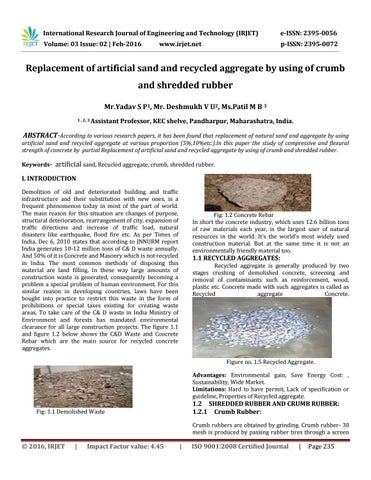
I. INTRODUCTION Demolition of old and deteriorated building and traffic infrastructure and their substitution with new ones, is a frequent phenomenon today in most of the part of world. The main reason for this situation are changes of purpose, structural deterioration, rearrangement of city, expansion of traffic directions and increase of traffic load, natural disasters like earthquake, flood fire etc. As per Times of India, Dec 6, 2010 states that according to JNNURM report India generates 10-12 million tons of C& D waste annually. And 50% of it is Concrete and Masonry which is not recycled in India. The most common methods of disposing this material are land filling. In these way large amounts of construction waste is generated, consequently becoming a problem a special problem of human environment. For this similar reason in developing countries, laws have been bought into practice to restrict this waste in the form of prohibitions or special taxes existing for creating waste areas. To take care of the C& D waste in India Ministry of Environment and forests has mandated environmental clearance for all large construction projects. The figure 1.1 and figure 1.2 below shows the C&D Waste and Concrete Rebar which are the main source for recycled concrete aggregates.
Fig: 1.2 Concrete Rebar In short the concrete industry, which uses 12.6 billion tons of raw materials each year, is the largest user of natural resources in the world. It’s the world’s most widely used construction material. But at the same time it is not an environmentally friendly material too.
1.1 RECYCLED AGGREGATES:
Recycled aggregate is generally produced by two stages crushing of demolished concrete, screening and removal of contaminants such as reinforcement, wood, plastic etc. Concrete made with such aggregates is called as Recycled aggregate Concrete.
Figure no. 1.5 Recycled Aggregate. Advantages: Environmental gain, Save Energy Cost: , Sustainability, Wide Market. Limitations: Hard to have permit, Lack of specification or guideline, Properties of Recycled aggregate.
1.2 SHREDDED RUBBER AND CRUMB RUBBER: 1.2.1 Crumb Rubber:
Fig: 1.1 Demolished Waste
Crumb rubbers are obtained by grinding. Crumb rubber- 30 mesh is produced by passing rubber tires through a screen
© 2016, IRJET
|
Impact Factor value: 4.45
|
ISO 9001:2008 Certified Journal
|
Page 235