International Research Journal of Engineering and Technology (IRJET)
e-ISSN: 2395 -0056
Volume: 03 Issue: 02 | Feb-2016
p-ISSN: 2395-0072
www.irjet.net
Analysis of Various Single Frame Super Resolution Techniques for better PSNR Sweta Patel1, Karshan Kandoriya2 1Student, Dept. of Computer Science and Engineering, Parul Institute of Engineering and Technology, Gujarat,
India
2Ass. Professor, Dept. Of Computer Science and Engineering, Parul Institute of Engineering and Technology,
Gujarat, India ---------------------------------------------------------------------***--------------------------------------------------------------------degradation models. Technical implementation of super resolution can be done in two ways: single-frame resolution image from single degraded image or low resolution image. In single frame SR technique, the missing and multi-frame Super-Resolution. Single-frame superhigh frequency information in the LR image is estimated from resolution methods generate high resolution image large number of training set images and added to the LR from single degraded noisy image. image. It require only one LR image for reconstruction so it There are many methods proposed for single image has more practical value for various applications. In this super resolution. These methods can be summarized as paper, we are going to review different Super Resolution methods based on reconstruction based approach and methods which generate high resolution image from one or learning based approaches. In this paper brief more low resolution image. description of these methods has been given. In section 2 introduction of each method is given. Next, section 3 Key Words: Spatial Resolution, Single frame, Supergives comparison of these methods. Final section Resolution, Interpolation, Restoration concludes the paper.
Abstract – Single-frame Super-Resolution generate high
1. INTRODUCTION In recent decades, Image Super-Resolution [1] is broadly used research area and it solve the resolution enhancement problem by quality of its optics, sensor and display components. But, high resolution improve by hardware is usually expensive and/or time consuming. Therefore, we can increase the resolution in two ways either by increase the pixel numbers or by increase chip size. But it can degrade the acquisition time and quality of image. So there is alternative approach to enhance resolution of the image. Super resolution is process of obtaining high quality of image via single low resolution image or numerous. It can be used in security surveillance, biomedical applications, remote sensing, enlarging photograph for high quality etc. Super resolution techniques can be classified into two major parts: Frequency domain and spatial domain approach. Frequency domain approach can perform Fourier transform of an image. These methods have low computational complexity, simple and more suitable for removing aliasing than spatial domain. This method is popular but expensive. Spatial domain approach allow more flexibility in incorporating a priori constraints, noise models, and spatially varying © 2016, IRJET
|
Impact Factor value: 4.45
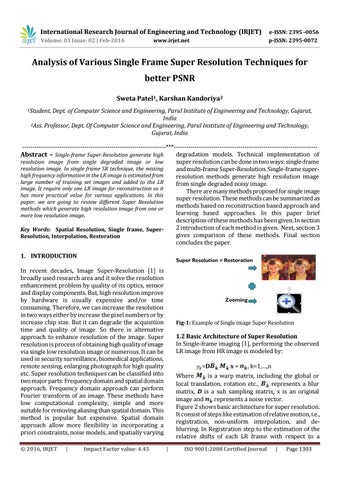
Fig-1: Example of Single image Super Resolution
1.2 Basic Architecture of Super Resolution In Single-frame imaging [1], performing the observed LR image from HR image is modeled by: =D
x+
, k=1,…,n
Where is a warp matrix, including the global or local translation, rotation etc., represents a blur matrix, D is a sub sampling matrix, x is an original image and represents a noise vector. Figure 2 shows basic architecture for super resolution. It consist of steps like estimation of relative motion, i.e., registration, non-uniform interpolation, and deblurring. In Registration step to the estimation of the relative shifts of each LR frame with respect to a |
ISO 9001:2008 Certified Journal
|
Page 1303
International Research Journal of Engineering and Technology (IRJET)
e-ISSN: 2395 -0056
Volume: 03 Issue: 02 | Feb-2016
p-ISSN: 2395-0072
www.irjet.net
reference LR image with sub-pixel accuracy, Nonuniform interpolation is to produce an improved resolution image and image restoration is applied to the up-sampled image to remove blurring and noise. Before apply any technique on image, preprocessing is
carried out on image to remove noise or to convert image into gray scale image. There are many techniques for super resolution such as MAP estimation approach, IBP estimation approach, Markov Network, sparse representation, Manifold approach, etc.
Fig-2: Basic Steps of Super resolution
2. SUPER RESOLUTION METHODS
Gradient profile prior Method
Super Resolution methods are mainly categorized in reconstruction based approach and learning based approach. These approaches are briefly described as below:
A gradient profile-based [4] methods learn the similarity between the shape statistics of the LR and HR images in a training step. This learned information will be used to apply a gradient based constraint to the reconstruction process. The distribution of this gradient profile prior is defined by a general exponential family distribution.
2.1 Reconstruction based Approach In Reconstructed based approach, incorporate the prior knowledge to model a regularized cost function. The image priors include the gradient prior, non-local self-similarity and the sparsity priors. These prior characterize different and complementary aspects of natural image feature. Therefore combinational on of multiple image prior for SR model may be beneficial to improvement of performance.
IBP Estimation Approach The IBP reconstruction [8] process is to estimate an HR image as an initial solution first and then use formula to calculate its simulative LR image according to system model,
Primal sketches Method
=
If equals to the original HR image accurately, at the same time when simulating the imaging process in conform to the actual situation, then the simulated LR image should be the same as the observation LR
Primal sketches [3] were used as the a priori. The primal sketches is the hallucination algorithm is applied only to the primitives like edges, ridges, corners, T-junctions, and terminations but not to the non-primitive parts of the image. Having an LR input image they first it to the target resolution, then for every primitive point a 9×9 patch is considered. Then, based on the primal sketch prior and using a Markov chain inference, the corresponding HR patch for every LR patch is found and replaced. This actually hallucinates the high-frequency complement of the primitives.
© 2016, IRJET
|
Impact Factor value: 4.45
+
image y, but when the two vectors are different, project the error yonto the reversely and make
correct further by using formula , = + (y- )
Where is HR image through the first time revised, is a back projection kernel. This process is repeated iteratively to minimize the energy of the error.
|
ISO 9001:2008 Certified Journal
|
Page 1304
International Research Journal of Engineering and Technology (IRJET)
e-ISSN: 2395 -0056
Volume: 03 Issue: 02 | Feb-2016
p-ISSN: 2395-0072
www.irjet.net
MAP Estimation Approach
Markov Network based Approach
Maximum A-Posteriori (MAP) approach [8], is popular because it provides a flexible and convenient way to include an a priori information and builds a strong relationship between the LR images and the unknown HR image. It is the basic idea of MAP estimation approach to treat the HR image and observation LR images as two different stochastic process, to regard the SR reconstruction problem as a statistical estimation problem, to make the HR image reaching MAP on the premise of known LR image sequence. So MAP estimator of the ideal HR image x is to maximize a posteriori probability density function. P (x| , , ..., )
Markov network [8] to model the space relationship of image from the perspective of probability for the first time, divide image into small blocks, assume that each image block is corresponding to a node on the Markov network, and acquire transition probability matrix for adjacent HR image block and transition probability matrix Φ between HR image block and LR image block through learning. The Markov network model can be expressed by,
Regularization Estimation Approach
local adjacent image block in the HR image,
P(x ׀y) =
(
)
(
)
where y is input LR image, x is the HR image to estimate, Z is the normalized parameter, and are is the LR
image block corresponding to Regularization method [8] is to use the solution of prior information, convert ill-posed problems to wellconditioned. Such as to minimize Lagrange equation with constrained least square method by formula min
2 +
Manifold-based method In Manifold-based approach [7], HR and LR images form manifolds with similar local geometries in two distinct feature spaces. This method is also used for dimensionality reduction. It Find its k-nearest neighbor representation in low dimensional manifold for each image block in the test samples and use these k-nearest neighbors to calculate weighted coefficient and then use the weights and neighbors to find the corresponding objects in the HR manifold to reconstruct the HR patch. In this situation, each HR image block is related to its corresponding LR image block which determine the reconstruction accuracy and maintain some kind of connection among its neighborhood block which decide the local preserving feature and smoothness of the reconstruction image.
2
Where C is a high-pass filter, which can eliminate the influence of small singular values appearing in high frequency, is referred to as the regularization parameter, which can balance the relationship between smoothness and validity of the solution. A observation model, which fuses together optical system prior knowledge, use the iterative registration algorithm based on gradient, and consider the optimization process of gradient descent method and conjugate gradient method to minimize cost function. 2.2 Learning based Approach
Sparse Representation Approach
Learning-based or Hallucination algorithms were first introduced in which a neural network was used to improve the resolution of fingerprint images. These algorithms contain a training step in which the relationship between some HR examples (from a specific class like face images, fingerprints, etc.) and their LR counterparts is learned. This learned knowledge is then incorporated into the a priori term of the reconstruction. The training database of learning-based SR algorithms needs to have a proper generalization capability.
© 2016, IRJET
|
Impact Factor value: 4.45
In Sparse Representation [5] the signal is represented by approximation of an image/signal with linear combination of only small set of elementary signal called atoms. Atoms are chosen either from predefined set of function or learned from training set. The sparse representation of high resolution image can be recovered from low resolution image patches. It used a small set of randomly chosen image patches of training and their SR method only applied to images with similar statistical nature. To obtain dictionary use HR image set for training HR dictionary. Correspondingly the image of this set are then down sampled and |
ISO 9001:2008 Certified Journal
|
Page 1305
International Research Journal of Engineering and Technology (IRJET)
e-ISSN: 2395 -0056
Volume: 03 Issue: 02 | Feb-2016
p-ISSN: 2395-0072
www.irjet.net
blurred and then used in training LR dictionary. Once two dictionaries are obtained up-scaling of LR image and calculate representation co-efficient using LR dictionary by employing vector selection algorithm. Then invoking assumption that representation coefficient of the desired HR patch array are the same HR patch array is reconstructed.
3. COMPARATIVE METHODS
STUDY
OF
DIFFERENT
Table 1 shows the comparison among the different methods used for the detection of defects in images.
Then the feature extraction is done using high pass filtering operations.
Table -1: Comparison of various super resolution methods Method
Advantages
Disadvantages
Primal sketches [3]
It is use to enhance edges, ridges and corner.
It require large databases of millions of high resolution and low resolution patch pair and are therefore computationally intensive.
Gradient profile prior [4]
It is use gradient profiles in natural images is robust against changes.
Prior based on gradient profile need large set of natural images.
IBP estimation approach [8]
It is simple in principle and easy to realize.
The response of the iteration need not always converge to one of the achievable solution.
MAP estimation approach [8]
It can join with expected properties prior to minimize cost function, and introduce the priori regularity constraints to ensure the uniqueness of the solution.
Ability for preserving edges and details of the reconstruction image is relatively weaker.
Markov network [8]
It can obtain high frequency information and high quality image under the condition of magnification 4 times.
Its efficiency is that request of training sample choice is high and sensitive to noise.
Manifold-based approach [ 7]
It require less training sample with low sensitivity to noise compared to Markov network.
It is difficult to choose neighborhood block size.
Sparse Representation
It overcome the problem of
Generally, it is computationally intractable and
approach [5]
choice of neighborhood size.
Solution is typically nonzero in every component.
© 2016, IRJET
|
Impact Factor value: 4.45
|
ISO 9001:2008 Certified Journal
|
Page 1306
International Research Journal of Engineering and Technology (IRJET)
e-ISSN: 2395 -0056
Volume: 03 Issue: 02 | Feb-2016
p-ISSN: 2395-0072
www.irjet.net
4. CONCLUSIONS In this paper, survey of various methodologies for super resolution is presented. These methods can be classified into two categories: reconstruction and learning based approach. A brief description of these method including advantages and disadvantages is given wherever known. So the combination of these approaches can give better result instead of using individual approach. REFERENCES [1] S. Park, M. Park, and M. G. Kang, “Super-resolution image reconstruction: A technical overview,” IEEE Signal Process. Mag., vol. 20, no. 3, pp. 21–36, May (2003). [2] Z. Wang, A. C. brans.ovik, H. R. Sheikh and E. P. Simoncelli, “Image quality assessment: From error visibility to structural similarity, IEEE Image Process .,vol. 13, no. 4, pp,600-612,2004. [3] Sun, J., Zhang, N.N., Tao, H., Shum, H.Y.: Image hallucination with primal sketch priors. Proceedings of IEEE Conference on Computer Vision and Pattern Recognition 2, 729–736 (2003). [4] Sun, J., Sun, J., Xx, Z.B., Shum, H.Y.: Image super-resolution using gradient profile prior. In: Proceedings of IEEE International Conference on Computer Vision and Pattern Recognition, USA (2008). [5] Yang, J., Wright, J., Huang, T., Ma, Y, ” Image superresolution via sparse representation “, IEEE ICIP, 2010. [6] Kamal Nasrollahi, Thomas B. Moeslund: Superresolution: a comprehensive survey ,Springer Machine Vision and Applications (2014) 25:1423–1468. [7] Chang H, Yeung DY, Xiong Y. Super-resolution through neighbor embedding. In: IEEE computer society conference computer via pattern recognition; 2004. p. I-275–I-282. [8] Lu Ziwei, Wu Chengdong1, Chen Dongyue, Qi Yuanchen1, Wei Chunping: Overview on Image Super Resolution Reconstruction, IEEE 2014.
© 2016, IRJET
|
Impact Factor value: 4.45
|
ISO 9001:2008 Certified Journal
|
Page 1307