International Research Journal of Engineering and Technology (IRJET)
e-ISSN: 2395 -0056
Volume: 03 Issue: 02 | Feb-2016
p-ISSN: 2395-0072
www.irjet.net
Existence result of solutions for a class of generalized p-laplacian systems R.Sahandi Torogh Department of Mathematics, Varamin-Pishva Branch, Islamic Azad University, Varamin, Iran
--------------------------------------------------------------------------------------------------------------------------------Abstract: In this paper, I study the
existence of solutions to a class of nonlinear problem. I generalize the existence results of a class of pLaplacian equation and extend it to a (p,q)-Laplacian system. Using some theorems, I establish sufficient conditions under which, this problem can be solved.
In [3] the authors proved that (1.3) has a countable number of eigenvalue satisfying when , and the corresponding has exactly zero in
eigenfunction (0,1).
2. Preliminaries and Lemmas In this section, we state some theorem according to the references.
Keywords: solution, non-linear equation, (p,q)-Laplacian system
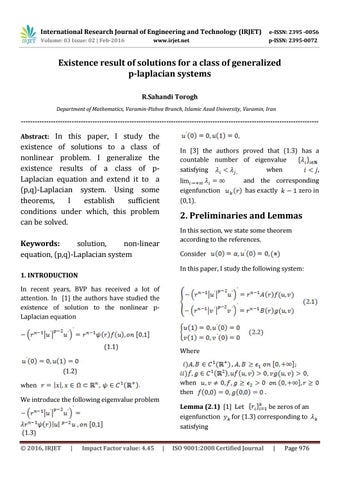
Consider In this paper, I study the following system:
1. INTRODUCTION In recent years, BVP has received a lot of attention. In [1] the authors have studied the existence of solution to the nonlinear pLaplacian equation
(1.1)
Where ,
(1.2) when then
when We introduce the following eigenvalue problem
Lemma (2.1) [1] Let be zeros of an eigenfunction for (1.3) corresponding to satisfying
(1.3) © 2016, IRJET
|
Impact Factor value: 4.45
.
|
ISO 9001:2008 Certified Journal
|
Page 976
International Research Journal of Engineering and Technology (IRJET)
e-ISSN: 2395 -0056
Volume: 03 Issue: 02 | Feb-2016
p-ISSN: 2395-0072
Assume exist a solution
for each of
www.irjet.net
We introduce substitution for the solution of (2.1) and (2.2) by using the generalized sine function has been well
, there
studied by ([3], [4], [6], [7]). The function
satisfies
Which has at least two zeros in Assume exist a solution
for each , there of satisfying on
Lemma (2.2) [1] Let
And
, and satisfy We define
Then the solution following properties: if satisfies
In addition ,
of (1.1) , ( ) has the So,
has no zero in on
and for some
, then we have if
has no zero in satisfying for
Now, I define phase-plane coordinates for solutions (2.1) and (2.2) as following
for some then
In this paper, I extend the result of [1]. I am interested in investigating nonlinear the (p,q)Laplacian system (2.1) and (2.2). 3. MAIN RESULTS In this section we state and prove some lemmas and then a theorem to prove the existence of positive solutions for system (2.1), (2.2). © 2016, IRJET
|
Impact Factor value: 4.45
With
|
ISO 9001:2008 Certified Journal
Then
|
Page 977
of
International Research Journal of Engineering and Technology (IRJET)
e-ISSN: 2395 -0056
Volume: 03 Issue: 02 | Feb-2016
p-ISSN: 2395-0072
www.irjet.net
In the rest of the paper, we consider So, Lemma (3.1)
Suppose
for there exists
, then
such that for all
After differentiating with respect to r, we have
solution has at most k-1 zeros in
That is the of (2.1) and (2.2) for
Suppose for exists
, then there
such that when
solution at least k-1 zeros in Proof. exists
That is, the of (2.1) and (2.2) has for
The assumption implies that, there and such that
Also we have
,
for
Since is a solution of (2.1) and (2.2) , there exists such that for and From (3.3) , (3.4) we have
The phase function for (2.1) and (2.2) with , we conclude
,
© 2016, IRJET
|
Impact Factor value: 4.45
|
ISO 9001:2008 Certified Journal
|
Page 978
International Research Journal of Engineering and Technology (IRJET)
e-ISSN: 2395 -0056
Volume: 03 Issue: 02 | Feb-2016
p-ISSN: 2395-0072
www.irjet.net
Let be the solution of (1.3) with and be its Pr fer angle, then are eigenfunctions of (1.3). Thus The
Assume that for there exists
comparison theorem was studied by ([8], p.30), include that
such that the solution has at most (k -1) zeros in for
,
Proof.
By assumption, we have there exist exists and
then
by assumption, there exist and such that ,
such that
when
(3.6).
when Similar to (i), we get, there exists that
Let
such
for
be the k-th eigenfunction of (1.3)
corresponding to and be zeros of with and Lemma (2.1) implies that, there exists a solution of (2.3) having at least two zeros in Now, fix let be zeros of satisfying By (2.4) and remark that tends to zero as tends to infinity. For this , we can choose an such that and
and
So, by (3.3) and (3.4) we get
where are consistent with (2.4). Let we prove have at least one zero in Suppose that have no zero in Lemma (2.2) implies that when Similar as in (i), we have
From (3.6), we have
Lemma (3.2)
Assume that for for
there exists
then Then ( in [5],p. 182) implies that have at least one zero in This leads to a contradiction. Hence with have at least one zero in
such that the solution has at least k zeros in for
© 2016, IRJET
|
Impact Factor value: 4.45
|
ISO 9001:2008 Certified Journal
|
Page 979
International Research Journal of Engineering and Technology (IRJET)
e-ISSN: 2395 -0056
Volume: 03 Issue: 02 | Feb-2016
p-ISSN: 2395-0072
Set
www.irjet.net
If then have at least one zero in for each . It means that have at least k zeros in for by assumption, there exist such that
and
,
when
, for So
can be small ,
and
and are uniformly bounded for The number of zeros of of (1.1) and ( ) is uniformly
bounded for Also, we have
(3.9) when
, now, let be the solution of the equation
(3.7). For every let and be the Pr fer angle of the solutions of (3) with So, hence by
satisfying from (3.5) with (for and
and and (3.9) we obtain )
the comparison theorem, and from (3.3) and (3.4)
satisfying
And
Define:
Where is between By (3.9) , we get
and
By (3.3) and (3.4) and comparing with (3.8) there exists a sufficiently large
© 2016, IRJET
|
Impact Factor value: 4.45
|
ISO 9001:2008 Certified Journal
|
Page 980
International Research Journal of Engineering and Technology (IRJET)
e-ISSN: 2395 -0056
Volume: 03 Issue: 02 | Feb-2016
p-ISSN: 2395-0072
www.irjet.net
And also we have
when ,
. Note that
Then (2.1) and (2.2) have a solution with at most k-1 zeros in (0,1).
and
are bounded by
Proof. By (3.11) and lemma (3.1) (i), there exits such that
So, we have
for Lemma (3.2) (i) implies that there exits such that
. for
. Since . Similarly If inequality, we obtain
(3.12) can be proved. Now the proof is completed.
By the Gronwell
REFERENCES [1] W-C. Wang, Y-H. Cheng, “On the existence of sign-changing radial solutions to nonlinear p-Laplacian equations in .”, Nonlinear Analysis, 102, 14-22, 2014.
Hence
[2] W.Reichel, W, Walter, “Radial solutions of equations and inequalities involving the pLaplacian”. J. Inequal.Appl, 1, 47-71,1997.
So,
[3] P.Binding and P.,Drabek., “Sturm-Liouville theory for the p-Laplacian”. Studia Sci : Math, Hungar, 40, 373-396, 2003.
Now, the proof is completed. Theorem (3.3) Suppose that there exists an integer such that
[4] W.Reichel, W, Walter, “Sturm-Lioville type problems for the p-laplacian under asymptotic non-resonance conditions”. J. Differential Equations, 156, 50-70, 1999. [5] W. Walter, “Sturm-Liouville theory for the radial – operator”. Math, Z. 227, 175-185, 1998. [6] P. Lindqvist, “Some remarkable sine and cosine functions”. Ric, Mat, 44, 269-290, 1995.
© 2016, IRJET
|
Impact Factor value: 4.45
|
ISO 9001:2008 Certified Journal
|
Page 981
International Research Journal of Engineering and Technology (IRJET)
e-ISSN: 2395 -0056
Volume: 03 Issue: 02 | Feb-2016
p-ISSN: 2395-0072
www.irjet.net
[7] A.Elbert, “A half-linear second order differential equation. Colloqia Mathematica Societatis Jonos Bolyai”, 30, Qualitiative Theory of Differential Equations, Szeged (Hungary), 153-180, 1979. [8] G. Birkhoff, G.C. Rota, Ordinary Differential Equations, Fourth ed, Wiley, New York, 1989.
© 2016, IRJET
|
Impact Factor value: 4.45
|
ISO 9001:2008 Certified Journal
|
Page 982