International Research Journal of Engineering and Technology (IRJET) Volume: 03 Issue: 02 | Feb-2016
www.irjet.net
e-ISSN: 2395 -0056 p-ISSN: 2395-0072
Sentiment Analysis on Twitter Data Using Apache Flume and Hive Ms. Pooja S. Patil1, Ms. Pranali B. sable2, Ms. Reshma J. Fasale3, Mr. P. A. Chougule4 123 Department of Computer Science Engg., Dr.J.J.Magdum College Of Engg., Jaysingpur,India. 4 Assistant Professor, Department of Computer Science Engg., Dr.J.J.Magdum College Of Engg., Jaysingpur,India.
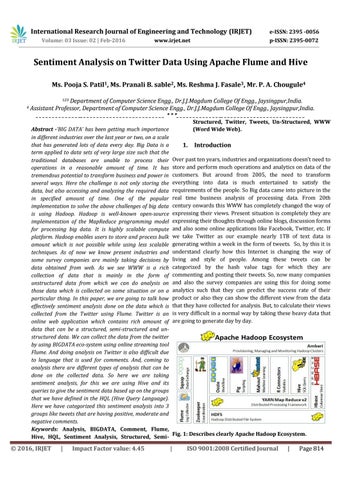
_ _ _ _ _ _ _ _ _ _ _ _ _ __ _ _ _ _ _ _ _ _ _ _ _ _ _ _ _ _ _ _ _ _ _ _ _ _ _ * * *_ _ _ _ _ _ _ _ _ _ _ _ _ __ _ _ _ _ _ _ _ _ _ _ _ _ _ _ _ _ _ _ _ _ _ _ _ _ _ Structured, Twitter, Tweets, Un-Structured, WWW Abstract -‘BIG DATA’ has been getting much importance (Word Wide Web). in different industries over the last year or two, on a scale that has generated lots of data every day. Big Data is a 1. Introduction term applied to data sets of very large size such that the traditional databases are unable to process their Over past ten years, industries and organizations doesn’t need to operations in a reasonable amount of time. It has store and perform much operations and analytics on data of the tremendous potential to transform business and power in customers. But around from 2005, the need to transform several ways. Here the challenge is not only storing the everything into data is much entertained to satisfy the data, but also accessing and analyzing the required data requirements of the people. So Big data came into picture in the in specified amount of time. One of the popular real time business analysis of processing data. From 20th implementation to solve the above challenges of big data century onwards this WWW has completely changed the way of is using Hadoop. Hadoop is well-known open-source expressing their views. Present situation is completely they are implementation of the MapReduce programming model expressing their thoughts through online blogs, discussion forms for processing big data. It is highly scalable compute and also some online applications like Facebook, Twitter, etc. If platform. Hadoop enables users to store and process bulk we take Twitter as our example nearly 1TB of text data is amount which is not possible while using less scalable generating within a week in the form of tweets. So, by this it is techniques. As of now we know present industries and understand clearly how this Internet is changing the way of some survey companies are mainly taking decisions by living and style of people. Among these tweets can be data obtained from web. As we see WWW is a rich categorized by the hash value tags for which they are collection of data that is mainly in the form of commenting and posting their tweets. So, now many companies unstructured data from which we can do analysis on and also the survey companies are using this for doing some those data which is collected on some situation or on a analytics such that they can predict the success rate of their particular thing. In this paper, we are going to talk how product or also they can show the different view from the data effectively sentiment analysis done on the data which is that they have collected for analysis. But, to calculate their views collected from the Twitter using Flume. Twitter is an is very difficult in a normal way by taking these heavy data that online web application which contains rich amount of are going to generate day by day. data that can be a structured, semi-structured and unstructured data. We can collect the data from the twitter by using BIGDATA eco-system using online streaming tool Flume. And doing analysis on Twitter is also difficult due to language that is used for comments. And, coming to analysis there are different types of analysis that can be done on the collected data. So here we are taking sentiment analysis, for this we are using Hive and its queries to give the sentiment data based up on the groups that we have defined in the HQL (Hive Query Language). Here we have categorized this sentiment analysis into 3 groups like tweets that are having positive, moderate and negative comments. Keywords: Analysis, BIGDATA, Comment, Flume, Hive, HQL, Sentiment Analysis, Structured, Semi- Fig. 1: Describes clearly Apache Hadoop Ecosystem.
© 2016, IRJET
|
Impact Factor value: 4.45
|
ISO 9001:2008 Certified Journal
|
Page 814
International Research Journal of Engineering and Technology (IRJET) Volume: 03 Issue: 02 | Feb-2016
www.irjet.net
e-ISSN: 2395 -0056 p-ISSN: 2395-0072
The above figure shows clearly the different types of ecosystems after creating application it will be having one consumer keys to that are available on Hadoop. If we consider getting the data access that application for getting Twitter data. The following is from Twitter one should use any one programming language to the figure that show clearly how the application data looks after creating the application and here it’s self we can see the crawl the data from their database or from their web pages. consumer details and also the access token details. We want to Coming to this problem here we are collecting this data by using take this keys and token details and want to set in the Flume BIGDATA online streaming Eco System Tool known as Flume configuration file such that we can get the required data from the and also the shuffling of data and generating them into Twitter in the form of twits. structured data in the form of tables can be done by using Apache Hive.
2. State of Art As we have seen the procedure how to overcome the problem that we are facing in the existing problem that is shown clearly in the proposed system. So, to achieve this we are going to follow the following methods: 1. Creating Twitter Application. 2. Getting data using Flume. 3. Querying using Hive Query Language (HQL) As it can have seen existing system drawbacks, here we are going to overcome them by solving this issue using Big Data Fig. 2: Creating Twitter application from Twitter Developer. problem statement. So here we are going to use Hadoop and its Ecosystems, for getting raw data from the Twitter we are using The figure show clearly the application keys that are generated Hadoop online streaming tool using Apache Flume. In this tool after creating application and in this keys we can see the top two keys are the API key and API secret. And coming to the reaming only we are going to configure everything that we want to get two keys it is nothing but know as the access tokens that we data from the Twitter. For this we want to set the configuration want to generate it by ourselves by clicking the generate access and also want to define what information that we want to get token. After clicking that we can get the two keys that are our form Twitter. All these will be saved into our HDFS (Hadoop account access token and coming to that one is Access token and Distributed File System) in our prescribed format. From this raw the other one is the Access token secret. data we are going to create the table and filter the information that is needed for us and sort them into the Hive Table. And form 3.2 Getting data using Flume After creating an application in the Twitter developer site we that we are going to perform the Sentiment Analysis by using want to use the consumer key and secret along with the access some UDF’s (User Defined Functions) by which we can perform token and secret values. By which we can access the Twitter and sentiment analysis by taking Stanford Core NLP as the data we can get the information that what we want exactly here we dictionary so that by using that we can decide the list of words will get everything in JSON format and this is stored in the HDFS that coming under positive, moderate and negative. The that we have given the location where to save all the data that following figure shows clearly the architecture view for the comes from the Twitter. The following is the configuration file proposed system by this we can understand how our project is that we want to use to get the Twitter data from the Twitter. effective using the Hadoop ecosystems and how the data is going 3.3 Querying using Hive Query Language to store form the Flume, also how it is going to create tables (HQL)After running the Flume by setting the above configuration using Hive also how the sentiment analysis is going to perform. then the Twitter data will automatically will save into HDFS
where we have the set the path storage to save the Twitter data that was taken by using Flume. From these data first we want to create a table where the filtered data want to set into a 3.1 Creating Twitter Application formatted structured such that by which we can say clearly that First of all if we want to do sentiment analysis on Twitter data we have converted the unstructured data into structured format. we want to get Twitter data first so to get it we want to create an For this we want to use some custom serde concepts. These account in Twitter developer and create an application by concepts are nothing but how we are going to read the data that clicking on the new application button provided by them. After is in the form of JSON format for that we are using the custom creating a new application just create the access tokens so that serde for JSON so that our hive can read the JSONdata and can we no need to provide our authentication details there and also create a table in our prescribed format. Also we are using
3. Experimental Setup
© 2016, IRJET
|
Impact Factor value: 4.45
|
ISO 9001:2008 Certified Journal
|
Page 815
International Research Journal of Engineering and Technology (IRJET) Volume: 03 Issue: 02 | Feb-2016
www.irjet.net
e-ISSN: 2395 -0056 p-ISSN: 2395-0072
another UDF’s (User Defined Functions) for performing the custom serde for JSON so that our hive can read the JSON data sentiment analysis on the tales that are created by using Hive. and can create a table in our prescribed format. From that we can perform the sentiment analysis. And acquire Also we are using another UDF’s (User Defined Functions) for the results where a new table is created by partition concept performing the sentiment analysis on the tales that are created such that all the comments that are having positive will go into by using Hive. From that we can perform the sentiment analysis. the positive partition and all the comments that are having And acquire the results where a new table is created by partition moderate will go into moderate partition and finally all the concept such that all the comments that are having positive will comments that are having negative will go into negative go into the positive partition and all the comments that are partition. The following figure shows clearly how the rating is having moderate will go into moderate partition and finally all done and how the data is partitioned into 3 types. the comments that are having negative will go into negative partition. The following figure shows clearly how the rating is done and how the data is partitioned into 3 types. 4. Sentiment Analysis In short, Sentiment Analysis is the process of detecting the contextual polarity of text. In other words, it determines whether a piece of writing is positive, negative or neutral. An alternative term is opinion mining, as it derives the opinion, or the attitude of a speaker. A common use case for this technology is to discover how people feel about a particular topic. For example, do people on Twitter think that Chinese food in San Francisco is good or bad? Analyzing tweets for sentiment will answer this question for you. You can also learn why people think the food is good or bad, by extracting the exact word indicating why people did or didn't like the food. "I love the summer in New York, but I hate the winter." The individual scores would show "love the summer" as positive and "hate the Fig. 4: Result after performing the sentiment analysis. winter" as negative. However, the sentiment for the entire comment would be neutral, because the positive sentiment for the word love would cancel out the negative sentiment for the 6. Application and scope word hate. Because Sentiment Analysis can track a particular topic, many companies use it to track or monitor their products, The major applications of the big data are : 1. Sentiment Analysis: Sentiment data is unstructured data that services or reputation in general. represents opinions, emotions, and attitudes contained in sources such as social media posts, blogs, online product reviews, and customer support interactions. Different companies and Organizations use social media analysis to understand how the public feels about something at a particular moment in time, and also to track how those opinions change over time. 2. Text Analytics: It is the process of deriving the high quality information from the raw data such as unstructured data and predicting the analysis. 3. Volume Trending: Here volume is estimated in terms of amount of data to process a job. Volume trending is a big issue nowadays. Day by day it has been increasing in a much higher rate in the organizations and social media sites etc. 4. Predictive Analytics: Predictive analysis gives the predictive scores to the organizations to help in making the smart decisions and improve business solutions. It optimizes marketing campaigns and website behaviour to increase customer 5. Result These concepts are nothing but how we are going to read the responses in business, conversions and meetings, and to data that is in the form of JSON format for that we are using the Fig. 3: Architecture diagram for proposed system.
© 2016, IRJET
|
Impact Factor value: 4.45
|
ISO 9001:2008 Certified Journal
|
Page 816
International Research Journal of Engineering and Technology (IRJET) Volume: 03 Issue: 02 | Feb-2016
www.irjet.net
e-ISSN: 2395 -0056 p-ISSN: 2395-0072
decrease the burden on the people. Each customer's predictive perform those operations. Coming to this paper we have score informs actions to be taken with that customer. achieved by this problem statement and solving it in BIGDATA by using Hadoop and its Eco Systems. And finally we have done 5. Massively Scalable Architectures sentiment analysis on the Twitter data that is stored in HDFS. So, here the processing time taken is also very less compared to the 6. Social Media Data: With Hadoop, we can mine Twitter, previous methods because Hadoop Map Reduce and Hive are the Facebook and other social media conversations for sentiment best methods to process large amount of data in a small time. data about people and used it to make targeted, real time decisions that increase market share.
9. References
7. Web Click stream data: Hadoop makes easy to track 1. Go, A., Bhayani, R., & Huang, L. (2009). Twitter sentiment customers and their activities in different issues like products classification using distant supervision. CS224N Project Report, purchasing and viewing etc. It makes analyzers to know the Stanford, 1-12. behaviour and interest of the customers and can able to visualize 2.A. Pak and P. Parouek, “Twitter as a corpus for sentiment similar type of products to the customers. analysis and opinion mining,” in Proceedings of LREC, vol. 2010. Scope: The Proposed system can finds the most popular 3. J. Dean and S. Ghemawat, “MapReduce: Simplified Data information about the people, organizations and can be used in Processing on Large Clusters,” Communications of the ACM, the field of analytics. Vol. 51, Iss. 1, pp. 107-113, January 2008. 4. K. Shvachko, H. Kuang, S. Radia, and R. Chansler, “The Hadoop Applications : Distributed File System,” in the 26th IEEE Symposium on Mass Storage Systems and Technologies, pp. 1-10, May 2010. Finds the most number of follows in the social 5. Bahrainian, S.A., Dengel, A., Sentiment Analysis using networking sites. Sentiment Features, In the proceedings of WPRSM Workshop This system can be useful to track the business analysis and the Proceedings of IEEE/WIC/ACM International Conference on Web Intelligence, Atlanta, USA, 2013. of the organizations. 6.“Sentimental Analysis”, Inc. [Online]. Available: http://www.cs.uic.edu/~liub/FBS/sentiment-analysis [Accessed Allows researchers to retrieve and analyze the data 23 March 2013]. easily from large datasets. 7.(Online Resource) Hive (Available on :http://hive.apache.org/). 7. Future work In this paper it has shown the way for doing sentiment analysis for Twitter data. Also, we can do this by using Oozie by creating a work flow so that we can give a time slang such that it will work based upon that time we allocated for performing a particular work. Also at last we can also visualize the word map i.e., the most frequent words that are used in positive, moderate and negative fields by using R language to visualize.
8. Conclusion There are different ways to get Twitter data or any other online streaming data where they want to code lines of coding to achieve this. And, also they want to perform the sentiment analysis on the stored data where it makes some complex to
© 2016, IRJET
|
Impact Factor value: 4.45
|
ISO 9001:2008 Certified Journal
|
Page 817