International Research Journal of Engineering and Technology (IRJET)
e-ISSN: 2395 -0056
Volume: 03 Issue: 12 | Dec -2016
p-ISSN: 2395-0072
www.irjet.net
HEAT TRANSFER ANALYSIS OF HELICAL COIL HEAT EXCHANGER WITH Al2O3 NANO FLUID Vinita sisodiya 1, Dr.Ankur geete 2 1 M. Tech scholar in Mechanical Engineering, SD Bansal college of technology, Indore, M.P, India 2 Associate professor in Mechanical Engineering Department, SD Bansal college of technology, Indore, M.P, India
---------------------------------------------------------------------***---------------------------------------------------------------------
ABSTRACT
The present study has focused on the use of Helical coil heat exchangers (HCHEs) with Al2O3 -Water phase change material to understand if HCHEs can yield greater rates of heat transfer. An analytical study was conducted using a counter flow HCHE consisting of 8 helical coils. Two analysis was conducted, one where water was used as heat transfer fluid (HTF) on the coil and sell sides, respectively; while the second one made use of different Volume fractions of Al2O3 and water on the coil and shell sides, respectively. The NTUeffectiveness relationship of the HCHE when Al2O3 fluid is used approaches that of a heat exchanger with a heat capacity ratio of zero. The heat transfer results have shown that when using an Al2O3, an increase in heat transfer rate can be obtained when compared to heat transfer results obtained using straight heat transfer sections. It has been concluded that the increased specific heat of the Al2O3 as well as the fluid dynamics in helical coil pipes are the main contributors to the increased heat transfer.
centrifugal force due to the curvature of the tube results in the secondary flow development which enhances the heat transfer rate. This phenomenon can be beneficial, especially in the laminar flow regime. Thermal performance and pressure drop of a shell and helically coiled tube heat exchanger with and without helical crimped fins have been investigated by Naphon one of the most frequent uses of helically coiled tubes is in shell and coiled tube heat exchangers. Going through the existing literature, it was revealed that there are a few investigations on the heat transfer coefficients of this kind of heat exchangers considering the geometrical effects like coil pitch. Also, this scarcity is more prominent for shell-side heat transfer coefficients.
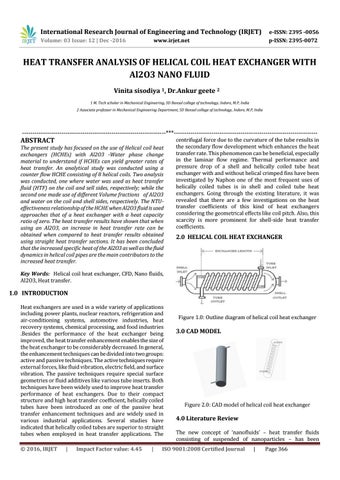
2.0 HELICAL COIL HEAT EXCHANGER
Key Words: Helical coil heat exchanger, CFD, Nano fluids, Al2O3, Heat transfer.
1.0 INTRODUCTION Heat exchangers are used in a wide variety of applications including power plants, nuclear reactors, refrigeration and air-conditioning systems, automotive industries, heat recovery systems, chemical processing, and food industries .Besides the performance of the heat exchanger being improved, the heat transfer enhancement enables the size of the heat exchanger to be considerably decreased. In general, the enhancement techniques can be divided into two groups: active and passive techniques. The active techniques require external forces, like fluid vibration, electric field, and surface vibration. The passive techniques require special surface geometries or fluid additives like various tube inserts. Both techniques have been widely used to improve heat transfer performance of heat exchangers. Due to their compact structure and high heat transfer coefficient, helically coiled tubes have been introduced as one of the passive heat transfer enhancement techniques and are widely used in various industrial applications. Several studies have indicated that helically coiled tubes are superior to straight tubes when employed in heat transfer applications. The © 2016, IRJET
|
Impact Factor value: 4.45
|
Figure 1.0: Outline diagram of helical coil heat exchanger
3.0 CAD MODEL
Figure 2.0: CAD model of helical coil heat exchanger
4.0 Literature Review The new concept of ‘nanofluids’ – heat transfer fluids consisting of suspended of nanoparticles – has been
ISO 9001:2008 Certified Journal
|
Page 366
International Research Journal of Engineering and Technology (IRJET)
e-ISSN: 2395 -0056
Volume: 03 Issue: 12 | Dec -2016
p-ISSN: 2395-0072
www.irjet.net
expected as a vision for these challenges [1]. Some review papers have discussed on the preparation methods for nanofluids [2-4]. A nanofluid is a fluid produced by the distribution of nanoparticles with a typical size of less than 100 mm in a liquid. Nanofluids have enhanced thermal properties. In an industrial heat exchangers are broadly used and performance of heat exchangers can be improved by different methods. Due to the compressed structure and high heat transfer coefficient, helical coil heat exchangers find open use in industrial applications [5] such as power generation, nuclear industry, process plants, heat recovery systems, food industry, and refrigeration. Seban and McLaughlin [5] experimentally investigated the heat transfer in coiled tubes for both laminar and turbulent flows. Prabhanjan et al. [6] Investigated the heat transfer rates of a straight tube heat exchanger to that of a helically coiled heat exchanger. Wongwises et al. [7] Studied the condensation heat transfer in a tube-in-tube helical heat exchanger. Thermal performance in helically coiled heat exchangers was experimentally and numerically investigated by Jayakumar et al. [8]. It was studied that the constant wall flux boundary condition was a better hypothesis to investigate the heat transfer inside the helical coil than either constant wall temperature or constant wall heat transfer coefficient boundary conditions. The overall heat transfer coefficient will increase, Also there is a widespread research had been done on the performance of other types of heat exchangers [9-12]. Studies are carried out in CFD tool for the effects of several geometrical parameters on heat transfer characteristics of water and the effect of different nanofluids Chou, and Al2O3 with different volume fractions (1-5%).on heat transfer characteristics
5.0 Effect of different nano particles: In this section, three different volume fractions of nano particles Al2O3 with water as a base fluid is used. The graph is plotted between Nusselt Number and Reynolds Number for different fractions of Al2O3 nano particle. Nusselt Number increases with the increase in Reynolds Number. These results also indicate that all the types of nanofluids are comparatively richer in heat transfer rate than the pure water because all the nanofluids possess a higher Nusselt number compared to pure water. It is clearly seen that Al2O3 – water nanofluid shows the best nanofluid and posses the higher Nusselt Number compared to pure water. The purpose of this paper is to present results of an investigation into the overall variation of heat transfer coefficient around the helical coiled tube shapes. The numerical study considers the effect of nanofluid such as Al2O3 on the flow and heat transfer characteristics of tube banks in a physical domain for different Reynolds number.
© 2016, IRJET
|
Impact Factor value: 4.45
|
6.0 Properties of Nanofluids The selection process and determination of nanofluid thermo physical properties are important area in nanofluid applications. The single-phase method is chosen to calculate the thermo physical properties of nanofluids. In the current study the considered nano fluid is a mixture of water and containing mainly Al2O3. The thermo physical properties of the Al2O3 as nano particle and water-based nanofluid present at temperature 293 K in Table 1.
Table 1.0 Properties of nano fluid
7.0 Results and Discussion The purpose of this paper is to present results of an investigation into the overall variation of heat Transfer coefficient around the in-line array with helical coil tube shapes. The numerical study considers the effect of nanofluid such as Al2O3 on the flow and heat transfer characteristics of tube banks in a physical domain for different Reynolds number. Table 2.0, Table 3.0, Table 4.0 and Table 5.0 show the results of water and Nano fluid at different velocities respectively
ISO 9001:2008 Certified Journal
|
Page 367
International Research Journal of Engineering and Technology (IRJET)
e-ISSN: 2395 -0056
Volume: 03 Issue: 12 | Dec -2016
p-ISSN: 2395-0072
www.irjet.net
Water Table 2.0 Results of water Velocity
Reynolds Number
Heat transfer coefficient (Max)
Nusselt Number
W/m2K .2
1640
1.51202e7
117575
.4
3281
2.07091e7
161034
.6
4922
1.82002e7
141525
.8
6563
1.82964e7
142270
1
8204
1.93154e7
150197
Figure4.0: Shell side calculated Reynolds number versus the Nusselt number
Al2O3 (2%) Water Table4.0 Results of Al2O3 (2%) water
Nusselt Number
200000
Velocity
Reynolds Number
150000
Heat transfer coefficient(Max)
Nusselt Number
W/m2K
100000
Nusselt Number
50000
.2
1640
2.1629e7
159036
.4
3281
1.6853e7
123919
.6
4922
1.8002e7
132367
.8
6563
1.82964e7
134532
1
8204
1.93154e7
142242
0 0
2000
4000
6000
8000 10000
Figure 3.0: Shell side calculated Reynolds number versus the Nusselt number
Al2O3 (1%) Water Table3.0 Results of Al2O3 (1%) water Velocity
Reynolds Number
Heat transfer coefficient (Max)
Nusselt Number
W/m2K .2
1640
1.94462e7
147096
.4
3281
1.55309e7
117480
.6
4922
1.63026e7
123313
.8
6563
1.69332e7
128087
1
8204
7.7687e6
58764
|
Impact Factor value: 4.45
|
© 2016, IRJET
Figure 5.0: Shell side calculated Reynolds number versus the Nusselt number ISO 9001:2008 Certified Journal
|
Page 368
International Research Journal of Engineering and Technology (IRJET)
e-ISSN: 2395 -0056
Volume: 03 Issue: 12 | Dec -2016
p-ISSN: 2395-0072
www.irjet.net
Al2O3 (3%) Water
Vector Plot of Velocity
Table5.0 Results of Al2O3 (3%) water Velocity
Reynolds Number
Heat transfer coefficient(Max)
Nusselt Number
W/m2K .2
1640
1.99365e7
142607
.4
3281
1.65173e7
118149
.6
4922
1.85506e7
132693
.8
6563
1.67906e7
120104
1
8204
7.3585e6
52635
Figure 8.0: Velocity vector distribution throughout the coil
Temperature field
Nusselt Number
160000 140000 120000 100000 80000
Nusselt Number
60000 40000 20000
Figure 9.0: Temperature field diagram
0 0
2000
4000
6000
8.0 Conclusions & Future scope
8000
Figure 6.0: Shell side calculated Reynolds number versus the Nusselt number
Contour Plot of Temperature Distribution
Figure 7.0: Temperature distribution throughout the coil
© 2016, IRJET
|
Impact Factor value: 4.45
|
8.1 Conclusions Numerical simulation has been investigated on heat transfer characteristics and pressure drop of Al2o3 / water nano fluid in compact heat exchanger with helical coil tube shapes and an in-line Arrangement of tubes under steady state laminar fluid flow. The numerical results reveal the Enhancement in heat transfer, with respect to the base fluid, identified to characterize nanofluid. Heat transfer enhancement is increasing with the nanoparticle and using helical coil tube geometry. Heat transfer coefficient increases with increase in Reynolds Number for convective heat transfer. Because at higher flow rates, the dispersion effects and chaotic movement of the nano particles intensifies the mixing fluctuations and causes increase in heat transfer coefficient. Nanofluid containing small amount of nanoparticles have substantially higher heat transfer coefficient than those of base fluids. And it increases with increase in the particle volume fraction. Because the increase in the nanoparticle volume fractions, intensifies the interaction and collision of nanoparticles.
ISO 9001:2008 Certified Journal
|
Page 369
International Research Journal of Engineering and Technology (IRJET)
e-ISSN: 2395 -0056
Volume: 03 Issue: 12 | Dec -2016
p-ISSN: 2395-0072
www.irjet.net
operated with nanofluid” International Journal of Heat and Mass Transfer 70, 289-297 , 2014 (12) Mir Hatef Seyyedvalilu and S.F.Ranjbar, “The Effect of Geometrical Parameters on Heat Transfer and Hydro Dynamical Characteristics of Helical Exchanger”. International Journal of Recent advances in Mechanical Engineering (IJMECH) Vol.4, No.1, 2015.
4.2 Future scope Numerical simulation can investigate on heat transfer characteristics and pressure drop of different nanofluids like Mgo, Sio, in compact heat exchanger with different shapes and an in-line Arrangement of tubes under steady state laminar fluid flow and also can evaluate Heat transfer coefficient with comparison of Dean Number for convective heat transfer.
9.0 REFERENCES
(1) D. Wu, H. Zhu, L. Wang, L. Lu, “Critical issues in nanofluids
preparation, characterization and thermal conductivity”, Current Nanoscience, Volume 5, Issue no.1, pp 103–112, 2009. (2) A. Ghadimi, R. Saidur, H.S.C.Metselaar, “A review of nanofluid stability properties and characterization in stationary conditions”, International Journal of Heat Mass Transfer, Volume 54, Issue 17, pp 4051–4068, 2011. (3) Yu. Wei, Huaqing Xie, “A review on nanofluids: preparation, stability mechanisms, and applications”, Journal of Nanomaterials, Volume 2012 (2012), Article ID 435873, 17 pages. http://dx.doi.org/10.1155/2012/435873 (4) P. Naphon, S. Wongwises, “A review of flow and heat transfer characteristics in curved tubes” Journal of Renewable Sustain Energy Reviews, Vol 10 (2006) pp 463–490. (5) R.A. Seban, E.F. McLaughlin, “Heat transfer in tube coils with laminar and turbulent flow” International Journal of Heat Mass Transfer, vol. 6 (1963) pp 387–395. (6) D.G. Prabhanjan, G.S.V. Raghavan, T.J. Rennie, “Comparison of heat transfer rates between a straight tube heat exchanger and a helically coiled heat exchanger” International Communications of Heat Mass Transfer, vol. 29 pp185-191, 2002. (7) S.Wongwises ,M. Polsongkram, “Condensation heat transfer and pressure drop of HFC-134a in a helically coiled concentric tube-in-tube heat exchanger,” International Journal of Heat Mass Transfer vol. 29 pp 4386-4398, 2006. (8) J.S. Jayakumar, S.M. Mahajani, J.C. Mandal, Kannan N. Iyer, P.K. Vijayan, “CFD analysis of single-phase flows inside helically coiled tubes” Journal of Computational Chemical Engineering , volume 34 (2010) pp 430–446. (9) Rennie T.J, Raghavan G.S.V. (2002) “Laminar parallel flow in a tube-in-tube helical heat exchanger” AIC2002 Meeting CSAE/SCGR Program, Saskatchwan.pp 14-17. (10) Rohit S. Khedkar, Shriram S. Sonawane, Kailas L. Wasewar, “Heat transfer study on concentric tube heat exchanger using TiO2– water based nanofluid,” International Communications in Heat and Mass Transfer,57, 163-169,2014. (11) M.M. Elias, I.M. Shahrul, I.M. Mahbubul, R. Saidur, N.A. Rahim, “Effect of different nanoparticle shapes on shell and tube heat exchanger using different baffle angles and
© 2016, IRJET
|
Impact Factor value: 4.45
|
ISO 9001:2008 Certified Journal
|
Page 370