International Research Journal of Engineering and Technology (IRJET)
e-ISSN: 2395 -0056
Volume: 03 Issue: 12 | Dec -2016
p-ISSN: 2395-0072
www.irjet.net
Design and implementation of combined effect of modified DES and Hamming (224,128) Code data security techniques on the transmission of 128-bit digital data from one base station to another base station written in VHDL 1Paresh Kumar Pasayat, Asst.Professor, IGIT Government Engineering College, Odish, India
Rajashree Nath, UG student, IGIT Government Engineering College, Odish, India Bipasha Pradhan, UG student, IGIT Government Engineering College, Odish, India 4 Anil Kumar Dakua, UG student, IGIT Government Engineering College, Odish, India 5 Swadhyaya Mohanty, UG student, IGIT Government Engineering College, Odish, India 6 Abhinav Das, UG student, IGIT Government Engineering College, Odish, India 2
3
---------------------------------------------------------------------***--------------------------------------------------------------------encryption using modified DES and Hamming (224,128) code techniques. security algorithm used to provide security to the 128-bit
Abstract - The proposed paper mainly deals with the data
digital data before transmission into the space .The desired 128-bit data is encrypted using modified DES producing 128bit middle data and Hamming (224,128) code technique to produce 224-bit encrypted data. As the proposed design is having the combined effect of both modified DES and Hamming(224,128) code data security techniques, the security level is very high as compared to the design having individual data security technique. Due to the increment of key size from 56-bits to 112-bits in modified DES, the design is more resistive to the Brute-Force Attack. This can be used in the field of Automated teller machine transactions(ATM),Banking sector, Military sector and Protecting confidential company information. The proposed work is done by using VHDL language. The code is tested and simulated using Xilinx ISE9.2i software.
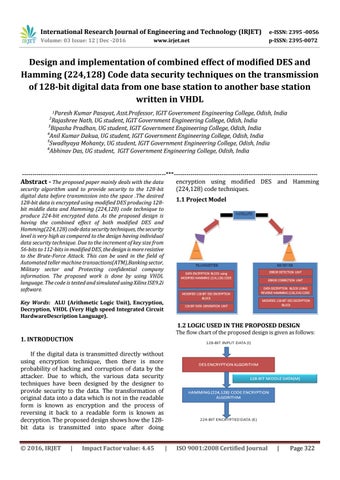
1.1 Project Model
Key Words: ALU (Arithmetic Logic Unit), Encryption, Decryption, VHDL (Very High speed Integrated Circuit HardwareDescription Language).
1.2 LOGIC USED IN THE PROPOSED DESIGN
The flow chart of the proposed design is given as follows:
1. INTRODUCTION If the digital data is transmitted directly without using encryption technique, then there is more probability of hacking and corruption of data by the attacker. Due to which, the various data security techniques have been designed by the designer to provide security to the data. The transformation of original data into a data which is not in the readable form is known as encryption and the process of reversing it back to a readable form is known as decryption. The proposed design shows how the 128bit data is transmitted into space after doing © 2016, IRJET
|
Impact Factor value: 4.45
|
ISO 9001:2008 Certified Journal
|
Page 322
International Research Journal of Engineering and Technology (IRJET)
e-ISSN: 2395 -0056
Volume: 03 Issue: 12 | Dec -2016
p-ISSN: 2395-0072
www.irjet.net
The logic used in the modified DES encryption is given as follows:
16 ROUNDS IN DES: DES uses 16 rounds of operations. Each round consists of following units performing different types operations. BIT SEPERATOR UNIT: The output of the initial permutation block is given to the bit separator unit. BS_OUT_DATA_ONE<=BS_IN_DATA(127 DOWNTO 64); BS_OUT_DATA_TWO<=BS_IN_DATA(63 DOWNTO 0); FIESTAL CIPHER UNITXOR UNIT: The block diagram showing the Fiestal Cipher Unit is given as follows:
ROUND KEY GENERATOR: KEY_OUT_1 <= KEY_IN(0) & KEY_IN(95 DOWNTO 1); KEY_OUT_2 <= KEY_IN(1)& KEY_IN(0) & KEY_IN(95 DOWNTO 2); KEY_OUT_3 <= KEY_IN(2) & KEY_IN(1)& KEY_IN(0) & KEY_IN(95 DOWNTO 3); KEY_OUT_4 <= KEY_IN(3) & KEY_IN(2) & KEY_IN(1)& KEY_IN(0) & KEY_IN(95 DOWNTO 4); KEY_OUT_5 <= NOT KEY_IN(95 DOWNTO 0); KEY_OUT_6 <= NOT KEY_IN(95 DOWNTO 0); KEY_OUT_7 <= NOT KEY_IN(95 DOWNTO 0); KEY_OUT_8 <= KEY_IN(45) & KEY_IN(95 DOWNTO 1); KEY_OUT_9 <= KEY_IN(48) & KEY_IN(95 DOWNTO 1); KEY_OUT_10 <= KEY_IN(41) & KEY_IN(95 DOWNTO 1); KEY_OUT_11 <= KEY_IN(45) & KEY_IN(94 DOWNTO 1) & KEY_IN(90); KEY_OUT_12 <= KEY_IN(91) & KEY_IN(95 DOWNTO 1); KEY_OUT_13 <= KEY_IN(45) & KEY_IN(95 DOWNTO 1); KEY_OUT_14 <= KEY_IN(46) & KEY_IN(95 DOWNTO 1); KEY_OUT_15 <= KEY_IN(40) & KEY_IN(95 DOWNTO 1); KEY_OUT_16 <= KEY_IN(1) & KEY_IN(95 DOWNTO 1); Here KEY_IN is the 112-bit cipher key and KEY_OUT is the 16 nos. of keys generated from the Round Key Generator.
Then, the two outputs of the bit separator unit is given to the Fiestal Cipher Unit and the different performed are given as follows. S_EX_P_BOX_OUTPUT := FCU_IN_DATA( 31 DOWNTO 0) & FCU_IN_DATA(63 DOWNTO 32) & "00000000000000000000000000000000"; S_XOR_OUTPUT := S_EX_P_BOX_OUTPUT XOR KEY_INPUT; S_SUBT_BOX_OUTPUT := S_XOR_OUTPUT(31 DOWNTO 0) & S_XOR_OUTPUT(63 DOWNTO 32) & S_XOR_OUTPUT(95 DOWNTO 64);
The logic used for the implementation of the different blocks of modified DES is given as follows: INITIAL PERMUTATION UNIT: IPU_DATA_OUT(0) <= IPU_DATA_IN(127); IPU_DATA_OUT(1) <= IPU_DATA_IN(126); IPU_DATA_OUT(2) <= IPU_DATA_IN(125); IPU_DATA_OUT(3) <= IPU_DATA_IN(124); IPU_DATA_OUT(123 DOWNTO 4) <= IPU_DATA_IN(123 DOWNTO 4); IPU_DATA_OUT(124) <= IPU_DATA_IN(3); IPU_DATA_OUT(125) <= IPU_DATA_IN(2); IPU_DATA_OUT(126) <= IPU_DATA_IN(1); IPU_DATA_OUT(127) <= IPU_DATA_IN(0); Here IPU_DATA_IN and IPU_DATA_OUT are the 128-bit input and output datas of the initial permutation block.
© 2016, IRJET
|
Impact Factor value: 4.45
FCU_OUT_DATA <= S_SUBT_BOX_OUTPUT(15 DOWNTO 0) & S_SUBT_BOX_OUTPUT(31 DOWNTO 16) & S_SUBT_BOX_OUTPUT(63 DOWNTO 32); The different operations that are performed in the Fiestal Cipher Unit are XOR operation, swapping operation, bit append operation. DES FUNCTION[F(R,KEY)]: The different units of the DES function used in the Fiestal Cipher is given as follows:
|
ISO 9001:2008 Certified Journal
|
Page 323
International Research Journal of Engineering and Technology (IRJET)
e-ISSN: 2395 -0056
Volume: 03 Issue: 12 | Dec -2016
p-ISSN: 2395-0072
www.irjet.net
Here, the value for each bit of H is given as follows: H6 = B3 xor B2 xor B0 H5 = B3 xor B1 xor B0 H4 = B2 xor B1 xor B0 H3 = B3 H2 = B2 H1 = B1 H0 = B0 Step 3 After that the Hamming codes corresponding to each word are appended to form the desired 224-bit encoded data. The block diagram showing the encryption process using the above algorithm is shown as follows:
XOR UNIT: XU_OUT_DATA <= XU_IN_DATA_ONE XOR XU_IN_DATA_TWO; SWAP UNIT: SU_OUT_DATA_ONE <= SU_IN_DATA_TWO; SU_OUT_DATA_TWO <= SU_IN_DATA_ONE; BIT APPEND UNIT: BAU_OUT_DATA <= BAU_IN_DATA_ONE & BAU_IN_DATA_TWO; There are 16 nos. of round in the modified DES and after the completion of the round 16, the final permutation operation is performed.
2. RESULTS AND DISCUSSION The VHDL code of the proposed project is compiled, synthesized and simulated using Xilinx ISE 9.2i software and the desired results have been obtained. The simulation result of the 128-bit digital data given to the DES encryption block to produce 128-bit middle data is shown as follows:
FINAL PERMUTATION: FPU_DATA_OUT(0) <= FPU_DATA_IN(127); FPU_DATA_OUT(1) <= FPU_DATA_IN(126); FPU_DATA_OUT(2) <= FPU_DATA_IN(125); FPU_DATA_OUT(3) <= FPU_DATA_IN(124); FPU_DATA_OUT(123 DOWNTO 4) <= FPU_DATA_IN(123 DOWNTO 4); FPU_DATA_OUT(124) <= FPU_DATA_IN(3); FPU_DATA_OUT(125) <= FPU_DATA_IN(2); FPU_DATA_OUT(126) <= FPU_DATA_IN(1); FPU_DATA_OUT(127) <= FPU_DATA_IN(0); Algorithm For Hamming (224,128) code Encryption Unit Step 1 First, 128-bit data is divided into 32 nos. of words each consisting of 4-bit data. Step 2 The 7-bit Hamming (7,4) code encoding technique is applied to each word. For each word, the encoding unit generates 7-bit encoded data. The logic for implementing the Hamming code technique is given as follows: Suppose, the 4-bit data (B) to be encoded is B3B2B1B0 and the 7-bit Hamming code (H) generated is H6H5H4H3H2H1H0.
© 2016, IRJET
|
Impact Factor value: 4.45
Fig-1: Simulation result of modified DES encryption block The simulation result of the 128-bit middle data given to the Hamming(224,128) code encryption block to produce 224-bit encrypted data is shown as follows:
|
ISO 9001:2008 Certified Journal
|
Page 324
International Research Journal of Engineering and Technology (IRJET)
e-ISSN: 2395 -0056
Volume: 03 Issue: 12 | Dec -2016
p-ISSN: 2395-0072
www.irjet.net
[3] Bruce Schneir: Applied Cryptography, 2nd edition, John Wiley & Sons. [4] A.Litwin, “Cryptography and Network Security” LOS Alamitos,CA:IEEE computer society press. [5] Douglas L. Perry. “VHDL Programming by Examples”, TMH. [6] Hamacher, Vranesic, and Zaky. Computer Organization, 5th edition, New York: McGraw-Hill Companies. [7] Soufiane Oukili,Seddik Bri,”FPGA implementation of Data Encryption Standard using time variable permutations”, International Conference on Microelectronics (ICM),IEEE,pp.126-129,2015.
Fig-2: Simulation result of Hamming(224,128) code encryption block
[8] J. G. Pandey,Aanchal Gurawa, Heena Nehra,A. Karmakar , ”An efficient VLSI architecture for data encryption standard and its FPGA implementation”,VLSI SATA,IEEE International Conference,pp.1-5,2016.
The comparison study has been done based on the maximum combinational path delays of different data security algorithms obtained from the Xilinx software written VHDL code which is shown as follows:
[9] Ramadhan J. Mstafa; Khaled M. Elleithy, ”A highly secure video steganography using Hamming code (7, 4)”, Systems, Applications and Technology Conference (LISAT), IEEE Conference,pp.1-6,2014.
Table -1: Comparison study Name of the data security algorithm
Maximum combinational path delay found from the latest work (in ns)-T1
Maximum combinational path delay obtained from the proposed work (in ns)-T2
Complexity in terms of threshold value of Maximum combinational path delay
Security Level on the basic of Complexity
SUBSTITUTION CIPHER TRANSPOSITION CIPHER HAMMING CODE PROPOSED ALGORITHM
1.5
1.89
Low
Low
5.4
6.479
High
High
7.4 -------------
8.468 21.589
High Very High
High Very High
[10] B.A. Farouzan, “Cryptography and Network Security”, Tata McGraw Hill Publication.
3. CONCLUSIONS As the proposed design is having the combined effect of both modified DES and Hamming (224,128) code data security techniques, the security level is very high as compared to the design having individual data security technique. Due to the increment of key size from 56-bits to 112-bits in modified DES, the design is more resistive to the Brute-Force Attack.
REFERENCES [1] W.Stallings,“Cryptography and Network Security”, 2nd Edition, Prentice Hall. [2] Christof Paar, Jan Pelzl, "The Data Encryption Standard (DES) and Alternatives", "Understanding Cryptography", Springer.
© 2016, IRJET
|
Impact Factor value: 4.45
|
ISO 9001:2008 Certified Journal
|
Page 325