International Research Journal of Engineering and Technology (IRJET)
e-ISSN: 2395 -0056
Volume: 03 Issue: 12 | Dec -2016
p-ISSN: 2395-0072
www.irjet.net
Taguchi optimization for AA2024 / Al2O3 surface composite hardness fabricating by Friction stir processing Essam B. Moustafa1, Samah Mohammed2, Sayed Abdel-Wanis3, M.S. Abd-Elwahed4, Tamer Mahmoud5, El-Sayed El-Kady6.
2,3,5,6 Mechanical Engineering Department, Shoubra Faculty of Engineering/Benha University, Egypt 1.4 Mechanical Engineering Department, Faculty of Engineering/KAU University, K.S.A
---------------------------------------------------------------------***---------------------------------------------------------------------
Abstract - In the current study, Taguchi experimental
resultant surface composite moreover identify the significant influence parameter, that affecting on the composite surface properties.
design approach was applied to identify the most effect control factors of process in FSP such as number of passes, rotation speed and linear travel speed, that controlling the optimization process. The experimental tests showed a significant influence of processing parameters on the results of the hardness properties. The prediction model analysis showed that the Maximum hardness value obtained at 1120 rpm, 14 mm/min for the third pass. Hardness of AA2024 / Al2O3 surface composite has been improved by 46% with respect to base metal. The numerical model was verified by minimum prediction error.
2. EXPERIMENTAL WORK
2.1. Material preparation The rolled sheets of 4 mm thickness, AA2024 aluminum alloy, have been cut into the required size (150mm * 150 mm). Table 1 presents the alloying elements properties. Straight grooves with 5mm width and 2mm depth are machined in the base metal plates, in order to fill with Al2O3 Nano powder with 30 nm. Surface composite is fabricated by friction stir processing FSP technique. A large number of trial have been carried out to find out feasible working limits of FSP processing parameters. The main affected parameters are concerned in the study are tool rotation speed, welding rate speed and number of passing.
Key Words: FSP, Taguchi, Hardness, processing, parameters
1. INTRODUCTION Aluminum and its alloy have received considerable attention as an essential element in the recent years. However, their applications are widely used in various fields due to their good mechanical properties coupled with their lightweight. Surface composites fabricating using Friction stir processing (FSP) by inserting ceramic particles into cast or wrought alloys [1, 2]. Reinforcement particles are dispersed and fabricated with base metal by various methods as investigated by [3, 4, 5]. Processing parameters have a significant an influence on the mechanicals properties of the surface composite using FSP technique [6]. At higher tool rotational speeds the hardness decreased and as reported by [7, 8, 9, 10].Multi-pass FSP have been studied by many investigators [11, 12, 13, 14, 15, 16]. They are reported that FSP using multiple passes have a great effect on the mechanical properties. Taguchi techniques have been used widely for optimization and measuring the effect of various process parameters on their performance with minimum variation [17, 18, 19, 20]. The processing parameters have a major influence on the target properties. M. Salehi et.al [21] were applied Taguchi approach to predict the effect of processing parameters on the FSP results. Relationship between process parameters and related performance such as tool wear and surface roughness were investigated by [22] using Taguchi orthogonal array. In the current study Taguchi approach has been carried out to predict the effect of number of passes in addition to processing parameters on the hardness of
© 2016, IRJET
|
Impact Factor value: 4.45
Table0 1: Chemical composition of the as received AA2024 Alloy (Weight %) Cu 4
Mg 1.6
Fe 0.5
Si 0.5
Mn 0.4
Zn 0.25
Ti 0.15
Cr 0.1
Al Remain
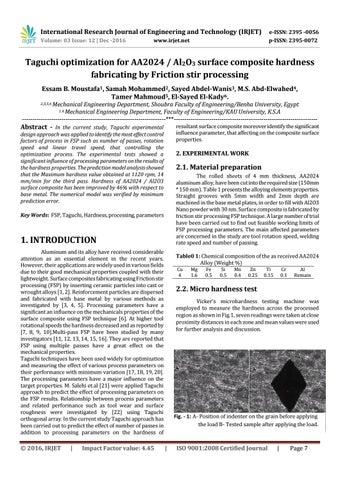
2.2. Micro hardness test Vicker’s microhardness testing machine was employed to measure the hardness across the processed region as shown in Fig.1, seven readings were taken at close proximity distances in each zone and mean values were used for further analysis and discussion.
Fig. - 1: A- Position of indenter on the grain before applying the load B- Tested sample after applying the load.
|
ISO 9001:2008 Certified Journal
|
Page 7
International Research Journal of Engineering and Technology (IRJET)
e-ISSN: 2395 -0056
Volume: 03 Issue: 12 | Dec -2016
p-ISSN: 2395-0072
www.irjet.net
where, n is number of tests and y is value of response variables.
2.3. Process parameters effect For this study, Taguchi orthogonal array design of experiment with three factors at three levels was used. Three variables have been chosen as independent variables are: Number of passes (P), Tool rotation speed (N) and Travel speed (V). All the factors and their levels are tabulated in Table 2. The selection of which orthogonal array is based on number of control factors and interactions of interest, number of levels for factors and desired experimental resolution or cost budget. As three levels and three factors are taken into consideration, L9 (33) orthogonal array is used in this study. Only the main factor effects are taken into consideration and not the interactions.
Table -3: Experiments result data.
Table -2: DOE- Factors and their levels. Level Factors Number of passes (P)
I
II
III
1
2
3
Tool rotation speed (N) rpm
900
1120
1400
Travel speed (V) mm/min
10
14
20
N
V
(rpm)
(mm/min)
1
900
2
No.
P
HV
10
1
68.0
1120
14
2
106.2
3
1400
20
3
103.8
4
900
14
3
100.8
5
1120
20
1
88.8
6
1400
10
2
83.4
7
900
20
2
96.2
8
1120
10
3
102.8
9
1400
14
1
96.4
3. RESULTS AND DISCUSSIONS Standard Taguchi L9 orthogonal array and results of hardness tabulated in Table 3 show that hardness values of Vickers number (HV) are ranging from 66 HV to 103 HV. The average hardness values in single pass, double pass, and triple pass FSPed surface composite of AA2024/Al2O3 alloy are higher than that of the as received alloy. The average measured microhardness value of the base metal AA2024 is 60.2 HV, while the higher average measured value of the surface composite were 106.2 HV resulting from experiments designed by Taguchi robust design. The number of passes are played an influential role in the microhardness results, as shown in Chart 1. The average microhardness value in the nugget zone affected by passes number, which it was improved by 46%.
Chart - 1: Microhardness profile through cross section of FSPed at 900 rpm - 10 mm/min traverse speed. Calculated means and S/N ratio of each process parameters are shown in Table 4 and Table 5 respectively. Taking into account that a larger S/N ratio indicates to better quality characteristics. Furthermore, the main effect plot shown in Chart 3. for hardness calculated by Minitab software indicates that HV was at maximum when combination of N (1120 rpm); V (14 mm/min); and P (no. of passes 3) . Notable variation in Vicker's hardness number can be seen with change in number of passes. Optimum value of HV can be predicted at selected levels of significant levels of parameters. The optimum levels of
For each factors, signal-to-noise ratios (S/N) and means are be used to assess their influence on response. Appropriate S/N ratio have to be chosen based on previous expertise and understanding of the process. In this study, the S/N ratio is chosen based on the criterion the larger-is-better and it is calculated according to Eq (1). (1)
© 2016, IRJET
|
Impact Factor value: 4.45
|
ISO 9001:2008 Certified Journal
|
Page 8
International Research Journal of Engineering and Technology (IRJET)
e-ISSN: 2395 -0056
Volume: 03 Issue: 12 | Dec -2016
p-ISSN: 2395-0072
www.irjet.net
process parameters have already been selected as N2, V2 and P3 as shown in Table 4. Estimated mean of HV can be calculated as formulated in Eq. (2).
Confirmation test Conducting operation at optimum combination of N2, V2 and P3, the average of hardness number of FSPed surface composite of AA2024/Al2O3 alloy was 110 HV which close to the estimated value of 114 HV from prediction model.
4. CONCLUSIONS The present study aims to establish the optimal value of FSP parameters to maximise hardness value of AA2024/Al2O3 Nanocomposite surface. Minimum number of experiments were designed and carried out using Taguchi orthogonal array. A maximum HV has been found at optimal parameters of FSP (tool rotational speed, 1120 rpm; traverse speed, 14 mm/min; and number of passes, 3). Numerical prediction model with 3.5 % uncertainty error has developed and confirmed by the experimental results. In addition, parameter P has been found to have the most significant influence on hardness value of AA2024/Al 2O3 Nanocomposite surface.
Chart - 2: Main effect plot for hardness. calculated as formulated in Eq. (2). (2) where, , overall mean of HV; , mean of HV at second level of N 1120 rpm; , mean of HV at second level of traverse speed 14 mm/min; , mean of HV at third level of number of passes. Substituting values of various terms in Eq. (2),
REFERENCES [1] U. P. B. M. K. reviewVipin Sharma, "Surface composites by friction stir processing: A review," Journal of Materials Processing Technology, vol. 224, p. 117–134, 2015.
HV = 99.27 + 101.13 + 102.47 – 2*(94.044) = 114.78 Table 4: Main effects of HV (Mean) Mean Factors I II III Delta Rank N
88.33
99.27
94.53
10.93
3
V
84.73
101.13
96.27
16.40
2
P
84.40
95.27
102.47
18.07
1
[2] K. D. ,. M. K. B. G. Mohsen Bahrami, "A novel approach to develop aluminum matrix nano-composite employing friction stir welding technique," Materials and Design, vol. 53, p. 217–225, 2014. [3] K. R. E. C. Yulong Li a, "The mechanical response of an A359/SiCp MMC and the A359 aluminum matrix to dynamic shearing deformations," Materials Science and Engineering, vol. 382, p. 162–170, 2004. [4] I. D. S. J. V. N. M. G. Ashok Kumar, "Friction stir processing of intermetallic particulate reinforced aluminum matrix composite," Advanced Materials Letters, vol. 4, pp. 230-234, 2013.
S/N ratio
Factors I
II
III
Delta
Rank
N
38.79
39.91
39.48
1.12
3
V
38.44
40.09
39.65
1.65
2
P
38.43
39.54
40.21
1.78
1
[5] T. S. b. A. G. D.K. Lima, "Synthesis of multi-walled CNT reinforced aluminium alloy composite via friction stir processing," Materials Science and Engineering A, vol. 507, p. 194–199, 2009. [6] A. Devaraju , A. Kumar and A. Kumaraswamy, "Influence of reinforcements (SiC and Al2O3) and rotational speed on wear and mechanical properties of aluminum alloy 6061-T6 based surface hybrid
Table 5: Main effects of HV (S/N ratio)
© 2016, IRJET
|
Impact Factor value: 4.45
|
ISO 9001:2008 Certified Journal
|
Page 9
International Research Journal of Engineering and Technology (IRJET)
e-ISSN: 2395 -0056
Volume: 03 Issue: 12 | Dec -2016
p-ISSN: 2395-0072
www.irjet.net
composites produced via friction stir processing," Materials and Design, vol. 51, p. 331–341, 2013.
1157–1168, 2012. [16] Z. Z. Y. Z. G. C. Y. G. M. L. J. Z. Rui Yang, "Effect of multipass friction stir processing on microstructure and mechanical properties of Al3Ti/A356 composites," Materials Characterization, vol. 106, p. 62–69, 2015.
[7] E. R. Mahmoud, K. Ikeuchi and M. Takahashi, "Fabrication of SiC particle reinforced composite on aluminium surface by friction stir processing," Science and Technology of Welding and Joining, vol. 13, no. 7, pp. 607-608, 2008.
[17] A. Ersan , Necip and . B. Burak, "Design optimization of cutting parameters when turning hardened AISI 4140 steel (63 HRC) with Al2O3 + TiCN mixed ceramic tool," Materials and Design, vol. 28, p. 1618– 1622, 2007.
[8] A. Thangarasu, N. Murugan, I. Dinaharan and S. J. Vijay, "Effect of tool rotational speed on microstructure and microhardness of AA6082/TiC surface composites using friction stir processing," Applied Mechanics and Materials, Vols. 592-594, pp. 234-239, 2014.
[18] A. D. , H. S. M. and . Z.-H. A., "Taguchi optimization of process parameters in friction stir processing of pure Mg," Journal of Magnesium and Alloys, vol. 3, p. 168– 172, 2015.
[9] P. Asadi, M. K. Besharati Givi, K. Abrinia, M. Taherishargh and R. Salekrostam, "Effects of SiC Particle Size and Process Parameters on the Microstructure and Hardness of AZ91/SiC Composite Layer Fabricated by FSP," Journal of Materials Engineering and Performance, vol. 20, no. 9, p. 1554– 1562, 2011.
[19] Parviz Asadi, Mostafa Akbari and Mostafa Akbari, "Optimization of AZ91 friction stir welding parameters using Taguchi method," Journal of Materials: Design and Applications., vol. 21, pp. 291302, 2016.
[10] D. K. Lim, T. Shibayanagi and A. P. Gerlich, "Synthesis of multi-walled CNT reinforced aluminium alloy composite via friction stir processing," Materials Science and Engineering A, vol. 507, p. 194–199, 2009.
[20] S. Rajakumar, c. Muralidharan and v. Balasubramanian, "Optimisation and sensitivity analysis of friction stir welding process and tool parameters for joining AA1100 aluminium alloy," Int. J. Microstructure and Materials Properties, vol. 6, pp. 132-156, 2011.
[11] A. Rao, V. Katkar and G. Gunasekaran, "Effect of multipass friction stir processing on corrosion resistance of hypereutectic Al–30Si alloy," Corrosion Science, vol. 83, p. 198–208, 2014.
[21] . M. S. M. SALEHI and M. J. AGHAZADEH , "Optimization of process parameters for producing AA6061/SiC nanocomposites by friction stir processing," Trans. Nonferrous Met. Soc. China, vol. 22, 2012.
[12] J. L. C. S. S. M. G. B. J. M. T. J.F. Guo, "Effects of nanoAl2O3 particles addition on grain structure evolution and mechanical behavior of friction stir processed Al," Materials Science & Engineering A, vol. 602, p. 143–149, 2014.
[22] J. Davim, "Design of optimisation of cutting parameters for turning metal matrix composites based on the orthogonal arrays," Journal of Materials Processing Technology, vol. 132, p. 340–344, 2003.
[13] M. n. A. M. SarkariKhorrami, "The effect of SiC nanoparticles on the friction stir processing of severely deformed aluminum," Materials Science & Engineering A, vol. 602, p. 110–118, 2014. [14] R. M. L.B. Johannes, "Multiple passes of friction stir processing for the creation of superplastic 7075 aluminum," Materials Science and Engineering A, vol. 464, p. 255–260, 2007. [15] E. A. E.-D. Magdy M. El-Rayes, "The influence of multipass friction stir processing on the microstructural and mechanical properties of Aluminum Alloy 6082," Journal of Materials Processing Technology, vol. 212, p.
© 2016, IRJET
|
Impact Factor value: 4.45
|
ISO 9001:2008 Certified Journal
|
Page 10