International Research Journal of Engineering and Technology (IRJET)
e-ISSN: 2395 -0056
Volume: 03 Issue: 01 | Jan-2016
p-ISSN: 2395-0072
www.irjet.net
Pipeline Monitoring Using Vibroacoustic Sensing – A Review S.Ravi1 , S.KarthikRaj2 , D.Sabareesan3 ,R.Kishore4
1Assistant professor, Department of Mechanical Engineering, Sri Ramakrishna Engineering College,
Coimbatore , Tamilnadu , India
2,3,4U.G Students, Department of Mechanical Engineering, Sri Ramakrishna Engineering College,
Coimbatore , Tamilnadu , India
Abstract : Vibroacuostic Sensing is an emerging technique for detection of leaks and foreign particles in fluid transportation pipelines. This sensing is based on the remote identification of fluid transients and pipe shell vibrations produced by interaction with pipe or flow. The system performance is a function of the thermodynamic properties of the fluids, which can be separated into liquid, gases and multiphase mixtures. While liquid are considered incompressible, Gases and mixtures sustain strong volume variations, thus producing variable flow conditions along the pipelines. This paper analyses pressure transient propagation in gas filled pipelines. Field test should be conducted at different pressures, with or without flow, and also in operational conditions, generating controlled interactions with infrastructure to collect vibroacoustic signals by a network of monitoring stations located along the pipeline.
Key Words: Keywords – pipeline, vibroacoustic sensing , third party interference (TPI) --------------------------------------------------------------------***---------------------------------------------------------------------1. INTRODUCTION
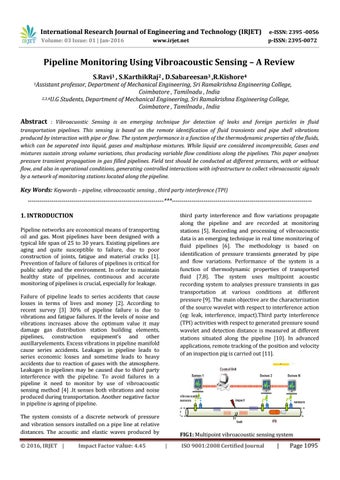
third party interference and flow variations propagate along the pipeline and are recorded at monitoring stations [5]. Recording and processing of vibroacoustic data is an emerging technique in real time monitoring of fluid pipelines [6]. The methodology is based on identification of pressure transients generated by pipe and flow variations. Performance of the system is a function of thermodynamic properties of transported fluid [7,8]. The system uses multipoint acoustic recording system to analyses pressure transients in gas transportation at various conditions at different pressure [9]. The main objective are the characterization of the source wavelet with respect to interference action (eg: leak, interference, impact).Third party interference (TPI) activities with respect to generated pressure sound wavelet and detection distance is measured at different stations situated along the pipeline [10]. In advanced applications, remote tracking of the position and velocity of an inspection pig is carried out [11].
Pipeline networks are economical means of transporting oil and gas. Most pipelines have been designed with a typical life span of 25 to 30 years. Existing pipelines are aging and quite susceptible to failure, due to poor construction of joints, fatigue and material cracks [1]. Prevention of failure of failures of pipelines is critical for public safety and the environment. In order to maintain healthy state of pipelines, continuous and accurate monitoring of pipelines is crucial, especially for leakage. Failure of pipeline leads to series accidents that cause losses in terms of lives and money [2]. According to recent survey [3] 30% of pipeline failure is due to vibrations and fatigue failures. If the levels of noise and vibrations increases above the optimum value it may damage gas distribution station building elements, pipelines, construction equipment’s and other auxillaryelements. Excess vibrations in pipeline manifold cause series accidents. Leakages in pipeline leads to series economic losses and sometime leads to heavy accidents due to reaction of gases with the atmosphere. Leakages in pipelines may be caused due to third party interference with the pipeline. To avoid failures in a pipeline it need to monitor by use of vibroacoustic sensing method [4] .It senses both vibrations and noise produced during transportation. Another negative factor in pipeline is ageing of pipeline. The system consists of a discrete network of pressure and vibration sensors installed on a pipe line at relative distances. The acoustic and elastic waves produced by © 2016, IRJET |
Impact Factor value: 4.45
FIG1: Multipoint vibroacoustic sensing system |
ISO 9001:2008 Certified Journal
|
Page 1095
International Research Journal of Engineering and Technology (IRJET)
e-ISSN: 2395 -0056
Volume: 03 Issue: 01 | Jan-2016
p-ISSN: 2395-0072
www.irjet.net
2. TESTING PROCEDURE:
2.3 WELDING HIT COUNT:
2.1 IMPACT TEST:
This procedure is used to identify the count of weld and sound peak produced by the pig at the welding joints or dents. This case requires one station to detect the sound peak. From this method we can find the position of welded joints and its behavior at various load. Any defect in welded joint is identified by change in sound peak measured by the pig.
A list of actions are carried at the pipe like impacting, drilling, grinding in impact test to find third party interference (TPI). The system consists of array of vibrational sensor at the testing point. Impact tests are carried out using an oscillating pendulum mass up to 80kg and a 5kg hammer. Different impact energies, E, were obtained by increasing the departing distance of the pendulum (E<750). Dynamic measurements of pipe displacement were carried out at the hit position of pendulum by three component accelerometer. It shows that the energy entering the pipe was approximately two third of the total one. The fig shows the impact test parameters and acceleration signal at hammer.
2.4 CROSS CORRELATION METHOD: The sound peak produced by the pig at the welding dents propagates in both directions and it is recorded at both sides by the monitoring stations [12]. The cross correlation peak happens at differential propagation time between the source position and recording stations. 2.5 SPILL TEST: Leak test were performed by operating different valves along the pipeline [13]. Short (1s) and long (7to10s) spilling sequences are produced. An echo detection procedure [14] is applied by filtering the recording signal with time varying matched filter with time varying filter. The starting matched filter is the source wavelet. 3. LITERATURE REVIEW: 1) F. Musaakhunovaa , Aleksandr A. Igolkin , “An extensive research on vibration and acoustic characteristic in a pipeline is conducted ”.The levels of vibration and acoustic noise level in various parts of pipelines are measured to obtain experimental data to vibration loading in pipeline.
FIG 2: Impact test parameters and acceleration signal at hammer 2.2 PIG TRACKING: Pig devices are frequently used for in-line service inspection of gas pipelines. They are designed to collect a wide range of, pig requires tracking because they may strike inside pipe and their speed must be measured. Some of the pigs use electromagnetic emitters and moves inside the pipeline. Pigs can be taken out at the monitoring station. When the sealing cups of the pig encounter a weld, vibrational and acoustic signals are generated. They carry information on the source and on the transmission channel. The range of detection dependents on the pipeline diameter and type of pig. Pig tracking is used to measure environmental pressure noise produced by the flow of fluid and by compressors. Pig tracking involves two techniques welding hit count and cross correlation method.
2)Giancario Bernasconi ,Giuseppe Giunta , “design a pipeline monitoring system, reducing negative pressure waves ”.A discrete network of pressure and vibration sensor are placed along the pipeline at a certain distance and results from the sensor are recorded at various stations along the pipeline .Thus collecting results for gas transportation pipe lines 3) F.Diongi, A.Bassan, M.Veneziani, “Third party interference and leakages must be avoided”. Remote real time monitoring is setup using fibre optics and discrete acoustic sensing to perform tests to simulate intrusions, impacts and leak eve 4) Riccardo schiavon, Giancarlo bernasconi, “Real time monitoring of pipeline is key factor for environmental
© 2016, IRJET |
Impact Factor value: 4.45
|
ISO 9001:2008 Certified Journal
|
Page 1096
International Research Journal of Engineering and Technology (IRJET)
e-ISSN: 2395 -0056
Volume: 03 Issue: 01 | Jan-2016
p-ISSN: 2395-0072
www.irjet.net
sustainability of oil and gas industry”. Campaigns in controlled conditions were carried out and pressure wave propagation is studied. Background noise removal algorithms have been developed to increase sensitivity of system.
pipeline can be controlled by using techniques like smart pipe, augmented reality. 11)Jaiwan Cho ,Youngchil Seo, “ Defect detection in a pipeline using ultrasound thermography”. Ul0trasonic vibration energy is passed in the exterior side of the pipeline. A hot spot is produced around the defect is identified by measuring temperature along the pipe. Temperature at hotspot is higher when compared to other areas.
5) Alberto Martini, Marco Troncossi and Alessandro Rivola, “The objective is the development of system for automatic early detection of burst leaks in service pipes”. Detection of leaks in pipeline is conducted using vibration monitoring techniques. The experimental data obtained from the system are used develop algorithm for leak detection purpose.
4. EXISTING METHDOLOGY: 1) Eddy current method: The eddy current technique is based on electromagnetism. When an alternating current is applied to a conductor, magnetic field is created in and around the conductor. If another conductor is brought closely eddy current induced in second conductor. 2) Pressure wave Detector: The negative pressure wave technique is an effective method for fluid leakage detection and location. It is difficult to distinguish the source that has led to fluid pressure drop. 3) Fiber optic sensor: The ability to measure temperatures and strains at thousands of points along a single fiber is particularly relevant for monitoring pipelines. Sensing system is based on Raman scattering are used to detect pipeline leakages. 4) Soil monitoring: In soil monitoring methods, the pipeline is first injected with small amount of a tracer chemical, which seeps out of the pipe in the event of a leak. This is detected by dragging an instrument along the pipeline 5) Infrared Thermography: Some leaks can be detected through the identification of temperature changes in the immediate surroundings. It is used to detect hot fluid leaks. This methods equipment can be used from moving vehicles ,aircraft and portable system in ground cover
6) Rejane B.Santos, Wellick S .de Almeida, “Increasing operational reliability of the systems is crucial to minimize risk of leaks”. The system consists of microphone installed inside the pipeline and coupled to a data acquisition card and computer. Leak test are carried out under event with leak and event without leak by spectrum analysis. 7) Ritaban Dutta, Anthony Cohn, “Experimental multi sensor images were obtained for monitoring pipelines”. The system consists of vibro-acoustic sensor based location methods and ground penetrating radar imaging system. Three types of sensory images were processed computationally to extract depth and location information of the pipeline with high accuracy. 8) David Hanson, Bob Randall, “possible to locate presence of leaks in pipes by measuring at remote locations”. Leaks are detected by measuring time delay of the leak noise reaching the different sensors. Location of leak may be pinpointed by measuring wave speed in the pipe. 9) Wei-Yu Lu, Wei-Hui Wang, “pipe flow noises are calculated by numerical simulation of sound pressure field along the pipe”. The frequency factors along the material are determined by experimental modal analysis. Flow noise can be eliminated by using shearing materials like wool,
5. PROPOSED METHODOLGY: The monitoring of pipeline health is done by using acoustic waves [15]. This technique can be used to measure pipeline walls, detect gas contamination, measure flow, and detect gas leaks and structural defects in the pipe. An acoustic sensor uses mechanical waves as sensing mechanism. As the waves propagates through or on the surface of material, any changes to characteristics of the propagation path affect the
Lead sheet and aluminium. 10) Zheng Liu,Yehuda Kleiner, “Art of inspection using condition assessment in pipelines”. The system includes conventional non-destructive testing and advanced sensors for monitoring. Structural deterioration of
© 2016, IRJET |
Impact Factor value: 4.45
|
ISO 9001:2008 Certified Journal
|
Page 1097
International Research Journal of Engineering and Technology (IRJET)
e-ISSN: 2395 -0056
Volume: 03 Issue: 01 | Jan-2016
p-ISSN: 2395-0072
www.irjet.net
velocity and amplitude of the wave. Changes in velocity can be monitored by measuring the frequency or phase characteristics of the sensor and can be correlated to the corresponding physical quantity that is being measured.
deformations and causes for failures of flow regulation. 7. REFERENCES: [1]. Giunta, G., Dionigi, F., Bernasconi, G., Del Giudice, S., Rovetta, D., 2011a, “Vibroacoustic Monitoring of Pigging Operations in Subsea Gas Transportation Pipelines,” ASNT Fall Conference, Palms Spring, USA. [2]. Giunta, G., Dionigi, F., Bassan, A., Veneziani, M., Bernasconi, G., Del Giudice, S., Rovetta, D., Schiavon, R., Zanon, F., 2011b, “Third Party Interference and Leak Detection on Buried Pipelines for Reliable Transportation of Fluids,” 10th Offshore Mediterranean Conference, Ravenna, Italy. [3]. Giunta G., Bernasconi G., Del Giudice S., 2013, “Vibroacoustic Monitoring of Gas-Filled Pipelines”, ASNT Fall Conference and quality testing show, Las Vegas, Nevada, USA. [4]. Alberto Martini, Marco Troncossi and Alessandro Rivola, “vibration monitoring as a tool for leak detection in water distribution network”. [5]. Rejane B.santos, Wellick S. de almeida, Flavio V .da silva, “spectral analysis for detection of leaks in pipe carrying compressed air”. [6]. David Hanson, Bob Randall and Graham Brown, “Locating leaks in underground water pipes using complex spectrum”. [7]. Wei- Yu Lu and Wei-Hui Wang, “vibroacoustic attenuation effect of sandwich damping mateil on pipe flow noise”. [8]. Jaiwan Cho, Youngchil Seo and Seungho Jung, “Defect detection within apipe using ultrasonic sound excited thermograph”. [9]. Giunta, G., Bernasconi, G., “Method and system for continuous remote monitoring of the integrity of pressurized pipelines and properties of the fluids transported”. [10]. Bernasconi, G., Del Giudice, S., Giunta, G., 2012, “Pipeline Acoustic Monitoring,” Pipeline Technology Conference, Hannover, Germany. [11]. Bernasconi, G., Del Giudice, S., Giunta, G., ionigi, F., Schiavon, R., Zanon, F., 2013a, advanced Pipeline Monitoring Using Multipoint Acoustic Data,” 11th Offshore Mediterranean Conference and Exhibition, Ravenna, Italy. [12]. Bernasconi, G., Del Giudice, S., Giunta, G., Dionigi, F., 2013b, “Advanced pipeline vibroacosutic monitoring”,
Due to limitations in detection range, it is usually necessary to install many sensors along a pipeline. The sensor detect acoustic signal in the pipeline and discriminate leak sounds from other sounds generated by normal operational changes. When a leak occurs, noise is generated as the fluid escapes from the pipeline. The wave of the noise propagates with a speed determined by the physical properties of fluid in the pipeline. Acoustic detectors detect these waves and find the leaks. 6. CONCLUSION: Impacts, intrusions, threats, leaks are the principle causes of pipeline fluid transportation failure and maintenance stops. On the other hand these events produce vibrations and acoustic emissions in the source point, that can be used to detect, locate and classify the defect. Vibro acoustic sensing is emerging technique for real time monitoring of pipelines. The system has been used for both single phase and multiphase transportation lines. The main results are as follows Environmental noise is on order of 1 to 10 kpa is produced by flow generation and regulation equipment, as well as by turbulence. Sound attenuation increases with frequency and decreases with gas pressure and pipe radius. Adaptive noise reduction requires very accurate design of sensor positioning and knowledge of pipe system layout. Pressure noise level produced by third party interference and leak events is detected in the 50 to 300 Hz bandwidth at a distance of 10 km. spills and leaks are low pass signals. Travelling pigs generate vibroacoustic transients when they cross pipeline internal welding dents. This signal can be effectively processed to track the position of pig and its velocity. Pipeline terminals are sources of environmental pressure transients that propagates in both direction along the flow. It is then possible by cross correlation method to obtain an equivalent acoustic channel of pipeline. Long term monitoring pipeline can aid the detection of pipe © 2016, IRJET |
Impact Factor value: 4.45
|
ISO 9001:2008 Certified Journal
|
Page 1098
International Research Journal of Engineering and Technology (IRJET)
e-ISSN: 2395 -0056
Volume: 03 Issue: 01 | Jan-2016
p-ISSN: 2395-0072
www.irjet.net
[13]. Giunta, G., Bernasconi, G., “Method and system for the remote detection of the position of a pig device inside a pressurized pipeline”. [14]. Bickerstaff, R., Vaughn, M., Stoker, G., Hassard, M., Garrett, M., “Review of Sensor Technologies for In-line Inspection of Natural Gas Pipelines [15]. Blackstock, D. T., 2000, “Fundamentals of physical acoustics,” John Wiley&Sons, Inc.
© 2016, IRJET |
Impact Factor value: 4.45
|
ISO 9001:2008 Certified Journal
|
Page 1099