International Research Journal of Engineering and Technology (IRJET)
e-ISSN: 2395 -0056
Volume: 03 Issue: 11 | Nov -2016
p-ISSN: 2395-0072
www.irjet.net
Health Parameter Measurement Using Internet of Things Ms.Priti Satpute1, Ms.Sneha Sahani2, Ms.Amruta Suravase3, Ms.Pooja Thombare4, Prof.Jayshree Mahajan5, Prof.Rahul V. Chavan6 1,2,3,4,5,6Department of Computer Engineering, SKN-Sinhagad Institute of Technology & Science Lonavala, Pune,
India.
---------------------------------------------------------------------***---------------------------------------------------------------------
Abstract - In the last decade the healthcare monitoring
systems have strained major special treatment of the researchers. In this a mobile device support wireless healthcare monitoring system which can give real time online in sequence about physiological situation of a patient. Our proposed system is designed to determine and monitor main physiological data of a patient in arrange to exactly give details the condition of her/his body and condition. In adding up the proposed system is able to send startling message about the patient’s serious health data by text messages or by email information. The patient’s temperature, heart beat rate, muscles, blood pressure, blood glucose level, and ECG data are monitored, displayed, and stored by our system. If system detects any sudden changes in patient heartbeat or body temperature, the system automatically alerts the user about the patients position over IOT and also shows details of heartbeat and temperature of patient exist over the internet. Thus IOT based patient health track system effectively uses internet to monitor patient health status and keep lives on time. To ensure stability and accuracy the proposed system has been field tested. The test results show that our system is able to calculate the patient’s physiological information with a very high correctness. Our system puts forward a smart patient health tracking system that uses Sensors to track patient health and uses internet to update their respected ones in case of any issue. Our system uses temperature as well as heartbeat sensing to keep track of patient physical condition. Key Words: Atmega 328p, ESP8266, LCD Display, Sensors, Extreme Burner. To have a healthy life Now-a-days many people are looking forward. Because of pollutions and highly competitive feature in field of living, number of people diminishing request for heart correlated disease are seen frequently arise due to increase of stress level. These days sustain a strong life is hard. It is very important to keep follow on body by ordinary check-up. Patient monitoring refers to the continuous examination of repeating events of physiologic purpose to guide treatment or to monitor the helpfulness of interference and is new first and foremost in the concerted care unit and functioning room. In India and in various countries there is no system which constantly monitor the patient when patient is in move. And this moved us to work in this premises.
© 2016, IRJET
|
Impact Factor value: 4.45
|
1. LITERATURE SURVEY Gsm based- The system proposed by them is integrated into a small compact unit as small as a cell phone or wrist watch. This device is designed to provide a continuous access to person’s health care data through wireless communication. Secured – this paper proposed a system a system which uses Wi-Fi protocol for sending and receiving patient health care data. It only uses temp and heart rate monitoring sensors. In case of emergency it uses GSM modem to alert the doctor and at the same time buzzer turns alert to the care taker. Zigbee based wearable – this Zigbee based wireless healthcare monitoring system provide real time online information about the health condition of patient by sending alarming messages to the health care professionals. This can be used by the health care professional to make necessary advice from anywhere in the world. Zigbee based patient – This proposed system is designed to monitor heartbeat and body temperature, the data measured is transmitted to receiver wirelessly through zigbee. Range of zigbee is less which arises problem between sender and receiver. In case of any abnormality in patient SMS is send to the doctor.
3. Proposed System from Sender
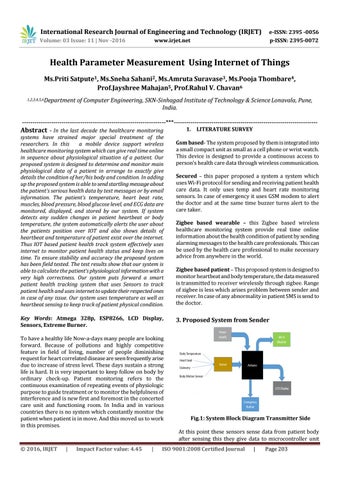
Fig.1: System Block Diagram Transmitter Side At this point these sensors sense data from patient body after sensing this they give data to microcontroller unit
ISO 9001:2008 Certified Journal
|
Page 203
International Research Journal of Engineering and Technology (IRJET)
e-ISSN: 2395 -0056
Volume: 03 Issue: 11 | Nov -2016
p-ISSN: 2395-0072
www.irjet.net
(ATMEGA 328P). Microcontroller convert data and send it to LCD and other component. This sensor gives the analog data microcontroller switch this data into digital form. For ex. Temp sensor gives the dada in mili volts like 200mv. and the microcontroller convert it into essentially temp value i.e. 27degree. Heartbeat measures bit rate of body and oximetry sensor is used to identify the blood level and glucose level sense data and gives to microcontroller which is also in analog form. Body motion sensor is used to discover the motion of the patient. Power supply unit is used to give power to sensors and controller unit. After converting this data can be display on LCD display board. Here we put an emergency switch which is used if system is not working properly and patient is not filling not well then patients compress this button. After pressing this button Wi-Fi send the message to your main unit or android app. and urgent situation message is display on LCD board. Wi-Fi (transmitter) component connects data from microcontroller.
System can be switched into manual mode whenever required Operation from Remote location. Compatible. Easy to install and Use.
5. APPLICATIONS
Patient Status Body Temperature Monitoring Heart Beat monitoring ECG Monitoring Hospital Old Age Homes Animal or Forest
6. SUMMARY AND CONCLUDING REMARKS In this paper, we reviewed the current state and projected future directions for integration of remote health monitoring technologies into the clinical practice of medicine. Wearable sensors, particularly those equipped with IOT intelligence, offer attractive options for enabling observation and recording of data in home and work environments, over much longer durations than are currently done at office and laboratory visits. This treasure trove of data, when analyzed and presented to physicians in easy-to-assimilate visualizations has the potential for radically improving healthcare and reducing costs. We highlighted several of the challenges in sensing, analytics and visualization that need to be addressed before systems can be designed for seamless integration into clinical practice.
REFERENCES [1] Jawbone Inc., “Jawbone fitness trackers,” accessed April 2015. [Online]. Available: https://jawbone.com/up/trackers. Fig.2: System Block Diagram Receiver Side One Android application is there which is having in mobile or laptop. Every 30sec - 60 sec we get the patient’s body reading which is display in android application and receiver unit.. In receiver module which is having LCD display and buzzer. If patients having emergency and doctor is busy, then buzzer is used to remind doctor there is an emergency.
4. ADVANTAGES
Highly sensitive Fit and Forget system Low cost and reliable circuit Complete elimination of manpower
© 2016, IRJET
|
Impact Factor value: 4.45
[2] FitBit Inc., “flex: Wireless activity + sleep wristband,” accessed April 2015. [Online]. Available: https://www.fitbit.com/flex [3] Apple Inc., “Apple watch,” accessed April 2015. [Online]. Available: https://www.apple.com/watch. [4] A. Pantelopoulos and N. Bourbakis, “A survey on wearable sensor-based systems for health monitoring and prognosis,” IEEE Trans. Sys., Man, and Cybernetics, Part C: Applic. and Reviews, vol. 40, no. 1, pp. 1–12, Jan 2010. [5] D. Son, J. Lee, S. Qiao, R. Ghaffari, J. Kim, J. E. Lee, C. Song, S. J. Kim, D. J. Lee, S. W. Jun, S. Yang, M. Park, J. Shin, K. Do, M. Lee, K. Kang, C. S. Hwang, N. Lu, T. Hyeon, , and D.-H. Kim, “Multifunctional wearable devices for diagnosis and therapy
|
ISO 9001:2008 Certified Journal
|
Page 204
International Research Journal of Engineering and Technology (IRJET)
e-ISSN: 2395 -0056
Volume: 03 Issue: 11 | Nov -2016
p-ISSN: 2395-0072
www.irjet.net
of movement disorders,” Nature Nanotechnology, pp. 1–8, 2014. [6] A. Page, O. Kocabas, T. Soyata, M. Aktas, and J.-P. Couderc, “Cloud- Based Privacy-Preserving Remote ECG Monitoring and Surveillance,” Annals of Noninvasive Electro cardiology (ANEC), 2014. [Online]. Available: http://dx.doi.org/10.1111/anec.12204. [7] R. Paradiso, G. Loriga, and N. Taccini, “A wearable health care system based on knitted integrated sensors,” IEEE Trans. Info. Tech. in Biomedicine, vol. 9, no. 3, pp. 337–344, Sept 2005.
© 2016, IRJET
|
Impact Factor value: 4.45
|
ISO 9001:2008 Certified Journal
|
Page 205