International Research Journal of Engineering and Technology (IRJET)
e-ISSN: 2395 -0056
Volume: 03 Issue: 11 | Nov -2016
p-ISSN: 2395-0072
www.irjet.net
Guru- An E-Learning System Vadiraj Adya1, Marlene Mathew2,Yash Chaudhari3 1UG Student, Dept. of Computer Engineering, PVPIT,Bavdhan, Pune, India. 2UG Student, Dept. of Computer Engineering, PVPIT, Bavdhan, Pune, India 3
UG Student, Dept. of Computer Engineering, PVPIT, Bavdhan, Pune, India
---------------------------------------------------------------------***--------------------------------------------------------------------Abstract - The research community in the recent years has believed that an e-learning system is the next generation elearning. The current models of e-learning systems however lack the support of underlying infrastructures, which can dynamically allocate the required computation and storage resources for e-learning systems. The proposed system is a platform in which users like students, teachers, parents will be able to retrieve the information from the cloud and also transparency can be maintained between them. The system consists of 3 modes namely Offline, Online & Premium which will help the user to access the information on the cloud in the manner one wants to. As cloud computing will be used in this particular proposed system, space utilization will be done to its maximum as well as storage of databases will also be more efficient as users can view it easily.
Lack of Flexibility
Bottleneck Problems
Storage space also need to expand with the increasing learning resources. The single server storage capacity is restricted and processing ability cannot meet the growing demand. The performance will be reduced sharply, even crash, lead to service interruptions when a large number of users request services at the same time.
Function Limitations
Simple functions such as video on demand and resource downloading are provided by most existing elearning platform. This does not meet the need of developing joint training project on the Internet.
Key Words:Information retrieval, Distributed Applications, Cloud Databases, Payment Gateway, File Transfer.
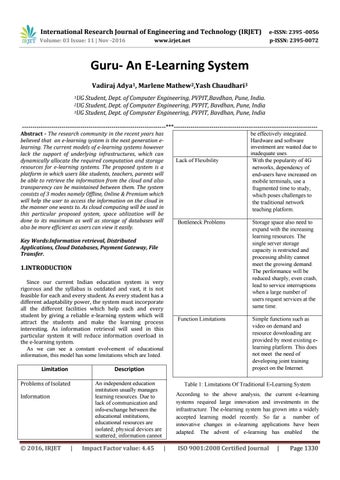
1.INTRODUCTION Since our current Indian education system is very rigorous and the syllabus is outdated and vast, it is not feasible for each and every student. As every student has a different adaptability power, the system must incorporate all the different facilities which help each and every student by giving a reliable e-learning system which will attract the students and make the learning process interesting. As information retrieval will used in this particular system it will reduce information overload in the e-learning system. As we can see a constant evolvement of educational information, this model has some limitations which are listed.
Limitation
Description
Problems of Isolated
An independent education institution usually manages learning resources. Due to lack of communication and info-exchange between the educational institutions, educational resources are isolated; physical devices are scattered; information cannot
Information
© 2016, IRJET
|
Impact Factor value: 4.45
be effectively integrated. Hardware and software investment are wasted due to inadequate uses. With the popularity of 4G networks, dependency of end-users have increased on mobile terminals, use a fragmented time to study, which poses challenges to the traditional network teaching platform.
Table 1: Limitations Of Traditional E-Learning System According to the above analysis, the current e-learning systems required large innovation and investments in the infrastructure. The e-learning system has grown into a widely accepted learning model recently. So far a number of innovative changes in e-learning applications have been adapted. The advent of e-learning has enabled the
|
ISO 9001:2008 Certified Journal
|
Page 1330
International Research Journal of Engineering and Technology (IRJET)
e-ISSN: 2395 -0056
Volume: 03 Issue: 11 | Nov -2016
p-ISSN: 2395-0072
www.irjet.net
development of distance education as opportunities. It is an Internet-based learning process which includes various sets of applications and processes such as virtual classroom, webbased and computer based learning. The concept “Cloud Computing” in the past few years, has emerged as a viable and promising solution to the challenges associated with providing enhanced service environments along with the advantages of scalability, flexibility, accessibility, reliability, and high performance while reducing IT-related operating costs. Cloud computing integrates the network resources, minimizes the terminal equipment needs, and provides a great convenience for end users. It is necessary for us to seek for moving from the e-learning system into a new cloud infrastructure . Cloud services are currently employed by enterprises, to improve the scalability of their services and to deal with bursts in resource demands. A cloud computing infrastructure is one of the important components of an elearning system. Hence, it has a direct impact on the reliability and sustainability of an E-learning system. The main contribution of this paper is to introduce Cloud computing into an e-learning system as its infrastructure to build a sustainable and prospering e-learning system. This allows for some crucial features: (1) tracking the situation of resource configuration and utilization in real time, allocate resources on demand, and make full use of resources; (2) allowing workloads to recover from unavoidable hardware/software faults; (3) promoting the evolvement or extinction of learning species (including learning contents, services, and applications). This paper is organized as follows: Firstly, it describes what Cloud computing can provide to an e-learning system. Secondly, it demonstrates the architecture of the proposed system based on Cloud computing infrastructure. The remainder of this paper will give a short presentation of the functional framework and related work. It also presents the benefits of using cloud architecture and it describes all the involved components and future scope of proposed e-learning system.
Indian education system is very severe and stern as the syllabus is very outdated and vast. Thus the system is not feasible to every student. Every student has different grasping power of learning. So a system should incorporate all the things that help each and every student by giving a virtual e-learning system which will allow all students to learn better and make their daily curriculum interesting.
|
Impact Factor value: 4.45
Cloud Computing is a new paradigm for organizing and managing ICT resources. There are various definitions of cloud computing, one of which is the definition according to The National Institute of Standards and Technology (NIST) which defines cloud computing as “model for enabling convenient, on-demand network access to a shared pool of configurable computing resources that can be rapidly provisioned and released with minimal management effort or service provider interaction”. Generally speaking, the cloud computing service model consists of three layers: (1) Software as a Service (SaaS); (2) Platform as a service (PaaS); (3) Infrastructure as a service (IaaS). Cloud computing allows an e-learning system with the infrastructure which is reliable, flexible, cost-efficient, selfregulated, and QoS-guaranteed. The contribution of Cloud computing to an e-learning system mainly contains those aspects as follows: 1. QoS-guaranteed infrastructures, e.g., time, cost, reliability, and hardware performance like CPU bandwidth and memory size, and sustains SLA-oriented resource allocation. 2. Support for variety of applications, making it convenient and rapid to get the required computation and storage resources. 3. Real-time configuration information and resource utilization information, allocating resources on demand, and improving the usage rate of resources. 4. Through the automatic resource management, emergencies can be solved rapidly, and labour-intensive jobs can be achieved. Hence, the cost is cut down.
3.PROPOSED SYSTEM& ARCHITECTURE:
1.1 Problem Statement
© 2016, IRJET
2. RELATED WORK
|
The proposed system is a platform in which user’s like students, teachers, parents will be able to retrieve the information from the cloud and also transparency can be maintained between them. The three modes in the proposed system with the userrelated functionalities are as follows: 1.Offline (Only available in Android app):The generalized summary of each and every chapter of different subjects for students from 5th to 12th standards is given in this mode and it can be viewed by all the above users. 2.Online :A brief introduction will be given regarding chapter-wise details of every subject. This feature can also be viewed by all the above users.
ISO 9001:2008 Certified Journal
|
Page 1331
International Research Journal of Engineering and Technology (IRJET)
e-ISSN: 2395 -0056
Volume: 03 Issue: 11 | Nov -2016
p-ISSN: 2395-0072
www.irjet.net
3.Premium :Downloading and editing of information can be done by paying through a payment gateway provided in this system. For students, added functionalities such as access to various recorded lectures by experts and various tools like highlighters will be provided in this mode. For teachers, various links of expert lectures and tool for sending notification to the selected students registered on the particular website will be provided. For parents, short notes and links for expert lectures as well as chat box for interaction with teachers.
Service management- The block provide service offering and service request catalogue. The core in cloud environment is infrastructure layer. Hence, we need Infrastructure management to organize ICT facilities (e.g., functional, and physical infrastructures) involved in Cloud Education.
The proposed system architecture helps to focus each layer on specific task as well as isolate it from other layer operations. The hierarchical architecture of education cloud is proposed and illustrated in Figure1. It is designed with five layers: Infrastructure layer, operational layer, service layer, access layer and user layer. The uppermost layer of proposed architecture is the user layer. It’s is the entry-portal into virtualization platform for educational resources based on the cloud. The second layer is access layer. A variety of hardware resources like desktops, laptop computer, mobile phones, tablets are provided to developers to develop applications and user can also access them using these same hardwares available at this layer.
Fig.1- Architecture of Cloud Education
A. Function Framework: The design of the software model is guided by students, teachers, and educational institution's demands. These resources can be accessed by users from any terminals with a high-speed Internet connection. Since computation takes place on a remote server, the user’s hardware and software requirements are much low, reducing both cost and maintenance requirements. The general portal provides a public access for all users. User login for authentication is done by own unique identifier and roles and privileges assigned to them. The students will be classified autonomously according to the courses bythe relevant functional modules of the platform, and it will also generate the relation between teachers and students. The tasks of a teacher is to supervise the students' study, answer questions, provide with guidance, check and correct school work and test papers and organize the group discussion. During the study, the platform provides with an online classroom, video on demand service, and many other learning tools. It also provides many open educational resources include course materials, modules, textbooks, streaming videos, tests, software, and any other tools, materials, or techniques used to support access to knowledge.
The third layer is service layer. We provide some service model in Cloud Education such as: Application(AaaS)–We have some application in this model among others: e-Learning, e-Academic, e-Lab, eLibrary, e-Course, e-Finance, e-Facility, and e-Staff. Data(DaaS)- –In these services, there are several data collections such as: learning materials, library collection, scientific publication, student identity, lecturer profile, educational institution profile, and many more. Infrastructure(IaaS) - We also provide infrastructure service such as: virtual storage The Operational layer is area of management concerned operational activity in Cloud Environment Quality Management –Two important activities in this block are performance monitoring & capacity management. Security Management – Cloud security management is an essential mechanism to convince the users when they are using their services.
© 2016, IRJET
|
Impact Factor value: 4.45
|
ISO 9001:2008 Certified Journal
|
Page 1332
International Research Journal of Engineering and Technology (IRJET)
e-ISSN: 2395 -0056
Volume: 03 Issue: 11 | Nov -2016
p-ISSN: 2395-0072
www.irjet.net
B. Expected Benefits of Proposed Architecture: The expected benefits of cloud computing solutions over traditional technologies list in Table 2
Benefit
As a new computing technology, cloud computing gradually affects the evolution of education. Cloud computing provides a convenient teaching environment for teachers, an open learning environment with rich resources and interactive collaboration for students, and an economical but powerful administration environment for educational institutions and managers. In this article, we first analyzed the existing problems of the traditional e-learning platforms, expounds the concept and characteristics of cloud computing, then proposed a novel education cloud architecture and developed a number of features for this education cloud model. Our design is not only breaking the traditional education constraints of time and place, but also taking advantage of high-quality education services. It will promote the development of joint training program, and let the students have a chance to accept a more comprehensive and professional education.
Description
Mobility
No restriction on position and terminal for users. The resources can be obtained and shared through all kinds of a terminal and they can get all kinds of services through the network at anytime and anywhere.
Large capacity
According to the user demand and service requirement, cloud computing can be dynamically adjusted and expanded.
Resource Integration and Sharing
Cloud services pull all the education resources together. It offers them to multiple different systems and users through an abstracted infrastructure. With a large storage, many resources can be gathered and integrated by cloud data storage mechanism.
Flexible Expense
4. CONCLUSION AND FUTURE SCOPE
However, we have not yet implemented and evaluated the proposed system. Our research continues in the field of architecture improvement and implementation. To strengthen the proposed infrastructure, future directions of our study would be to apply appropriate cloud-based applications. The most concerned problem will be data security and hence in order to achieve security objectives and ensure the data security, privacy security, and service security, we need to do some in-depth study of security mechanism and establish a security policy by accommodating cloud security components for dependable education services.
5. REFERENCES:
Cloud computing can reduce the investment because institutions do not need to pay for the purchase of infrastructure, both in terms of procurement of servers and storage and also operating expenses can be reduced because the use of resources is based on a pay-as-yougo model for charging customers on the basis of pay per use.
1.
2.
3. 4. 5. 6.
Baginda Anggun, Nan Cenka, Zainal A. Hasibuan ,“ Enhancing Educational Services Using Cloud Technology” International Conference of information and communication Technology(ICoICT),2013 Atta ur Rehman Khan, Mazliza Othman, Sajjad Ahmad Madani, Samee Ullah Khan, “A Survey of Mobile Cloud Computing Application Models”, Institute of electrical & electronics engineers(IEEE), 2013 (2016) The IEEE website. [Online]. Available: http://www.ieee.org/ www.google.co.in www.wikipedia.com htttp://smallseotools.com/plagiarismchecker/
Table 2: Expected benefits of cloud computing solutions over traditional technologies
© 2016, IRJET
|
Impact Factor value: 4.45
|
ISO 9001:2008 Certified Journal
|
Page 1333