International Research Journal of Engineering and Technology (IRJET)
e-ISSN: 2395 -0056
Volume: 03 Issue: 10 | Oct -2016
p-ISSN: 2395-0072
www.irjet.net
Automatic Toll Collection Using QR Code Kasturi Shah1, Prajakta Joshi2, Dishaa Garg3 1234Student, Dept. Of CE, Sinhgad Institute of Technology, Maharashtra, India
Abstract - Nowadays streams of traffic are increased, toll gates on highways are congested and use manual toll collection system causing long queues of vehicles, the heavy traffic jam and the waste of time of travelers. To avoid such problems we are developing the system which automatically will reduce the toll amount registered with a vehicle at the time of vehicle registration. In this system camera is used for capturing the QR code mounted on front side of the vehicle which will be sent to QR code decoding process, if the information is authentic which is already stored in central database, the amount will be deducted and booms will open automatically ,if it is not then vehicle will be blocked.
Key Words: Toll plaza, QR code, Transaction, Camera,
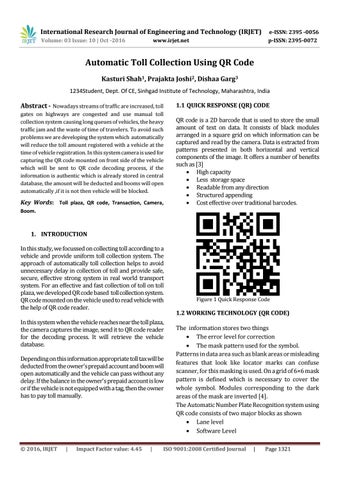
1.1 QUICK RESPONSE (QR) CODE QR code is a 2D barcode that is used to store the small amount of text on data. It consists of black modules arranged in a square grid on which information can be captured and read by the camera. Data is extracted from patterns presented in both horizontal and vertical components of the image. It offers a number of benefits such as [3] High capacity Less storage space Readable from any direction Structured appending Cost effective over traditional barcodes.
Boom.
1. INTRODUCTION In this study, we focussed on collecting toll according to a vehicle and provide uniform toll collection system. The approach of automatically toll collection helps to avoid unnecessary delay in collection of toll and provide safe, secure, effective strong system in real world transport system. For an effective and fast collection of toll on toll plaza, we developed QR code based toll collection system. QR code mounted on the vehicle used to read vehicle with the help of QR code reader. In this system when the vehicle reaches near the toll plaza, the camera captures the image, send it to QR code reader for the decoding process. It will retrieve the vehicle database. Depending on this information appropriate toll tax will be deducted from the owner's prepaid account and boom will open automatically and the vehicle can pass without any delay. If the balance in the owner's prepaid account is low or if the vehicle is not equipped with a tag, then the owner has to pay toll manually.
© 2016, IRJET
|
Impact Factor value: 4.45
|
Figure 1 Quick Response Code
1.2 WORKING TECHNOLOGY (QR CODE) The information stores two things The error level for correction The mask pattern used for the symbol. Patterns in data area such as blank areas or misleading features that look like locator marks can confuse scanner, for this masking is used. On a grid of 6×6 mask pattern is defined which is necessary to cover the whole symbol. Modules corresponding to the dark areas of the mask are inverted [4]. The Automatic Number Plate Recognition system using QR code consists of two major blocks as shown Lane level Software Level
ISO 9001:2008 Certified Journal
|
Page 1321
International Research Journal of Engineering and Technology (IRJET)
e-ISSN: 2395 -0056
Volume: 03 Issue: 10 | Oct -2016
p-ISSN: 2395-0072
www.irjet.net
At the lane level, the CCTV (Closed Circuit Television) cameras take a snapshot of the car in such a way that the QR code is also included in the image [5]. Otherwise, a small optical QR code scanner can be installed for on spot recognition. As vehicles pass under the camera/scanner their QR codes are digitally recorded. The image/video/QR code embedded information is sent along with the date and time stamp to the remote computer[5]. The QR code recognition technique is performed at the software level and consists of the following step. If the direct information is sent from lane level it is forwarded for searching the record in a database. Else if image/video feed is received then focus the QR code recognition software component onto the QR code received to retrieve the information and then search for the record in a database. 3. EXISTING SYSTEM Electronic Toll collection (ETC) system is specially designed for the smooth working of toll booths, which hold an important part in an intelligent transportation system. There are various technologies which are already proposed; each technology has its own principles, advantages, and limitation. Basically, two technologies are elaborated for ETC using RFID and Barcode Reader. Radio Frequency Technology (RFID) is used [1] to read each vehicle with the help of RFID reader. Infrared Proximity Sensor is used to detect vehicles that arrive at the toll plaza. The controllers MSP 430 Launchpad are used to receive a signal that is received by IR receiver. The vehicle number are transmitted through the IR transmitter. The system proposed in recent paper [2] uses barcode reader technology in electronic toll collection (ETC) system. In this system barcode tags that are mounted on the number plate of vehicles, or on the front side of vehicles. With the help of barcode reader, the embedded information present on the barcode is read. The proposed system eliminates toll authorities to manually perform ticket payments and collection of cash. The barcode system has a disadvantage of very low throughput and less storage. To overcome this disadvantage the ETC using QR code Technology we © 2016, IRJET
|
Impact Factor value: 4.45
|
are developing. In the QR code technology, the QR code is mounted on the vehicle and QR code reader scans that QR code then it checks that the user and vehicle are registered or not if yes then it will automatically deduct the amount from user account if no then user have to register for their vehicle. 3. PROPOSED SYSTEM First vehicle owner needs to download the application and has to register by giving basic details such as username, vehicle details and then registering an account pertaining to the owner either prepaid or postpaid. During the registration, the owner needs to deposit a certain amount in his account. The registration provides QR code to the vehicle. The second module is toll management. The gate needs to register for the various toll amount levied on different vehicle types that approach a toll gate. As the vehicle approaches the gate, QR code reader captures the QR code and decodes, authenticates and the respective amount will be deducted from owner account. 4. ADVANTAGES The advantages of the proposed system are as follows:
Reduction of fuel consumption as no stopping is required at the toll. No Traffic congestion as the process is fast and does not allow congestion of traffic. As fuel consumption is less it reduces air pollution. Reducing the number of personnel required for toll collection. Making the process easier and faster. Fewer and shorter queues at toll plazas by increasing toll booth service rates. Better audit control by centralized user accounts.
ISO 9001:2008 Certified Journal
|
Page 1322
International Research Journal of Engineering and Technology (IRJET)
e-ISSN: 2395 -0056
Volume: 03 Issue: 10 | Oct -2016
p-ISSN: 2395-0072
www.irjet.net
REFERENCES [1] Sana Said Al-Ghawi, Muna Abdullah Al Rahbi, Dr.S.Asif Hussain, S.Zahid Hussain, “Automatic Toll E-ticketing System for Transportation Systems,” 978-1-4673-9584-7/16/$31.00 ©2016 IEEE . [2] Devika Mahtre“Electronic Toll Collection Using Barcode Reader,” International Journal of Advanced Research in Computer Science and Software Engineering, ISSN: 2277 128X.
[3] Rahul Raj C. P, SeshuBabu Tolety, Catheine Immaculate, “QR code based navigation system for closed building using smart phones,” 978-1-4673-5090-7/13/$31.00 ©2013 IEEE. [4] Han Qi, Du Chenjie, Yao Yingbiao, Lei Lei, “A New Express Management System Based on Encrypted QR Code,” 978-14673-7644-0/15/$31.00 ©2015 IEEE. [5] Deepashree Mehendale“A Comparative Study Of Different
Technologies For Electronic Toll Collection System,” International Journal of Innovative Research in Computer and Communication Engineering, ISSN: 2320-9801.
“
3. CONCLUSIONS In this paper, we proposed a new approach of automatic toll collection using QR code which is easy to use and versatile. The code itself stores huge amount of information vertically and horizontally that is easily scanned and stored. It stores the information in small space which helps not only to eliminate the manual data entry but also inspires for automatic toll solutions. The proposed system saves time, manpower and reduces traffic congestion at toll gates which ultimately reduce the waiting time of travelers and fuel consumption. It gives toll authorities to set variable pricing for toll services and thus a fair policy of tax collection can be followed.
© 2016, IRJET
|
Impact Factor value: 4.45
|
ISO 9001:2008 Certified Journal
|
Page 1323