International Research Journal of Engineering and Technology (IRJET)
e-ISSN: 2395 -0056
Volume: 03 Issue: 10 | Oct-2016
p-ISSN: 2395-0072
www.irjet.net
A Survey on Different techniques for Image Inpainting Hiral Nileshbhai Patel1 1Student, Dept. of Computer Science and Engineering, Parul Institute of Engineering and Technology, Gujarat,
India ---------------------------------------------------------------------***---------------------------------------------------------------------
Abstract- Inpainting is the process of reconstructing
(that would be called over painting).
missing or damage part of picture based on the background information. Inpainting is also called the process by which we try to fill the damaged or missing portions of an image that the person can’t see the fault in image. It can be used for restoration of older films and object removal in digital images. This paper provide a review of different techniques used for image Inpainting. We discuss different inpainting techniques like Exemplar based, PDE based, texture synthesis based image inpainting, Hybrid Inpainting and Semi-automatic and Fast Inpainting.
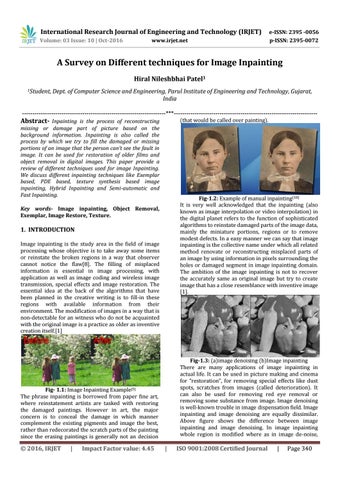
Fig-1.2: Example of manual inpainting[10] It is very well acknowledged that the inpainting (also known as image interpolation or video interpolation) in the digital planet refers to the function of sophisticated algorithms to reinstate damaged parts of the image data, mainly the miniature portions, regions or to remove modest defects. In a easy manner we can say that image inpainting is the collective name under which all related method renovate or reconstructing misplaced parts of an image by using information in pixels surrounding the holes or damaged segment in image inpainting domain. The ambition of the image inpainting is not to recover the accurately same as original image but try to create image that has a close resemblance with inventive image [1].
Key words- Image inpainting, Object Removal, Exemplar, Image Restore, Texture.
1. INTRODUCTION Image inpainting is the study area in the field of image processing whose objective is to take away some items or reinstate the broken regions in a way that observer cannot notice the flaw[8]. The filling of misplaced information is essential in image processing, with application as well as image coding and wireless image transmission, special effects and image restoration. The essential idea at the back of the algorithms that have been planned in the creative writing is to fill-in these regions with available information from their environment. The modification of images in a way that is non-detectable for an witness who do not be acquainted with the original image is a practice as older as inventive creation itself.[1]
Fig-1.3: (a)image denoising (b)Image inpainting There are many applications of image inpainting in actual life. It can be used in picture making and cinema for “restoration”, for removing special effects like dust spots, scratches from images (called deterioration). It can also be used for removing red eye removal or removing some substance from image. Image denoising is well-known trouble in image dispensation field. Image inpainting and image denoising are equally dissimilar. Above figure shows the difference between image inpainting and image denoising. In image inpainting whole region is modified where as in image de-noise,
Fig- 1.1: Image Inpainting Example[5] The phrase inpainting is borrowed from paper fine art, where reinstatement artists are tasked with restoring the damaged paintings. However in art, the major concern is to conceal the damage in which manner complement the existing pigments and image the best, rather than redecorated the scratch parts of the painting since the erasing paintings is generally not an decision
© 2016, IRJET
|
Impact Factor value: 4.45
|
ISO 9001:2008 Certified Journal
|
Page 340
International Research Journal of Engineering and Technology (IRJET)
e-ISSN: 2395 -0056
Volume: 03 Issue: 10 | Oct-2016
p-ISSN: 2395-0072
www.irjet.net
individual pixels are modified. In image inpainting the pixels may or may not restricted the noisy information whereas the in image de-noise each pixels contained the noisy data as well as real data.
between different techniques are discussed in section 3. Section 4 is about the conclusion.
2. SURVEY ON IMAGE INPAINTING TECHNIQUES Now a days, there are different approaches to image inpainting are available. And we can classify them into several categories as follows:1. Texture Synthesis based Inpainting. 2. PDE based Inpainting. 3. Exemplar based Inpainting. 4. Hybrid Inpainting. 5. Semi-automatic and Fast Inpainting. In this section we briefly explain the concepts, advantages, drawbacks of the image Inpainting techniques.
1.1 Approaches Of Image Inpainting
There are two main approaches of image inpainting. 1) Texture synthesis algorithms: In these algorithms sample the texture form the surrounding region and by using that sample, the region is to be inpainted. In texture synthesis large image generate from the sample texture. It has been demonstrated for textures that the repeating two dimensional patterns with some randomness. The limitation of these algorithms is that it losses the linear structure [5]. 2) Structure recreation: These algorithms try to reconstruct the structures like lines and object contours in image. It is easy to reconstruct then Structure of image when the region inpainted area is small. The limitation of these algorithms is that there is blurring portion in the inpainted region. The structure recreation method focuses on linear structures which can be thought as one dimensional pattern such as object contours and lines [5].
2.1 Texture Synthesis Based Inpainting Texture synthesis based algorithms are most basic method of image Inpainting and these algorithms are used to entire the gone regions using related neighbourhoods of the damaged pixels. The texture synthesis algorithms synthesize the new-fangled image pixels from an preliminary see and then strive to preserve the local construction of the image. All the former Inpainting techniques utilize these methods to pile up the missing region by sampling and copying pixels from the neighbouring area.[3] The foremost intention of texture synthesis based inpainting is to produce texture patterns, which is similar to a prearranged sample pattern, in such a way that the reproduced texture retains the statistical properties of its source texture. And it does not appear simply as a tiled reshuffle of the root-texture. In the universal description of this crisis, an input sample of a texture is given, and the goal is to manufacture more of that texture. The simplest key is to tile the texture sample on are rectangular grid of desired size. However, even if the taster can be tiled seamlessly, the resulting larger grid structure is easily noticeable and it distorts the perception of the actual texture. More sophisticated techniques are mandatory for reproducing the actual texture with all its description and nothing more[2]. All texture based methods are diverse in terms of their capability to generate texture with diverse color, strength, gradient and statistical characteristics. Texture synthesis based inpainting method can not execute well for natural images.These methods not hold edges and boundaries well. In some cases punter need to go through which texture to replace with which texture. So these methods are used for tiny area of inpainting[5].
Fig- 1.1.1: Comparison between pure texture synthesis and pure image structure inpainting and combine of both. In second image on first row, reconstruct both texture and structure while pure texture synthesis fails to reconstruct the structure of the wall and produces artifacts in the water in first image on second row, while pure image inpainting reconstructs the wall but fails with the water in second image on second row.
Fig- 1.1.2: Comparison between texture and structure algorithm. In this paper, different types of image inpainting techniques presented are discussed. Section 2 is about the survey on image inpainting techniques. Comparison
© 2016, IRJET
|
Impact Factor value: 4.45
2.2 PDE based Inpainting Partial Differential Equation based algorithm is projected by Marcelo Bertalmioet.al [1].This algorithm is the iterative algorithm. The algorithm is to persist geometric and photometric information that arrive at the border of the occluded region into region itself. This is
|
ISO 9001:2008 Certified Journal
|
Page 341
International Research Journal of Engineering and Technology (IRJET)
e-ISSN: 2395 -0056
Volume: 03 Issue: 10 | Oct-2016
p-ISSN: 2395-0072
www.irjet.net
done by propagating the information in the direction of minimal change using is isophotelines. The algorithm is to persist geometric and photometric information that arrives at the margin of the occluded region into area itself. This is finished by propagating the information in the direction of minimal change using Isophote lines. This algorithm will construct good result if missed regions are miniature one. But when the missed regions are bulky this algorithm will get so long time and it will not produce good results[6].
method is not suitable for images with large size holes as for edge region no specific method is used.
3. COMPARISON TABLE Table 1 shows the comparison among the different methods used for the inpainting. Table-1: Comparison of various image inpainting methods. Method Advantages Disadvantage Texture Focused on Take long time if target synthesis maintain the region is large. based structure of Some bluring effect is the presented in the resultant inpainting video sequence. area. It Produce good results if missed region are small one and target region is nontextured. Partial This method This method Provide Differential Provide simplicity but can not Equation simplicity. handle large area. (PDE) based Exemplar Several It will work only if the based video show missing region contains more simple structure and accurate. texture. Better result for inpainting large missing area.
2.3 Exemplar based Inpainting
This method is very successful .It use Isophote driven Inpainting and texture synthesis proposed by Criminisi et.al [1]. Exemplar- based Inpainting iteratively synthesizes the unidentified region i. e. target region, by the most comparable scrap in the basis region. According to the satisfying instruct, the method fills structure in the misplaced region using spatial information of neighbouring regions. This method is an efficient approach for reconstructing huge objective regions. Generally, an exemplar-based Inpainting algorithm includes the following four main steps: 1) Initializing the Target section, in which the initial mislaid area are extracted and represented with proper data structures. 2) compute Filling Priorities, in this a predefined priority function is used to compute the filling order for all vacant pixels p∈δΩ in the establishment of every filling iteration. 3) penetrating Example and Compositing, in which the as a rule similar example is searched from the source region Φ to compose the given patch, Ψ (of size N × N pixels) that centered on the agreed pixel p. 4) Updating Image Information, in which the edge δΩ of the target region Ω and the mandatory information for computing filling priorities are updated[3]. The exemplar based image inpainting selects the best matching patches as of the familiar region, whose resemblance is determined by certain metrics, and insert into the target patches in the missing area.
2.4 Hybrid Inpainting
In this method, PDE and texture synthesis based inpainting methods are combined for filling holes. Here main goal is to decompose image into texture and structure region. Then corresponding regions are filled by texture synthesis and edge propagating algorithms respectively[1]. It requires more computational time for large holes. Structure completion through segmentation based inpainting technique is found in hybrid inpainting. 2.5 Semi-automatic and Fast Inpainting A two step process is proposed by Li called inpainting with Structure propagation. A fast inpainting method is proposed by Oliviera which do inpainting using iterative convolving inpainting region with diffusion kernel. Another method uses FMM (Fast Marching Method) which is used for image information propagation. This
© 2016, IRJET
|
Impact Factor value: 4.45
|
Hybrid inpainting
Handle large holes and preserves both structure and texture effectively.
Computation time of this algorithm is more for large holes.
Semiautomatic and Fast Inpainting
Works well only single object
For multiple objects, the optimization is great deal more difficult and proposes approximated the answer by using belief propagation.
ISO 9001:2008 Certified Journal
|
Page 342
International Research Journal of Engineering and Technology (IRJET)
e-ISSN: 2395 -0056
Volume: 03 Issue: 10 | Oct-2016
p-ISSN: 2395-0072
www.irjet.net
4. CONCLUSION Old paintings commonly contain damaged part. Inpainting is the process of reconstructing damaged parts of an image in a visually plausible way. Image Inpainting is a technique to restore a damaged image. It is a process of filling-in lost data in a elected area of input illustration, in such a way that the inpainted region remains undetected by an spectator But throughout this development predicament like blurring of image around the edges arises so removing that blur part and removing large objects is the main concern. By using wavelet transformation multiple objects can be remove at a single time and large objects also can be remove.
[12] [13]
[14]
5. REFERENCES [1] [2] [3]
[4]
[5] [6]
[7] [8]
[9]
[10] [11]
International Journal of Computer Science and Information Technologies, Volume 5,2014, 6350-6354. Hongying Zhang, Shimei dai,” Image Inpainting Based on Wavelet Decomposition”, Procedia Engineering,Volume 29,2012,3674-3678. Celia A. Zorzo Barcelos, Marcos Aure´lio Batista,” Image restoration using digital inpainting and noise removal”, Image and Vision Computing,Volume 25,2007,61-69. A. Roumy, G. Blanchard,” exemplar-based image inpainting: fast priority and coherent nearest neighbor search”,IEEE international workshop on machine learning for signal processing, 9781-4673-1026-0112,2012.
N.Neelima1, M.Arulvan,”Object Removal by Region Based Filling Inpainting”,978-1-46735301-4/13,IEEE,2013. Suraj Vantigodi, R.Venkatesh Babu, ”Entropy Constrained Exemplar-based Image Inpainted”, 978-1-4799-4665-5/14,IEEE,2014. Ye-fei Liu, Fu-long Wang,Xiang-yan Xi,”Enhanced algorithm for exemplar based image inpainting”, 2013 Ninth International Conference on Computational Intelligence and Security, 978-1-4799-2548-3,IEEE,209-213. Jing Wang,Ke Lu,Daru Pan,Ning He,Bing-kun Bao,” Robust object removal with an exemplar-based image inpainting approach”, Neuro computing,2014, 150–155. Lixin Yin,Chen Chang,”An Effective Exemplarbased Image Inpaintin Method”, 978-14673-2101-3/12,IEEE,2012. Vahid. K. Alilou, Farzin Yaghmaee,”Introducing a new fast exemplar based inpainting algorithm”, The 22nd Iranian Conference on Electrical Engineering, 978-1-4799-4409-5/14,IEEE,2014. Yongsheng Xu, Shuwen Wang, Image Inpainting Based on Wavelet Transformation, 978-1-47993279-5/14,IEEE,2014. Mandeep Singh,Seema Baghla,”A Review On Object Removal Using Exampler Based Image impainting Technique”, 22779655,International Journal Of Engineering Sciences & Research Technology, 2015,472-475. Kaushikkumar R. Patel,Lalit Jain,”Image Inpainting – A Review of the Underlying Different Algorithms and Comparative Study of the Inpainting Techniques”, 0975 – 8887 , International Journal of Computer Applications , 2015,32-38. Mahesh Mahajan, Mr. Praveen Bhanodia,” Image Inpainting Techniques for Removal of Object”, 978-1-4799-3834-6/14 , IEEE, 2014. Jaspreet Kaur Chhabra,Mr. Vijay Birchha,”Detailed Survey on Exemplar Based imageInpainting Techniques”,0975-9646 ,
© 2016, IRJET
|
Impact Factor value: 4.45
|
ISO 9001:2008 Certified Journal
|
Page 343