International Research Journal of Engineering and Technology (IRJET)
e-ISSN: 2395 -0056
Volume: 03 Issue: 10 | Oct -2016
p-ISSN: 2395-0072
www.irjet.net
Environmental Assessment and Pollution Mitigation of Wind Power Generation in Indian Imdadullah, Member IEEE Electrical Engineering Section, University Polytechnic Aligarh Muslim University, Aligarh-202002, India E-mail: imdadullah.in.1982@ieee.org ---------------------------------------------------------------------***---------------------------------------------------------------------
Abstract - Wind energy has the highest potential of
pollution mitigation among all renewable energy sources. However, it is intermittent in nature and its availability varies from place to place and season to season. There is a remarkable change in wind turbine technology in the last few years. To enhance the efficiency of wind turbine various developments has been made in the technology such as power electronics, aerodynamics and mechanical drive train design. This paper presents the pollution mitigation assessment of wind power generation in India. The equivalent amount of energy generated through thermal power plant is replaced by the energy generated by the wind and the amount of pollution mitigated by the wind energy is being presented. Results, calculation, and discussion based on existing available data have been presented.
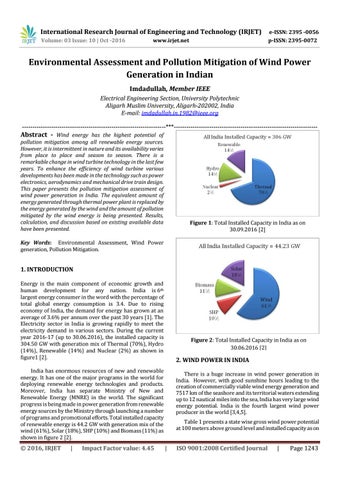
Figure 1: Total Installed Capacity in India as on 30.09.2016 [2]
Key Words: Environmental Assessment, Wind Power generation, Pollution Mitigation.
1. INTRODUCTION Energy is the main component of economic growth and human development for any nation. India is 6th largest energy consumer in the word with the percentage of total global energy consumption is 3.4. Due to rising economy of India, the demand for energy has grown at an average of 3.6% per annum over the past 30 years [1]. The Electricity sector in India is growing rapidly to meet the electricity demand in various sectors. During the current year 2016-17 (up to 30.06.2016), the installed capacity is 304.50 GW with generation mix of Thermal (70%), Hydro (14%), Renewable (14%) and Nuclear (2%) as shown in figure1 [2].
Figure 2: Total Installed Capacity in India as on 30.06.2016 [2]
2. WIND POWER IN INDIA
India has enormous resources of new and renewable energy. It has one of the major programs in the world for deploying renewable energy technologies and products. Moreover, India has separate Ministry of New and Renewable Energy (MNRE) in the world. The significant progress is being made in power generation from renewable energy sources by the Ministry through launching a number of programs and promotional efforts. Total installed capacity of renewable energy is 44.2 GW with generation mix of the wind (61%), Solar (18%), SHP (10%) and Biomass (11%) as shown in figure 2 [2].
© 2016, IRJET
|
Impact Factor value: 4.45
There is a huge increase in wind power generation in India. However, with good sunshine hours leading to the creation of commercially viable wind energy generation and 7517 km of the seashore and its territorial waters extending up to 12 nautical miles into the sea, India has very large wind energy potential. India is the fourth largest wind power producer in the world [3,4,5]. Table 1 presents a state wise gross wind power potential at 100 meters above ground level and installed capacity as on
|
ISO 9001:2008 Certified Journal
|
Page 1243
International Research Journal of Engineering and Technology (IRJET)
e-ISSN: 2395 -0056
Volume: 03 Issue: 10 | Oct -2016
p-ISSN: 2395-0072
www.irjet.net
31.03.2016 [6]. It reveals that Tamil Nadu is a leader in wind power generation followed by Maharashtra.
coupled to an electric generator. The output power of a wind turbine depends on the site-specific parameters which include wind speed and air density and design parameters consisting of “coefficient of performance” of the wind rotor, swept area of the rotor, cut-in, cut-out and rated wind speed of the rotor. Hence, the annual useful energy, AUEwind, generated by a wind generator can be expressed as [12].
Table 1: State wise gross wind power potential and cumulative installed capacity in India as on 31.03.2016 [6] S.NO.
State
Gross wind power potential at 100 meter above ground level (MW) 44229 84431 55857 1700 10484 45394 18770 33800 4244 3342 302251
1. Andhra Pradesh 2. Gujarat 3. Karnataka 4. Kerala 5. Madhya Pradesh 6. Maharashtra 7. Rajasthan 8. Tamil Nadu 9. Telangana 10. Others Total (All India)
Installed Capacity (MW) 1431.45 3948.61 2869.15 43.50 2141.10 4653.83 3993.95 7613.86 77.70 4.30 26777.45
v co
AUE wind 8760 Pv F v dv
Where, γ = wind turbine mechanical availability factor for downtime during maintenance etc. P(v) = power generated by the wind generator at wind speed v F(v) = Weibull probability distribution function vci = cut-in wind speed (m/s) vco = cut-out wind speed (m/s)
The electrical power generation based on fossil fuels has been associated with adverse environmental impacts such as land degradation, deforestation, and water and air pollution. Furthermore, there are great concerns about the release of greenhouse gas (GHG) emissions mainly from fossil fuels based power generation [7, 8]. The key component of greenhouse gas is carbon dioxide (CO2). To address these environmental issues, development and promotion of renewable energy technologies (RETs) have been made towards large-scale dissemination in India. Renewable energy technologies are considered as the best potential option for mitigation of CO2 emissions into the atmosphere due to fossil fuel-based power generation.
The power generated by the wind generator at wind speed v can be given as [13]
Pv
k v F v c c
k 1
e
v c
k
(3)
Where, k represents the shape parameter and c the scale parameter. From equations (1), (2) and (3) the annual useful energy (in kWh) generated by the wind generator can be calculated as [12]. k
C p a A k co k 2 c v e AUE wind 4.38 dv (4) k c vci v
v
The annual gross CO2 mitigation potential of a wind generator depends on the annual electricity saved by the wind generator and the CO2 emission factor (CEFe) for electricity [12].
3.1 Annual CO2 emission mitigation potential through wind power generation The wind turbine converts the kinetic energy of the wind through a rotor consists of two or more blades mechanically
Impact Factor value: 4.45
(2)
The variation in wind speed at a location is often described by the Weibull probability distribution function F(v) and is given by the following equation [14].
Wind power has the largest installed capacity amongst all renewable energy in India. Therefore, CO2 emission mitigation through wind power generation is considered in this paper. In recent past years, the effort has been made to study the CO2 emission mitigation potential through renewable energy sources [9,10,11]. In this perspective, the development of a framework for the assessment of CO2 emission mitigation potential through wind power generation has been discussed. The result of calculations has been made on the basis of available data is also presented and discussed. Potential of CO2 emissions mitigation by wind power generation would essentially depend on the amount of fuel saved by its use. The amount of fuel saved would directly depend on annual useful energy provided by the wind power generation and the efficiency of utilization of fuel being saved in the existing fossil fuel based power plant.
|
1 C p Av 3 2
Where, Cp = coefficient of performance of the wind rotor ρa = air density (kg/m3) A = area swept by the rotor blades (m2) V = velocity of the air (wind speed)(m/sec)
3. METHODOLOGY
© 2016, IRJET
(1)
v ci
|
ISO 9001:2008 Certified Journal
|
Page 1244
International Research Journal of Engineering and Technology (IRJET)
e-ISSN: 2395 -0056
Volume: 03 Issue: 10 | Oct -2016
p-ISSN: 2395-0072
www.irjet.net
k v v C p a A k co k 2 c GCE wind 4.38 k v e dv CEFe c 1 l vci
The annual electricity generation in India by wind power with 25% PLF based on the gross potential and installed capacity is 661.60 TWh and 58.58 TWh respectively as given in Table 2.
(5)
6. CONCLUSIONS
Where, l represents the transmission and distribution losses of electrical power (in fraction) and CEFe the baseline CO2 emission factor (kg/kWh).
In this paper, the assessment reveals that there is a huge potential of CO2 emission mitigation by the use of wind energy in India. Based on available data the gross potential of wind power is more than 3, 00,000 MW and the existing installed capacity is around 26500 MW in India. The final annually estimated CO2 emission mitigation potential through gross potential and installed wind power capacity in India is 572.90 million tonne and 50.13 million tonne respectively.
For a given capacity of a wind generator the gross annual CO2 emissions mitigation potential can be given as [12].
GCEwind 8760 PLFwind Pwind CEFe
(6)
Where, Pwind = capacity of wind generator (in MW) PLFwind = plant load factor of the wind generator The term 8760 PLFwind Pwind of equation (6) is the annual amount of electricity saved by the wind power generation. Table 2 present the assessment of annual CO2 emission mitigation potential through estimated gross potential and installed capacity of wind power generation on the basis of state wise baseline CO2 emission factor (kg/kWh). Table 2: Annual CO2 mitigation potential through gross and installed wind power generation in India S. No.
State
*Baseline (kg CO2 /kWh)
1 A. P. 2 Gujarat 3 Karnataka 4 Kerala 5 M. P. 6 Maharashtra 7 Rajasthan 8 Tamil Nadu 9 Telangana 10 Others All India
0.86 0.89 0.86 0.86 0.89 0.89 0.75 0.86 0.86 0.86
Annual electricity generation (TWh)
Gross 96.8 184.9 122.3 3.7 22.9 99.4 41.1 74.0 9.2 7.3 661.6
Installed 3.13 8.64 6.28 0.09 4.68 10.19 8.74 16.67 0.16 0.009 58.58
Fig. 3: Annual CO2 emissions mitigation potential through gross wind power potential in India.
Annual CO2 emissions mitigation Potential (million tonnes) Gross Installed 83.30 163.76 105.17 03.18 20.38 88.46 30.82 63.64 07.91 06.28 572.90
2.69 7.69 5.40 0.08 4.16 9.07 6.56 14.34 0.14 7.74×10⁻³ 50.13
*Source: [12]
Fig. 4: Annual CO2 emissions mitigation potential through installed wind power generation in India.
5. RESULTS AND DISCUSSION Annual CO2 emission mitigation potential through the gross potential of wind power in India has been estimated as 572.90 million tonne. Amongst all Indian states, Gujarat has the largest CO2 emissions mitigation potential through gross wind power potential (163.76 million tonne) followed by Karnataka (105.17 million tonne), Maharashtra (88.46 million tonne), Andhra Pradesh (83.30 million tonne), Tamil Nadu (63.64 million tonne), and so on as shown in Table 2 and figure 3.
© 2016, IRJET
|
Impact Factor value: 4.45
REFERENCES [1]. http://indianpowersector.com/ [2]. Central Electricity Authority, “All India Installed Capacity of Power Stations,” Minist. Power, Gov. India, pp. 1–7, 2016. [3]. National Institute of Wind Energy (NIWE), Ministry of New and Renewable Energy, Govt. of India, http://niwe.res.in/
|
ISO 9001:2008 Certified Journal
|
Page 1245
International Research Journal of Engineering and Technology (IRJET)
e-ISSN: 2395 -0056
Volume: 03 Issue: 10 | Oct -2016
p-ISSN: 2395-0072
www.irjet.net
[4]. V. Khare, S. Nema and P. Baredar, “Status of solar wind renewable energy in India” Renewable and Sustainable Energy Reviews, Vol. 27, 2013, pp 1–10. [5]. R. B. Sholapurkar and Y. S. Mahajan “Review of Wind Energy Development and Policy in India”, Energy Technology & Policy, 2:1, 2015, pp 122-132, DOI: 10.1080/23317000.2015.1101627 [6]. Ministry of New and Renewable Energy (MNRE), Govt. of India, Wind Power Programme, 2016, http://mnre.gov.in/file-manager/UserFiles/Statewise-wind-power-potential-utilized.pdf [7]. R.A. Dias, C.R. Mattos, and J.A.P. Balestieri, “The limits of human development and the use of energy and natural resources”, Energy Policy, Vol. 34 No. 9, 2006, pp. 1026-31. [8]. Xu Zhao and Dongkun Luo, “Driving force of rising renewable energy in China: Environment, regulation and employment” Renewable and Sustainable Energy Reviews, Vol. 68 , 2017, pp 4856. [9]. S.C. Bhattacharya, P.A. Salam, H.L. Pham, and N.H. Ravindranath, “Sustainable biomass production for energy in selected Asian countries”, Biomass and Bioenergy, Vol. 25 No. 5, 2003, pp. 471-82.
BIOGRAPHY Imdadullah received the B.Tech. Degree in electrical engineering and the M.Tech. Degree in power systems and drives from Aligarh Muslim University (AMU), Aligarh, India, in 2003 and 2006. He is currently an Assistant Professor in electrical engineering with the University Polytechnic, AMU, Aligarh, India. His areas of interests are renewable energy and power systems and drives.
[10]. M., Imdadullah and I. Ashraf, "Estimation of CO2 Mitigation Potential through Renewable Energy Generation," IEEE International Power and Energy Conference, 2006, pp. 24-29. [11]. Ishan Purohit, P. Purohit, "CDM potential of windmill pumps in India", International Journal of Energy Sector Management, Vol. 1, No. 2, 2007, pp.141 – 159 [12]. P. Purohit and A. Michaelowa, “Potential of wind power projects under the Clean Development Mechanism in India” Carbon Balance and Management, 2007, doi:10.1186/1750-0680-2-8 [13]. MR Patel, “Wind and Solar Power Systems” CRC Press, New York; 1999, pp-28 [14]. P. Purohit and T.C. Kandpal “Techno-economic evaluation of water pumping windmills in India”, International Journal of Global Energy Issues, Vol. 21 No. 3, 2004, pp. 263-75.
© 2016, IRJET
|
Impact Factor value: 4.45
|
ISO 9001:2008 Certified Journal
|
Page 1246