International Research Journal of Engineering and Technology (IRJET)
e-ISSN: 2395 -0056
Volume: 03 Issue: 10 | Oct-2016
p-ISSN: 2395-0072
www.irjet.net
Home Security: - Water leakage and L.P.G gas detection Leenisha Mistry1, Santosh Susarla2, Rutuja Kharade3, Akhil Kamble4, Mandar Mokashi5 1,2,3,4Students, Dept. of Computer Engineering, Dy Patil School of Engineering, Maharashtra, India
5Assistant Professor, Dept. of Computer Engineering, Dy Patil School of Engineering, Maharashtra, India
---------------------------------------------------------------------***---------------------------------------------------------------------
Abstract - Home Security has been a major issue where gas
and water leakage can cause dangerous consequences which will further lead to critical scenarios. Gas leakage can cause fire explosion and suffocation due to LPG displacing air hence causing a decrease in oxygen concentration. Water leakage can cause the flood at our place and even short circuit; if water touches the live wire then it may further lead to the fire. Here we are creating a system which will detect water and gas leakage so that major precaution can be taken by us. Key Words: L.P.G - Liquid petroleum gas, GSM ModuleGlobal System for Mobile Communications, SIM, Arduino, Interfacing, Water and Gas Sensor.
1. INTRODUCTION The aim of this project is to detect any leakage of L.P.G or dripping water in small scale factories or in home appliances .Gas and Water leakage is a major issue at home. L.P.G also referred to as simply propane or butane, are flammable mixtures of bottled gasses used as fuel in heating gadgets, cooking mechanisms, and vehicles.LPG is bulkier than air and different than natural gasses and thus will flow along floors and tend to settle in low spots, such as basements. There are two main effects from this, the first is a possible blast if the mixture of LPG and air is within the explosive limits and there is a flaming source. The second is suffocation due to LPG displacing air, causing a decrease in oxygen concentration. Faucet leaks are a common occurrence and usually are simple to repair. That slow dripping faucet is not just a thwarting; it wastes unexpected amounts of water. The slow dripping faucet is wasting more than 1,000 gallons per year. Existing water and gas leak detection systems are very costly. Water leak detection can cause $135 and if you buy a device online it may cause Rs 1599. Gas leak detection system separately can cause Rs 5100 or more. So we are combining both the technology to reduce the cost and to provide safety before it’s too late.
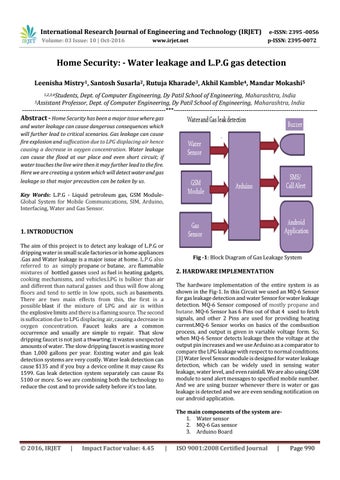
Fig -1: Block Diagram of Gas Leakage System
2. HARDWARE IMPLEMENTATION The hardware implementation of the entire system is as shown in the Fig-1. In this Circuit we used an MQ-6 Sensor for gas leakage detection and water Sensor for water leakage detection. MQ-6 Sensor composed of mostly propane and butane. MQ-6 Sensor has 6 Pins out of that 4 used to fetch signals, and other 2 Pins are used for providing heating current.MQ-6 Sensor works on basics of the combustion process, and output is given in variable voltage form. So, when MQ-6 Sensor detects leakage then the voltage at the output pin increases and we use Arduino as a comparator to compare the LPG leakage with respect to normal conditions. [3] Water level Sensor module is designed for water leakage detection, which can be widely used in sensing water leakage, water level, and even rainfall. We are also using GSM module to send alert messages to specified mobile number. And we are using buzzer whenever there is water or gas leakage is detected and we are even sending notification on our android application. The main components of the system are1. Water sensor 2. MQ-6 Gas sensor 3. Arduino Board
© 2016, IRJET
|
Impact Factor value: 4.45
|
ISO 9001:2008 Certified Journal
|
Page 990
4. 5.
International Research Journal of Engineering and Technology (IRJET)
e-ISSN: 2395 -0056
Volume: 03 Issue: 10 | Oct-2016
p-ISSN: 2395-0072
www.irjet.net
2.3 Arduino Board
Power supply-batteries GSM module
2.1 Water Sensor
Arduino Board is a microcontroller board. It consists of Power USB, Power (Barrel Jack), Voltage Regulator, Crystal Oscillator, Arduino Reset, Analog pins, Main microcontroller etc. Arduino board can be powered by using the USB cable from your computer or can be powered directly from the power supply by connecting it to the Barrel Jack. When the board is plug to the power source LED should light up. We can reset Arduino board by reset button. Arduino has five Analog pins for input and 14 digital I/O pins.
Water level Sensor module is designed for water leakage detection, which can be widely used in sensing water leakage, water level, and even rainfall. Connecting a water sensor to an Arduino is a great way to detect a spill, leak, flood etc. It can be used to detect the existence, the level, the volume and/or the absence of water. Water sensor has three terminals – S, Vout (+), and GND (-). Connect the sensor as follows – 1. Connect the +Vs to +5v on your Arduino board. 2. Connect S to digital pin number 8 on Arduino board. 3. Connect GND with GND on Arduino. 4. Connect LED to pin 9 on Arduino board. When the sensor detects water, pin 8 on Arduino Board becomes low and then the LED on Arduino is turned on.
Fig -4: Arduino Board
2.4 Power supply-batteries Fig -2: Circuit diagram of water sensor and Arduino
The Arduino board can operate on an external supply of 6 to 20 volts. If the Arduino board is supplied with less than 7volts, then the 5volt pin may supply less than five volts and the board may be unstable. If we are using more than 12volts, the voltage regulator can damage the Arduino board by overheating. The recommended range is 7 to 12 volts. Using 9 volts for Arduino board works well. You can simply connect the one end (+) of your battery to Arduino Vin and the another end (-) to Arduino ground. You should see the LED on the Arduino turn on to indicate that it is powered.
2.2 MQ-6 Gas Sensor MQ-6 Sensor is used in gas leakage detecting at home and industry, are suitable for detecting of LPG, propane, isobutane, LNG, avoid the noise of alcohol and cigarette smoke. MQ-6 Sensor composed of mostly propane and butane. MQ-6 Sensor has 6 Pin and 4 of them are used to fetch signals, and other 2 are used for providing heating current.MQ-6 Sensor works on basics of the combustion process, and output is given in variable voltage form. So, when LPG gas detects leakage then the voltage at the output pin of MQ-6 is increased and we use Arduino as a comparator to compare the LPG leakage with respect to normal conditions. [3]
Fig -5: Power supply-batteries Fig -3: MQ-6 Gas Sensor
© 2016, IRJET
|
Impact Factor value: 4.45
|
ISO 9001:2008 Certified Journal
|
Page 991
International Research Journal of Engineering and Technology (IRJET)
e-ISSN: 2395 -0056
Volume: 03 Issue: 10 | Oct-2016
p-ISSN: 2395-0072
www.irjet.net
2.5 GSM module
REFERENCES
A GSM module is a specialized type of GSM modem (just like SIM 900) which accepts a SIM card and operates just like a mobile phone. GSM Module is a reliable wireless module. With the help of GSM Module we can send messages to our mobile phone via Arduino Board. Whenever leakage is detected then the message is sent to the user via GSM Module.
[1]
LPG Leakage Monitoring and Multilevel Alerting System by Selvapriya November 2013. [2] Smart Water Leakage Detection and Metering Device, Bheki Sithole, 2016. [3] LPG Gas Leakage Detection & Control System.National Conference on Synergetic Trends in engineering and Technology (STET-2014) . [4] Microcontroller based LPG gas detector using gsm module, Ashish Sharma (B.Tech., EL Engg.).
3. RESULT The archetype of leakage system has been tested by sensing a small amount of LPG gas near to the sensor. MQ-6 Sensor detects the LPG gas leakage and water sensor detects the water leakage and sends the signal to the Arduino. After that, Arduino sends an active signal to other externally connected devices. [1]As a result, a buzzer rings, and with the help of GSM module SMS is sent to our cell phone devices. When the reset button is pressed, the system refreshes itself and the whole system regains its initial position.
4. CONCLUSIONS In this system, we have combined both gas and water leakage detection. Gas leakage is detected with the help of the MQ-6 gas sensor. The sensor sends a signal to Arduino. In the next step, Arduino sends an active signal to other externally connected devices. SMS can be sent by changing programming GSM module. To change the SIM card we have to make changes in the program. [1] In future, we will try to combine most of the sensors to increase home security.
ACKNOWLEDGEMENT We would like to heartily acknowledge all the group members who put their heart and soul in it to make it a successful project. We would like to thank our guide Mr.Mandar Mokashi for guiding us on every possible juncture while making the project. It is due to his very crucial critics that molded the project into its finished form also a lot of thanks to all the near and dear ones who helped us with whatever small contributions that made this project possible.
© 2016, IRJET
|
Impact Factor value: 4.45
|
ISO 9001:2008 Certified Journal
|
Page 992