International Research Journal of Engineering and Technology (IRJET)
e-ISSN: 2395 -0056
Volume: 03 Issue: 10 | Oct -2016
p-ISSN: 2395-0072
www.irjet.net
Quality of Services Improvement in Broadband WiMAX through Channel Scheduling Heena Kaunser1, Ashish Gagneja2 1M.Tech (ECE), Panchkula Engineering College, Haryana, India 2Professor (ECE), Panchkula Engineering College, Haryana, India
---------------------------------------------------------------------***---------------------------------------------------------------------
Abstract - Planning a heterogeneous network including
interoperability is given amongst WiMAX and different systems which have distinctive QoS plans, as DiffServ. WiMAX and WLAN Incorporation outline is proposed in [5] for connection layer QoS. Here, a mapping plan of DiffServ to the connection layer administrations for both WiMAX and WLAN is appeared. The end-to-end QoS systems were created to serve the clients with the wired terminals. More research work on DiffServ approach connected to the remote frameworks and versatile clients in heterogeneous environment is required keeping in mind the end goal to comprehend the advantages of the DiffServ systems. Current exploration is open with respect to the mapping of QoS classes and the configuration of complete interworking models between WiMAX and DiffServ networks. The present study demonstrated that none of the current calculations or algorithms has required ability to create an efficient, strong and fair scheduler to support all WiMAX classes.
systems giving distinctive QoS, for example, the developing WiMAX, is a troublesome assignment. For better enhancement there are various scheduling algorithms, for example, FirstIn-First-Out (FIFO), Priority queue (PQ), Weight Fair Queuing (WFQ), Round Robin (RR), Deficit Round Robin (DRR), Modified Deficit Round Robin (MDRR), was done. Round Robin (RR) scheduling algorithm has been concentrated on inside and out. After that it was endeavored to upgrade the throughput of the framework with respect to the channel quality if the subscriber stations while mulling over decency. The best scheduling algorithms in this assessment is resolved based on the base jitter, throughput and most extreme got activity for every servicing class and particular application.
Key Words: Quality of Service, WiMax, IEEE 802.16e, Scheduling Algorithm, Round Robin (RR).
2. QoS TECHNICAL CHALLENGES
The IEEE 802.16e [6] standard based Mobile WiMAX (Worldwide Interoperability for Microwave Access) system will be investigated for the purpose of Quality of Service provisioning. As a specialized test, radio asset administration will be essentially considered. Having as a top priority the expensive range and the undeniably all the more requesting applications with always developing number of supporters, principle thought of this theory have been given to profit by the decreased measure of range expended for the same number of clients.
1. INTRODUCTION
The popularity of wireless networks is widely recognized because of its strong support and ease of use in the end systems. Heterogeneous wireless networks are becoming of wide spread use with Internet's continuous sight and sound applications. Short range WLAN frameworks, and diverse cell frameworks and WiMAX, give some level of QoS and are expected to acknowledge pervasive Internet administrations. In any case, real time sight and sound applications, specifically intuitive and live spilling applications, set strict prerequisites for the QoS. A few applications require moderately wide data transmission; the transfer speed ought to be accessible in both bearings continually. Applications like voice and video require short transmission deferral and jitter however despite everything they have capacity to endure a few parcel misfortune [1]. WiMAX is equipped for achieving remote territories with high information rate exchange, versatility support and a local Nature of Service administration (regardless of the fact that simply restricted to the remote IEEE802.16 joins) [2]. By taking a gander at the writing, a remapping system is proposed in [3] to progressively conform the mapping rules for nrtPS and rtPS (for VBR activity sources) classes of WiMAX to DiffServ. A design for flagging and WiMAX assets administration is proposed in [4] considering an end-to-end QoS empowered situation. In this methodology
© 2016, IRJET
|
Impact Factor value: 4.45
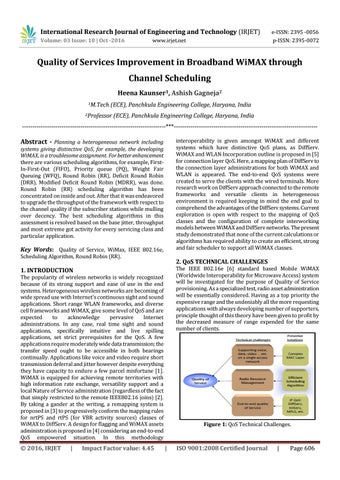
Figure 1: QoS Technical Challenges.
|
ISO 9001:2008 Certified Journal
|
Page 606
International Research Journal of Engineering and Technology (IRJET)
e-ISSN: 2395 -0056
Volume: 03 Issue: 10 | Oct -2016
p-ISSN: 2395-0072
www.irjet.net
As a potential arrangement the booking calculations will be taken into primary thought and the present surely understood calculations will be quickly depicted. Inside the pool of booking calculations and with the end goal of accomplishing proficient radio asset administration, planning calculation's characteristics, properties and design will be concentrated on in subtle element. Upheld by the way that the standard does not underscore a particular planning calculation for surveying administrations, and after that a well thoroughly considered calculation will be of awesome commitment to the zone under scrutiny. For elucidation, Figure 1 is attracted to demonstrate the specialized difficulties joined by giving Quality of Service their comparing potential arrangement [3]. Note from Figure 1 that there are two other challenges to comprehensively provide QoS: Supporting multimedia (voice, data, video … etc.) on a single access network and end‐to‐end quality of service.
the following parcel to be dequeued from the accessible multi lines and sent onto the yield join. This is outlined in Figure 3 demonstrated as follows
3. SCHEDULING ALGORITHMS
After Packet Switching (PS) systems appeared, need was perceived to separate between various sorts of bundles. From that point forward parcel planning has been a hot examination subject its as yet being researched at numerous foundations. This is basically because scheduling means bandwidth sharing [13]. Customarily, the First Come First Served (FCFS) plan had been utilized for bundle booking. Bundles originating from all the info connections were enqueued into a First in First out (FIFO) memory stack, and after that they were dequeued one by one on to the yield join. This is appeared in Figure 2. Since dissimilar to bundles were blended and treated similarly, parcels requiring pressing conveyance couldn't be accomplished. So there is no scheduling move making place for this situation.
Figure 3: Multiple Queue Scheduling.
4. ROUND ROBIN (RR)
Round‐Robin as a scheduling algorithm is considered the most basic and the least complex scheduling algorithm. It has an unpredictability estimation of O (1) [13]. Fundamentally the calculation benefits the multiplied lines in a round robin style. Every time the scheduler pointer stop at a specific line, one parcel is dequeued from that line and afterward the scheduler pointer goes to the following line. This is appeared in Figure 3.3. Note that for this situation all bundles are of same length. Be that as it may, for occasion a MPEG video application may have variable size parcel lengths. This case is appeared in Figure 4. It is assumed that queues Q2‐Q5 have constant packet size of 50 bytes and Q1 have a packet size of 100 bytes. Note that in Figure 4, Q1 has superior throughput than the other queues. Previously Q1 was transmitting 3x50 bytes per X interval = 150 bytes/X interval Now Q1 is transmitting 2x100 bytes per X interval = 200 bytes/X interval This was caused by transmitting longer packet lengths. Hence, we can deduce that the round robin scheduling algorithm does not convey fairness in systems with variable packet lengths, since RR tends to serve flows with longer packets more.
Figure 2: FCFS FIFO Stack. In the present time diverse lines are indicated to non comparative bundles for accomplishing parcel grouping. For this situation booking ought to be finished. The fundamental assignment of the implanted scheduling algorithm is to pick
© 2016, IRJET
|
Impact Factor value: 4.45
|
ISO 9001:2008 Certified Journal
|
Page 607
International Research Journal of Engineering and Technology (IRJET)
e-ISSN: 2395 -0056
Volume: 03 Issue: 10 | Oct -2016
p-ISSN: 2395-0072
www.irjet.net
As demonstrated in Figure 6, show packet delays for VoIP traffic in scenarios with 100% traffic load. In comparative analysis shows the values of jitters for different loads with enabled network. It can be seen that as the network load increases, the jitter of the packets decreases: this is because when the network approaches saturation point the fluctuations of packet delays decrease.
Figure 4: Round Robin Scheduler: Variable Packet Size.
5. SIMULATED RESULTS
Figure 6: Delay with 100% Load.
In this section, the proposed algorithm is evaluated via computer simulation using MATLAB simulator. All simulation results are obtained on the basis of proposed approach Round Robin (RR) as scheduling algorithm for throughput and range in WiMAX system. Figure 5 show the BER of received symbols according to number of users using Matlab.
As demonstrated in Figure 7, show the BER of received symbols according to number of users using Matlab.
Figure 7: BER of Received Symbols. As presented in Figure 8, show packet delays for VoIP traffic in scenarios with 112.5% traffic load. In comparative analysis shows the values of jitters for different loads with enabled network. It can be seen that as the network load increases, the jitter of the packets decreases: this is because when the network approaches saturation point the fluctuations of packet delays decrease.
Figure 5: BER of Received Symbols.
© 2016, IRJET
|
Impact Factor value: 4.45
|
ISO 9001:2008 Certified Journal
|
Page 608
International Research Journal of Engineering and Technology (IRJET)
e-ISSN: 2395 -0056
Volume: 03 Issue: 10 | Oct -2016
p-ISSN: 2395-0072
www.irjet.net
Figure 8: Delay with 112.5% Load. As demonstrated in Figure 9, show the BER of received symbols according to number of users using Matlab.
Figure 10: Delay with 125% Load.
6. CONCLUSION
Designing a scheduler that is less unpredictable, more efficient and gives a superior Quality of Service is of incredible significance to mobile WiMAX systems. In this dissertation, a comprehensive, yet brief, introduction was given for the IEEE 802.16e monetarily known as Mobile WiMAX Systems. Round Robin (RR) scheduling algorithm has been concentrated on inside and out. The Round Robin (RR) scheduling algorithms gives better results on the base jitter, throughput and most extreme got activity for every servicing class and particular application. Further simulations must be done to guarantee that the scheduler is also able to provide the QoS requirements with a larger number of subscriber stations with respect to the QoS constraints that were achieved in this work. Furthermore, the proposed scheduler might be taken forward and applied on other distinctive systems. This will test the versatility of the algorithm to various situations. Figure 9: BER of Received Symbols.
REFERENCES
As presented in Figure 10, show packet delays for VoIP traffic in scenarios with 125% traffic load. In comparative analysis shows the values of jitters for different loads with enabled network. It can be seen that as the network load increases, the jitter of the packets decreases: this is because when the network approaches saturation point the fluctuations of packet delays decrease.
© 2016, IRJET
|
Impact Factor value: 4.45
|
1)
Abdul Hasseeb and Belio Tralli, “QoS Performance Analysis for VoIP Traffic in Heterogeneous Networks with WiMAX Access” IEEE International Conference on Advanced Communications Technology, Feb. 13-16, 2011.
2)
C. So-In, R. Jain, and A. Al-Tamimi, “Capacity Estimations in IEEE 802.16e Mobile WiMAX networks,” Submitted for publication, IEEE Wireless Communication Magazine., April 2008.
3)
C. So-In, R. Jain, and A. Al-Tamimi, “eOCSA: An Algorithm for Burst Mapping with Strict QoS Requirements in IEEE 802.16e Mobile WiMAX Networks,” Submitted for publication, IEEE Wireless Communication and Networking Conference, 2008.
ISO 9001:2008 Certified Journal
|
Page 609
4) 5)
6)
International Research Journal of Engineering and Technology (IRJET)
e-ISSN: 2395 -0056
Volume: 03 Issue: 10 | Oct -2016
p-ISSN: 2395-0072
www.irjet.net
WiMAX Forum, “WiMAX System Evaluation Methodology V2.1,” Jul. 2008, 230 pp. H. Martikainen, A. Sayenko, O. Alanen, and V. Tykhomyrov, “Optimal MAC PDU Size in IEEE 802.16,” Telecommunication Networking Workshop on QoS in Multiservice IP Networks., Venice, Italy, 2008, pp. 6671. S. Sengupta, M. Chatterjee, and S. Ganguly, “Improving Quality of VoIP Streams over WiMAX,” IEEE Transaction on Computers, vol. 57, pp 145- 156, Feb. 2008.
7)
C. So-In, R. Jain, and A. Al-Tamimi, “Generalized Weighted Fairness and its support in Deficit Round Robin with Fragmentation in IEEE 802.16 WiMAX,” Submitted for publication, IEEE Sarnoff Symposium, 2009, Dec. 2008.
8)
T. Wand, H. Feng, and B. Hu, “Two-Dimensional Resource Allocation for OFDMA System,” in Proc. IEEE International Conference Communications Workshop., Beijing, China, 2008, pp. 1-5.
9)
B. Chang and C. Chou, “Analytical Modeling of Contention-Based Bandwidth Request Mechanism in IEEE 802.16 Wireless Network,” IEEE Transaction Vehicular Technology, vol. 57, pp 3094-3107, Sept. 2008. 10) Sayenko, O. Alanen, and T. Hamaainen, “Scheduling solution for the IEEE 802.16 base station,” Int. Journal of Computer and Telecommunications Networking, vol. 52, pp. 96-115, Jan. 2008. 11) J. Borin and N. Fonseca, “Scheduler for IEEE 802.16 Networks,” IEEE Communication Letter, vol. 12, pp. 274-276, April 2008. 12) Y. Wang, S. Chan, M. Zukerman, and R.J. Harris, “Priority-Based fair Scheduling for Multimedia WiMAX Uplink Traffic,” in Processing IEEE International Conference Communications, Beijing, China, 2008, pp. 301-305. 13) W. Lilei and X. Huimin, “A new management strategy of service flow in IEEE 802.16 systems,” in Processing IEEE Conference Industrial Electronics and Applications, Harbin, China, 2008, pp 1716-1719. 14) Z. Kong, Y. Kwok, and J. Wang, “On the Impact of Selfish Behaviors in Wireless Packet Scheduling,” in Processing IEEE International Conference Communications, Beijing, China, 2008, pp. 3253-3257. 15) N. Ruangchaijatupon and Y. Ji, “Simple Proportional Fairness Scheduling for OFDMA Frame-Based Wireless Systems,” in Processing IEEE Wireless Communication and Networking Conference, Las Vegas, NV, 2008, pp. 1593-1597.
© 2016, IRJET
|
Impact Factor value: 4.45
|
ISO 9001:2008 Certified Journal
|
Page 610