
International Research Journal of Engineering and Technology (IRJET) e-ISSN: 2395-0056
Volume: 13 Issue: 06 | Jun 2026 www.irjet.net p-ISSN: 2395-0072
International Research Journal of Engineering and Technology (IRJET) e-ISSN: 2395-0056
Volume: 13 Issue: 06 | Jun 2026 www.irjet.net p-ISSN: 2395-0072
Chinmai
Tarphe1 , Varsha Mharse2, Sandhya Kaprawan3
123Department of Information Technology, University of Mumbai, India.
Abstract - Mental health problems like stress, anxiety and depression are growing fast and emotional help is still not readily available because social stigma and inadequate care systems hinder timely assistance for mental health issues. This research work presents an Artificial Intelligence based Mental Health Chatbot which can offer immediate, non-judgemental and continuous emotional support to individuals through conversational interaction. It uses Natural Language Processing (NLP) and Machine Learning algorithms to process the text input by the user, detect emotional patterns, and provide relevant replies. Data preprocessing was done and then loaded to the data set building algorithms such as tokenization, stop words removal, and vectorization. The system's emotional state awareness will be improved by applying machine learning algorithms, such as XG Boost and NLP classification. The model works well in emotion recognition and giving proper supportive responses, and based on our observation and testing, it is able to improve the accuracy of the conversation, as well as creating dynamic responses and overall effect of conversation better than rule-based methods using the experiments. The chatbot is not designed to diagnose, treat or replace a mental health professional, rather it is a tool that is easy to access as a first help aid that helps individuals learn to voice themselves freely and seek help
Key Words: Mental Health, Sentiment Analysis, NLP, Depression and Stress Detection, AI Chatbots, Machine Learning .
Stress, anxiety, depression and emotional distress are mental health disorders that have reached the large scale,andarenowamajorhealthconcernformillionsofpeoplearoundtheworld.AI,NLPandMLtechniques are growing in sophistication to develop intelligent conversational systems providing scalable, accessible mental health support [21]. Mental health competencies-based AI chatbots developed into a realistic and practical digital environment where someone can converse with a human-like chatbot, receive an analysis of their emotions, and receive a response in seconds. They use both sentiment detection and contextual understanding,alongwithdeeplearningarchitectures,toidentifyfeelingsbasedontextinputandtransformit into a personalized response. According to the research studies, sentiment analysis combined with NLP techniqueshassignificantlyimprovedthechatbot'scapacitytoidentifythesentimentoftheuserandprovide context-relevantassistance.
o To create a mental health chatbot powered by Artificial Intelligence (AI) and leveraging Natural LanguageProcessing(NLP)andMachineLearning(ML)methods.
o To use multi-class classification methods to classify multiple emotional states of stress, anxiety, depression,lonelinessandneutralstates.
o Toenhancetheaccuracyofchatbots'responsesandtheirunderstandingofthecontextthankstodeep learningmodelslikeBi-LSTMandNLP-basedclassifiers.
o Toofferaccessible,real-timeandnon-judgementalmentalhealthassistancewithconversationalAI.
o Assesstheframework'sperformanceonthebasisoftheaccuracyofclassification,therelevanceofthe responsesandtheabilitytodetecttheemotions.
1. Whatarethedifferentmethodsformulticlassclassificationandhowwelldotheydifferentiatebetween differentpsychologicaldisorders,whenanalysedfromuserdialogue?
International Research Journal of Engineering and Technology (IRJET) e-ISSN: 2395-0056
Volume: 13 Issue: 06 | Jun 2026 www.irjet.net p-ISSN: 2395-0072
2. Can NLP and deep learning based models generate responses more personal and in context than the rulebasedchatbots?
3. How do AI-driven conversational systems gives an improved gateway for the initial mental health support?
4. Howeffective is itintheproposed structure to detectsuch emotions as anxietystress depressionand loneliness?
5. What are the main challenges and ethical concerns with the use of AI-powered chatbots in mental health?
AI and NLP are revolutionizing digital mental health platforms by allowing for the creation of chatbots that comprehend and engage with human emotions. Numerous research papers have investigated different strategies for the creation of mental health talkbots that offer emotional support, emotional assistance, and sentiment-basedcommunication.
Abd-Alrazaq et al. [1] did a thorough review of chatbot systems in mental health care applications. Their research underscored the benefits of AI-driven conversational applications for improving access to mental healthcare.Theauthorsdeterminedthatachatbotsystemcanbeanimmediatehelperandlessenthestigmaof traditional therapy. Due to privacy issues, emotional issues, and ethical concerns, the study also uncovered somelimitations.
InA.R.etal.[2]proposedanAI-poweredmentalhealthcarechatbotusingsentimentanalysistechniques.This system employed two Bidirectional Long Short-Term Memory (Bi-LSTM) models that could be used to categorize emotional states based on the text. The model was able to accurately identify emotional patterns, but itwas found to be highlysensitive to the qualityof the datasets andthe methods used for preprocessing thedata.
Mmbayietal.[3]developedasentimentanalysis-basedmonitoringmodelformentalhealthchatbotstoassess user engagement with the chatbots. The study highlighted the importance of the use of NLP techniques in enhancing emotional interaction and conversational quality. Results showed that sentiment based systems couldbeusedtoeffectivelytrackuserbehaviorandengagementovertime.
Balcombe [5] investigated the use of AI chatbots in the field of digital mental health and examined Human–Artificial Intelligence (HAI) approaches that emphasize empathy, ethics, and usercentered design. The study emphasizedtrust,privacysecurity,andethicalutilizationofAIinmentalhealthapps.
Casu et al. [6] conducted a scoping review of AI chatbot systems in mental healthcare and investigated their effectiveness, feasibility and realistic application. The study's findings indicated that AI chatbots can deliver scalable and cost-effective support mechanisms. But, there were some limitations like emotional misunderstanding,contextuallymisunderstandingandlackoflongtermclinicalvalidation.
Recent research by Siddals et al. [7] and Manole et al. [8] also highlighted the increasing capabilities of generative AI chatbots for managing anxiety and providing emotional support. These research papers highlightedthesignificanceofsophisticatedNLPmodelsincomprehendingtheemotionalcontextandcreating tailoredresponses.
The emotionpredictionproposed byMehta et al. [17]is givenbythe followingconfusionmatrix. Overall the modelachievesthemulticlassclassificationperformancewithanaccuracyof90%asreportedin[17].
International Research Journal of Engineering and Technology (IRJET) e-ISSN: 2395-0056
Volume: 13 Issue: 06 | Jun 2026 www.irjet.net p-ISSN: 2395-0072
Table-1: ComparativeAnalysisofAI-BasedMentalHealthChatbotModels
Reference number Model used Accuracy(%)
[1] Rule-Based & AI Based Mental HealthChatbots (CBT-based Chatbots)
NotMentioned/It isScopingreview.
Data used
Mental health chatbot studies, user interactiondatasets, depression/anxiety/autism/PTSD relateddata
[2] Bidirectional LSTM 80.88% Tweetdataset
[3] BERT,Random Forest,SVM, Logistic Regression,SGD, NaïveBayes
[5] AI Chatbots, NLP, ML,CBT-based Conversational Agents
[9] CBT-based AI Chatbot/NLP Conversational Agent
[12] GenerativeAI Companion Chatbots (Cleverbot, Simsimi,GPT-3)
BERT: 99.18%, RandomForest: 98.18% 82,102 mental health chatbot reviews collected from Google Play StoreandAppleAppStore.
Notmentioned Literature review studies, digital mental health datasets, chatbot interaction studies, Woebot & Wysacasestudies
NotMentioned
Recognition Accuracy:61.9%
Mental health chatbot interaction dataandappstudies
Conversation datasets from Cleverbot,Simsimi,andGPT-3 chatbotinteractions)
International Research Journal of Engineering and Technology (IRJET) e-ISSN: 2395-0056
Volume: 13 Issue: 06 | Jun 2026 www.irjet.net p-ISSN: 2395-0072
[13] Dialogflow NLPbased Emotional DisclosureChatbot (Woebot-inspired CBTChatbot)
[20] AI-Based Mental HealthChatbots/ NLP
Conversational Agents
behavioral/user study paper: User Satisfaction Score:5.41/7, ReuseIntention: 5.34/7
Not Mentioned it is framework and literature review paper.
348participantresponsescollected throughAmazonMechanicalTurk mentalhealth counseling interactions.
34 research papers on mental health chatbots, public service chatbot studies, COVID-19 mental health datasets, user interaction studies
[22] LSTM-RNN (Deep LearningModel) 99.9% Twitter Dataset (Sentiment140, TWINTscrapedtweets,Google Word2Vec)
[23] NLPandMachine Learning-based SentimentAnalysis Model 88%
10,000 social media posts from Twitter, Instagram, Facebook, and Reddit
Table-2: ComparativeAnalysisofExistingMentalHealthChatbots.
Chatbot Therapeutic Approach Prompt Strategies Target Audience Limitations
Woebot CBT-focused, anxiety and stress management
Wysa CBT-focused, mindfulness, anxiety, and stress management
Replika CBT-focused, mindfulness, general supportivetalk
Prescripted conversationflows Adults Limited adaptive personalization; minimal role assignmentcustomization
Empathetic but genericprompts Teens, adults Restricted context integration; lacksdynamicreal-time updates
Passive,user-led queries General Inconsistenttherapyalignment; uncertain crisis management features
International Research Journal of Engineering and Technology (IRJET) e-ISSN: 2395-0056
Volume: 13 Issue: 06 | Jun 2026 www.irjet.net p-ISSN: 2395-0072
Tess CBT and motivational interviewing
Talkspace Chatbot
Guided selfhelp and therapyaccess facilitation
Rasa Modular framework (opensource)
Youper AI-driven CBT and mindfulness
Sanvello CBT, mindfulness, relaxation
MindShift CBT for anxiety
Ada AI Symptom checker+chat support
Theabovetableisreferredfrom[21].
Thematically structured modules
Guided conversationflows withservice integration prompts
Customizable NLU and dialogue flows;partial scriptexpansions
Adaptivedaily check-ins
Prebuilt guided journeysand journaling prompts
Topic-focused modules, psychoeducation
Basic triage-style prompts; limited mentalhealth focus
General Basicpromptcues;lacksdeeper user-specificcontextanalysis
General Limited direct therapeutic intervention; primarily a gateway to paid services; not a replacementfortherapy
Developers Requires specialized design; does not inherently provide integratedtherapeuticcues
General May lack advanced role assignment; personalization limitedtousermoodsurveys
General Primarily static prompts; expansions often generic, lackingadvancedusercontext
General Narrow domain focus (anxiety);conversationlogicnot stronglycustomized
General Lacks robust therapy alignment; prompt structure is primarilybiomedical
Aspertheliteraturereviewed,itcanbeseenthattheexistingchatbot systemsareprimarilyconcernedabout simple sentiment analysis andfixed routines. Some systems still struggle with accurately identifyingintricate emotions,preservingthecontext,andguaranteeingethicalAIconduct.Thus,theaimoftheproposedsystemis toenhancetheemotiondetectionaccuracyandconversationalqualitybyusingahybridsentimentanalysisand multi-classclassificationtechnique.
Previousmentalhealthchatbotsystemshavedemonstratedsignificantadvancementsindeliveringautomated conversationalassistancetoemotionalsupport.Butthereareanumberofthingsthataremissingfromcurrent approaches.Mostofthecurrentsystemsarerule-basedanduseapre-definedsetofresponses,restrictingtheir capacitytocomprehendintricateemotionalsituationsandgiveindividualizedinteractions.
Manystudies are limitedto binarysentimentclassification, which distinguishes betweenemotions ofpositive and negative. These methods are not adequate for detecting a range of psychological conditions like stress, depression, anxiety and loneliness. This constraint compromises emotional assessment accuracy and usefulness.
International Research Journal of Engineering and Technology (IRJET) e-ISSN: 2395-0056
Volume: 13 Issue: 06 | Jun 2026 www.irjet.net p-ISSN: 2395-0072
There is also no efficient multiclass text classification mechanism that can discern between a number of emotional states with greater accuracy. Often, the responses given by the chatbots are generic and do not adjusttotheuser’semotionalstate,whichdecreasesinteractionandsupportquality.
Another issue that needs special attention is the lack of attention to ethical issues such as privacy protection, secureuserdatahandlingandresponsibleresponsegeneration.
TheconstraintsunderscoretheimportanceofhavinganAI-poweredmentalhealthchatbotwiththeabilityto incorporate sentiment analysis and multiclass text classification to properly identify a variety of emotional states,andtoprovidecontext-responsive,personalized,andethicalanswers.
This virtual companionship has been recently brought to the fore because they are available at all times and non-judgemental. This version has built in appreciation of technology that gives neutral responses, but has incorporatedmooddetectionwithcognitivepatternanalysistodeterminepersonalexperiences.Theirarrival isunobtrusive,theirpresenceisunasking,theirpresenceisinforming.
Theemotionalinputtotheuserisviaasimpletext-onlywindow.Thesystemprocessesthemessage,eliminates noiseandreorganizesstructureafterithasbeeninputted.Here,additionalwordsfallawaylikesnow.Cleanup stepoftenmakesfuzzyemotionallanguagecomeintofocus.Betterinputresultsinbettermachineanalysisof moodstates[7],[8].
Emotionpatternsarecreatedafterthecleaningprocedureusingsentimentanalysis.Amodeldevelopedfroma varietyoflabeledexamplesidentifiessignalslinkedtoanxiety,depression,orstress.Previousworkwithsuch sentiment-basedtoolsanddiversedatademonstratedstrongperformancewithregardstopsychologicalwellbeingmonitoring[7],[9].
If the system detects emotional clues, responses arrive with empathy, woven into each response. It does not seektodiagnose,buttorecognisethefeelingsinagentlemanner,followingtheguidanceofpreviousresearch thathasaddressedsupportivechattools[3]and[5].Accesstochatbotisfreeandtherearenofeesofanykind, in particular no premium tiers hiding under the hood. The bot is quiet, but it works whenever it is required withoutanyneedforaresponse.
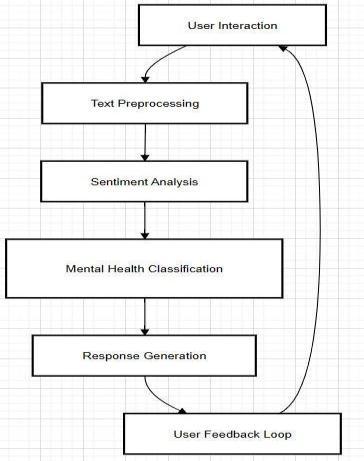
Workflow of Chatbot
Oncetheuserenterstextintotheinput,thechatbotstartsprocessingtheinput.
The first step is to detect emotion, in which the system is able to detect the emotional tone of the message.
The second part of the process is context analysis analyzing context words and meaning to understand.
Responseplanning–post-interpretation,choosingthemostappropriatereplyaccordingtothedetected emotion.
Thelanguageformulationstageisusedtoconvertaplannedresponseintonaturallanguagetext.
Finally,outputdeliveryreturnsthecreatedresponsetotheuser.
Eachstageisfollowedsequentiallytoensurecontinuityoftheconversation.
Afeedbackloopenablesthechatbottorefineitsreactionsinfutureinteractionsbasedontheoutcomes ofitsinteractions.
International Research Journal of Engineering and Technology (IRJET) e-ISSN: 2395-0056
Volume: 13 Issue: 06 | Jun 2026 www.irjet.net p-ISSN: 2395-0072
User Interaction
Thechatbotisusedintypedtextmessages.
Communicationisallverbal,notusingverbalgestures.
Thechatbotoffersauser-friendlyandeasilyaccessibleplatformformentalhealthservices.
Text Pre-processing
Thepre-processingstepistomakeeverythinglowercase.
Thisguaranteesconsistencywhenprocessingtext.
Thesecondstepistoeliminatetheextraneouswordsintheinput(stopwords).
Identificationandextractionofdelimitersandspecialsymbols.
Thesecleaningprocessesareusedtomakethetextreadyforfurtheranalysis.
Inthis,theaccuracyofsentimentanalysisandclassificationtasksisenhanced.
Sentiment Analysis
Thechatbotprocessestexttoclassifythesentimentaspositive,negative,orneutral.
Thisstageidentifiestheuser'semotionaltoneintheirmessage.
Itadditionallylooksforemotionalconnectionsinthetext.
Sentimentanalysisisusedtodeterminetheuser'sstateofmind.
Mental Health Classification
Thecleanedtextisclassifiedintocategoriessuchas: Anxiety Depression Stress
Classificationinvolvesmatchingtheinputpatternstotraineddatalabels.
Thesystempredictsthemostrelevantmentalhealthcategory.
Accuraciesofclassificationwilldependuponthequalityofthetrainingdata.
Response Generation
Thechatbotgivesasuitablereplyaccordingtothementalhealthlevelclassification.
Answerswillbeempathetic,supportiveandcontextsensitive.
Thesystempromotesmeaningfulinteractionbytheuser.
Feedback Loop
Userfeedbackistakenfollowingresponsedelivery.
Feedbackaidsinimprovingfutureresponsesfromthechatbot.
Continuousfeedbackensuresthatthesystemlearnsandtheconversationsaremoreeffective.
International Research Journal of Engineering and Technology (IRJET) e-ISSN: 2395-0056
Volume: 13 Issue: 06 | Jun 2026 www.irjet.net p-ISSN: 2395-0072
ThedatasetusedinthisresearchwascollectedfromthepublicdatarepositoryavailableonKaggle Thedataset file named “Combined Data.csv” contains text-based mental health statements and their corresponding psychologicalconditionlabels.
1.TotalRecords:53,043
2.DatasetFormat:CSV
3.MainFeatures:
Statement→textualuserstatement Status→mentalhealthcategory/classlabel
The dataset combinesmultiplemental health-related textual samplesformulti-class classificationtasks inAIbasedmentalhealthanalysissystems.
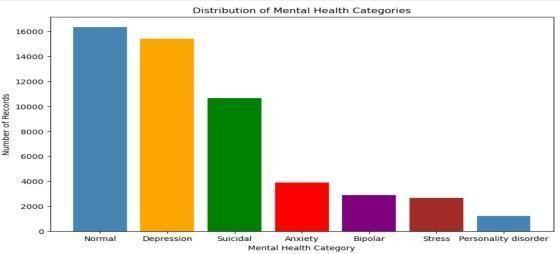
. DistributionofMentalHealthCategoriesintheDataset.
This diagram shows the number of samples of various mental health categories available in the data set on whichthisexperimentisperformed.Thedatasethas7numberofclassesnamelyNormalDepressionSuicidal AnxietyBipolar,StressandPersonalityDisorder.Fromthediagramwecanseethatthesamplenumbersinthe classes Normal and Depression are higher than other classes while the samples in the class Personality Disorderarelow.Fromthiswecanseethatthedataisreasonablyimbalanced.
International Research Journal of Engineering and Technology (IRJET) e-ISSN: 2395-0056
Volume: 13 Issue: 06 | Jun 2026 www.irjet.net p-ISSN: 2395-0072
Lookingattheissuefromanotherperspective,it'sclearthatthischatbotfillsthegapintoday'sresearchnotby doing separate sentimentanalyses, but by combining the recognition of the mood with the monitoring of the emotional patterns at a deeper level. The most remarkable thing is that it meets the already identified user requirements: availability at any time, confidentiality, and answers that truly resonate with the user - all inspired by previous works. Unlike conventional methods, where each interaction is considered as an independentevent,thenewmodel,throughtheuseofboththeaffectiveindicatorsandthecontextualchanges, isabletomaintaintheemotionalstatealongdifferentexchanges.
Previously,systemslackedtheabilitytounderstandsubtlety;thismethodcompensatesforitthroughinherent features.Joining the datasets leads to fewer misses in emotion recognition, allowing the creation of more accurate models for changing conditions, which is very important for the continuous monitoring of mood by automated means [7][9]. Besides confidentiality, the correct and responsible implementation of AI is very important, with an emphasis on the system being a tool to support the human care rather than replacing it [3][6].
ThisprojectaimstodevelopanAI-poweredmentalhealthchatbotthatusessentimentanalysiscombinedwith multi-classclassificationtodiscernauser'semotionalstateandofferacomfortingresponseinaconversation. The paper shows that AI and NLP techniques can be very helpful in recognizing signs of stress, anxiety, and depressionthroughtext-basedcommunication.
The chatbot envisioned here acts as an easily reachable, instantly available, and non-judgmental medium of emotional support with an added feature of motivating users to get professional help if needed. Test results reveal that conversation systems, prompted by AI, can not only enhance emotional surveillance but also increaseuser'swillingnesstointeract.
Introducinghighlysophisticateddeeplearningalgorithms,offeringmultilingualinterface,implementingspeech communication,incorporatingrecognitionoffacialemotions,andallowinguserstomonitortheirmoodinreal timecanbeconsideredasthenextstepsfordevelopment.Seekingtheadviceofmentalhealthpractitionerswill helpmaketheartificiallygeneratedresponsesmoredependableandsuitableforrealhealthcaresettings.
Mental health chatbots based onAI did well inmulti-class classificationbutsome limitations remain. For one thing the dataset was got from publicly available online sources that may not be representative of actual clinical scenarios or of the population of people who might use this system. Besides, the dataset was a little imbalanced and so the prediction of uncommon classes like Personality Disorder and Stress may not be very accurate.
TheAIbasedmentalhealthchatbotsmainlyusetextinputandsomaymisstheotherwaysofperceptionlike tone,facialexpressions,orbehaviorcontextoverall.Becauseofthis,thepredictiongeneratedbythemodelcan onlybetakenasaguideandnotadiagnosis.
Another critical ethical concern when creating and implementing AI-powered mental health chatbots is the problemofsafetyandbias.AIprogramsmightsuggestincorrectorharmfuladvice,leadingtoasafetyriskfor theuserInparticularwhenthemodeldoesnotofferdifferentalternatives.Tobeexact,amentalhealthchatbot should not become a part of a therapy or medication plan since it cannot replace a professional's judgment. Users must understand that a chatbot supplies only emotional support and cannot work as a professional helpingmedium.Biaspresentinthetrainingdatacanskewthemodel'spredictionsleadingtounfairtreatment toward some groups of people. It is useful to keep the deployed model under constant review. Human interventionandcarefulwatchareessential.
International Research Journal of Engineering and Technology (IRJET) e-ISSN: 2395-0056
[1]A. A. Abd-alrazaq, M.Alajlani, A. A. Alalwan, B. M. Bewick, P.Gardner, and M. Househ, “Anoverviewof the featuresofchatbotsinmentalhealth:Ascopingreview,”InternationalJournalofMedicalInformatics,vol.132, p.103978,Dec.2019,doi:10.1016/j.ijmedinf.2019.103978.
[2]A.R.etal.,“ArtificialIntelligencePoweredChatbotforMentalHealthcareBasedonSentimentAnalysis,”in Proceedings of the 5th International Conference on Advances in Science and Technology (ICAST), Dec. 2022, doi:10.1109/ICAST58049.2022.10039548.
[3]I.I.Mmbayi,C.Gakii,andF.M.Musyoka,“Sentimentanalysis-basedmodelformonitoringuserengagement withmentalhealthchatbots,”EngineeringReports,vol.7,no.6,Jun.2025,doi:10.1002/eng2.70247.
[4]A.Basith,“AI-poweredmentalhealthchatbot:Asurvey,”PhilPapers,2025.[Online].Available:PhilPapers.
[5] L. Balcombe, “AI chatbots in digital mental health,” Informatics, vol. 10, no. 4, p. 82, Dec. 2023, doi: 10.3390/informatics10040082.
[6] M. Casu, S. Triscari, S. Battiato, L. Guarnera, and P. Caponnetto, “AI chatbots for mental health: A scoping review of effectiveness, feasibility, and applications,” Applied Sciences, vol. 14, no. 13, p. 5889, Jul. 2024, doi: 10.3390/app14135889.
[7] S. Siddals, J. Torous, and A. Coxon, “‘It happened to be the perfect thing’: Experiences of generative AI chatbotsformentalhealth,”npjMentalHealthResearch,vol.3,no.1,pp.1–9,Oct.2024,doi:10.1038/s44184024-00097-4.
[8] A. Manole, R. Cârciumaru, R. Brînzaș, and F. Manole, “Harnessing AI in anxiety management: A chatbotbasedinterventionforpersonalizedmentalhealthsupport,”Information,vol.15,no.12,p.768,Dec.2024,doi: 10.3390/info15120768.
[9] S. Gupta et al., “AI-based and digital mental health apps: Balancing need and risk,” IEEE Journal of BiomedicalandHealthInformatics,2023,doi:10.1109/JBHI.2023.10063146.
[10] A. Lal, P. Dhadwal, D. Gade, and J. Joy, “TherapAI: AI-powered therapy chatbot with sentiment analysis, mood tracking, and automated reporting for enhanced mental health support,” in Proceedings of the IEEE InternationalConference,Dec.2024,pp.1–8,doi:10.1109/ICAST.2024.10932101.
[11]M.V.Heinzetal.,“RandomizedtrialofagenerativeAIchatbotformentalhealthtreatment,” NEJMAI,vol. 2,no.4,Mar.2025,doi:10.1056/aioa2400802.
[12]J.DeFreitas,A.K.Uğuralp,Z.OğuzUğuralp,andS.Puntoni,“Chatbotsandmentalhealth:Insightsintothe safetyofgenerativeAI,”JournalofConsumerPsychology,vol.34,no.3,Oct.2023,doi:10.1002/jcpy.1393.
[13] G. Park, J. Chung, and S. Lee, “Effect of AI chatbot emotional disclosure on user satisfaction and reuse intentionformentalhealthcounseling:Aserialmediationmodel,”CurrentPsychology,vol.42,Nov.2022,doi: 10.1007/s12144-022-03932-z.
[14]W.Pichowicz,M.Kotas,andP.Piotrowski,“Performanceofmentalhealthchatbotagentsindetectingand managingsuicidalideation,”ScientificReports,vol.15,no.1,Aug.2025,doi:10.1038/s41598-025-17242-4.
Volume: 13 Issue: 06 | Jun 2026 www.irjet.net p-ISSN: 2395-0072 © 2026, IRJET | Impact Factor value: 8.315 | ISO 9001:2008 Certified Journal | Page16
International Research Journal of Engineering and Technology (IRJET) e-ISSN: 2395-0056
Volume: 13 Issue: 06 | Jun 2026 www.irjet.net p-ISSN: 2395-0072
[15]T.G.Heckman,J.C.Markowitz,andB.D.Heckman,“AgenerativeAIchatbotformentalhealthtreatment:A stepintherightdirection?”NEJMAI,vol.2,no.9,Aug.2025,doi:10.1056/aip2500453.
[16] I. Gratch and T. Essig, “A letter about ‘Randomized trial of a generative AI chatbot for mental health treatment,’”NEJMAI,vol.2,no.9,Aug.2025,doi:10.1056/aip2500390.
[17]V.Mythily,D.Vinoparkavi,P.Sukumar,C.V.,A.M.,andB.M.,“AI-DrivenChatbotforMentalHealthSupport UsingSentimentAnalysis,”inProceedingsofthe1stInternationalConferenceonResearchandDevelopmentin Information, Communication, and Computing Technologies, 2025, pp. 292–297, doi: 10.5220/0013881700004919.
[18]B.M.ChaudhryandH.R.Debi,“UserperceptionsandexperiencesofanAI-drivenconversationalagentfor mentalhealthsupport,”mHealth,Jan.2023,doi:10.21037/mhealth2355.
[19] Y. Cheng and H. Jiang, “AI-powered mental health chatbots: Examining users’ motivations, active communicative action and engagement after mass-shooting disasters,” Journal of Contingencies and Crisis Management,vol.28,no.3,pp.339–354,Sep.2020,doi:10.1111/1468-5973.12319.
[20] N. Damij and S. Bhattacharya, “The role of AI chatbots in mental health related public services in a (post)pandemicworld:Areviewandfutureresearchagenda,”IEEEXplore,Apr.2022.[Online].Available:IEEE Xplore.
[21]L.Wang,T.Bhanushali,Z.Huang,J.Yang,S.Badami,andL.Hightow-Weidman,“EvaluatingGenerativeAIin MentalHealth:SystematicReviewofCapabilitiesandLimitations,”JMIRMentalHealth,vol.12,p.e70014,May 2025,doi:10.2196/70014.
[22] M. L. Joshi and N. Kanoongo, “Emotional Artificial Intelligence and Machine Learning Techniques for DepressionDetectionandAnalysis,”MaterialsToday:Proceedings,vol.58,pp.217–226,2022.
[23] S. Swapna, “AI-Powered Sentiment Analysis in Real-Time Brand Monitoring,” International Journal of IntegratedResearchandPractice(IJIRP),vol.1,no.7,pp.67–74,Oct.2025.