
International Research Journal of Engineering and Technology (IRJET) e-ISSN: 2395-0056
Volume: 13 Issue: 05 | May 2026 www.irjet.net p-ISSN: 2395-0072
International Research Journal of Engineering and Technology (IRJET) e-ISSN: 2395-0056
Volume: 13 Issue: 05 | May 2026 www.irjet.net p-ISSN: 2395-0072
G. Sadhika Prasanna¹, V. Divya², A. Angelena³, D. Sathwika⁴ , of Mrs. Premalatha.S
¹⁻⁴ Department of Computer Science and Engineering, Keshav Memorial Institute of Technology, Hyderabad, India
Under the guidance Assistant Professor, Department of Computer Science and Engineering Keshav Memorial Institute of Technology, Hyderabad, India ***
Abstract - The increasing global demand for energy and the need for sustainable resource utilization present significant challenges for modern energy systems. Traditional energy management approaches rely on static forecastingtechniques andmanual grid balancing, leading toinefficienciessuchasenergywastage,gridoverloads,and inaccurate demand prediction.
The proposed system, WattWise, is a smart energy consumption forecasting and grid load optimization platform that leverages machine learning and real-time data analytics to enhance energy efficiency. By utilizing historical consumption data, weather patterns, and user behaviour, the system predicts future energy demand and optimizes grid distribution accordingly.
The system is developed using Python and Django, with machine learning models such as LSTM for time-series forecasting. It also provides an interactive dashboard for visualization and decision-making. The solution improves energy utilization, reduces wastage, and ensures balanced energy distribution, making it suitable for modern smart grid applications.
Key Words: Energy Forecasting, Smart Grid, LSTM, Machine Learning, Grid Optimization, Data Analytics, Sustainability
Efficient energy management has become a critical requirementduetoincreasingenergydemand,population growth,andenvironmentalconcerns.Traditionalenergy systems are unable to dynamically adapt to real-time fluctuations caused by weather conditions, seasonal variations,anduserbehaviour.
Mostexistingsystemsrelyonstaticmodels,whichleadsto mismatches between energy supply and demand. This results in energy wastage, higher operational costs, and instabilityingridperformance.
WattWise addresses these challenges by introducing an intelligent system that integrates machine learning and real-timeanalytics.Itforecastsenergyconsumptionusing
historical and external data sources and optimizes grid loaddistributiondynamically.
Thesystemalsoprovidesauser-friendlydashboardthat enablesstakeholderstomonitorusagepatterns,analyze trends,andmakeinformeddecisions.Theprimarygoalis to build a scalable, efficient, and sustainable energy managementsolution.
Energyconsumptionforecastingandgridoptimizationhave been widely studied using both traditional and modern techniques.
EarlierapproachesusedstatisticalmodelssuchasARIMA andExponentialSmoothing,whichperformwellforlinear data but fail to capture complex patterns influenced by externalfactors.
Machine learning techniques such as Support Vector Machines,DecisionTrees,andRandomForestsimproved predictionaccuracybyhandlingnonlinearrelationships. Recentadvancementsindeeplearning,especiallyRecurrent Neural Networks (RNN) and Long Short-Term Memory (LSTM), have shown significant improvements in timeseriesforecastingduetotheirabilitytocapturetemporal dependencies.
Optimization techniques like Genetic Algorithms and Particle Swarm Optimization have been used to improve gridefficiencybybalancingsupplyanddemand. However,mostexistingsystemslack:
Real-timeadaptability
Integrationofforecastingandoptimization
Scalabilityforlargedatasets
User-friendlyvisualizationinterfaces
WattWise addresses these limitations by combining forecasting, optimization, and visualization into a unified system.
International Research Journal of Engineering and Technology (IRJET) e-ISSN: 2395-0056
Volume: 13 Issue: 05 | May 2026 www.irjet.net p-ISSN: 2395-0072
Intoday’srapidlyevolvingworld,energyconsumptionis increasingatanunprecedentedrateduetourbanization, industrial growth, and population expansion. Efficient management of energy resources has become a critical challenge for power providers and grid operators. However,traditionalenergymanagementsystemsarenot equipped to handle the dynamic and complex nature of modernenergydemands.Thesesystemsrelyonoutdated forecastingtechniquesandlacktheintelligencerequiredto adapt to real-time fluctuations, resulting in inefficient utilizationofresources.
One of the major issues with existing systems is their dependenceonstaticforecastingmodels.Thesemodelsare primarily based on historical data and do not consider real-timeinfluencingfactorssuchasweatherconditions, seasonal variations, and user behaviour. As a result, the predictions generated are often inaccurate, leading to either overproduction or underproduction of energy. Overproduction results in energy wastage, while underproduction can cause power shortages and grid instability.
Anothersignificantchallengeistheinefficientbalancingof energysupplyanddemand.Currentgridsystemsoftenfail to dynamically adjust energy distribution based on changingdemandpatterns.Duringpeakdemandperiods, this can lead to grid overloads and potential failures, whereas during low demand periods, energy resources remain underutilized. This imbalance not only affects operationalefficiencybutalsoincreasescostsandreduces theoverallreliabilityofthepowergrid.
Additionally,mostexistingsolutionslacktheintegrationof advanceddata-driventechniquessuchasmachinelearning and real-time analytics. Without leveraging these technologies, systems are unable to identify complex patterns and relationships in energy consumption data. Thislimitstheirabilitytomakeaccuratepredictionsand optimize grid performance effectively. Moreover, the absenceofintelligentsystemspreventsproactivedecisionmaking,forcingoperatorstorelyonreactiveapproaches.
Anotherlimitationisthelackofuser-friendlyvisualization anddecision-supportsystems.Manycurrentplatformsdo not provide clear insights into energy usage patterns, makingitdifficultforstakeholderstointerpretdataand take informed actions. Without proper dashboards and analytical tools, the decision-making process becomes inefficientandlessimpactful.
Furthermore, scalability remains a critical concern. Existingsystemsoftenstruggletohandlelargevolumesof dataandcomplexgridinfrastructures.Asenergysystems growandbecomemoreinterconnected,thereisaneedfor solutionsthatcanprocesslargedatasetsefficientlywhile
maintainingperformanceandaccuracy.
Therefore, there is a strong need for an intelligent, scalable,andadaptivesystemthatcan:
Accurately forecast energy consumption using advancedtechniques
Dynamicallyoptimizegridloaddistributioninreal time
Integrate multiple data sources such as historical dataandexternalfactors
Provide clear and interactive visual insights for decision-making
Improve overall efficiency, reliability, and sustainabilityofenergysystems
The WattWise system is proposed to address these challengesbycombiningmachinelearning,real-timedata processing,andgridoptimizationintoaunifiedplatform, enablingsmarterandmoreefficientenergymanagement.
Theproposedsystem,WattWise,isanintelligentenergy managementplatformdesignedtoaddressthelimitations of traditional energy forecasting and grid management systems. It integrates machine learning, real-time data processing,andgridoptimizationtechniquestoprovidean efficient,scalable,andadaptivesolutionformodernenergy systems.
Unlike conventional systems that rely on static models, WattWise uses advanced data-driven approaches to continuously analyze and predict energy consumption patterns.Thesystemleveragesmultipledatasourcessuch ashistorical energyusage, weather conditions,and user behaviortogenerateaccurateanddynamicforecasts.
At the core of WattWise is a machine learning-based forecastingmodule,whichusesmodelssuchasLongShortTermMemory(LSTM)networks.
The system processes time-series data to identify patternsinenergyconsumption
Itcapturestemporaldependenciesandtrendsover time
Predictionsarecontinuouslyupdatedasnewdatais received
This enables the system to generate highly accurate forecasts, even in complex and dynamic environments, overcomingthelimitationsoftraditionalstatisticalmodels.
WattWise is designed to operate in a real-time environment,ensuringthatpredictionsanddecisionsare alwaysbasedonthelatestavailabledata.
Incoming data (energy usage, weather, user activity)isprocessedinstantly
International Research Journal of Engineering and Technology (IRJET) e-ISSN: 2395-0056
Volume: 13 Issue: 05 | May 2026 www.irjet.net p-ISSN: 2395-0072
The system dynamically updates predictions as conditionschange
Real-time responsiveness improves accuracy and adaptability
This capability allows the system to handle sudden changessuchaspeakdemandorunexpectedfluctuations effectively.
3. Grid Load Optimization
In addition to forecasting, WattWise includes a grid optimization module that ensures efficient energy distribution.
Balancesenergysupplyanddemanddynamically
Preventsgridoverloadduringpeakusage
Avoidsunderutilizationduringlowdemandperiods
Minimizesenergywastage
Byintegratingforecastingwithoptimization,thesystem ensures that energy resources are used efficiently and sustainably.
4. Data Integration and Analysis
Thesystemintegratesmultipletypesofdata toimprove decision-making:
Historicalenergyconsumptiondata
Weatherconditionsandenvironmentalfactors
Userbehaviorpatterns
By combining these datasets, WattWise can identify complex relationships and generate more accurate predictions,leadingtobetteroptimizationoutcomes.
5. Interactive Dashboard and Visualization
WattWise provides a user-friendly interface with interactivedashboards:
Displaysenergyusagetrendsandpredictions
Visualizesdatausinggraphs,charts,andanalytics
Helpsusersandoperatorsmakeinformeddecisions
6. Scalable and Flexible Architecture
Thesystemisbuiltusingmoderntechnologiessuchas:
Pythonformachinelearningandbackendlogic
Djangoforwebframework
MySQL/SQLitefordatabasemanagement
Itisdesignedtobe:
Scalable → Handles large datasets and multiple users
Flexible → Can be deployed in smart homes, industries,andsmartcities
Modular→Easytoupgradeandextend
TheproposedWattWisesystemprovidesanintelligentand efficient solution for modern energy management by integrating machine learning and real-time data processing.Itaccuratelyforecastsenergyconsumptionand dynamicallyoptimizesgridloaddistribution.Thesystem reduces energy wastage and prevents grid overloads by balancing supply and demand effectively. Its interactive dashboard enables better monitoring and informed
decision-making. Overall, WattWise enhances efficiency, reliability,andsustainabilityinenergysystems.
5.
ThemethodologyoftheWattWisesystemdefinesthestepby-stepapproachusedtocollectdata,processit,generate predictions,andoptimizeenergydistribution.Thesystem isdesignedinamodularmanner,whereeachcomponent performs a specific function, ensuring efficiency, scalability,andaccuracy.
Thesystembeginswithuserinteractionthroughasimple interface.
Userscanuploadenergyconsumptiondatasets(CSV files)ormanuallyenterinputvalues
Authenticationensuressecureaccesstothesystem
Inputdataincludesenergyusagedetailsandrelated parameters
This step acts as the entry point of the system, enabling userstoprovidetherequireddataforanalysis.
5.2.
Thesystemcollectsandintegratesmultipletypesofdatato improvepredictionaccuracy:
Historicalenergyconsumptiondata
Externalfactorssuchasweatherconditions
Userbehaviourpatterns
Combiningthesedatasourcesallowsthesystemtocapture real-world complexities and improve forecasting performance.
5.3.
Beforeapplyingmachinelearningmodels,thedataispreprocessedtoensurequalityandconsistency.
Data cleaning → removes missing or inconsistent values
Normalization → scales data for better model performance
Transformation→convertsrawdataintosuitable format
This step is critical because accurate input leads to accuratepredictions.
5.4.
Thecoreofthesystemisthemachinelearningprediction module.
UsesLSTM(LongShort-TermMemory)model
Processestime-seriesdatatoidentifypatterns
Learnsfrompasttopredictfutureenergydemand
Themodelcontinuouslyimprovesasmoredataisprocessed, ensuringhighpredictionaccuracy.
International Research Journal of Engineering and Technology (IRJET) e-ISSN: 2395-0056
Volume: 13 Issue: 05 | May 2026 www.irjet.net p-ISSN: 2395-0072
5.5. Real-Time Data Processing
WattWiseoperatesinareal-timeenvironment:
Continuously updates predictions as new data arrives
Adaptstochangingconditionssuchaspeakdemand orweatherchanges
Ensuresup-to-datedecision-making
Thismakesthesystemdynamicandresponsive.
5.6. Grid Load Optimization
After forecasting, the system optimizes energy distribution:
Balancessupplyanddemanddynamically
Preventsgridoverloadduringhighdemand
Avoidsenergywastageduringlowdemand
Improvesoverallgridefficiency
Thisintegrationof forecastingand optimizationisa key strengthofthesystem.
5.7. Visualization and Dashboard
The system provides a user-friendly dashboard for analysis:
Displayspredictionsusinggraphsandcharts
Showsenergyusagetrendsandpatterns
Enablesuserstomakeinformeddecisions
Visualizationmakescomplexdataeasytounderstand.
5.8. Data Storage and Management
Allsystemdataissecurelystoredinadatabase:
Storesuserdata,datasets,andpredictions
Maintainshistoricalrecordsforanalysis
Ensuresdataavailabilityandscalability
This supports long-term learning and system improvement.
5.9. System Workflow Summary
1. Useruploadsdataorinputsvalues
2. Dataiscollectedandpre-processed
3. Machine learning model predicts energy consumption
4. Optimizationmodulebalancesgridload
5. Resultsarevisualizedondashboard
6. Dataisstoredforfutureuse
6.SYSTEM ARCHITECTURE
The system architecture of the WattWise platform illustratestheoverallstructureandinteractionbetween differentcomponentsinvolvedinenergyconsumption forecastingandgridloadoptimization.
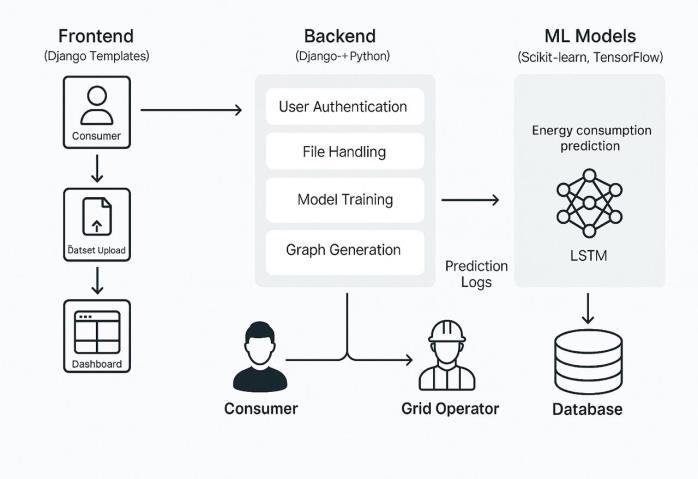
Thesystembeginswiththeuseraccessingtheapplication through a web-based interface, where they can upload energy datasets or provide input parameters. This interface is designed to be simple and user-friendly, enablingsmoothinteractionwiththesystem.
Oncetheuserprovidestheinput,therequestissenttothe backend server developed using the Django framework. The backend acts as the central processing unit of the system,handlinguserauthentication,managingrequests, and coordinating the flow of data between different modules. It ensures that all operations are executed efficientlyandsecurely.
After receiving the input data, the system moves to the data processing module, where the data is cleaned, normalized,andtransformedintoasuitableformat.This step ensures that the data is accurate and consistent, whichisessentialforgeneratingreliablepredictions.The processed data is then passed to the machine learning moduleforfurtheranalysis.
Themachinelearningmoduleformsthecoreofthesystem and is responsible for predicting future energy consumption.ItusesadvancedmodelssuchasLongShortTerm Memory (LSTM) networks to analyze time-series dataandidentifypatternsinenergyusage.Basedonthis analysis,thesystemgeneratesaccurateforecastsoffuture energydemand.
Once the prediction is generated, the grid load optimizationmodulecomesintoaction.Thismoduleuses thepredicteddatatobalanceenergysupplyanddemand dynamically. It ensures that energy is distributed efficientlyacrossthegrid,preventingoverloadduringpeak demand and minimizing wastage during low demand periods. This step significantly improves the overall efficiencyandreliabilityoftheenergysystem. Thesystemalsoincludesadatabaselayerthatstoresuser information, uploaded datasets, prediction results, and
International Research Journal of Engineering and Technology (IRJET) e-ISSN: 2395-0056
Volume: 13 Issue: 05 | May 2026 www.irjet.net p-ISSN: 2395-0072
systemlogs.Thisensuresthatdataissecurelymaintained andcanbeaccessedforfutureanalysis.Thedatabaseplays acrucialroleinmaintainingconsistencyandsupporting scalability.
Finally,theresultsarepresentedtotheuser throughan interactive dashboard. The dashboard displays energy consumptiontrends,predictionresults,andoptimization insightsusinggraphsandvisualizations.Thisallowsusers andstakeholderstoeasilyunderstandthedataandmake informeddecisions.
Overall, the architecture ensures smooth data flow, efficientprocessing,andseamlessinteractionbetweenall components. The modular design makes the system scalable,flexible,andsuitableforreal-worldapplications such as smart grids, industrial energy management, and sustainableenergysystems.
The Watt Wise system was successfully developed and evaluated to analyse its performance in energy consumptionforecastingandgridloadoptimization.The systemwasabletoprocessinputdatasetsefficientlyand generate accurate predictions using the implemented machinelearningmodel.Theuseofhistoricaldataalong withexternalfactorssuchasweatherconditionsanduser behaviour contributed to improved prediction accuracy, demonstrating the effectiveness of the data-driven approach.
Duringexecution,thesystemeffectivelyperformedenergy consumptionforecastingusingtheLSTMmodel,capturing time-seriespatternsandtrendsinthedata.Thepredicted values closely aligned with expected consumption patterns,indicatingthatthemodeliscapableofhandling complex and dynamic energy usage scenarios. This accuracyisessentialforensuringreliabledecision-making inenergymanagementsystems.
The grid load optimization module also performed efficiently by dynamically balancing energy supply and demand.Thesystemsuccessfullyminimizedsituationsof overload and underutilization by distributing energy resources based on predicted demand. This not only improvedthestabilityofthegridbutalsoreducedenergy wastage, making the system more sustainable and costeffective.
Theinteractivedashboardprovidedclearandmeaningful visualizations of energy trends, predictions, and optimization results. Users were able to easily interpret the data through graphs and charts, enabling better understanding and decision-making. The user interface wasresponsiveandintuitive,ensuringsmoothinteraction evenfornon-technicalusers.
Performance analysis showed that the system operates efficientlywithminimaldelayinprocessingandprediction generation.Ithandleddatasetuploads,datapreprocessing, and model execution without significant performance issues.Theintegrationofdifferentmodulessuchasdata processing, machine learning, and optimization worked seamlessly,ensuringconsistentsystembehaviour.
Overall,theresultsdemonstratethattheWattWisesystem effectively achieves its objectives of accurate energy forecasting and efficient grid load optimization. The combination of machine learning, real-time processing, andvisualizationmakesthesystemreliable,scalable,and suitableforreal-worldenergymanagementapplications.
TheWatt Wisesystemwassuccessfullydevelopedasan intelligent solution for energy consumption forecasting and grid load optimization. By integrating machine learning techniques with real-time data processing, the system is able to accurately predict energy demand and dynamically balance energy distribution. The use of advanced models such as LSTM improves forecasting accuracy,whiletheoptimizationmoduleensuresefficient utilization of energy resources and prevents grid instability.
The system demonstrated reliable performance in handling data processing, prediction generation, and visualizationthroughaninteractivedashboard.Itsuserfriendly design enables stakeholders to easily monitor energytrendsandmakeinformeddecisions.Overall,Watt Wise provides a scalable, efficient, and sustainable approachtomodernenergymanagement,addressingthe limitations of traditional systems and contributing to improvedenergyefficiencyandresourceutilization.
The Watt Wise system can be further enhanced by incorporating advanced features and expanding its capabilities to meet real-world energy management requirements more effectively. One important improvementistheintegrationofInternetofThings(IoT) devices,whichcanprovidereal-timeenergyconsumption data directly from smart meters and appliances. This would improve the accuracy of predictions and enable moreprecisegridoptimization.
Future developments can also include the integration of renewableenergysourcessuchassolarandwindpower into the system. By considering renewable energy availability, the system can make smarter decisions in balancingenergydistributionandpromotingsustainable energy usage. Additionally, more advanced machine learning and deep learning models can be explored to
International Research Journal of Engineering and Technology (IRJET) e-ISSN: 2395-0056
Volume: 13 Issue: 05 | May 2026 www.irjet.net p-ISSN: 2395-0072
furtherimprovepredictionaccuracyandadaptability. Anotherpotentialenhancementisthedeploymentofthe system on cloud platforms, which would allow better scalability,accessibility,andreal-timeprocessingoflarge datasets. Security features can also be strengthened by implementing advanced encryption and secure data handlingtechniquestoprotectsensitiveuserandenergy data.
Furthermore, the system can be extended to support multiplecommunicationchannelsandprovideautomated alerts or recommendations to users and grid operators. Enhancingthevisualizationdashboardwithmoredetailed analytics and predictive insights can also improve decision-makingcapabilities. Overall,thesefutureimprovementswill makeWattWise more robust, intelligent, and suitable for large-scale deploymentinsmartcities,industries,andmodernenergy systems.
[1]PythonSoftwareFoundation,“PythonDocumentation,” [Online].Available:https://docs.python.org/
[2]DjangoSoftwareFoundation,“DjangoDocumentation,” [Online]. Available: https://docs.djangoproject.com/
[3] TensorFlow Team, “TensorFlow Documentation,” [Online].Available:https://www.tensorflow.org/Accessed: 2025.
[4] F. Chollet, “Deep Learning with Python,” Manning Publications,2018.
[5] S. Hochreiter and J. Schmidhuber, “Long Short-Term Memory,” Neural Computation, vol. 9, no. 8, pp. 1735–1780,1997.
[6]J. Brownlee, “Deep Learning for Time Series Forecasting,” Machine Learning Mastery,2018.
[7]T.Hong,P.Wang,andH.L.Willis,“AReviewofShortTermLoadForecastingTechniques,”IEEETransactionson PowerSystems,2016.
[8]GoogleDevelopers,“MachineLearningCrashCourse,” [Online].Available:https://developers.google.com/machin e-learning
[9]MySQL Documentation Team, “MySQL Reference Manual,”[Online].Available:https://dev.mysql.com/doc/
[10] A. Géron, “Hands-On Machine Learning with ScikitLearn,Keras,andTensorFlow,”O’ReillyMedia,2019.
[11]InternationalEnergyAgency(IEA),“EnergyEfficiency
Report,”[Online]. Available: https://www.iea.org/
[12]Research Papers on Smart Grid Optimization and Energy Forecasting (Various Authors, IEEE, Elsevier Journals).