
International Research Journal of Engineering and Technology (IRJET) e-ISSN: 2395-0056
Volume: 11 Issue: 12 | Dec 2024 www.irjet.net p-ISSN: 2395-0072

International Research Journal of Engineering and Technology (IRJET) e-ISSN: 2395-0056
Volume: 11 Issue: 12 | Dec 2024 www.irjet.net p-ISSN: 2395-0072
Shreyash S. Chavan1 , Prof. P. V. Muley2
1PG Student, Dept. of Civil Engineering, Datta Meghe College of Engineering (DMCE), Airoli, Navi Mumbai, Maharashtra, India
2 Professor, Dept. of Civil Engineering, Datta Meghe College of Engineering (DMCE), Airoli, Navi Mumbai, Maharashtra, India ***
Abstract - This study provides a comparative analysis of various structural systems, including Reinforced Concrete (RC) frames, shear walls, bracing systems, and outrigger systems, to assesstheirseismic performanceas per IS 1893: 2016. The evaluation is conducted across seismic zones II, III, IV, and V to determine the efficiency of these systems in resisting earthquake-induced forces. Key parameters such as base shear, inter-story drift,and lateral displacement are analyzed using static and dynamic methods to assess the behavior of each structural system under different seismic intensities.The findings highlight the strengths and limitations of each system, offering critical insights to aid in selecting appropriate structural solutions for enhanced seismic safety and performance across varying zones
Key Words: Seismic performance, structural systems, RC frames,shearwalls,bracingsystems,lateraldisplacement, earthquakeresistance
1.INTRODUCTION
Seismicdesignhasevolvedsignificantlyovertime,driven byadeeperunderstandingofearthquakedynamicsandthe need for resilient structures. In India, traditional constructionmethodsprovidedsomeresistancetoseismic forces, but modern approaches have brought systematic improvements.Historicalarchitecture,suchastemplesand forts, showcased durability through massive and solid designs, albeit without explicit seismic principles. Early construction relied on empirical methods until modernizationhighlightedtheneedforstructuredseismic design, leading to the adoption of global standards and localizedstrategies.
Major earthquakeshave been pivotal inshapingIndia's seismicdesignpractices.The1934Bihar-NepalEarthquake (magnitude 8.0) underscored the need for robust engineering in vulnerable regions. The 1967 Shillong Earthquake (magnitude 6.7) emphasized seismic considerationsinnortheasternIndia.Thedevastating2001 Gujarat Earthquake (magnitude 7.7) spurred a comprehensiveoverhaulofdesigncodes,includingstricter
enforcementofregulationsandupdatestostandardslikeIS 1893. These events have driven the evolution of seismic design,ensuringsaferandmoreresilientstructuresacross thecountry.
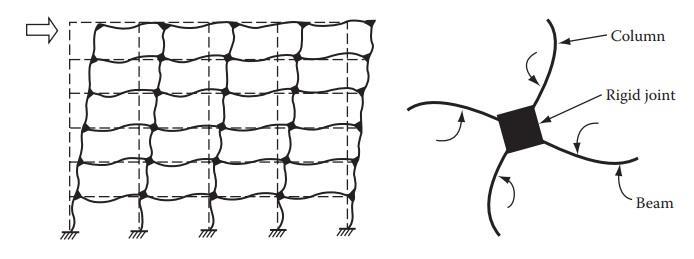
Moment-Resisting Frames: Moment-ResistingFrames are structural systems that rely on rigid beam-column connectionstoresistlateralforcesthroughbending,offering significantductilitytoabsorbseismic energy.Theyenable openfloorplans,providingflexibilityinarchitecturaldesign. ClassifiedintoOrdinary,Intermediate,andSpecialMoment Framesbasedonductilityandseismicperformance,theyare widely used in earthquake-prone regions. However, these frames can be costly and complex to construct and may sustain damage during severe earthquakes. Modern advancementslikeseismicisolationanddampingsystems areincreasinglyintegratedtoenhancetheirresilienceand efficiency.
Shear walls: Shearwallsareverticalstructuralelements designedtoresistlateralforcesthroughshearandstiffness, commonly placed in building cores for stability. They are categorized into reinforced concrete, masonry, and compositeshearwalls.Renownedfortheirexcellentlateral stability and efficiency in tall buildings, they offer a costeffectivesolutionwhendesignedproperly.However,shear walls can limit floor plan flexibility and demand precise constructiontechniques.Moderninnovationsemphasizethe useofhigh-performancematerialsandadvanceddesignsto enhancetheirstrengthandadaptability
International Research Journal of Engineering and Technology (IRJET) e-ISSN: 2395-0056
Volume: 11 Issue: 12 | Dec 2024 www.irjet.net p-ISSN: 2395-0072
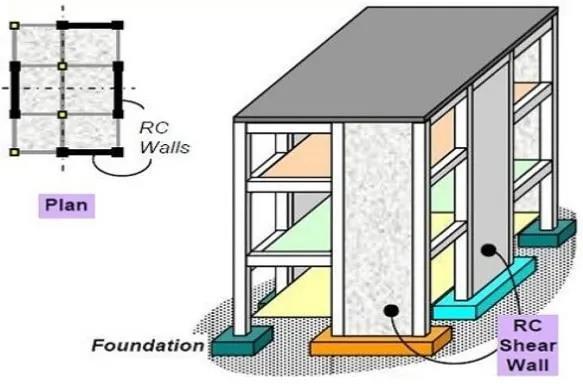
Fig -2:ShearWallinStructuralEngineering
Bracing: Bracing systems use diagonal elements to resist lateralforcesbyconvertingthemintoaxialloads,providing enhanced stability and reducing building sway. Common types include X-Bracing, K-Bracing, Chevron Bracing, EccentricBracing,andKneeBracing.Thesesystemsarecostefficient and space-saving but may limit architectural flexibilityandposechallengesinaestheticsandconstruction. Modern trends focus on incorporating smart sensors and hybrid designs with damping systems to optimize performanceandresilience
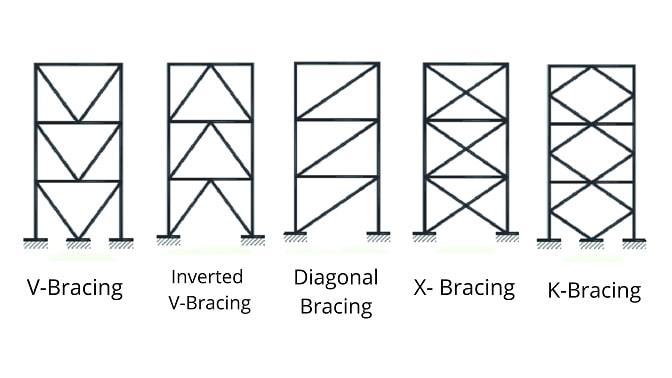
Fig -3:ShearWallinStructuralEngineering
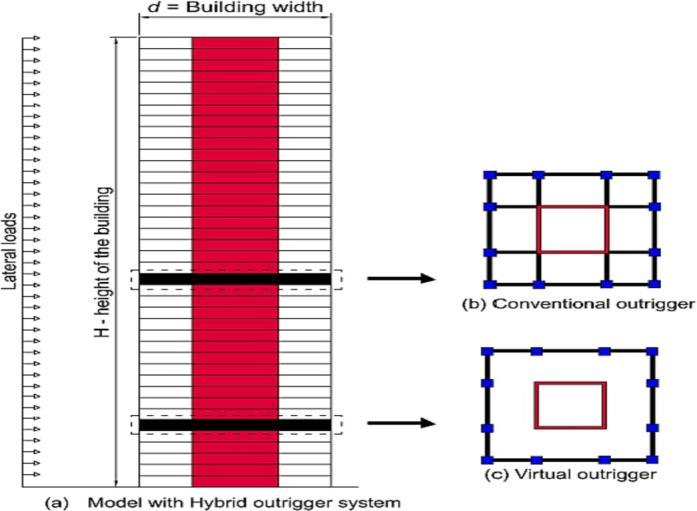
Outrigger: Outriggersystemsarestructuralsolutionsthat connectabuilding’scoretoexteriorcolumnsusinghorizontal beams,significantlyenhancingstabilityandreducinglateral swayfromwindorseismicforces.Byefficientlydistributing loads, they enable taller, more resilient structures with reduced material usage, contributing to cost and resource efficiency. Configurations include single, multi-outriggers, outriggers with belt trusses, and hybrid designs, offering flexibility for various architectural and structural needs. However,theyinvolvecomplexdesigns,highinitialcosts,and potential impacts on floor layouts and interior spaces. Modernadvancements,suchassmartmonitoringsystems, ultra-high-performanceconcrete(UHPC),andhybriddesigns withdampingsystems,addressthesechallengeseffectively, optimizingperformanceandadaptabilityformodernhighrisestructures.
Pramod Kumar Lodhi et al. (2024), the seismic performance of RCC buildings with and without X-bracing systems was analyzed using ETABS v2021. The analysis focusedonvariousbuildingmodels,includingunbracedand X-bracedstructureslocatedinseismicZoneIII.TheResponse SpectrumMethod(RSM)wasappliedtoassessthestructural behavior under seismic loads. The study compared key seismicparameters,suchasmaximumdisplacement,storey drift,timeperiod,storeyshear,andmomentcapacity.Results showed a significant reduction in displacement (up to 56.45%)andstoreydrift(upto56.42%)inbracedbuildings compared to unbraced frames. The X-bracing system positioned at both the center and corners (Model-4) was foundtobethemosteffective,reducingthetimeperiodby 32.44%andenhancingthemomentandshearcapacities.The studyemphasizestheefficiencyandeconomyofsteelbracing systems in improving the earthquake resistance of RCC buildingsin seismic zones,with Model-4showing the best overallperformance.
Mr. Mukesh R. Zambre et al. (2022) conductedastudy on the effects of vertical alignment and bulk instability on multistoreystructuressubjectedtovariableloads,including seismic and wind loads. The research highlights the challenges in designing structures to withstand these high loads,particularlyduetotheflexibilityinmodernbuilding designs.TheauthorsselectedthreeRCbuildingframesfor evaluation,usingETABSanalysistostudymigrationpatterns inaG+20floorstructure.Thestudyexaminedbothuniform heightconfigurationsandirregularconfigurationsbeginning fromthe9thfloor.Themethodofresponsespectrumanalysis was employed to determine lateral loads and floor inspectionsduetoearthquakeimpacts,supportedbyIS1893 (Part 1): 2016 for dynamic analysis. The findings suggest limitationsonuploadcombinationsandrecommenddynamic analysisforidentifyingcriticalloadresponses.
International Research Journal of Engineering and Technology (IRJET) e-ISSN: 2395-0056
Volume: 11 Issue: 12 | Dec 2024 www.irjet.net p-ISSN: 2395-0072
Dr. Vijaya G. S et al. (2021) examined the structural behaviorofmulti-storeybuildingsfeaturingcoupledshear walls in seismic zones, using ETABS for analysis. They explored models with regular, mass reduction, and soft storeyconfigurationsacrossbuildingswith30,40,and50 stories.Thestudyrevealedthataxialforcesincreasedwith building height, rising by 30-35% every 10 stories. Soft storey and mass reduction models exhibited lower axial forces due to reduced stiffness, leading to potential cost savingsinfoundationwork.V-bracingprovedmoreeffective than X-bracing in reducing bending moments and axial forces, while the regular model exhibited better lateral resistanceduetoincreasedstiffness.Shearwallscontributed significantlytotheoverallloaddistribution,andV-bracing with coupled shear walls effectively minimized shear and axial forces, emphasizing the importance of selecting the rightbracingsystemforoptimalseismicperformance.
Nilendu Chakraborttyet al.(2020) analyzedtheseismic behaviorofaG+3reinforcedconcrete(RC)buildingacross four seismic zones (II, III, IV, and V) in India using ETABS software. The study aimed to ensure that buildings could withstand minor earthquakes without significant damage andmaintainstabilityduringmajorseismicevents.Findings showedthatbaseshearwashighestinZoneV,increasingby 72.2%,55.56%,and33.33%comparedtoZonesII,III,and IV.FloordisplacementvalueswerealsogreaterinZoneV, withmaximumdisplacementsrecordedat39.79mm,30.77 mm, and 18.52 mm more than in Zones II, III, and IV. Additionally, steel quantity and support reactions were higher in Zone V, where the steel quantity required was 53.84%,13.89%,and8.31%greaterthaninZonesII,III,and IV,respectively.Thestudyconcludedthatseismicforcesin higher zones, particularly Zone V, demand increased structural reinforcement and lead to different structural behavior.
K.N. Jeevan Kumar et al. (2020) studied the seismic behaviorofaG+15storeyRCbuildingwithvariousbracing systems using ETABS 18 software. The analysis involved sevenstructuralsystems,includinganunbracedframeand sixbracedframes,toevaluateperformanceintermsofstorey displacements,drift,naturaltimeperiod,andbaseshear.The results showed that bracing systems effectively reduced storey displacement, storey drift, and natural time period. Amongthem,theMegaX-bracingsystemperformedthebest, reducing displacement by 52.93% in the X-direction and 49.41% inthe Y-direction,and storey drift by53.88%and 55.23%intherespectivedirections.Furthermore,MegaXbracing increased seismic base shear compared to the unbraced building. The study concluded that the use of bracing systems significantly improves lateral load resistance, minimizing displacement and drift while enhancingstructuralstability.
P. Gwalani et al. (2020) investigatedtheseismicbehavior andcollapsevulnerabilityofreinforcedconcrete(RC)dual system buildings designed according to Indian standards, withanemphasisontheuseofRCshearwallscombinedwith
moment-resisting frames for lateral load resistance. While Indiancodes focus on capacity design for moment frames, theyprovidelimitedguidanceonshearwalldesign.Thestudy employedafiber-hingemodelandbi-directionalincremental dynamic analyses (BIDA) with far-field ground motion recordstoassesstheperformanceofthesestructures.The resultssuggestedthattheshearwallareashouldbeatleast 0.9%to1%ofthebuilding’splanareainbothdirectionsto ensureadequateperformanceduringmaximumconsidered earthquake(MCE)conditions.Increasingtheshearwallarea wasfoundtoenhancethebuilding'scollapsecapacity,with structureswhereshearwallscontributemorethan70%of lateral resistancepotentiallynotneedingastrongcolumnweakbeamconfiguration.Ashearwallarearatioof0.45% wasconsideredinsufficientforsafety,while0.9%to1.35% was identified as optimal for ensuring robust seismic performance.
E. Dileep Kumar et al. (2019) conductedacomparative studyonearthquake-resistantbuildingdesignusingbracing andshearwallsystems,utilizingETABSsoftwareforanalysis. The study modeleda G+10storey buildingand performed push-overanalysistocomparetheperformanceofgeneral, steel-braced,andshear-wallbuildingsinahighseismiczone. Keyfindingsincludedthatbothsteelbracingsandshearwalls effectivelyreducestorydrift,shear,andbendingcomparedto generalbuildings.Shearwallswerefoundtoreducetorsion andincreasestiffness,whilesteelbracingsresultedinalarger reductioninshearinbothXandYdirections.Additionally, thestudyrevealedthatbuildingwithshearwallshadahigher torsion and reduced time period compared to bracing systems, but overall, the shear wall system was more advantageousintermsofstiffnessandperformance,withthe shearwallbuildingsshowingupto75%lessmodelstiffness than general buildings. In conclusion, both systems offer substantialimprovementsovergeneralbuildings,withshear wallsprovidingsuperiorstabilityandstiffness.
Abdul Halim Etemad et al. (2019) compared the structural efficiency of tubular, outrigger, and bracing systemsforstabilizinghigh-risebuildings,usinga42-story concrete building model analyzed with ETABS 2016. The studyfoundthattheoutriggersystemwithcoreshearwalls and two outriggers at H/3 and 2H/3 from the top of the building provided the best performance in terms of time period,lateraldeflection,andbaseshear,althoughitledto architectural disturbances. The steel bracing system, specificallytheinvertedV-bracing,exhibitedminimallateral drift but was more flexible, resulting in higher lateral deflections and reduced lateral stiffness compared to the outrigger system. The tubular system, while offering good space utilization due to its perimeter columns, had higher baseshearthantheoutriggersystem,butitremainedwithin anacceptablerange.Theoutriggersystem,despitecausing somearchitecturalchallenges,wasfoundtobemoreeffective inreducingbaseshearby43.17%comparedtothetubular system,makingitthesuperioroptionforlateralstiffnessand structuralperformance.
International Research Journal of Engineering and Technology (IRJET) e-ISSN: 2395-0056
Volume: 11 Issue: 12 | Dec 2024 www.irjet.net p-ISSN: 2395-0072
Harshitha M.K. et al. (2018) conductedastudyonthe seismic performance of reinforced concrete (RC) framed structuresincorporatingstructuralsteelbracesusingETABS software.Theresearchaimedtoevaluatetheeffectivenessof variousbracingsystemsinimprovingtheseismicbehaviorof RCbuildings.AG+10buildinglocatedinseismiczoneIVwas analyzed with 16 different models, including a bare frame configuration. The study assessed key parameters such as lateraldisplacement,baseshear,andtimeperiod.Theresults indicated that the introduction of bracing significantly improvedtheseismicperformanceofthestructure.Among thevariousbracingsystems,invertedV-bracesandX-braces showedthemosteffectivereductioninlateraldisplacement, offering better resistance to storey displacement. Additionally,whiletheincorporationofbracesincreasedthe base shear, the X-braced frame exhibited the smallest increase. The analysis also revealed a decrease in the structure's time period due to the increased stiffness providedbythebraces,highlightingthecriticalroleofsteel bracing in enhancing the seismic resilience of RC framed buildings.
Dharanya et al. (2017) conductedacomparisonstudyon theseismicperformanceofshearwallsandcrossbracingsin amulti-storeyresidentialbuildingunderseismicloading.The studyfocusedonaG+4storeyresidentialreinforcedconcrete (RC) building with a soft storey, analyzed using ETABS software as per the IS 1893:2002 code provisions. The buildingwasmodelledwithX-bracingattheouterperiphery of the columns and shear walls at the corners. Key parameterssuchaslateraldisplacement,baseshear,storey drift,axialforce,shearforce,andtimeperiodwerecompared. The results revealed that the incorporation of shear walls significantly increased the base shear, improving the structure's stability against seismic forces. The structure's naturaltimeperiodwasnotablyreducedwiththeadditionof shearwalls,enhancingitsseismicresistancecomparedtothe bracingsystem.Furthermore,thestructurewithshearwalls exhibited the least lateral displacement, demonstrating superiorlateral stabilitycompared to the bracedand bare frameconfigurations.Thestudyconcludedthatshearwalls are more effective in improving the lateral stability of a structurethanbracingsystemsunderseismicloading.
Narla Mohan et al. (2017) conducted an analysis of a G+20reinforcedconcretebuildingsubjectedtoearthquake loadsindifferentseismiczonesusingETABSsoftware.The studyfocusedonunderstandingthebuilding'sresponseto lateral loads induced by seismic forces, specifically addressing the effects of base shear, displacement, storey drift, and torsion. The results revealed that as the seismic zoneincreases,thebaseshear,displacement,storeyshear, andtorsionaleffectsalsoincrease.Forexample,baseshear increasedbymorethan350%whenmovingfromZoneIIto ZoneV.Similarly,displacementandstoreydriftvalueswere higher in higher seismic zones and increased with wind pressure.Torsioneffectsweremostpronouncedatthebase ofthebuilding,showingasignificantriseasbothseismicand windloadsincreased.Thestudyhighlightedthatstructural performance,intermsoflateralstability,shear,anddrift,was
greatly influenced by the seismic zone and wind pressure, emphasizing the importance of these factors in the design andanalysisofearthquake-resistantstructures.
S. Monish et al. (2015) focusedontheeffectsoftwotypes of plan irregularities diaphragm discontinuities and reentrant corners on the seismic response of frame structures. Models incorporating these irregularities were developedaccordingtoClause7.1ofIS1893:2002(Part1) andanalyzedusingstatic and dynamic methods inETABS. Key parameters, such as base shear, displacement, and natural period, were evaluated to identify the most vulnerable models under severe seismic loading. The research underscored theincreased failure risk associated withcertainirregularitiesinearthquake-proneareas.
Abdul Karim Mulla et al. (2015) studiedtheimpactof outrigger systems on the seismic performance of tall RC structures,comparingregularandirregularbuildingswith andwithoutoutriggers,incorporatingcentrallyrigidshear wallsandsteelbracings.UsingETABS,equivalentstaticand responsespectrummethodswereappliedtoanalyzelateral displacement,drift,baseshear,andnaturalperiods.Results showedthatoutriggerssignificantlyimprovedstiffnessand reducedbaseshear,withconcreteoutriggersoutperforming steeloutriggers(X-bracing)inminimizingdisplacement.Midfloor outriggers were more effective than top-floor placement,andirregularbuildingswithverticalirregularities demonstrated better performance due to reduced selfweight.Outriggersalsoreducedinter-storeydrift,enhanced load-resisting capacity, and decreased natural periods, makingthemeffectiveinhigh-seismicityzones.
P.M.B. Raj Kiran Nanduri et al (2013) investigatedthe efficiencyandoptimalplacementofoutriggerandbelttruss systems in 30-storey high-rise RCC buildings subjected to windandearthquakeloads.Nine3Dmodelswereanalyzedto evaluate lateral displacement reduction with varying outriggerconfigurations.Resultsshowedthatincorporating an outrigger system significantly increases structural stiffness and minimizes lateral displacement. A 23% displacement reduction was achieved by placing the first outrigger at the top and the second at mid-height, demonstrating optimal performance. The study concluded thattheidealoutriggerplacementisat0.5timesthebuilding height, with additional benefits observed when using a secondoutriggerwithorwithoutabelttruss.
Kiran Kamath et al. (2012) conductedaninvestigationto studythestaticanddynamicbehaviorofoutriggerstructural systems in reinforced concrete buildings using ETABS software.Thestudyexamineddifferent3Dmodelswithand withoutoutriggers,varyingtherelativeflexuralrigidityfrom 0.25to2.0andtherelativeheightoftheoutriggerfrom0.975 to0.4.Theanalysisfocusedonparameterssuchasbending moments,shearforce,lateraldeflection,peakacceleration, andinter-storeydriftsforbothstaticanddynamicconditions. Theresultsindicatedthattheperformanceoftheoutrigger system was most efficient when placed at mid-height (relative height of 0.5). The study concluded that the
International Research Journal of Engineering and Technology (IRJET) e-ISSN: 2395-0056
Volume: 11 Issue: 12 | Dec 2024 www.irjet.net p-ISSN: 2395-0072
outrigger system significantly improves the building’s stiffness and lateral load resistance. While placing the outriggeratthetopreducedtheeffectivenesscomparedto the mid-height position, it still resulted in up to a 50% reductionindrift.Forpeakaccelerationdesign,placingthe outriggeratthetopreduceditbyupto30%.Additionally,the introductionofoutriggerssubstantiallyreducedforcesinthe core, especially bending moments, and also helped in controllingtopdisplacementsandinter-storeydrifts.
TheliteraturereviewconcludedaspartofstudyrevealsThe seismic performance of structures has been extensively analyzed using advanced modelling tools, focusing on bracing systems, shear walls, outriggers, and their combinationstoimproveearthquakeresilience.Keyfindings include:
1. Bracing Systems:
o X-bracing,V-bracing,andMegaX-bracingimprove seismic stability by reducing storey displacement anddrift.
o Mega X-bracing is particularly effective, reducing displacement and storey drift by significant amounts.
2. Shear Walls:
o Shearwallsimprovelateralstability,reducetorsion, andincreasestiffness.
o Theyareoftenmoreeffectivethanbracingsystems in enhancing seismic performance, particularly in reducinglateraldisplacement.
3. Outrigger Systems:
o Outriggersplacedatmid-heightincreasestructural stiffness, reduce base shear, and minimize displacement.
o Optimalplacementofoutriggersprovidesthebest performance for high-rise buildings in seismic zones.
4. Seismic Zone Impact:
o Buildingsinhigherseismiczones(ZoneV)require more reinforcement and exhibit higher displacementandbaseshearcomparedtobuildings inlowerzones(ZonesII-IV).
o Higher seismic zones demand stronger structural systemstohandletheincreasedseismicforces.
5. Impact of Design Irregularities:
o Buildings with diaphragm discontinuities or reentrant corners are more vulnerable to seismic forces.
o Irregularities increase failure risks, especially in earthquake-proneareas.
Afterextensivereviewofnumerousreviewpapers,several significantgapshavebeenidentified;
1. Research on VariousStructural Systems Remains Limited:
o While there is substantial research on common structural systems like bracing and shear walls, there is a lack of extensive studies comparing a wider range of structural systems, particularly in thecontextofcomplexorhigh-risebuildings.More in-depthresearchisneededonadvancedorhybrid systems that could potentially offer superior seismicperformance.Thiscouldincludeinnovative bracing configurations, advanced materials, or emerging technologies that are not yet widely studied.
2. Study Across Various Seismic Zones Needs to Be Done:
o Manystudiesfocusonseismicbehaviorinspecific zones, but the effects of different seismic zones (ranging from low to high seismic activity) on various structural systems are not thoroughly explored.Acomprehensivestudyacrossallseismic zones would provide valuable insights into how different building types, structural systems, and materials perform in regions with varying earthquakerisk.Thiswouldleadtomoretailored and region-specific seismic design guidelines, improvingoverallbuildingsafety.
3. Limited Analysis Addressing Vertical Irregularities in Structures:
o Whilelateralirregularitiesarewell-documentedin seismicstudies,verticalirregularities(e.g.,varying storyheights,softstoreys,orlargemassdifferences betweenfloors)areoftenunderrepresentedinthe analysis. These vertical irregularities can significantly impact the distribution of seismic forcesandleadtounexpectedstructuralbehavior, such as increased torsion or disproportionate settlement.Moreresearchisneededtounderstand how vertical irregularities affect the dynamic responseofbuildingsunderearthquakeloadingand to develop design strategies that mitigate these effects.
International Research Journal of Engineering and Technology (IRJET) e-ISSN: 2395-0056
Volume: 11 Issue: 12 | Dec 2024 www.irjet.net p-ISSN: 2395-0072
4. Limited Studies Conducted Using Architectural Plans:
o Muchoftheexistingseismicresearchisfocusedon simplifiedoridealizedbuildingmodels,whichmay notfullyreflectthecomplexitiesfoundinreal-world architecturaldesigns.Thereisagapinstudiesthat integrateactualarchitecturalplans,whichinclude intricatedetailssuchasopenings,irregularlayouts, and non-structural elements. Understanding how thesearchitecturalfeaturesinteractwithstructural systems during seismic events is crucial to improving the accuracy of seismic analysis and ensuring more reliable earthquake-resistant designs.
5. Economic Feasibility is Not Done:
o Many seismic studies focus on the technical performanceofvarioussystemsbutdonotevaluate the economic feasibility of implementing these systems on a large scale. Cost analysis, including construction, maintenance, and operational expenses,isessentialtodeterminethepracticality ofadvancedseismicsolutionsfordifferentbuilding types and regions. Without considering the economicimplications,itisdifficulttoensurethat the most effective seismic strategies are also financially viable, particularly for large-scale or publicinfrastructureprojects.
[1] Pramod Kumar Lodhi, Professor Dr. Rajeev Chandak (2024)AResearchonComparativeSeismicAnalysisof RCCBuildingwithandWithoutBracingUsingETABS–“International Journal of Scientific Research & Engineering Trends Engineering (IJSERT), Volume 10, Issue 04, Aug 2024”
[2] Mr.MukeshR.Zambre,Prof.Y.R.Suryawanshi,Prof.V. P. Bhusare, Dr. N. V. Khadake (2022) Seismic PerformanceofRCCIrregularBuildingwithShapeand Stiffness– “InternationalResearchJournalofEngineering and Technology (IRJET), Volume 09, Issue 05, May 2022”
[3] Dr.VijayaG.S,VinodhiniS(2021)AnalysisofHigh-Rise Building with Dual Systems – “ADBU-Journal of Engineering Technology, Volume 10, Issue 04, December 2021”
[4] Nilendu Chakrabortty, Akshit Lamba (2020) Analysis andDesignofG+3BuildinginDifferentSeismicZones using E-tabs – “International Research Journal of Engineering and Technology (IRJET), Volume 07, Issue 08, Aug 2020”
[5] KNJeevanKumar,SabyathPShetty(2020)Behaviorof Multi-Storey R.C.C Structure with Different Types of Bracing against Earthquake Forces – “International Research Journal of Engineering and Technology, (IRJET), Volume 07, Issue 07, July 2020”
[6] P. Gwalani, Y. Singh, H. Varum (2020) Seismic PerformanceofRCDualSystemBuildingsDesignedfor IndianCode– “The 17th World Conference on Earthquake Engineering, (17WCEE), September 13th to 18th 2020”
[7] E.DileepKumar,Dr.N.VictorBabu(2018)Comparative Analysis of Earth Quake Resistant Building Design by Consider Bracings and Shear Wall System in ETABS Software– “InternationalJournalofEngineeringResearch and Application, (IJERA), Volume 09, Issue 08, Aug 2019, pp. 40-47”
[8] Abdul Halim Etemad, Aditya Kumar Tiwary (2019) ComparisonofTubular,OutriggerandBracingSystem forStabilizationofHigh-RiseBuildings– “International Journal of Civil Engineering and Technology (IJCIET), Volume 10, Issue 03, March 2019, pp. 1968-1977”
[9] Harshitha M K, Vasudev M V (2018) Analysis of RC Framed Structure with Structural Steel Braces Using ETABS– “International Research Journal of Engineering and Technology (IRJET), Volume 05, Issue 01, Jan 2018”
[10] Dharanya,Gayathri,Deepika(2017)ComparisonStudy of Shear Wall and Bracings under Seismic Loading in Multi- Storey Residential Building – “International Journal of ChemTech Research (CHEMTECH), Volume 10, Issue 08, Oct 2017, pp. 417-424”
[11] Narla Mohan, A. Mounika Vardhan (2017) Analysis of G+20 RC Building in Different Zones using ETABS –“International JournalofProfessionalEngineeringStudies (IJPRES), Volume VIII, Issue 03, March 2017”
[12] S Monish, S Karuna (2015) A Study on Seismic Performance of High-Rise Irregular RC Framed Buildings – “International Research Journal of Engineering and Technology (IRJET), Volume 04, Issue 05, May 2015”
[13] Abdul Karim Mulla, Srinivas B. N (2015) A Study on Outrigger System in a Tall R.C Structure with Steel Bracing– “International Journal of EngineeringResearch & Technology (IJERT), Volume 04, Issue 07, July 2015”
[14] P.M.B. Raj Kiran Nanduri, B. Suresh, MD. Ihtesham Hussain(2013)OptimumPositionofOutriggerSystem for High-Rise Reinforced Concrete Buildings Under WindandEarthquakeLoadings– “American Journal of Engineering Research (AJER), Volume 02, Issue 08, 2013, pp-76-89”
International Research Journal of Engineering and Technology (IRJET) e-ISSN: 2395-0056
[15] KiranKamath,N.Divya,AshaURao(2013)AStudyon Static and Dynamic Behavior of Outrigger Structural System for Tall Buildings – “Bonfring International Journal of Industrial Engineering and Management Science (BIJIEMS), Volume 02, Issue 04, Dec 2012, ISSN 2277-5056”
Volume: 11 Issue: 12 | Dec 2024 www.irjet.net p-ISSN: 2395-0072 © 2024, IRJET | Impact Factor value: 8.315 | ISO 9001:2008