
International Research Journal of Engineering and Technology (IRJET) e-ISSN: 2395-0056
Volume: 11 Issue: 12 | Dec 2024 www.irjet.net p-ISSN: 2395-0072

International Research Journal of Engineering and Technology (IRJET) e-ISSN: 2395-0056
Volume: 11 Issue: 12 | Dec 2024 www.irjet.net p-ISSN: 2395-0072
Ms. Gauri P. Shirtode1 , Ms. Anurupa B. Kamble2 , Ms. Pranali M. Salunkhe3 , Ms. Dnyaneshwari S. Magar4, Ms. Samruddhi S. Inamdar5
Prof. Pragati G. Patil6 Prof. Sachin D. Pandhare7
1,2,3,4,5 Student, 6 Assistant Professor, 7Head of Department , Department of Computer Science and Engineering, SMSMPITR, Akluj, Maharashtra, India
Abstract – Brain tumors pose significant challenges in medical diagnostics due to their complexity and the critical need for accurate and early detection. Machine learning (ML) has emerged as a powerful tool in medical imaging and diagnostics, offering the potential to improve the accuracy, speed, and reliability of brain tumor detection. Brain tumor detection is a critical aspect of medical diagnosis, as earlyand accurate identification of tumors significantly improves treatment outcomes and patient survival rates. However, traditional diagnostic methods,suchasmanualinterpretation of medical imaging, are time-consuming,subjective,andprone to variability. In recent years, machine learning (ML) has emerged as a transformative tool in medical imaging,offering automated, accurate, and scalable solutions for tumor detection. This review paper explores the advancements in machine learning techniquesappliedtobraintumordetection, focusing on methodologies, datasets, andclinicalapplications. We provide an overview of key algorithms, including supervised learning, unsupervised learning,anddeeplearning models, highlighting their roles in tumor segmentation, classification, and prediction. Special attention is given to convolutional neural networks (CNNs) and their efficiency in processing medical imaging modalities such as MRI. Finally, we examine the integration of ML-based systems into clinical workflows, emphasizing their potential to complement radiologists and improve patient outcomes. This review aims to serve as a comprehensive resource for researchers and clinicians interested in leveraging machine learning for brain tumor detection and treatment planning.
Keywords:-Brain tumor detection, machine learning, Convolutional Neural Networks (CNNs), medical imaging, feature extraction, classification, data preprocessing.
Brain tumor represent a significant health challenge, affectingmillionsofpeopleworldwideandoftenleadingto severe neurological deficits or mortality. Beforehand and accurate discovery of brain excrescence is essential for effectiveopinion,treatmentplanning,andperfectingpatient issues.
Traditionaldiagnosticmethods,suchasmanualanalysisof magnetic resonance imaging (MRI), are time-consuming, subjective, and prone to human error. These limitations underscore the need for automated, reliable, and efficient approachestobraintumordetection.
Theadventofmachinelearning(ML)hastransformedthe landscape of medical imaging, offering powerful tools to analyselargevolumesofcomplexdata.MLalgorithmscan learnpatternsandfeaturesfrommedicalimages,enabling automated detection and classification of tumors with remarkableprecision.
Thisreviewpaperprovidesacomprehensiveanalysisofthe existingliteratureonbraintumordetectionusingmachine learning. It covers a range of topics, including publicly available datasets, preprocessing and feature extraction techniques, popular machine learning models, evaluation metrics, and challenges encountered in real-world applications.
Thispaperreviewsthecurrentsystemsandmethodologies employedinbraintumordetectionusingmachinelearning, focusingonthevariousapproaches,datasets,challenges,and futuretrends.Thereviewaimstoprovideinsightsintohow thesetechnologiesaretransformingthediagnosticprocess and paving the way for more efficient, cost-effective, and accuratemedicalsolutions.
Braintumorsrepresentacriticalhealthconcernduetotheir potentialtosignificantlyimpactneurologicalfunctionsand overallqualityoflife.Timelyandaccurateopinionplaysa vital part in perfecting patient issues by enabling early intervention and substantiated treatment strategies. Traditionaldiagnosticapproaches,suchasmanualanalysis of magnetic resonance imaging (MRI) and computed tomography(CT)scans,areoftentime-consumingandprone to variability among radiologists. These challenges necessitate the development of automated and reliable methodsforbraintumordetection.
Machinelearning(ML),asubsetofartificialintelligence(AI), has emerged as a transformative approach in medical imaging, offering unparalleled capabilities in pattern recognition, feature extraction, and decision-making. By
International Research Journal of Engineering and Technology (IRJET) e-ISSN: 2395-0056
Volume: 11 Issue: 12 | Dec 2024 www.irjet.net p-ISSN: 2395-0072
leveraging large datasets and advanced algorithms, ML modelscanassistcliniciansindetectingbraintumorswith highaccuracy,speed,andconsistency.Techniquessuchas supervised learning, deep learning, and transfer learning havedemonstratedpromisingresultsinidentifyingtumor types, segmenting tumor regions, and even predicting patientprognosis.
Bysummarizingthecurrentstateoftheart,thispaperaims toguideresearchersandcliniciansinselectingappropriate machine learning methodologies and understanding the potential and limitations of these technologies in brain tumordetection.Moreover,itseekstoidentifygapsinthe existingresearchandprovideinsightsintofuturedirections inthisrapidlyevolvingfield.
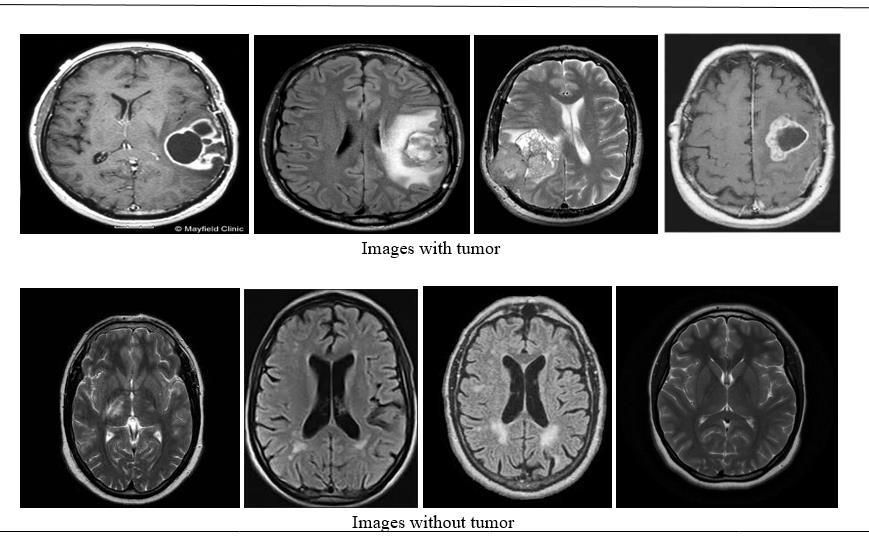
Theprimaryobjectiveofthisreviewpaperistoprovidea comprehensiveunderstandingoftheadvancementsinbrain tumordetectionusingmachinelearningtechniques.Itseeks to analyse and summarize the existing body of research, focusing on various machine learning methodologies, includingtraditionalapproachesandmoderndeeplearning techniques, that have been employed in this domain. By reviewing publicly available datasets, preprocessing methods,andfeatureextractionstrategies,thispaperaims to highlight the key components that contribute to the effectiveness of these models. Additionally, it seeks to examine the evaluation metrics used to assess model performanceanddiscussthechallengesassociatedwithrealworld implementation, such as data scarcity, class imbalance, interpretability, and computational requirements. Another significant objective is to explore emerging trends and innovative solutions, such as hybrid models,multimodaldataintegration,andfederatedlearning, whichhavethepotentialtoaddresscurrentlimitationsand advancethefield.Ultimately,thispaperaspirestoserveasa
valuable resource for researchers and practitioners by providinginsightsintothepotential,limitations,andfuture directionsofmachinelearninginbraintumordetection.
Specialists felt troublesome to identify the tumor at early organize.Theynotasitwerefelttroublesometodistinguish thetumoratearlyorganize,theymoreovertooknumerous daystoidentifyphysically.Duetothesetroublestherapeutic field faces certain issues. brain tumor detection using machinelearningleverageavarietyofapproaches,ranging from traditional algorithms to advanced deep learning models. Traditional methods often rely on handcrafted features,suchastexture,shape,andintensityextractedfrom medical images, which are then fed into classifiers like Support Vector Machines (SVMs), Random Forests, or DecisionTrees.Thesesystems,whileeffective,arelimitedby theirdependenceonfeatureengineeringandoftenstruggle togeneralizeacrossdiversedatasets.ChallengesinExisting Systems:Whilecurrentmethodsshowpromise,challenges like data scarcity, computational costs, and false positives/negativesstillexist Braintumordetectionusing machinelearninghasemergedasatransformativeapproach to improve the accuracy and efficiency of diagnosis. Traditionaldiagnosticmethods,suchasmanualanalysisof MRIorCTscans,areoftentime-consuming,subjective,and prone to human error. Machine learning (ML) leverages computational powerto analyzelarge volumes of medical imagingdata,identifyingpatternsandfeaturesthatmaybe imperceptibletothehumaneye.Existingsystemsforbrain tumor detection primarily utilize supervised learning techniques,wherelabeleddatasetsareusedtotrainmodels for classification and segmentation tasks. Algorithms like Support Vector Machines (SVM), Random Forests, and kNearestNeighbors(k-NN)havebeenappliedtodifferentiate betweentumorandnon-tumorregions.
Ref. No. Reference Paper Name Author Name Method
[1] Design and implementing brain tumor detectionusing machine learning approach. G. Hemanth, M.Janardhan, L.Sujihelen
[2] Brain Tumor Detection UsingMachine Learning. Manav Sharma, Pramanshu Sharma,Ritik Mittal, Kamakshi
In this paper author studied the model which is based on machine learning algorithm CNN and DataMiningmethodsto detect brain tumors from magnetic resonanceimageswith highaccuracy.
AConvolutionalNeural Network (CNN) has been utilized as the algorithm for feature extraction,anddivision. Thedatasetutilizedhas
International Research Journal of Engineering and Technology (IRJET) e-ISSN: 2395-0056
Volume: 11 Issue: 12 | Dec 2024 www.irjet.net p-ISSN: 2395-0072
Gupta beenprocuredfroman website.Inthispaper authorstudiedamodel which is based on machine learning algorithm CNN with 97.79%accuracy.
[7] A review on Brain Tumor Detection using Deep Neural Networks. Shaiq Wani, SachinAhuja, Abhishek Kumar
[3] Brain Tumor Detection using Deep Learning and Image Processing.
Aryan Sagar Methil
[4] A Literature Review on Brain Tumor Detection and Segmentation.
Aditya Miglani, Hrithik Madan, Saurabh Kumar, SanjayKumar
CNNachievedarecallof 98.55 on the training set, 99.73 on the confirmationsetwhich isveritablycompelling. Thispaperproposesa novel strategy to identify brain tumors from different brain pictures by to begin with carrying out distinctive picture preprocessing strategiesi.e.Histogram equalization and opening which was taken after by a convolutional neural network.
Magnetic Resonance Imaging(MRI)pictures areutilizedbyprosand neurosurgeonsforthe conclusion of brain tumors. The precision depends on the involvementandspace information of these specialists, and is moreover a time expending and costly handle. To overcome theselimitations,afew deep learning algorithms havebeen proposed for the locationofnearnessof braintumors.
[8] Review of Brain Tumor Segmentation, Detection and Classification Algorithms in fMRIImages. Tom Philip Pries,Roshan Jahan, Preetam Suman
[9] Brain Tumor Classification and Detection Based DL Models: A Systematic Review. Karrar Neamah, Farhan Mohamed, Myasar Mundher Adnan, Tanzila Saba, Saeed Ali Bahaj,Karrar Abdulameer Kadhim
presentedinthispaper.
Themajorthingofthis paperissubstantiallyto critically examine the former identification and classification efforts of brain excrescences using MRI( Magnetic Resonance Imaging) data.
Thispaperiscentered on review of those papers which incorporate division, location and classification of brain tumors.
This inquire about extend is devoted to conducting an comprehensive investigationofexisting endeavorsinthespace of brain tumor recognizableproofand classificationbymeans of MRI looks. The conclusion area comprehensively surveysthemeritsand demeritscharacteristic indeepneuralsystems.
[5] Brain Tumor Detection AnalysisUsing CNN:AReview.
Sunil Kumar, Renu Dhir, Nisha Chaurasia
[6] Review of Brain Tumor Detection Concept using MRIImages.
Ms. Swati Jayade,Dr.D. T. Ingole, Prof. Mrs ManikD. Ingole
The novel strategy employmentstheCNN classification strategy andhasbeenutilizedto ignore the dataset picture calculation mistake.
Inthisstudypaperwe covertheintroductory conception and practices of brain excrescence discovery from MRI images; review of different brain excrescence segmentationsystemis
[10] Brain Tumor Detection and Classification Using Intelligence Techniques:An Overview. Shubhangi Solanki,Uday Pratap Singh, Siddharth Singh Chouhan, SanjeevJain
Themainobjectiveness of this study stays to offer investigators, comprehensive literatureonmagnetic Resonance (MR) imaging’scapabilityto identify brain excrescences. This paperalsoexplainsthe morphology of brain excrescences,accessible data sets, addition styles, component extraction and categorization among Deep literacy (DL), Transferliteracy (TL), and Machine literacy(ML)models.
In conclusion, machine learning has emerged as a transformative technology in the field of brain tumor detection,offeringunprecedentedcapabilitiesinanalysing
International Research Journal of Engineering and Technology (IRJET) e-ISSN: 2395-0056
Volume: 11 Issue: 12 | Dec 2024 www.irjet.net p-ISSN: 2395-0072
complex medical imaging data with high accuracy and efficiency. This review has highlighted the evolution of machine learning techniques, from traditional algorithms Convolutional Neural Networks (CNNs) and transformerbased architectures. While these advancements have significantlyenhanceddiagnosticprecisionandautomation, challengessuchasdataavailability,classimbalance,andthe interpretability of models remain critical barriers to widespread clinical adoption. Promising trends, including federated learning, hybrid models, and the integration of multimodal imaging data, demonstrate the potential for overcomingtheselimitationsanddrivingfurtherprogressin the field. Moving forward, interdisciplinary collaboration between machine learning researchers, medical professionals,andpolicymakerswillbeessentialtoensure thatthesetechnologiesarenotonlyaccurateandreliablebut alsoethical,secure,andaccessible. Byaddressing existing challenges and exploring innovative solutions, machine learning can play a pivotal role in revolutionizing brain tumordetectionandultimatelyimprovingpatientoutcomes.
We would like to express our sincere gratitude to all the individuals and organizations that contributed to the developmentofthisreviewpaperonbraintumordetection using machine learning. First, we extend our deepest appreciationtotheresearchersandauthorswhosevaluable workhaspavedthewayforadvancementsinthisfield.Their contributionsintheareasofbrainimaging,machinelearning algorithms,andclinicalapplicationshavebeeninstrumental inshapingthecontentofthispaper.Wealsoacknowledge theacademicinstitutionsandhealthcareorganizationsthat haveprovidedaccesstodataandresources,whichhavebeen crucialinenablingtheprogressofmachinelearning-based tumordetectionsystems.
Specialthankstothepeerreviewersfortheirconstructive feedback and insightful suggestions, which have greatly improvedthequalityandclarityofthispaper.
Lastly,wewouldliketothankourfamiliesandcolleaguesfor theircontinuoussupportandencouragementthroughoutthe preparation of this review. Without their help, this work cannotnothavebeenpossible.
[1]. G. Hemanth , M. Janardhan ,L .Sujihelen, “Design and implementingbraintumordetectionusingmachinelearning approach” Third International Conference on Trends in ElectronicsandInformatics(ICOEI2019).
[2]. Manav Sharma, Pramanshu Sharma, Ritik Mittal , Kamakshi Gupta,“Brain Tumor Detection Using Machine Learning” Journal of Electronics and Informatics (ISSN: 2582-3825).
[3].AryanSagarMethil,“BrainTumorDetectionusingDeep LearningandImageProcessing”InternationalConferenceon ArtificialIntelligenceandSmartSystems(ICAIS-2021).
[4].AdityaMiglani,HrithikMadan,SaurabhKumar,Sanjay Kumar“ALiteratureReviewonBrainTumorDetectionand Segmentation”
[5].SunilKumar,RenuDhir,NishaChaurasia“BrainTumor DetectionAnalysisUsingCNN:AReview”
[6]. Ms. Swati Jayade, Dr. D. T. Ingole, Prof. Mrs Manik D. Ingole“ReviewofBrainTumorDetectionConcept UsingMRI Images” .
[7].ShaiqWani,SachinAhuja,AbhishekKumar“A reviewon PrainTumorDetectionusingDeepNeuralNetworks”
[8]. Tom Philip Pries,Roshan Jahan,Preetam Suman “Review of Brain Tumor Segmentation, Detection and ClassificationAlgorithmsinfMRIImages”.
[9].Karrar Neamah,Farhan Mohamed,Myasar Mundher Adnan, Tanzila Saba, Saeed Ali Bahaj,Karrar Abdulameer Kadhim“BrainTumorClassificationandDetectionBasedDL Models:ASystematicReview.
[10].ShubhangiSolanki,UdayPratapSingh,SiddharthSingh Chouhan,SanjeevJainpresentedBrainTumorDetectionand ClassificationUsingIntelligenceTechniques:AnOverview.