
International Research Journal of Engineering and Technology (IRJET) e-ISSN: 2395-0056
Volume: 11 Issue: 12 | Dec 2024 www.irjet.net p-ISSN: 2395-0072

International Research Journal of Engineering and Technology (IRJET) e-ISSN: 2395-0056
Volume: 11 Issue: 12 | Dec 2024 www.irjet.net p-ISSN: 2395-0072
Snehal R. Watharkar1, Shruti Dattatray Diwate2, Anushka Santosh Patil3, Rutuja Shankar Dhas4 , Prathmesh Kishor Dabhade5
1Assistent professor, Department of Electronics and Telecommunication Engineering, Kasegaon Education Society’s Rajarambapu Institute of Technology, affiliated to Shivaji University, Sakharale, MS-415414, India. 2345UG student, Department of Electronics and Telecommunication Engineering, Kasegaon Education Society’s Rajarambapu Institute of Technology, affiliated to Shivaji University, Sakharale, MS-415414, India. ***
Abstract - The main motive of body stress detection is health monitoring which works as a warning system in the case of the human body. This system integrates a temperature sensor, pulse sensor, GSR sensor, ECG sensor, and BP sensor and the output of these sensors givesphysiological parameters that predict stress level. The result of the monitoring system provides a clear pattern between sensor data andstresslevels. These results show the real-time prediction of body stress and it is accessed via a mobile application. The system provides a cost-effective and efficient solution for continuous stress monitoring. The paper offers valuable insights into health monitoring with technology, making it a worthwhile contribution.
Key Words: Body stress, Heart rate sensor, Temperature sensor, GSR sensor, Blood Pressure, LCD, Microcontoller, Bluetooth.
The detrimental effects of stress on health are welldocumented, with links to cardiovascular diseases, hypertension, diabetes, anxiety, and depression. The need for easily accessible stress monitoring techniques has become increasingly apparent. Stress affects the body in various ways, stemming from both psychological and physical triggers. Physiological changes such as increased heartrate,elevatedbloodpressure,acceleratedrespiration, higher body temperature, abnormal ECG patterns, and changesinskinconductivityareallindicatorsofheightened stresslevels.Byimplementingastressmonitoringsystem,it becomespossibletopreventadversehealtheffectsdue to changesintheseparameters.
The conventional methods of stress monitoring, such as questionnaires, interviews, and clinical evaluations, are time-consuming and provide only a snapshot of an individual's stress level at a specific moment. To address these limitations, the Body Stress Monitoring System has beendeveloped.Thissystemmeasuresstressbyanalyzing key physiological responses associated with the body’s reaction to stress. It utilizes an NTC thermistor to detect changesinbodytemperature,reflectingincreasedmetabolic activityandbloodflowduringstressfulconditions.TheECG sensor monitors heart activity, capturing heart rate
variability (HRV) and detecting irregular heart rhythms, both of which are common during stress. The heart rate sensorprovidesadditionalinsightintofluctuationsinheart rate, which often accelerates under stress. Finally, the GalvanicSkinResponse(GSR)sensormeasureschangesin skinconductivitycausedbyincreasedsweatglandactivity,a well-knownphysiologicalresponsetostress.Bycombining thedata fromthesefoursensors,thesystemcalculatesan individual’s stress level in real-time, providing a comprehensiveoverviewofthebody’sstressresponse.
Based on a Survey conducted with local hospital valuable insightsweregatheredregardingphysiologicalparameters and their relationship to stress. This information is instrumentalinrefiningtheBodyStressMonitoringSystem, asithighlightskeyfactorslikebloodpressure,pulserate,and oxygenlevels,whichfluctuateunderstressconditions.The surveyresultssupportfurthersensorcalibrationeffortsfor early stress detection and effective monitoring, which are crucialforaccurateandtimelyhealthassessments.
Blood Pressure (BP):
A normal BP range is 120/80 mm Hg. Stress-induced hypertensionoccurswhenBPexceeds140/90mmHg,often signalingelevatedstresslevels.BPismeasuredinmillimeters ofmercury(mmHg)withsystolic(uppervalue)anddiastolic (lowervalue)readings.
Sugar Levels:
For diabetic patients,stresscanraise blood glucoselevels, whileittypicallyhasminimalimpactonnon-diabetics.
Body Temperature:
Averagebodytemperatureisaround98.2°F(37°C).Although stressdoesnotusuallyincreasetemperature,feversabove 98.9°F(37.16°C)mayoccurduetootherhealthconditions.
Pulse Rate:
Thenormalpulseratefallsbetween72-82bpm,butstress canincreasebeyond100bpm,resultingintachycardia.
International Research Journal of Engineering and Technology (IRJET) e-ISSN: 2395-0056
Volume: 11 Issue: 12 | Dec 2024 www.irjet.net p-ISSN: 2395-0072
Oxygen Level:
Ahealthyoxygenlevelisabove95%.Ifoxygendropsbelow this threshold, it may indicate physical or mental stress, potentiallycausingsymptomssimilartosuffocation.
Sweating:
Visible perspiration on the face, scalp, or forehead is a commonsignofstressandmaybelinkedtoelevatedsugar levels.
Chest Pain:
Althoughnotdirectlymeasurablethroughsensors,chestpain can be stress-induced, particularly in individuals with cardiovascularconditions.
ECG Changes:
For those with pre-existing heart conditions, stress may indirectlyalterECGreadings,thoughitdoesnotsignificantly impactECGdatainhealthyindividuals.
Personal Life Issues:
Emotional events, arguments, injuries, or accidents can heightenstress.
Psychiatric Disorders:
Anxiety, insomnia, depression, and related disorders are knowntoamplifystress.
Chronic Diseases:
Hypertension,diabetes,osteoarthritis,andspondylosisare stress-exacerbatedconditionsthattendtoworsenasstress increases.
Intoday'sfast-pacedsociety,stresshasbecomeapervasive issueaffectingindividualsacrossvariousdomainsoflife.The detrimentalimpactofstressonphysicalhealth,mentalwellbeing, and overall productivity underscores the need for effectivestressmanagementstrategies.Inresponsetothis growing concern, researchers and technologists have increasinglyturnedtheirfocustowarddevelopinginnovative solutionsforstressmonitoringandintervention.
Recentdevelopmentsinhumanstressmonitoringsystems usingwearablesensorsarereviewed,highlightingtrade-offs in system design and sensor selection. The focus is on balancing the information content related to stress with wearability,addressingkeychallengesandconsiderations.[1]
An approach to detecting mental stress using unobtrusive wearablesensorsisdescribed,emphasizingtheanalysisof
heartratevariabilitytoestimatethestateoftheautonomic nervoussystem.[2]
Astudyexploresthedevelopmentof"Stress-Track,"asystem thatintegratesIoT,machinelearning,andwearablesensors to monitor stress levels in real time. It utilizes body temperature, sweat levels, and motion detection while emphasizing data storage and comprehensive stressanalysis.[3]
Theuseofmachinelearningandedgecomputinginstress detectionsystemswasexplored.Wearablesensorswereused to collect physiological data, which was then analyzed to identify stress indicators. This research highlighted the potentialofcombiningadvancedcomputingtechniqueswith wearablesensorsforefficient,real-timestressdetection.The research also discusses integrating stress monitoring into smart homesetups to makethe technology morepractical and accessible. This approach highlights the potential for deliveringefficient,real-timestressdetectionbycombining advanced computing techniques with wearable sensor systems.[4]
A sensor-based method was developed to identify and classifystresslevelsusingGalvanicSkinResponse(GSR)data. This research focused on workplace stress, addressing challengeslikedatavariabilityandaimingtoimprovestress detection accuracy. The goal was to provide reliable data insightsforeffectivestressmanagementstrategies.[5]
A new diagnostic approach was proposed that combines case-basedreasoning,fuzzylogic,andacalibrationphaseto accountforindividualdifferencesinstressresponses.This system aimed to overcome the limitations of traditional methodsbyprovidingpersonalizedstressassessmentsand aiding clinicians in decision-making for stress management.[6]
Building on these insights, the proposed Body Stress Monitoring System uses wearable sensors to provide accurate,real-timestressevaluations.Thesystemestimates stress levels by analyzing data from various sensors and calculating sensor-specific thresholds and offers users actionable feedback regarding potential health concerns. Emphasizingprivacyandethicalconsiderations,thesystem combinesprecision,usability,andaccessibility,makingita practicaltoolforstressdetectionandmanagementinboth personalandclinicalsettings.
ThegoaloftheBodyStressMonitoringSystemistomeasure stresslevelsbyanalyzingphysiologicalparametersusinga PIC18F4550 microcontroller, along with sensors and Bluetooth-enabled data display. The system is designed to trackbodytemperature,heartactivity,heartrate,andskin conductivity,whichareallindicatorsofstress.Theprocessed dataisthendisplayedbothonanLCDscreenandtransmitted
International Research Journal of Engineering and Technology (IRJET) e-ISSN: 2395-0056
Volume: 11 Issue: 12 | Dec 2024 www.irjet.net p-ISSN: 2395-0072
to a mobile application using Bluetooth for real-time monitoring.
PIC18F4550 micro-controller
Thisservesasthecentralprocessingunit,controllingsensor inputs,processingdata,andmanagingcommunicationwith theLCDandBluetoothmodule.
Temperature sensor
The temperature sensor is a crucial component used to measurebodytemperature,whichisessentialfordetecting stressresponses.ItutilizesanNTCthermistortodetectsmall changes in skin temperature and compares this data with normal body temperature. An increase in temperature indicated by the NTC thermistor signals the presence of stress.
Heart-rate sensor
Thissensorcontinuouslymonitorstheuser’sheartrate,akey parameterasstressoftencausesanelevatedheartrate.The heart rate sensor measuresthe number of heart beats per minuteforconfirminganelevatedheartrateunderstress.
ECG sensor
The electrocardiogram sensor tracks the heart's electrical activity, allowing for the analysis of heart rate variability (HRV) and abnormal heart rhythms caused by stress. The ECG sensor data is analyzed to assess HRV. Lower HRV is oftenassociatedwithstress,whileirregularheartpatterns furtherstrengthenthelikelihoodofastressresponse.
GSR sensor
The Galvanic Skin Response sensor measures skin conductivity,whichincreasesduetoheightenedsweatgland activity,anotherstressindicator.Eachsensoroutputsanalog signals,whicharethendigitizedbythemicrocontrollerfor further processing. The GSR sensor detects an increase in skinconductivity,whichisdirectlyrelatedtostress-induced sweatglandactivity.Theprocesseddata isanalyzedbyan algorithm that assigns different weightages to each physiologicalparameter,generatingafinalstressscore.
Integrated Hardware System
PowerSupply
Temperature Sensor
HeartRate Sensor
ECGSensor
GSRSensor
LDRSensor
PIC18F4550
Microcontroller
Fig-1: BlockdiagramofStressmonitoringSystem
TheBodyStressMonitoringSystemutilizesvarioussensors connected to the PIC18F4550 microcontroller to gather physiologicaldata.Thetemperaturesensor(NTCthermistor) onanalogpinRA1measuresbodytemperaturebyconverting thermalenergyintoananalogvoltage,whichisdigitizedby themicrocontroller'sADCtocalculatethetemperature.The heartratesensor(PulseSensor)onanalogpinRA0detects blood flow changes under the skin, generating an analog voltagethatisconvertedandprocessedtodetermineheart rate.Similarly,theECGsensoronanalogpinRA2measures the heart's electrical activity, providing a digital representationforhearthealthanalysis.AnLDR,connected toanalogpinRA3,measureslightintensitybygeneratingan analog voltage that the ADC digitizes for light-level evaluation.Themicrocontrollerprocessesthedatafromall sensorsandcomparesthereadingstopredefinedthresholds todetectpotentialstress.Ifthethresholdsareexceeded,the systemidentifiesstressandtransmitsthecalculatedstress level, along with other sensor data, to a mobile device via Bluetooth.
The Body Stress Monitoring System integrates a mobile application to display real-time stresslevels by combining sensor data, microcontroller processing, and Bluetooth communication.Physiologicaldataiscollectedusingsensors, includinganNTCthermistorforbodytemperature,ECGand heartratesensorsforcardiacactivity,aGSRsensorforskin conductivity, and an LDR sensor for blood pressure estimation.ThePIC18F4550microcontrollerprocessesthis
International Research Journal of Engineering and Technology (IRJET) e-ISSN: 2395-0056
Volume: 11 Issue: 12 | Dec 2024 www.irjet.net p-ISSN: 2395-0072
dataandcalculatesstresslevelsusingpredefinedalgorithms. A Bluetooth module transmits the processed data to the mobileapplication,whichfeaturesauser-friendlyinterface. The app displays live sensor readings and stress levels, categorizingthemas"Normal,""Moderate,"or"HighStress" for clarity. It also offers alerts for critical stress levels, encouraging timely user action. By providing immediate feedback, the application enhances the practicality of the system,allowinguserstomonitortheirstressconveniently whilesupportingbetterstressmanagementandoverallwellbeing
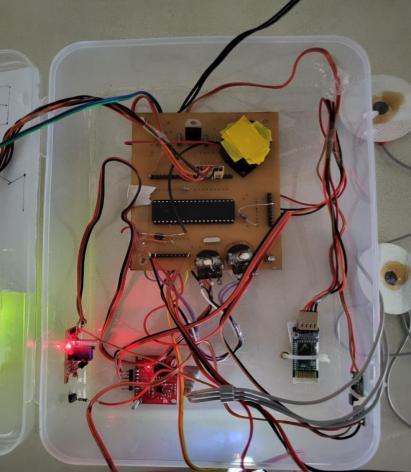
TheBodyStressMonitoringSystemdevelopedhereadoptsa unique approach by integrating a range of physiological sensors alongside the PIC18F4550 microcontroller for efficientdataprocessingandoutput.Comparedwithexisting systems in the literature, this system demonstrates key advancements.Traditionalsystemsfrequentlyusesingleor dual-sensorconfigurations,oftenlimitedtomonitoringheart ratevariability(HRV)orGalvanicSkinResponse(GSR)data. Forexample,ChoiandGutierrez-Osuna's(2009)workrelies onHRValone,whileBakkeretal.(2011)emphasizeGSRfor recognizing stress patterns. In contrast, this Body Stress Monitoring System combines an NTC thermistor (temperature), heart rate sensor, ECG sensor, and GSR sensor, delivering a comprehensive, multi-faceted stress analysis. Integrating multiple sensors enhances stress detection accuracy by capturing a broader physiological responseprofilethatincludesheartrate,temperature,and skinconductivity.
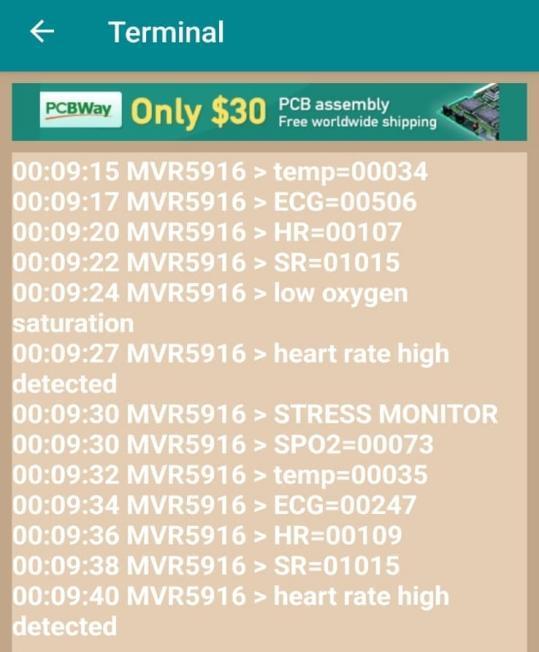
Stress detection among the individuals is determined by deviations in physiological parameters temperature, heart rate, blood pressure, and skin response from their normal ranges.Stressedindividuals(E,F,G,H)consistentlyexhibit elevated blood pressure (ranging from 125 mmHg to 140 mmHg,comparedtothenormal120/80mmHg)and,insome cases,elevatedheartrates(e.g.,107BPMforFand109BPM for G, above the normal range of 60–100 BPM). Despite
slightly lower-than-normal temperatures (33–36°C compared to 36.5–37.5°C), the heightened blood pressure and heart rate indicate stress. Conversely, non-stressed individuals (A, B, C, D, I) mostly have parameters within normal limits: heart rates between 77–90 BPM, blood pressureatornear120mmHg,andtemperaturesbelowthe normal range, but not indicative of stress. Although skin response values are uniformly high (around 1000 units) acrossallindividuals,stressdetectionappearstorelymore heavily on elevated blood pressure and heart rate. This suggests that these two parameters play a key role in identifyingstress,whereasskinresponsemayserveasaless variablebaselineinthisdataset.
Table -1: AnalysisTable
2024, IRJET | Impact Factor value: 8.315 | ISO 9001:2008
International Research Journal of Engineering and Technology (IRJET) e-ISSN: 2395-0056
Volume: 11 Issue: 12 | Dec 2024 www.irjet.net p-ISSN: 2395-0072
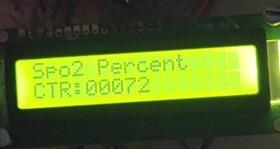
Fig-4:Spo2ResultonLCD
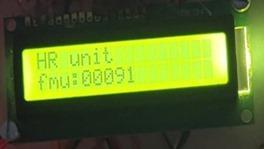
Fig-5:HeartRateResultonLCD
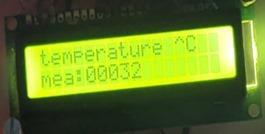
Fig-6:TemperatureResultonLCD
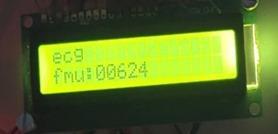
Fig-7:ECGResultonLCD
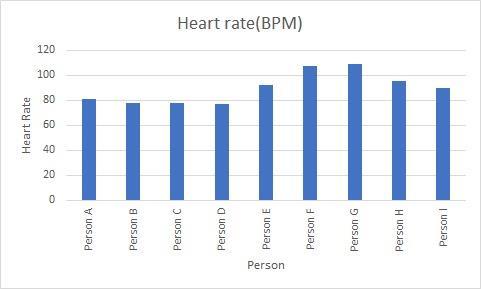
Chart-1:EvaluationofPerson’sHeartRate
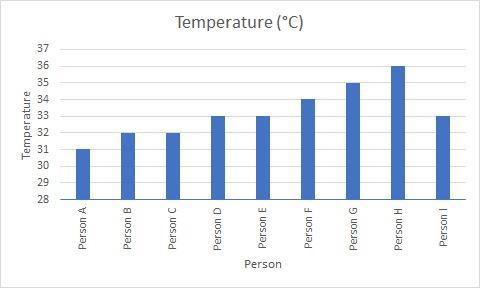
Chart-2:EvaluationofPerson’sBodyTemperature
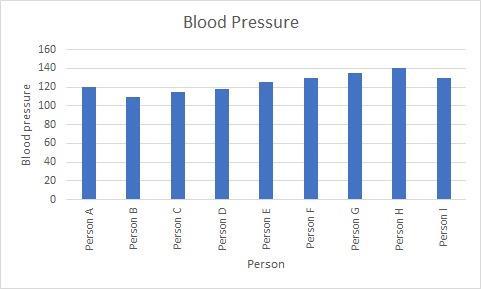
Chart-3:EvaluationofPerson’sBloodPressure
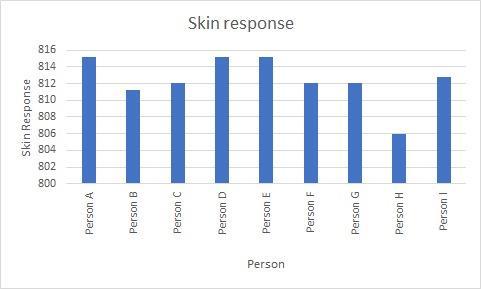
Chart-4:EvaluationofPerson’sSkinResponse
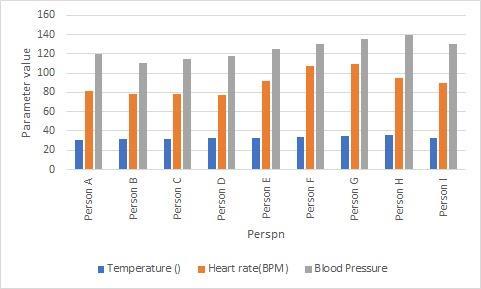
Chart-5:OverallAnalysis
TheBodyStressMonitoringSystemdescribedinthisproject isasimpleandnon-invasivewaytotrackstressinreal-time. ItusesthePIC18F4550microcontrollerandseveralsensors to measure different signs of stress. These include an NTC
2024, IRJET | Impact Factor value: 8.315 | ISO 9001:2008 Certified
International Research Journal of Engineering and Technology (IRJET) e-ISSN: 2395-0056
Volume: 11 Issue: 12 | Dec 2024 www.irjet.net p-ISSN: 2395-0072
thermistor to check body temperature, an ECG sensor to monitor changes in heart rate, a heart rate sensor, a GSR sensor to measure how much the skin sweats and an LDR sensortomeasurebloodpressure.Thesystemcollectsand processes this information to calculate stress levels. The resultsareshownonanLCDscreenandsenttoamobileapp throughBluetooth,givingusersquickfeedback.Thissystem offersa completesolution for tracking stress continuously andcanbeusefulforbothpersonalhealthcareandmedical settings. It helps to identify stress-related problems early, allowing people to take action and manage their stress to improveoverallwell-being.Overall,thissystemprovidesa more complete, affordable, and user-friendly option than manyotherstressmonitoringsystems.Itsfocusonreal-time dataandeaseofusemakesitidealforeverydayhealthand wellnessuse.Byofferingclearandimmediateinsights,this BodyStressMonitoringSystemcouldbevaluableinhelping peoplemanagestressandsupportpreventativehealthcare.
[1]Lakudzode,S.andRajbhoj,M.,2016.Reviewonhuman stress monitoring system using wearable sensors. International Research Journal of Engineering and Technology(IRJET),3(04).
[2]Choi,J.andGutierrez-Osuna,R.,2009,June.Usingheart rate monitors to detect mental stress. In 2009 Sixth InternationalWorkshoponWearableandImplantableBody SensorNetworks(pp.219-223).IEEE.
[3] Al-Atawi, A.A., Alyahyan, S., Alatawi, M.N., Sadad, T., Manzoor,T.,Farooq-i-Azam,M.andKhan,Z.H.,2023.Stress MonitoringUsingMachineLearning,IoTandWearable
[4]Sensors.Sensors,23(21),p.8875.
[5]Nath,R.K.,Thapliyal,H.,Caban-Holt,A.andMohanty,S.P., 2020.Machinelearningbasedsolutionsforreal-timestress monitoring. IEEE Consumer Electronics Magazine, 9(5), pp.34-41.
[6] Bakker, J., Pechenizkiy, M. and Sidorova, N., 2011, December. What's your current stress level? Detection of stress patterns from GSR sensor data. In 2011 IEEE 11th internationalconferenceondataminingworkshops(pp.573580).IEEE.
[6] Begum, S., Ahmed, M.U., Funk, P., Xiong, N. and von Schéele, B., 2007. Classify and diagnose individual stress using calibration and fuzzy case-based reasoning. In CaseBased Reasoning Research and Development: 7th International Conference on Case-Based Reasoning, ICCBR 2007 Belfast, Northern Ireland, UK, August 13-16, 2007 Proceedings7(pp.478-491).SpringerBerlinHeidelberg.