STUDY ON REINFORCED CONCRETE USING COCONUT FIBER

ANJALI DHAMALA1 , AAQIB FIRDOUS2 ,
1,2, PG Student, Department of Civil Engineering, Excel Engineering College. Komarpalayam
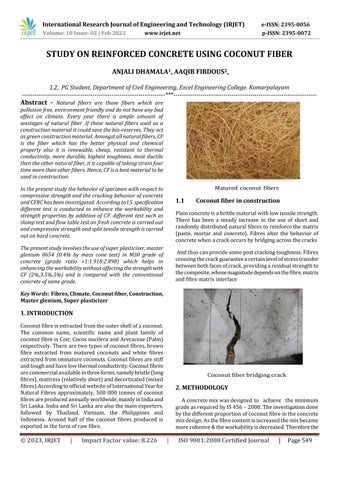
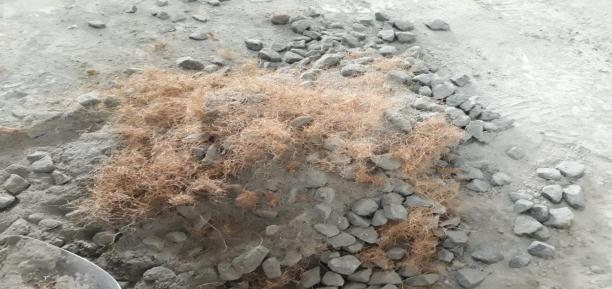
Abstract - Natural fibers are those fibers which are pollution free, environment friendly and do not have any bad effect on climate. Every year there is ample amount of wastages of natural fiber .If these natural fibers used as a construction material it could save the bio-reserves. They act as green construction material. Amongst all natural fibers, CF is the fiber which has the better physical and chemical property also it is renewable, cheap, resistant to thermal conductivity, more durable, highest toughness, most ductile then the other natural fiber, it is capable of taking strain four time more than other fibers. Hence, CF is a best material to be used in construction.
In the present study the behavior of specimen with respect to compressive strength and the cracking behavior of concrete and CFRC has been investigated. According toI.S.specification different test is conducted to enhance the workability and strength properties by addition of CF. different test such as slump test and flow table test on fresh concrete is carried out and compressive strength and split tensile strength is carried out on hard concrete.
The present study involves the use of super plasticizer, master glenium 8654 (0.4% by mass cone test) in M30 grade of concrete (grade ratio =1:1.918:2.898) which helps in enhancing the workability without affectingthestrengthwith CF (2%,3.5%,5%) and is compared with the conventional concrete of same grade.
Key Words: Fibres, Climate, Coconut fiber, Construction, Master glenium, Super plasticizer
1. INTRODUCTION
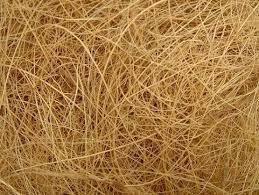
Coconutfibreisextractedfromtheoutershellofacoconut. The common name, scientific name and plant family of coconutfibreisCoir,CocosnuciferaandArecaceae(Palm) respectively.Therearetwotypesofcoconutfibres,brown fibre extracted from matured coconuts and white fibres extractedfromimmaturecoconuts.Coconutfibresarestiff andtoughandhavelowthermalconductivity.Coconutfibres arecommercialavailableinthreeforms,namelybristle(long fibres),mattress(relativelyshort)anddecorticated(mixed fibres).AccordingtoofficialwebsiteofInternationalYearfor Natural Fibres approximately, 500 000 tonnes of coconut fibresareproducedannuallyworldwide,mainlyinIndiaand SriLanka.IndiaandSriLankaarealsothemainexporters, followed by Thailand, Vietnam, the Philippines and Indonesia. Around half of the coconut fibres produced is exportedintheformofrawfibre.
1.1

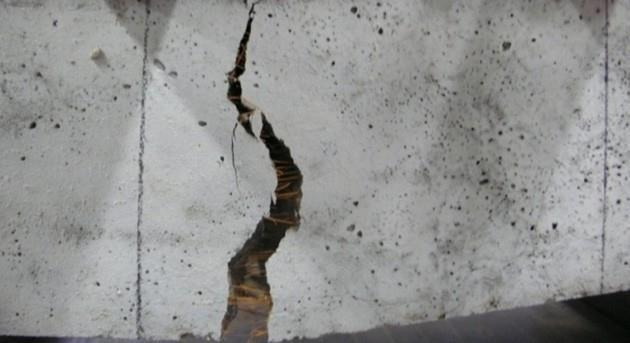
Plainconcreteisabrittlematerialwithlowtensilestrength. There has been a steady increase in the use of short and randomlydistributednaturalfibrestoreinforcethematrix (paste, mortar and concrete). Fibres alter the behavior of concretewhenacrackoccursbybridgingacrossthecracks
Andthuscanprovidesomepostcrackingtoughness.Fibres crossingthecrackguaranteeacertainlevelofstresstransfer betweenbothfacesofcrack,providingaresidualstrengthto thecomposite,whosemagnitudedependsonthefibre,matrix andfibrematrixinterface
2. METHODOLOGY
Aconcretemixwasdesignedto achieve theminimum gradeasrequiredbyIS456–2000.Theinvestigationdone bythedifferentproportionofcoconutfibreintheconcrete mixdesign.Asthefibrecontentisincreasedthemixbecame morecohesive&theworkabilityisdecreased.Thereforethe
suitabilityofcoconutfibrereinforcedconcretewithsuper plasticizer is studied in comparison with different proportionofcoconutfiber
Byaddingthecoconutfibretheworkabilitywasnotachieved whichwasrequired.Thereforeasuperplasticizerisadded whichgavethegoodworkabilityandalsonotaffectonthe properties and strength of concrete. The optimum percentageofmastergylaniumisdeterminedwiththehelp ofmassconetest.
Minimumofthreetestspecimenwastakenforeachanalysis. Thefollowingtestsconductedontherespectivespecimens.
• CompressiveStrengthoncube
• SplittingTensileStrengthoncylinder
Concrete mixes of grade M30 was made using OPC. Replacement of cement was made using Supplementary Coconut Fibers, with defined percentage 2%, 3.5%, 5% respectively.
The concrete mixes tested for compressive strength at 3 days,14days,and28daysofcuring.
Followingsectionsdescribestheexperimentalprogramme and the procedures used for conducting various test involvedintheprogramme.
3. TESTS ON MATERIALS
3.1. Tests on coarse aggregate
Thecoarseaggregatepassingthrough20mmsizesieveand retainingon10mmsieveistestedasperIS:2386-1963and propertiesarelistedintable
Theapparatususedare–AsetofISSievesofsizes–80mm, 63mm, 50mm, 40mm,31.5mm, 25mm, 20mm, 16mm, 12.5mm,10mm,6.3mm,4.75mm,3.35mm,2.36mm,1.18mm, 600μm,300μm,150μmand75μm.
Theweightofsampleavailableshouldnotbelessthanthe weight given below: The sample for sieving should be preparedfromthelargersampleeitherbyquarteringorby meansofasampledivider.
Procedure to determine particle size distribution of Aggregates.
The test sample is dried to a constant weight at a temperatureof110C.
ThesampleissievedbyusingasetofISSieves.
Oncompletionofsieving,thematerialoneachsieve isweighed.
Cumulative weight passing through each sieve is calculated as a percentage of the total sample weight.
Finenessmodulusisobtainedbyaddingcumulative percentageofaggregatesretainedoneachsieveand dividingthesumby100
PropertiesofAggregate
Tests on Fine aggregate
The fine aggregate passing through 4.75mm size sieve is testedasperIS:2386andpropertiesarelistedbelow.
Sieve analysis
Sieve analysis helps to determine the particle size distributionofthecoarseandfineaggregates.Thisisdoneby sievingtheaggregatesasperIS:2386(PartI)–1963.Inthis weusedifferentsievesasstandardizedbytheIScodeand thenpassaggregatesthroughthemandthuscollectdifferent sized particles left over different sieves. Fig.3a shows the distributionoffineaggregate.
SieveAnalysis
4. EXPERIMENTAL INVESTIGATION
4.1 Preparation of materials
Sample ofaggregate for eachbatchofconcrete shell be of desired grading and in air-dried condition. In general, the aggregate shall be separated into fine and coarse fraction andrecombinedforeachconcretebatchinsuchamannerso astoproducethedesiredgrading..
4.2 Proportioning
The proportioning of the materials including water in concretemixesfordeterminingthesuitabilityofthematerial available shall be similar in all aspects to those to be employedinwork.Wheretheproportionsoftheingredient ofconcreteusedonthesitearetospecifiedbyvolume,they shallbecalculatedfromtheproportionalbyweightusedin thetestcubesandtheunitweightofthematerials.
4.3 Weighing
The quantities of cement, each size of aggregate and water for each batch shall be determined by weight to an accuracyof0.1percentofthetotalweightofthebatch.
4.4 Mixing of concrete
The concrete shall be mixed by hand or perfectly in laboratorybatchmixerinsuchamannersoastoavoidloss ofwaterorothermaterials.Eachbatchofconcreteshallbe ofsuchasizesoastoleaveabout10percentexcessafter mouldingthedesirednumberoftestspecimen.
water at temperature of 24 – 30 Celsius until they are transportedtothetestinglaboratory Theyshallbesentto the testing laboratory well packed in a damp sand, damp sack or other suitable materials so as to arrive there in a dampconditionnotlessthan24hoursbeforethe time of test
5. Test on fresh concrete
5.1 Slump test:
The slump test is used to determine the workability of concretemixpreparedatthelaboratoryorconstructionsite. Theslumpvaluewasdeterminedforthevariousmixtobe preparedintheproject.Generallyconcreteslumpvalueis usedtofindouttheworkabilityofconcretewhichindicates water–cementratio.
Procedure:
• Cleantheinternal surfaceof themouldandapply oil.
• Placethemouldonsmoothhorizontalnon
porous baseplate.
• Fill the mould with the prepared concrete mix in fourapproximateequallayers.
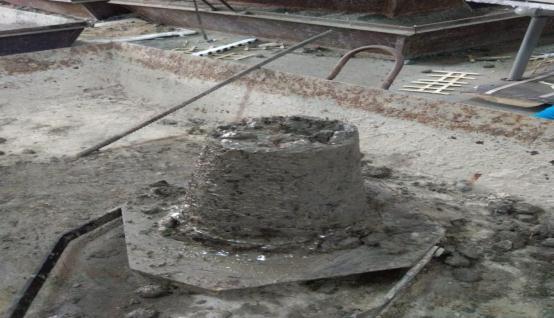
• Tampeachlayerwith25stokesoftheroundedend of the tamping rod in a uniform manner over the cross-section of the mould. For the subsequent layers the tamping should penetrate into the underlyinglayer.
4.5 Compaction
Mixingofconcrete
Whencompactionbyhand,thestandardtampingrodshall beusedand thestokesoftherodshall bedistributedin a uniform manner over the cross section of the mould. The number of stokes per layer required to produce specified condition will vary according to the type of concrete. For cubical specimen, the concrete shall be subjected to 35 stokesperlayerfor15cmcubes.Thestokesshalltouchthe surfaceofunderlyinglayer.Wherevoidsareleftbytamping rod,thesidesofthemouldshallbetappedtoclosethevoids.
4.6 Curing of test specimens
Thetestspecimensshallbestoredonthesiteataplace free from vibration, under damp matting, sacks or other similarmaterialsfor24hours+halfhourfromthetimeof addingthewatertotheotherincidents.Thetemperatureof theplaceofstorageshallbewithintherange22-32Celsius Aftertheperiodof24hours,thespecimenshallbemarked for the later identification removed from the mould and unless required for testing within 24 hours store in clean
• Remove the excess concrete and level the surface withatrowel.
• Cleanawaythemortarorwaterleakedoutbetween themouldandthebaseplate.
• Raisethemouldfromtheconcreteimmediatelyand slowlyinverticaldirection.
• Measuretheslumpasdifferencebetweentheheight ofthemouldandthatofhighestpointofspecimen beingtested
6. Tests on hardened concrete
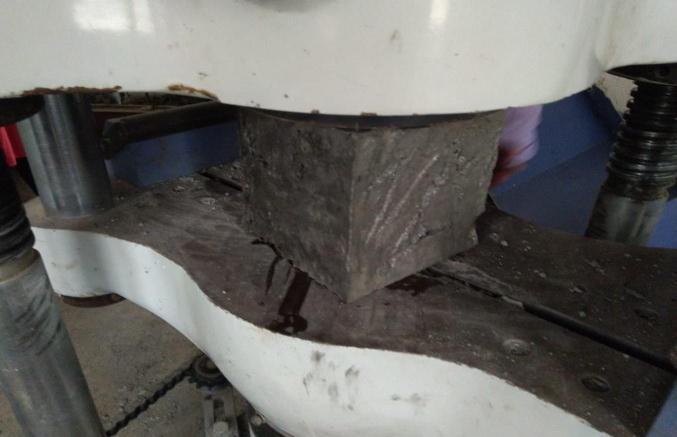
6.1 Compressive strength test
• Oneofthemostimportantanduseful propertyof concrete.
• Primarily meant to withstand compressive stress and can be used as an approximate qualitative measureforotherpropertiesofhardenedconcrete.
• Compressivestrength testiscarriedoutoncubes forvariousmixesM1,M2,M3andM4.
• Thecompressivestrengthofcubeswastestedon3, 7and28days.
• Formulaforcompressivestrengthofconcrete: =Loadapplied(P)/Crosssectionalarea(A)=N/mm2
• Determine the diameter of the test specimen by averagingthethreediametersandthelengthofthe specimen by averaging at least two length measurements taken in the plane containing the linesmarkedonthetwoends.
• Placethespecimenontheplywoodstripandalign so that the lines marked on the ends of the specimen are vertical and centered over the plywood strip. Place a second plywood strip lengthwise on the cylinder, centered on the lines markedontheendsofthecylinder.
• Applytheloadcontinuouslyandwithoutshockata constantratewithintherange100to200psi/min [0.7 to 1.4 MPa/min] splitting tensile stress until failure of the specimen. Record the maximum applied load indicated by the testing machine at failure.Notethetypeoffailureandtheappearance oftheconcrete.
Calculation:
The splitting tensile strength of the specimen are given below:
T = 2P/πld
Compressivestrengthtest
6.2 Split tensile strength test
Thetensilestrengthofconcreteisoneofthebasicand important properties. Splitting tensile strength test on concrete cylinder is a method to determine the tensile strengthofconcrete.
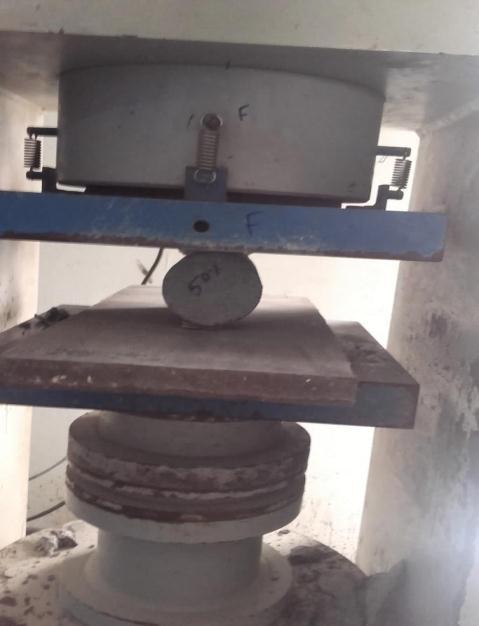
Need: The concrete is weak in tension due to its brittle nature and is not expect to resist the direct tension. The concretedevelopscrackswhensubjectedtotensileforces. Thus it is necessary to determine the tensile strength of concrete to determine the load at which the concrete membermaycrack.
Procedure:
• Drawdiametriclinesoneachendofthespecimen usingasuitabledevicethatwillensurethattheyare inthesameaxialplane
Where,
T =splittensilestrengthin MPa
P = maximum applied load indicated by the testingmachineinN
l= lengthinmm
d= diameterinmm
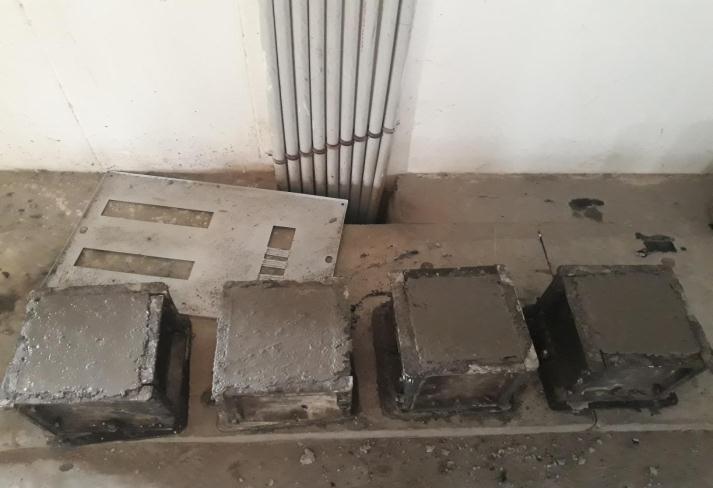
7. CASTING OF CUBES
Tablegivenbelowshowthequantityofcubesrequiredfor differentmixes.
9. CONCLUSIONS
From the experimental study, the following results were obtained:
Withrespecttocompressivestrength,incorporating asmallamountofCF2%enhancestheperformance of concrete, as expected and counters harmful shrinkageeffectsinconcrete.
The results suggest that short coconut fibers are more effective in enhancing the performance of concrete
The recommended threshold value of the fiber contentthatwillbenefitthelongtermdurabilityof theconcreteinallenvironmentsis2.0%.
Thepropertiescanincreaseordecreasedepending uponfiberlengthanditscontent.Asaresultofthis CFRC strengths can be greater than that of plain concrete.
ByreplacingcementcontentwithCF,decrementin theweightthusINERTIAOFSTRUCTUREmayresult intolowdensity,slenderandeconomicalaswellas greenstructures
Withtheadditionofadmixturecohesivemixcanbe madesuitablyworkable.
8. TEST RESULTS
The observations of the various tests on Fresh And Hard CFRC was conducted such as flow tests, slump test, compressivetestofconcreteandsplittensiletestshavebeen analyzed and the behavior is studied. The results of the analysis are discussed in the subsequent sections. The various types ofcubesandcylinders of different mix were testedundercompressiontestingmachine.
8.1 Compressive strength of concrete
It is a versatile material reported as most ductile and energy absorbent have wide scope in earthquake prone areas as well as in marine structures.
REFERENCES
[1] SlateFO,“Coconutfibersinconcrete”,EngJSingapore Vol.3(1),pp.51–54,(1976).
[2] Cook DJ, Pama RP, Weerasingle HLSD “Coir fibre reinforcedcementasalowcostroofingmaterial”,Build Environ,Vol.13(3),pp.193–198,(1978).
[3] AzizMA,ParamasivamP,LeeSL“Prospectsfornatural fibre reinforced concretes in construction”, Int J Cem Compos Lightweight Concrete, Vol. 3(2), pp.123–132, (1981).
[4] ParamasivamP,NathanGK,DasGuptaNC“Coconutfibre reinforced corrugated slabs”, Int J Cem Compos LightweightConcrete,Vol.6(1),pp.19–27,(1984).
CompressiveStrengthResults
[5] Agopyan V, Savastano Jr H, John VM, Cincotto MA. Developments on vegetable fibre- cement based materialsinSãoPaulo,Brazil:anoverview.CemConcr Compos2005;27(5):527
36.
[6] JohnVM,CincottoMA,SjostromC,AgopyanV,Oliveira CTA.Durabilityofslagmortarreinforcedwithcoconut fibre.CemConcrCompos2005;27(5):565–74.
[7] Mohammad HBMH “Coconut fiber reinforced wall panelling system”, Masters thesis, Faculty of Civil Engineering,UniversitiTeknologi,Malaysia,(2005).
[8] Ramakrishna G, Sundararajan T. “Studies on the durability of natural fibres and the effect of corroded fibres on the strength of mortar”, Cem Concr Compos Vol.27(5),pp.575–582,(2005).
[9] Li Z, Wang L, Wang X. “Flexural characteristics of coir fiberreinforcedcementitiouscomposites”,FiberPolym, Vol.7(3),pp.286–294,(2006).
[10] Reis JML “Fracture and flexural characterization of natural fiber-reinforced polymer concrete”, ConstructionandBuildingMaterials,Vol.20(9),pp.673–678,(2006).
[11] Asasutjarit C, Hirunlabh J, Khedari J, Charoenvai S, Zeghmati B, Shin UC “Development of coconut coirbased lightweight cement board”, Construction and BuildingMaterials,Vol.21(2),pp.277–288,(2007).
[12] Majid Ali “Coconut fibre: A versatile material and its applicationsinengineering”,JournalofCivilEngineering and Construction Technology, Vol. 2(9), pp. 189-197, (2011).
BIOGRAPHIES
ANJALI DHAMALA is a Civil EngineerfromtheAnnaUniversity. Her academic record is very impressive and good. She is very hardworkingandintelligent.

AAQIB FORDOUS is a Civil EngineerfromtheAnnaUniversity. His latest paper was “Design and analysisof4in1schoolcomplex” publishedinIRJET.