FIBER REINFORCED CONCRETE USIING SISAL FIBER WITH MgSO4
Dhaval Pateliya1 , Mauni Modi2
1PG Student, M.E (civil) Infrastructure Engineering, L.D.R.P. Institute of Technology & Research, Gandhinagar

2 Assistant professor, Dept. of Civil Engineering, L.D.R.P. Institute of Technology & Research, Gandhinagar ***
Abstract - This research work involves the topic of adding natural fibers to the concrete to study the strength properties and observe whether thepropagationofshrinkageproblemsis reduced. Basically, there are two types of natural fibre. Natural inorganic fibres like asbestos, basalt, etc. as well as natural organic fibres like banana, bamboo, coconut, palm, pine, kenaf, jute, sisal, sugar cane, and soon. Naturalfibres are studied as construction materials by differentresearchersand can be used in cement, mortar or concrete in building materials. This research work may include the characteristics of sisal fibre, its properties and also compatibility of fibre(sisal) and compares its nature of fibre- freeconcreteand concrete with natural fibre(sisal). But it also to compare and draw the conclusion of the proportion of different fibres cement. This study summarizes the comparisonanddifference between fiber-free concrete and concrete with natural fiber(sisal).
Key Words: Sisalfiber,Fiberreinforcedconcrete,Natural fiber,Artificialfiber,Testing.
1. INTRODUCTION TO SISAL FIBER
Sisalfiberisthemostcommonlyusedplantfibersandisvery easytogrow.Sisalisastrongfiberobtainedfromthesisal plantsleaves.Theplantofsisalfiberisofficiallycalledagavesisalana.Theplantshavingleaveslikeasword-shapedrose thatbeginstohaveteethandgraduallywearsmatureteeth overtime.Allleaveshavemanystraightandlongfibersthat canbe eliminated by means ofa method calledpeeling or decortication. During the peeling process, the leaves are brokentoremovethepulp andplantmaterial,left behind the strong fibers. For the production of twine and textile, fiberswillbewarpedintothread,orpulpedtomakepaper makepaperproducts.
1.1 PROPERTIES OF SISAL FIBER
Theactualcontentofthefiberelementsisabout4%ofthe weight of the plant and can be extracted by a method as “decortication”.Intheirnaturallife,typicalplantsgenerate 200to250fruitfullyavailableleaves.Also,eachleafofsisal plantswillproduceapproximately1000fibers.
Inordertoobtainasuperiorqualitystructureandgood sustainability,itispreferabletousesisal fiberstodevelop several strength characteristics of the structure. Different plantfibersofsisalfibersofsisalweretestedforitsadequacy fortheadditionincementconcrete.Thephysicalproperties
of the fibers do not show deterioration of the concrete structure. The leaves are dried out, brushed and bailed to producefibersfromsisalplant.
1.2 CHARACTERISTICS OF SISAL FIBER
Sisalfiberisthehardestcellulosefiberslikecoconutfiber.It containscelluloseabout70%inthefiber.Withcellulose,this fiberalsoconsists ofhemicellulose,lignin, pectinand wax etc. the properties of this fiber are greatly affected by its chemicalcomposition.In fiberslikesisalandcoconutfibers, cellulose is the strongest organic constituent that imparts fiber stability, stiffness and strength, where sisal fibers contain70%ofcelluloseonly.Hence,wecansaythatsisal fiber is a one of the strongest fibres. Hemicellulose is a polysaccharide that binds together in a relatively short branch. Lignin is an aromatic hydrocarbon polymercompositethatgivesstiffnesstothesisalplant.
1.3 NEED OF STUDY
Theapplicationofconcrete asa strengthening material in structuralissomewhatlimitedbythedisadvantagesuchas poor ductility and durability, fatigue, lower impact resistance, low tensile strength, brittleness. It is also very muchrestrictedtoabsorbdynamicstressescauseddueto shock loading. The brittleness is compensated in the structuralmemberbyaddingareinforcingbarorpre-stress inthetensilearea.Thedevelopmentofsteelbarssolvesthe problemoflowertensilepropertyofconcrete.Lowertensile strengthandhigherstrengthrequirementsoftheconcreteis the main problems of steel and these problems are still existed, and will be improved through different types of reinforcement material. Further concrete also has lower ductility. In concrete, increasing the fiber- content will increasewillincreasethestrengthanddecreasedryingand plasticshrinkagebylimitingthecrack-expansion.
1.4 SCOPE
The scope pf this study work is to find out the gap in researchoftheFRCusingsisalfiberbandimprovementin thephysicalandmechanicalpropertiesofSFRC(sisalfiber reinforced concrete). A limited number of additional tests are also performed to determine the tensile and flexure properties,compressive-anddurabilitypropertiesandalso tocheckitssuitabilitybycomparingtheconcretewithsisal fiberandwithoutsisalfiber.
2. MATERILS
The various to be used in this research works to makesisalfiberreinforcedare:
1. Sisalfiber
2. Cement
3. Aggregates
Fineaggregate
Coarseaggregate
aggregate properties, and different types of chemical reactionbetweentheaggregateandthecement-pastewhich mayhaveaneffectonthebond.
2.5 Water:
4.Water
5.MagnesiumSulphate(Tocheckdurability)
2.1 Sisal Fiber:
Sisal fibres are used as reinforcement in the sisal fibrereinforcedconcrete.Sisalfibreisanaturalfibre,oneof thestrongestfibres.Thelengthofsisalistobeusedaround2 to8cm;varioussizesofsisalfibresareavailableinmarket. Short discrete vegetable fibre (sisal) was examined for its suitabilitybeforeincorporationinacementconcrete.
2.2 Cement:
TheOrdinaryPortlandCementof53gradeswhichis readily available in the market is used in the project. The most commonly used cement in concrete is Ordinary Portland cement of 53 Grade conforming BIS: 126001989(2009).
Itisanimportantconstituentofconcrete,mortar–mix and many plasters. Typical physical requirement for cementsis:aircontent,fineness,expansion,strength,heatof hydration and setting (earlier & final) time. Most of these physicaltestsarecarriedoutusingmortarorpastecreated fromcement
2.3
The sand particles should also pack to give minimum void ratio, higher voids content leads to requirementsofmoremixingwater.Inthepresentstudythe sand confirms to Zone III as per Indian standards (BIS: 10262, BIS: 383). Sand should not contain any foreign materialthataffectsthestrengthofconcrete.
2.4
Generally, a concrete-mix includes both fine and coarse aggregate (combined) content about 60 to 70%. Aggregate(coarseandfine)usedbytheconcreteindustry aresuitabletomanufacturefibrereinforcedconcrete.The many aggregate properties that are very important with respect to concrete strength are particle size distribution, shape of the particles, mechanical properties of the
Waterisrequirementscanbeusedforconcreteand curing.Waterexercisedforconcreteshouldbefreefromall typeofimpurities.Thedirtywaterexercisedforconcreting work,thenitwillcreatedifficultiesininitialaswellasfinal setting and also a reason behind early failure of the structure. In order to cover the large surface area of the fibreswithacement-paste,theexperienceshowsthatthe cementratiois0.4-0.6andtheminimumcementcontentis 320kg/m.
2.6 Magnesium Sulphate:
Magnesiumsulphatesolutionwasusedtofindout the resistance to sulphate attack of sisal fiber reinforced concrete.Thesulphateresistancewasdeterminebasedon thechangeinweightandchangeincompressivestrengthof the samples after exposing t magnesium sulphate. The magnesiumsulphateprocuredinthepowderedfromlocal supplier was used. The magnesium sulphate used was in 99.97%pureform.
The magnesium sulphate (MgSO4) powder was dissolvedinwatertoprepareonacidicsolution.Depending upon the concentration required, the quality of the magnesium sulphate (MgSO4) varies in the solution expressedintermsofpercentagebyweight.
For instances, a solution of magnesium Sulphate (MgSO4) at a concentration of 5% consists of 5 kg of magnesium sulphate (Mg SO4) powder consisting of 100 litersofwater.Notethatwateristhemainingredientand theofmagnesiumsulphate(MgSO4)powderisonlyapartof themassofthemagnesiumsulphate(MgSO4)solution.
3 RESULTS AND DISCUSSIONS
3.1 Fresh Concrete Properties
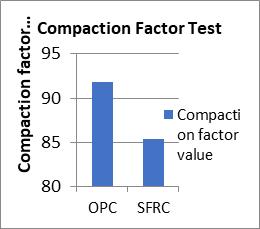
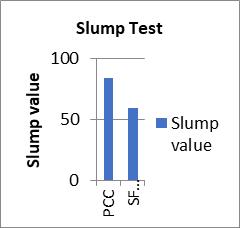
Aspartofinvestigation,determineoffreshconcrete propertieswasnecessarytodeterminetheeffectsofadding sisal fiber concrete on workability of the concrete is the slumptestandcompactionfactortest.
3.2.1 Workability of concrete
Todeterminetheworkabilityofconcretewithout fiberaswellassisalfiberreinforcedconcrete,varioustests onfreshwereperformedaccordingtocodeIS:1199-1959. Thetable1.1showsthepropertiesoftheworkabilitytests.
1.1:
Fromthevariesofslumptestitisconcludedthatthewatercontentrequiredtoobtainrequiredworkabilityishigherfor fiberconcrete.Theworkabilityoffiberreinforcedconcrete islesserthannormalconcreteforequalamountofwater. Thismaybecauseofthewater-absorptionabilityofdrysisal fiber. It indirectly gives that compaction of concrete is difficultasincreasefibercontent.
Table 1.2: Initial and final weight of each concrete specimen (With fiber)
Abovetable1.2and1.3showstheweightofeachconcrete cube specimen of SFRC before immersion to magnesium Sulphateandafterremovingfromitafter28,56and90days.
Table 1.4: Average weight % weight loss of specimens (without fibre)
3.2 Durability test
Durabilitytestwasperformedatthecuringperiod 28, 56, and 90 days. Total 24 cubes (12 with fiber + 12 without fibre) of size 150 mm x 150 mm x 150 mm were casted.Thencubeswereexposedtosolutionof5%MgSO4 and then durability of cubes measured in term of (1) percentage loss in weight and (2) percentage loss in compressivestrength.Forasingletest,threesampleswere testedwithanaverageof3asthefinalresult.Durabilitytest wasconductedasperIS-516:1959.
3.2.1 Percentage loss in Weight
Table 1.1: Initial and final weight of
Table 1.5: Average weight and % loss in weight (With fibre)
Abovetable1.4and1.5showstheresultsforinitialandfinal weight of each concrete specimen with and without sisal fibreafter28and56days.
Tables show that percentage loss in weight at 28 daysforconcretespecimenwithoutfiberis1.67% ascomparedtoconcretespecimenwithsisalfiber having1.50%weightloss.
Also,for56dayscuringperiod,percentagelossin weight for concrete specimen without fiber is 3.07%ascomparedtoconcretespecimenwithsisal fiberhaving2.20%weightloss.
For90dayscuringperiod,percentagelossinweight for concrete specimen without fiber is 4.09% as compared to concrete specimen with sisal fiber having2.97%weightloss.
Comparision of Weight loss (controlled) MgSo4
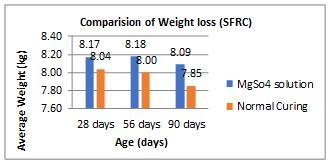
Graph 1-2: Average weight loss for controlled concrete specimens
Graph1-4: percentage weight loss for concrete specimens
Graph 1-4 compares percentage weight loss for concretespecimensbothcontrolledandconcretewithSisal fibresubjectedtonormalcuringwithwaterandexposedto MgSO4 solution. Here, it shows that percentage loss in weight for concrete without fibre is more compared to concrete with sisal fibre. Hence, concrete with sisal fibre (SFRC)ismoredurablethanplainconcretewithrespectto percentagelossinweight.
3.2.2 Loss in compressive strength
Table 1.6: Compressive strength for controlled cube
compressivestrengthforcontrolledcube
Graph1-3: Average weight loss for concrete specimens with fibre
Graph 1-2 and 1-3 compares average weight loss for concrete specimens both controlled and concrete with Sisal fibre subjected to normal curing with water and exposedtoMgSO4 solution.
Table 1.7: Compressive strength for cubes with fibre
compressivestrengthforcubeswithfibre
Table 1.6 and table 1.7 shows the results for compressive strength for concrete specimens both controlled and concrete with Sisal fibre subjected to normal curing with waterandexposedtoMgSO4 solution.
Table 1.8 and table 1.9 shows the results for average compressivestrengthandpercentagecompressivestrength loss for concrete specimens both controlled and concrete withSisalfibresubjectedtonormalcuringwithwaterand exposedtoMgSO4 solution.
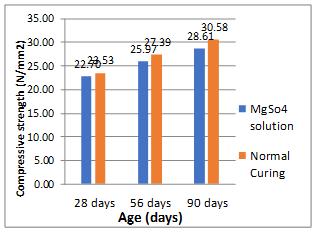
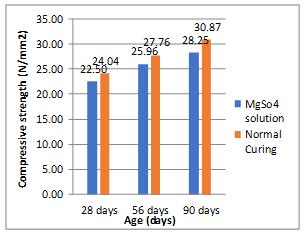
Graph 1-5 and 1-6 compares the average weight loss in compressive strength for concrete specimens both controlledandconcretewithSisalfibresubjectedtonormal curing with water and exposed to Magnesium Sulphate solution.
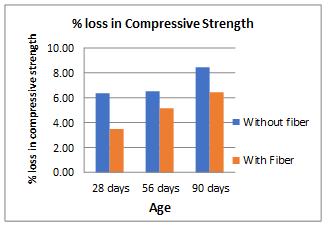
Graph1-7comparespercentagecompressivestrengthloss forconcrete specimensbothcontrolled and concretewith Sisal fibre subjected to normal curing with water and exposedtoMgSO4 solution.Here,itshowsthatpercentage compressivestrengthlossforconcretewithoutfibreismore comparedtoconcretewithsisalfibre. Hence,concretewith sisalfibre(SFRC)ismoredurablethanplainconcretewith respecttopercentagelossincompressivestrengthtoo.
4 CONLUSION
Fromtheexperimentalwork,resultanddiscussion,various concludingpointsaresummarized:
From the Slump values it is concluded that the amountofwaterrequiredtoobtainworkabilityis higher for fiber concrete. The workability of fiber reinforcedconcreteislesserthannormalconcrete forsamewatercontent.
ComparetonormalconcreteSisalfiberreinforced concrete (SFRC) is more durable. Here, after exposed to Magnesium Sulphate, compressive strength loss for SFRC is average 4% compared normalconcretehaving6.5%compressivestrength loss. Also, the weight loss is around 1.75% comparedto2.75%weightlossforPCC.
REFERENCES
1. Baluch H., Zibra Y.N., Azad A.K.: “fracture characteristics of sisal fibre reinforced concrete”, theinternationaljournalofcementcompositesand light weight concrete, volume 9, number 3, 1987:157-168
2. Barros J. A.O., silva F.A., Toledo Filho R.D.: “Experimental and numerical research on the potentialities of layered reinforcement configuration of continuous sisal fibers for thin mortarpanels”,Constructionandbuildingmaterials 102(2016):792-801
3. Bergstrom Swen G. &Gramt H.: “Durability of alkalisensitive fibres in concrete”, The international journal of cement composites and lightweight concrete,volume6,number2,1984:75-80
4. Ferreira S.R., Silva F.A., Lopes Lima P.R., Toledo Filho R.D.: “Effect of fiber treatment on the sisal fibrepropertiesandfibre-matrixbondincementbasedsystem.”,Constructionandbuildingmaterials 101(2015):730-740
5. Mwamila B.L.M.:” Natural twines as main reinforcementinconcretebeam”,Theinternational journal of cement composites and lightweight concrete,volume7,number1,1985:11-20
6. Rahumana.,YeshikaS.:“Studyonpropertiesofsisal fibre reinforced concrete with different mix proportions and different percentages of fibre addition”, international journal of research in engineeringandtechnology,vol-4,2015:474-477
7. RaijiwalaD.B.,PatelJ.A.,:“Useofsugarcanebagasse ashaspartialreplacementofcementinconcrete–Anexperimentalstudy”,Globaljournalofresearch inengineering,vol-15(2015)
8. Ramakrishna G., Sundararajan T.: “Studies on the durabilityofnaturalfibresandtheeffectofcorroded fibres on the strength of mortars”, cement and concretecomposites -585
9. Sanjuan M.A., Toledo Filho R.D.: “Effectiveness of crackcontrolatearlyageonthecorrosionofsteel bars in low modulus sisal and coconut fibrereinforcedmortars”,cementandconcreteresearch, Pergamon,vol-28,1998:555-565
10. Santos S.F., Schmidt R., Almeida A.E.S.F., Tonoli G.H.D.,SAVASTANOJr.H.:“supercriticalcarbonation treatmentonextrudedfibre-cementreinforcedwith vegetablefibres”,cementandconcretecomposites 56(2015)84-94
11. SantoshF.M.R., deSouza T.F.,BarqueteD.M.,Amado F.D.R.: “Comparative analysis of the sisal and piassava fibres as reinforcement in lightweight cementitious composites with EVA waste’, construction and building materials 128(2016):315-323
12. Sathish P., Murugesh V.: “Experimental Study on Sisal Fibre Reinforced Concrete with Partial ReplacementofCementbyGroundGranulatedBlast FurnaceSlag”,Internationaljournalofscienceand research,2015:79-82
13. Shetty M.S. “Textbook of Concrete Technology”, 2012:312-327
14. SilvaF.A.,MobasherB.,ToledoFilhoR.D.:“Cracking mechanismindurablesisalfibrereinforcedcement composites”, cement and concrete composites, 31(2009):721-730
15. SilvaF.A.,MobasherB.,ToledoFilhoR.D.:“Fatigue behavior of sisal fibre reinforced cement composites”, Material science and engineering, A527(2010):5507-5513
16. SilvaF.A.,MobasherB.,SoranakomC.,ToledoFilho R.D.: “Effect of fibre shape and Morphology on interfacialbondandcrackingbehaviorsofsisalfibre cement based composites”, Cement and concrete composites33(2010):814-823
17. Silva F.A., Toledo Filho R.D., Melo Filho J.D.A., De MoraesR.F.:“Physicalandmechanicalpropertiesof durable sisal fibre-cement composites”,
ConstructionandBuildingmaterials24(2010):777785
18. SenT., Paul A.:“Confiningconcrete withsisal and jute FRP as alternatives for CFRP and GFRP”, International journal of sustainable built environment(2005)4:248-264
19. SenT.,ReddyH.N.J.:“FlexuralstrengtheningofRC beamsusingnaturalsisalandartificialcarbonand glass fabric reinforced composite system” SustainableCitiesandSociety10(2014):195–206
20. Weij.,Meyerc.:“Improvingdegradationresistanceof sisal fiber in concrete through fiber surface treatment", Applied Surface Science 289 (2014) 511–523