Design and Fatigue Analysis of a Typical Aircraft Wing fuselage Lug attachment structure
Sonu Kumar1 , Amit Kumar Jha2 , G R Kesheorey31 M. tech Student, Department of Mechanical Engineering, Vindhya Institute of Technology & Science Indore (MP)

2 Senior Manager, Hindustan Aeronautics Limited, Bengaluru
3 Professor, Department of Mechanical Engineering, Vindhya Institute of Technology & Science Indore (MP)***
Abstract - The structure of a fighter jet is quite complicated. The aeroplane is required to do challenging manoeuvres while fighting off enemies. During that, high magnitude stresses will be placed on the wings as a result of the combination of high level acceleration and challenging maneuvers. The fighter aircraft often has multiple wing-fuselage attachment points. An aircraft rarely has a static overload-related failure during its service life. Fatigue and damage tolerance design, analysis, testing, and service experience correlation are crucial for maintaining an aircraft's airworthiness during its entire economic service life. The fatigue loading that occurs during service on lug type joints completes load transmission through the pin. This is why the wingfuselage lug joints are regarded as the aircraft structure's most fracture-critical parts.
In the current project, an attempt is made to predict the fatigue life of a wing-fuselage attachment bracket of a fighter aircraft to meet the stress and fatigue design considerations. Subsequently, linear static analysis is carried out. The stress results of finite element analysis show that stress levels of lug structure meet the strength requirement. Furthermore, utilizing constant amplitude SN data for various stress ratios and local stress history at stress concentration, fatigue life computation is carried for a typical service loading. The lug structure's computed damage factor for the given load spectrum comes out to be less than one. This demonstrates that the wing lug structure is safe to use and that the crack has not initiated.
Keywords: Fatigue life, Damage, Aircraft, Wing, Lug design, Static analysis
1. INTRODUCTION
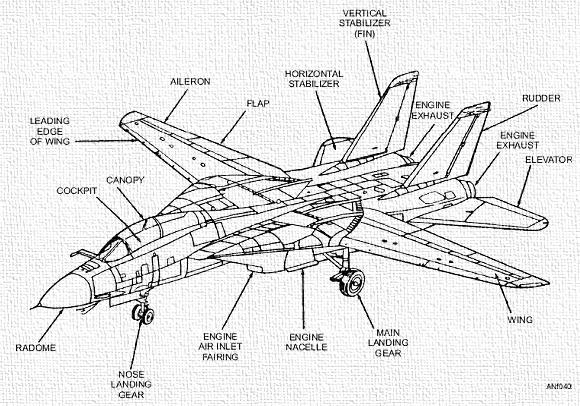
An aircraft is a sophisticated human-made flying machine that serves that function. The fuselage, wings, empennage, landing gear, power supply, and control surfaces are depicted in Fig. 1 as the majority of the aircraft'scomponents[1].
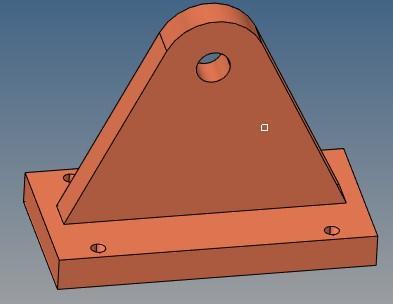
Wingsandthefuselagearejoinedbylugs,whicharealso usedtojoinenginestoenginepylons,flaps,ailerons,and
spoilers to the wings. For receiving large, focused loads, lugjointsarefrequentlyemployed.Additionally,whilein use, lug-type joints experience cyclic loading; all loads are transmitted through the pin. During cyclic loading, high-stress concentration and fretting at the pin-to-lug interface may lead to fracture initiation and crack growth.Asaresult,thewing-fuselagelugconnectionofa typical aircraft can be analyzed using finite element staticanalysisandfatiguelifecomputation.
Previously,lugsconnectingtowing-fuselageandvertical tail-fuselage for an aircraft airframe structure defined geometrywassubmittedtofiniteelementanalysis[2-3]. As a result of the fast acceleration and complicated motions, the wing surface will be subjected to severe loads [4]. The root of the wing will experience the highest stress concentration due to the maximum bending moment [5]. Brackets are used to attach the wings to the fuselage framework. The bending moment and shear stresses of the wing were transferred to the fuselage by these attachments [6]. Furthermore, fatigue is the continuous decrease of structural component strength during operations, with failure occurring at much lower levels of ultimate stress. This is due to the fact that repeated loads operate for a longer period of time. Based on static structural analysis, fatigue life calculations utilising the stress life technique and Goodman's criterion predict that the geometry is safe [7]. As a result, the wing-fuselage lug attachment structureisdesignedusing a finite elementanalysisand fatiguelifecalculationapproach.
2. METHODOLOGY
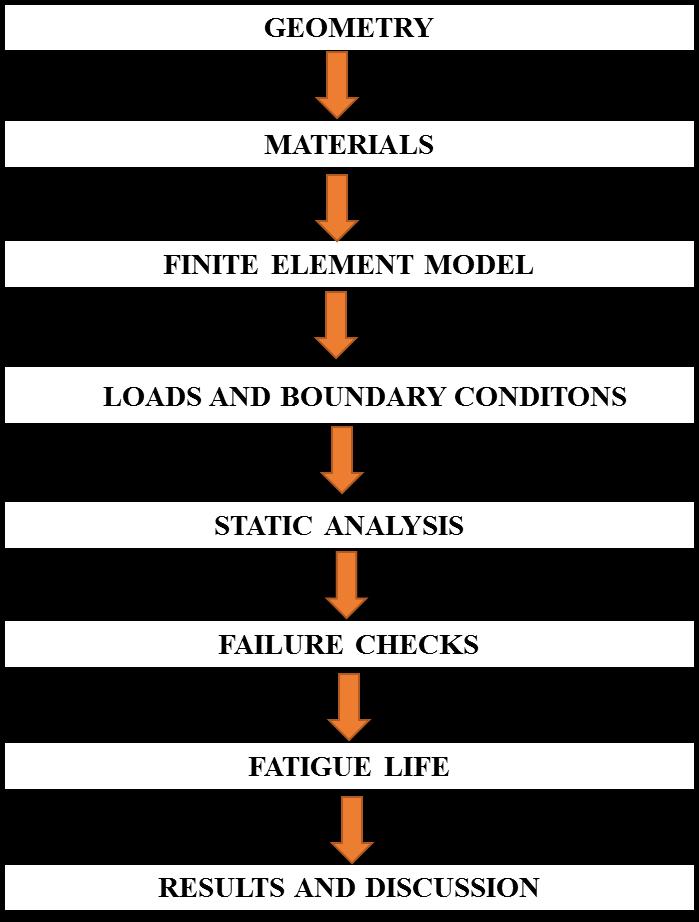
The present work is focused on the modeling and the static analysis of aircraft wing fuselage attachment lugs. Additionally,fatiguelifeestimationisalsocarriedoutto study the behaviour of lugs because of repeated cyclic loading. The methodology and workflow carried out in thepresentworkareasshowninFig2.
2.1 Geometry configuration
2.2 Materials
The combination of strength and lightweight is most important in material selection in aeronautical applications [8]. In many cases, trials and errors can be costly, thus a proper project and design are vital. As a result, the following material properties should be consideredforstructuralapplications[9-10]:
Elasticity: Itisthepropertybyvirtueofwhichamaterial deformed under the load is enabled to return to its original dimension when the load is removed. Some examplesareMildSteeletc.andmaybeconsideredtobe perfectlyelasticwithinacertainlimit.
Ductility: It is the property which permits a material to be drawn out longitudinally to a reduced section, under theactionoftensileforce.
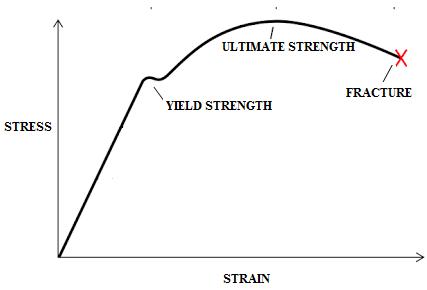
Yield stress: The yield stress is a measure of elastic deformation resistance. In structural applications, yield stress is usually more critical than tensile strength because once it is exceeded, the structure has deformed over and above acceptable limits. The material follows the stress up to the hooks law, also known as the proportionality limit, where stress equals strain and is knownasYieldstress.
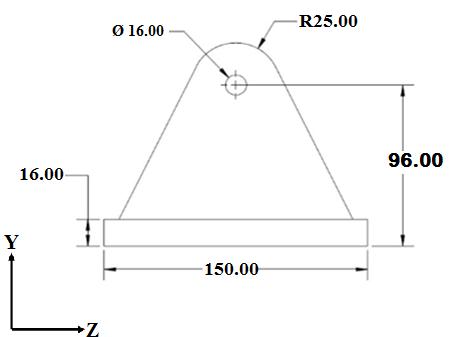
Ultimate stress: When the lower yield point is crossed out, there is a gradual increase in stress with respect to the strain; this increase follows the parabolic curvature until failure, but failure occurs at a point where it is going down the uppermost part of the gradually increasingcurve,whichisthepointofultimateStress.
2.3 Finite Element Model
MSC
Patran
MSC Patran is a general-purpose analysis software packagewithopenarchitectureandinteractivegraphics that provides a complete computer aided engineering environment for linking engineering design, analysis, and result assessment activities. It is a simulation software environment that aids engineers in the conceptualization, development, and testing of product designs[12].MSCPatranintegratesdesign,analysis,and outcomeevaluationintoasingleenvironment.Thereare pre- and post-processing tools, and sophisticated simulations may be done on virtual components, assemblies, and structures. MSC Patran allows engineers to directly import CAD (computer aided design) geometry from a defining CAD programme of their choice, create meshes, define loads, boundary conditions, visualise the results, and ultimately better understand the relationship between various design decisions and product performance characteristics such asstress,strain,vibration,heattransfer,andmanymore [12].MSCPatranusersmayeasilyandeffectivelyiterate and analyse various design options, as well as reuse previousdesignsandfindings,withouttheneedfornonvalue-added manual data cleaning and recreation. MSC Patran can help organizations to reduce the cost and confusion of maintaining various pre- and postprocessing techniques used throughout the company to improvegoodsandacceleratetimetomarket.
MSC Nastran is a powerful, general purpose finite element analysis tool with an integrated user interface and model editor which is used to analyse linear and nonlinear stress, dynamics, and heat transfer characteristicsofstructuresandmechanicalcomponents [12]. It offers combined sizing, shape, and topology to improve overall design efficiency and lifecycle performance predictability. MSC Nastran captures the complex interactions between multiple disciplines to ensure accurate stimulation of physical phenomena, enabling engineers to correctly stimulate how a design behaves under real-world conditions without having to
solelyrelyuponcostlyphysicalprototypes.Itisidealfor highly-engineered products such as automobiles, airplanes, heavy equipment, electronics and other complexproducts[12]
Mesh
Mesh creation is the processing of creating finite elements from curves, surfaces, or solids. MSC PATRAN providesthefollowingautomatedmeshes:isoparametric mesh, Paver, and Tetrahedral (Tet) mesh [12-14]. The lug bracket is meshed using Tet mesh as shown in Fig 5 andtabulatedinTable1.
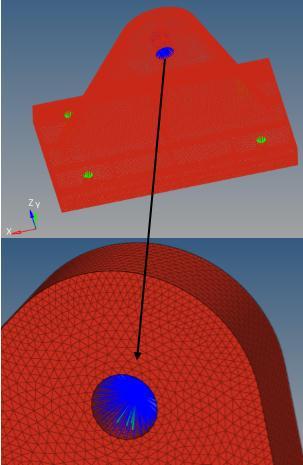
Totalnumberofnodes 60314
Totalnumberof elements
296801
Elementtype Tetrahedral
2.4 Loads and boundary conditions
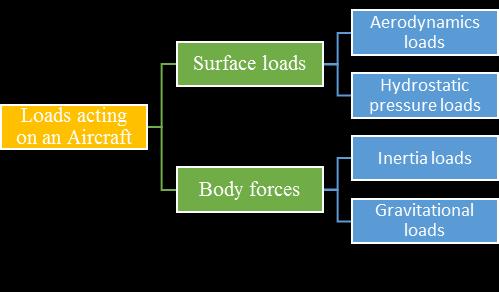
There are different types of loads acting on an aircraft, such as surface forces, body forces [8]. It can be shown asaschematicchartasbelowinFig6.
7:Loadsactingonanaircraft
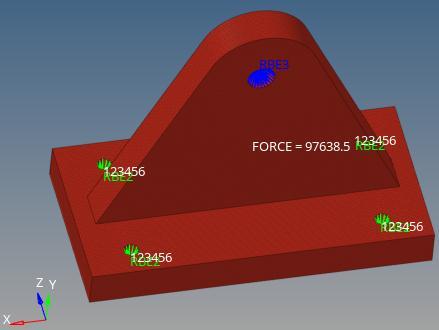
In Fig 7, it depicts the load and boundary conditions applied to the wing fuselage lug attachment bracket [8, 12-14]. The resultant force operating at the bracket's root is computed using a "6g" load factor with factor of safety(FOS)1.5.
ForceinYdirection=Fy=97060N
ForceinZdirectionFz=10613N
Resultantforce=Fr=97638.51N
The load is distributed to the lug structure by RIGID BODY ELEMENT (RBE3)[12-14]. As maximum lift is createdinthewingsduring take-off,it isinjectedatone end of the spar beam in an upward direction. At the bracket's root, where the wing and fuselage will be joined, this load will effectively provide the necessary bending moment. All six degrees of freedom are restricted to the semi-circular circumferential area between the top and bottom lug holes of the wing fuselagelugattachmentbracket.Thecentreofboltholes is connected to the lug structure by RIGID BODY ELEMENT(RBE2)[12-14].
2.5 Static analysis
A linear static analysis is one in which a linear relation exists between the applied forces and displacements [12-15]. In practise, this applies to structural problems where stresses remain within the linear elastic range of thematerialbeingemployed.Astaticanalysis(SOL101) run can be configured to validate finite element model findingssuchasdisplacements,deformation,andstress.
2.6 Failure checks
Lug and connected bolt analysis involves several failure modes, associated with different areas of the lug[8,14,16]:
2.6.1 Bolt shear (σs)
σs= MPa, where,Areaofbolt=A= , and, d=Diameterofbolt(mm)
2.6.2 Tension tear out (σt)-Lug
σt = ( ) MPa, where,Widthoflug=W(mm) and,Diameteroflug=D(mm)
ReserveFactor(RF)=
2.6.3 Shear tear out (σs) -Lug
σs= MPa, where,a=Shearoutdistance(mm), and, t=Thicknessoflug
RF= .
2.6.4 Bearing out (σb)-Lug
σb= MPa,
RF= .
2.7 Fatigue life
LoadsandBoundaryCondition
Fatigue is the phenomenon of progressive rupture, an elementundertheinfluenceoffluctuatingcyclicloads.In
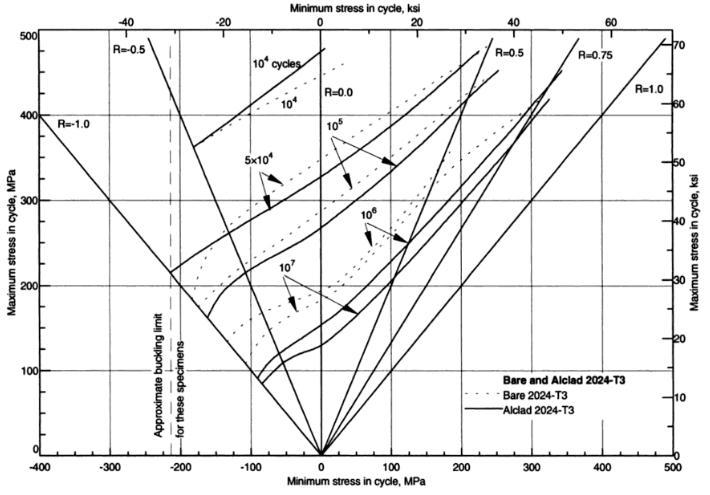
materials science, fatigue is a process whereby a material is weakened by cyclic loading [16-18]. The resulting stress may be less than the ultimate tensile stress, or even the yield stress of the material, but may stillcausecatastrophicfailure[16-18] Therearevarious techniques for plotting the results of the fatigue failure test of a member subjected to fluctuating stress. One of them is called the modified Goodman diagram and is shown in Fig 9 [11]. For this diagram the minimum stressisplottedontheabscissaandthemaximumstress componentsontheordinate.
2.7.1 Fatigue occurrence and objective
Fatigue occurs when a material experiences lengthy periodsofcyclicorrepeatedloads[17-20]
FluctuatingLoads
Multi-axialLoading
Vibrations/Excitations
Fatigue objective is to calculate life of structure when it issubjectedtorepetitiveload/randomload.
2.7.2 Fatigue damage
The failure happens primarily in three stages: fracture initiation, crack propagation, and catastrophic overload failure[17-20]. For fatigue estimates, a damage tolerant design criteria and stress-life techniques were used. Constant amplitude loading is preferable for fatigue calculations.Variableamplitudeloadswilloperateinthe issue, but they will be converted to groups of constant amplitude loading at their respective frequencies. If the loading has a constant amplitude, the number of cycles beforethepartfailsduetofatigueisrepresented.
Palmgren Miner's Rule is used to calculate fatigue life for crack initiation as expressed by equation 1[17-18]
Miner'srules:
D=∑ =C …(1) where,
D=damageandC=constantequalto1, ni=numberofcyclesataparticularstressand, Ni=thefatiguelifeatthatstress.
2.8 Results and discussion
2.8.1 Static analysis
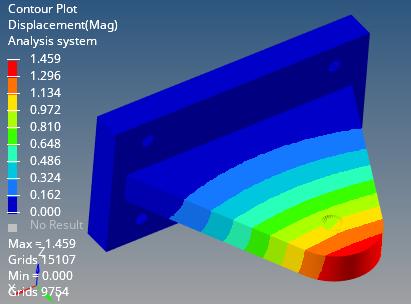
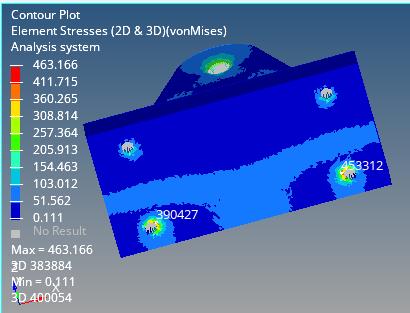
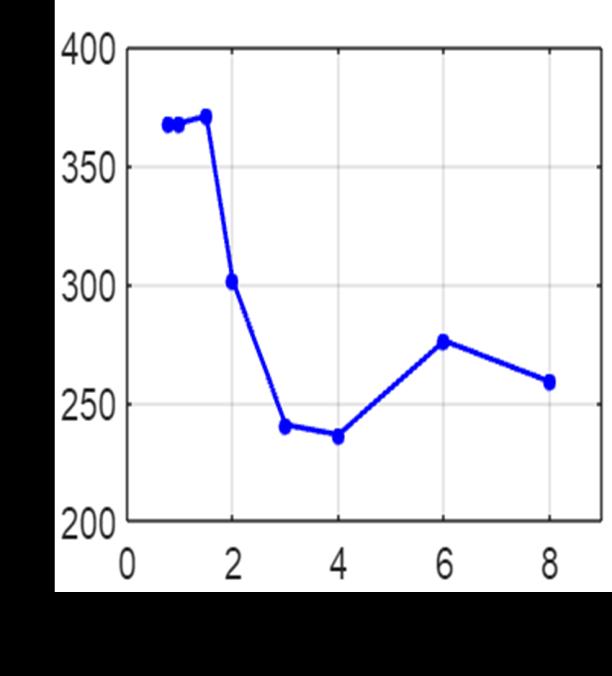
Results of static analysis of the lug are explained in this section. Additionally, convergence criteria for maximum principal stress vs element length is also studied as shown in Fig 10 and Table 3, respectively. Stress values at the lug attachment bracket connecting the bolt hole and the displacement contours are shown in Fig 11 and 12, respectively. The maximum stress near the hole in the connecting bolt of the lug attachment bracket is 463.166N/mm2and1.459mmisthetotaldeformation.
2.8.2 Failure analysis
Forcesusedinlugdesignaregivenbelow:
ForceinYdirection=Fy=97060N
ForceinZdirectionFz=10613N
Resultantforce=Fr=√ =97638.51N
Tensilestress=σt= , d=√ = √ =16mm
Failure Check for Bolt Shear
σt= , where,A= ,
Substituting,σt= = =242.93
ReserveFactor(RF)= = =3.03>1
Failure due to tension tear out
where, a=16.2mm,
σs = =188.35N
ReserveFactor= =1.55>1
Failure due to bearing
σb = = =381.4
ReserveFactor(RF)= =1.53>1
2.8.3
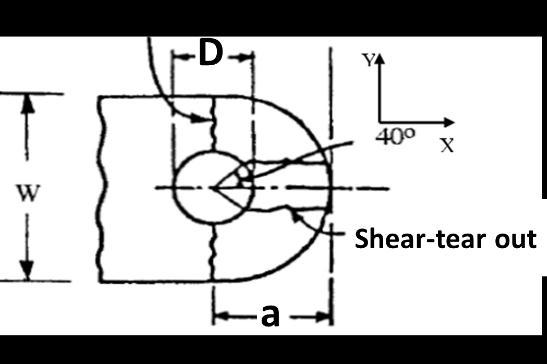
TensiontearoutiscalculatedasexpressedinFig13:
σt = ( ) =σt = ( )
where,W=45mm&D=16mm
σt= 210.43
ReserveFactor(RF):
RF= = =2.30>1
Failure due to shear tear out
SheartearoutiscalculatedasexpressedinFig13:
σs = ,
Lug component is subjected to cyclic loading, a fatigue crackwillinitiateatthepointofmaximumtensilestress. According to the results of the stress study of the wing fuselage lug bracket, maximum stress point is at one of the lug connecting bolt location. The fatigue load spectrum is tabulated in Table 4 and Table 5, respectively.
of lug attachment bracket results-at6g
As from Table 5, the overall damage calculated to the structure is found to be 8.820E-02 < 1. According to Miner’s rule if damaged is less than 1 then material is safe. So for all the given fatigue load spectrum the wing fuselage lug bracket is safe and no crack initiation takesplace.
3.CONCLUSION
The report presents the static analysis and fatigue life estimation of an aircraft wing lug structure to meet the stress and fatigue design considerations. Finite element model is prepared with TET4 elements of lug structure for static analysis. Subsequently, linear static analysis is carried out. The stress results of finite element analysis showthatstresslevelsoflugstructuremeetthestrength requirement. Furthermore, fatigue analysis was carried out to estimate the damage factor. The results of the calculated damage factor of the lug structure for the specified load spectrum is less than one. That shows, there is a safe life design of the wing lug structure and thecrackisnotinitiated.
Future work, which includes optimization, ground testing, and dynamic analysis of the wing lug structurecanbeplannedforfurtherstudy.
ACKNOWLEDGEMENT
I am thankful to my friends for their support during my projectwork.
REFERENCES
[1] Metallic Materials for Aerospace Industry, Retrieved from https://studycorgi.com/metallic-materials-foraerospace-industry,September2022.
[2] R. S. Harish, et al “Topology Optimization of Aircraft Wing Fuselage Lug Attachment Bracket,” International Journal of Innovative Science and Research Technology, Vol.7,Issue3,2022,pp.274-278,
[3] K. Siva Sankar, B. Ajnaneyuilu, “Design and Analysis of Lug Joint in an Airframe Structure using Finite Element Method,” International Journal of Research in Engineering, Science and Management, Vol. 2, Issue 9, 2019,pp177-186
[4] T.R. Brussat, K. Kathiresan and J.L. Rudd, Damage tolerance assessment of aircraft attachment lugs., Lockheed California Company, Burbank, CA 91520, U.S.A., AT&T Bell Laboratories, Marietta GA 30071, U.S.A., AFWAL/FIBEC, Wright-Patterson Air Force Base, OH45433,U.S.A.
[5] R. Rigby, M. H. Aliabadi, Stress intensity factors for cracks at attachment lugs., British Aerospace, Filton, Bristol BS99 7AR, U.K., Wessex Institute of Technology, AshurstLodge,Ashurst,SouthamptonS0407AA,U.K.
[6] J. Vogwell and J. M. Minguez , “Failure in lug joints andplateswithholes,”EngineeringFailureAnalysis,Vol. 2,Issue2,1995,pp129-135.
[7] Abraham J. , Damodara Reddy, “Design Structural Analysis and Fatigue Calculation of Wing Fuselage Lug Attachment of a Transport Aircraft,” International journal & magazine of Engineering, Technology, Management andResearch, Vol.4,Issue 8,August 2017, ISSN:2348-4845,60-65.
[8][1] Michael C Y Niu, Airframe stress analysis and sizing, Hong Kong Conmmilit press LTD, 2nd edition, 1999.
[9][2] R K Bansal, Strength of materials, Laxmi publications,revised4thedition,2009.
[10][3] Richard G. Budynas, J. Keith Nisbett, Shigley Mechanical engineering Design, Mc Graw Hill, 9th edition,2011.
[11] Scott D. Henry, et al, Fatigue data book: Light structural alloys, ASM International, 1995, ISBN 087170-507-9.
[12] MSC. Nastran Linear Static Analysis User’s Guide, Retrieved from www.mscsoftware.com, MSC. Software Corporation,CA,2012.
[13] S S Rao, Finite element method in engineering, ElseveirPublications,4th edition,2004.
[14] Nithin S Ghokhale, Sanjay S. Deshpande et al, Practical finite element analysis,Finitetoinfinite,Pune, India,1st edition,2008.
[15] Robert D Cook, Finite element modeling for stress analysis,JohnWiley&Sons,1st edition,1995.
[16] Shashikumar. C, Nagesh. N, Ganesh, “Design and AnalysisofWingfuselageattachmentbracketforfighter aircraft,” International Journal of Engineering Research And Technology, Vol. 4, Issue 1, January-February 2016, ISSN2091-2730.
[17] T L Anderson, Fracture mechanics - fundamentals ofapplication,Taylor&Francis,4thedition,2017.
[18] Sriranga B.k., Kumar R., “Stress Analysis and Fatigue life prediction of wing- fuselage lug joint attachment bracket of a transport aircraft,”
International Journal of Engineering Research And Technology,Vol.3,SpecialIssue03,May2014.
[19]MadihaKhan,MohammedRehmanKhan,D.Smitha, “Design and Analysis on Aircraft Wing to Fuselage Lug Attachment,”IOSRJournalofEnginering,ISSN(e):22503021,ISSN(p):2278-8719,2018,pp37-42.
[20] Sumanth M H, Ayyappa T, “Comparative analysis of aircraft wing fuselage lug attachment bracket,” International Journal of Engineering Research and Technology(IJERT),Vol.5,Issue11,July-2018.pp23474718.