
International Research Journal of Engineering and Technology (IRJET) e-ISSN:2395-0056
Volume: 12 Issue: 02 | Feb 2025 www.irjet.net p-ISSN:2395-0072
International Research Journal of Engineering and Technology (IRJET) e-ISSN:2395-0056
Volume: 12 Issue: 02 | Feb 2025 www.irjet.net p-ISSN:2395-0072
Mahin Khan1, Aishwarya Agrahari2, Neetesh Kumar Nema3, Muskan Naik
4
1,2B.Tech Student Department of Computer Science and Engineering, LCIT Bilaspur, CG, India
3,4Assistant Professor, Department of Computer Science and Engineering, LCIT Bilaspur, CG, India
Abstract – The SolarBot is an intelligent, solar-powered autonomous vehicle designed to navigate environments while avoiding obstacles and detecting potholes. This study examines recent advancements and highlights several important problems with automated vehicle obstacle detecting systems. Road accidents caused by unexpected obstacles and poorly maintained roads with potholes are a significant global issue, leading to thousands of injuries and fatalities annually. These hazards not only endanger lives but also result in substantial economic losses due to vehicle damage and increased healthcare costs. Future mobility is being propelled by the idea of autonomous driving. In order to deploy autonomous driving on our roads and city streets, obstacle and pothole detection technologies are essential. The technology and contemporary obstacle and pothole detection systems are examined in this paper. An ultrasonic sensor is employed for real-time obstacle detection and pothole identification, enabling the vehicle to make informed navigation decisions. With the exception of the fact that potholes are depressions rather than extrusions from a surface, pothole avoidance can be compared to other obstacleavoidancetechniques.
The sensor enables the vehicle to dynamically adjust its path, ensuring safe and efficient navigation. The integration of a self-charging mechanism allows the SolarBot to operate autonomously for extended periods, reducing the need for external power sources and making it an eco-friendly solution. This project demonstrates the potential of renewable energy in autonomous systems and provides a practical solution for smart navigation. It has been proposed that integrating several obstacle and pothole detection systems results in a more realistic depiction of the driving environment.
Key Words: Mini solar panel, 4007 pn junction Diode, 1000uf capacitor, 12v boost converter, Ultrasonic sensor, Obstacles
Roadsafetyremainsacriticalglobalconcern,withmillions of accidents occurring annually due to various factors, including poor road conditions, unexpected obstacles, and human error. Among these, potholes and road debris are significantcontributorstoaccidents,particularlyinregions with inadequate infrastructure maintenance. According to the World Health Organization (WHO), approximately 1.3 million people die each year due to road traffic crashes,
withanadditional20-50millionpeoplesufferingnon-fatal injuries.Asignificantproportionoftheseaccidentscanbe attributed to poorly maintained roads and the presence of obstacles.Forinstance,astudyconductedinIndiarevealed that potholes alone accounted for over 10% of road accidents in 2022, resulting in thousands of fatalities and injuries. Similarly, in the United States, the National Highway Traffic Safety Administration (NHTSA) reported thatroaddebrisandobstaclescausedover200,000crashes annually, leading to hundreds of deaths and significant economiclosses.
Autonomousvehiclesequippedwithadvancedsensingand navigation technologies have emerged as a promising solution to mitigate these challenges. By leveraging sensors, artificial intelligence, and real time data processing, autonomous systems can detect hazards, such as obstacles and potholes, and take corrective actions to avoid accidents. However, most existing systems rely on conventional power sources, which limit their sustainabilityandscalability.Integratingrenewableenergy, suchassolarpower,intoautonomoussystemscanaddress these limitations, enabling eco-friendly and self sustaining solutions.
This research focuses on the development of the SolarBot, anintelligent,solar-poweredautonomousvehicledesigned todetectandavoidobstaclesandpotholeswhileoperating inaself-sustainingmanner.TheSolarBotcombinescuttingedge hardware components with intelligent algorithms to createarobustandefficientsystem.Atitscore,thevehicle utilizes a mini solar panel to harvest renewable energy, ensuringcontinuousoperationwithoutrelyingonexternal powersources.Theenergy managementsystemincludesa 4007 PN junction diode to prevent reverse current flow, a 1000µF capacitor for energy storage, and a 12V boost converter to stabilize and enhance the voltage output. These components work together to optimize energy efficiency and ensure reliable performance. The significance of this project extends beyond its technical innovation. By addressing the critical issue of road accidents caused by obstacles and potholes, the SolarBot has the potential to save lives, reduce injuries, and minimizeeconomiclosses.
It also serves as a proof of concept for integrating renewable energy into autonomous systems, paving the wayforfutureadvancementsinsustainabletransportation andsmartinfrastructure.
International Research Journal of Engineering and Technology (IRJET) e-ISSN:2395-0056
Volume: 12 Issue: 02 | Feb 2025 www.irjet.net p-ISSN:2395-0072
The development of autonomous vehicles and smart navigation systems has been a focal point of research in recent years, driven by the need to improve road safety, reduce accidents, and enhance transportation efficiency. Thisliteraturereviewexploresexistingworkintheareasof obstacle detection, pothole detection, and solar-powered autonomous systems, highlighting the gaps that the SolarBotprojectaimstoaddress.
Obstacle Detection in Autonomous Systems-
Obstacle detection is a critical component of autonomous navigation systems. Sensing technologies, such as ultrasonic sensors have been employed for this purpose. For instance, Patel et al. (2020) developed an obstacleavoidance robot using ultrasonic sensors, which provided real-time distance measurements to detect and avoid obstacles. Similarly, Zhang et al. (2019) utilized a combination of LiDAR and cameras to create a highprecision obstacle detection system for autonomous vehicles. While these systems are effective, they often rely on complex algorithms and expensive hardware, limiting theirscalabilityandaffordability.
Pothole Detection Techniques -
Potholedetectionhasgainedsignificantattentionduetoits impactonroadsafetyandvehiclemaintenance.Traditional methods rely on manual inspection, which is timeconsuming and inefficient. Recent advancements have focusedonautomateddetectionusingsensorsandmachine learning. Eze et al. (2021) proposed a pothole detection system using accelerometers and GPS modules to identify road surface anomalies. Another study by Kumar et al. (2020) employed image processing techniques to detect potholes from camera footage. However, these systems often require high computational power and are not integrated with obstacle detection mechanisms, leaving a gapforaunifiedsolution.
Theintegrationofrenewableenergysources,suchassolar power, into autonomous systems has been explored to enhancesustainabilityandreducedependencyonexternal power sources. Singh et al. (2019) developed a solarpowered robotic vehicle for agricultural applications, demonstrating the feasibility of using solar panels for continuous operation. Similarly, Wang et al. (2021) designed a solar-powered drone with energy-efficient navigation algorithms. While these studies highlight the potential of solar energy in autonomous systems, they often lack advanced navigation capabilities, such as obstacleandpotholedetection.
Efficient energy management is crucial for the performance of solar-powered systems. Components such asdiodes,capacitors,andboostconvertersplayavitalrole in optimizing energy storage and utilization. Rao et al. (2018) investigated the use of PN junction diodes and capacitors in solar energy systems, demonstrating their effectiveness in preventing energy loss and stabilizing voltageoutput.Additionally,Guptaetal.(2020)proposeda 12V boost converter design to enhance the efficiency of solar-powereddevices.Thesestudiesprovideafoundation for the energy management system used in the SolarBot project.
While existing research has made significant progress in individual areas, such as obstacle detection, pothole detection, and solar power integration, there is a lack of systems that combine these functionalities into a single, cohesive solution. Most studies focus on either navigation or energy efficiency, but not both. For example, Lee et al. (2022) developed an autonomous vehicle with advanced obstacle detection but relied on conventional power sources.Similarly,Alietal.(2021)createdasolar-powered vehicle but did not incorporate advanced navigation features.Thisgapintheliteratureunderscorestheneedfor a system like the SolarBot, which integrates obstacle avoidance, pothole detection, and solar-powered energy managementintoasingleplatform.
Despite the advancements in autonomous systems, several challengesremain.Theseincludethehighcostofadvanced sensors, the complexity of integrating multiple functionalities, and the limited efficiency of solar energy systems in low-light conditions. Additionally, real-world deployment of such systems requires robust algorithms that can handle dynamic and unpredictable environments. The SolarBot project addresses these challenges by using cost-effective components, such as ultrasonic sensors, and optimizing energy management through the use of diodes, capacitors,andboostconverters.
1.EnhancedRoadSafety:
• Real-time detection of potholes and obstacles reduces theriskofaccidentsandvehicledamage.
• Alerts drivers and authorities about hazardous road conditions.
International Research Journal of Engineering and Technology (IRJET) e-ISSN:2395-0056
Volume: 12 Issue: 02 | Feb 2025 www.irjet.net p-ISSN:2395-0072
2.Cost-EffectiveSolution:
• Reduces vehicle repair costs by avoiding potholes and obstacles.
• Lowers road maintenance costs by enabling proactive repairs.
3.SustainableandEco-Friendly:
• Powered by solar energy, reducing reliance on nonrenewableenergysources.
• Environmentally friendly and suitable for remote or off-gridareas.
4.ScalabilityandAdaptability:
• Can be deployed in various environments, including urban,rural,andindustrialareas.
• Adaptable to different vehicle types, such as cars, buses,andautonomousvehicles.
5.SupportforAutonomousVehicles:
• Provides critical data for autonomous vehicles to navigatesafelyandefficiently.
• Enhances the reliability of self-driving systems in challengingroadconditions.
5. PROBLEM STATEMENT
Roadtransportationplaysacrucialroleinmodernmobility, yet poor road conditions and obstacles pose significant safety and efficiency challenges. Vehicles navigating urban and rural areas often encounter potholes and unexpected obstacles,whichcanleadtoaccidents,vehicledamage,and increased maintenance costs. Moreover, conventional autonomous systems rely on external power sources, making them energy-dependent and less sustainable. In ordertoimproveroadsafetyandnavigationefficiency,this project focuses on creating an autonomous, self-charging car with pothole identification and obstacle avoidance features Despite advancements in autonomous vehicle technologies, most existing systems focus on either obstacle detection or pothole detection, but not both. Additionally, these systems often rely on conventional power sources, which limit their sustainability and scalability.
The integration of renewable energy, such as solar power, into autonomous systems remains underexplored, particularly in the context of combined obstacle and pothole detection. Furthermore, the high cost of advanced sensors and the complexity of integrating multiple functionalities pose significant challenges for widespread adoption.thisresearchcontributestothedevelopmentofa smart, self-sustaining autonomous vehicle capable of navigating complex environments with minimal human
intervention, reducing energy dependency, and improving roadsafety
The primary objective of this study is to design, develop, and evaluate an intelligent, solar-powered autonomous vehicle capable of detecting and avoiding obstacles and potholes while operating in a self-sustaining manner. The specificobjectivesofthestudyareasfollows:
1. To Design an Autonomous Navigation System: -
Develop a robust navigation system using ultrasonic sensors for real-time obstacle detection and pothole identification,enablingthevehicletodynamicallyadjustits pathandavoidhazards.
2.To Integrate Solar Power for Sustainable Operation:Incorporate a mini solar panel, along with a 4007 PN junctiondiode,1000µFcapacitor,and12Vboostconverter, to create an efficient energy management system that ensurescontinuousandeco-friendlyoperation.
3.To Optimize Energy Efficiency:- Design and implement a self-charging mechanism that maximizes energy harvesting from the solar panel and ensures stable power supplytothevehicle’scomponents.
4.To Develop a Cost-Effective Solution:- Utilize affordable and readily available components to create a system that is accessible for widespread deployment, particularlyindevelopingregionswithlimitedresources.
5.To Address Road Safety Challenges:- Provide a practical solution to reduce accidents caused by obstacles and potholes, contributing to improved road safety and reduced economic losses associated with vehicle damage andhealthcarecosts.
The SolarBot operates on the integration of renewable energy harvesting, real-time sensor based navigation, and intelligent decision-making to achieve autonomous obstacleavoidanceandpotholedetection.
Theworkingprincipleofthesystemcanbedividedintothe followingkeycomponentsandprocesses:
1. Solar Energy Harvesting and Power ManagementThe SolarBot is powered by a mini solar panel, which convertssunlightintoelectricalenergy. Thisenergyisthen regulatedandstoredusingthefollowingcomponents:
• 4007 PN Junction Diode: Preventsreverse current flow, ensuringthattheenergyflowsonlyfromthesolarpanel tothestoragesystem.
International Research Journal of Engineering and Technology (IRJET) e-ISSN:2395-0056
Volume: 12 Issue: 02 | Feb 2025 www.irjet.net p-ISSN:2395-0072
• 1000µF Capacitor: Stores the harvested energy, providing a stable power supply during periods of low sunlightorhighpowerdemand.
• 12V Boost Converter: Steps up the voltage from the solar panel to a stable 12V output, ensuring that the vehicle’s components receive consistent power for optimalperformance.
ThisenergymanagementsystemensuresthattheSolarBot operates autonomously without relying on external power sources,makingitsustainableandeco-friendly
The core of the SolarBot’s navigation system is an ultrasonicsensor,whichoperatesontheprincipleofsound wave reflection. The sensor emits high-frequency sound wavesandmeasuresthetimetakenforthewavestoreflect off an object and return to the sensor. Based on this time delay, the distance to the obstacle is calculated using the formula:Distance=(SpeedofSound×TimeDelay)/2
• Ifan obstacleis detected withina predefined threshold distance, the sensor sends a signal to the microcontroller.
• Themicrocontrollerprocessesthisdataandtriggersthe vehicle’s motors to change direction, avoiding the obstacle.
3. Pothole Detection Mechanism-
Theultrasonicsensor isalsoutilizedforpotholedetection. Whenthevehicleapproachesapothole:
• The sensor measures the depth of the pothole by calculating the difference in distance between the road surfaceandthebottomofthepothole.
• Ifthedepthexceedsapredefinedthreshold,thepothole isidentifiedasahazard.
• The microcontroller then directs the vehicle to either stoporreroutetoavoidthepothole.
4. Microcontroller-Based Decision-Making
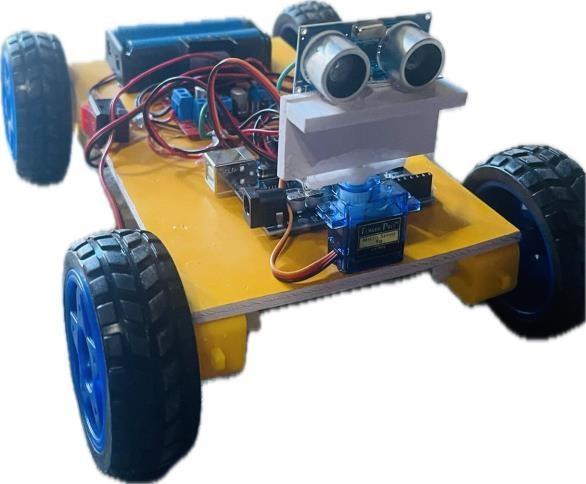
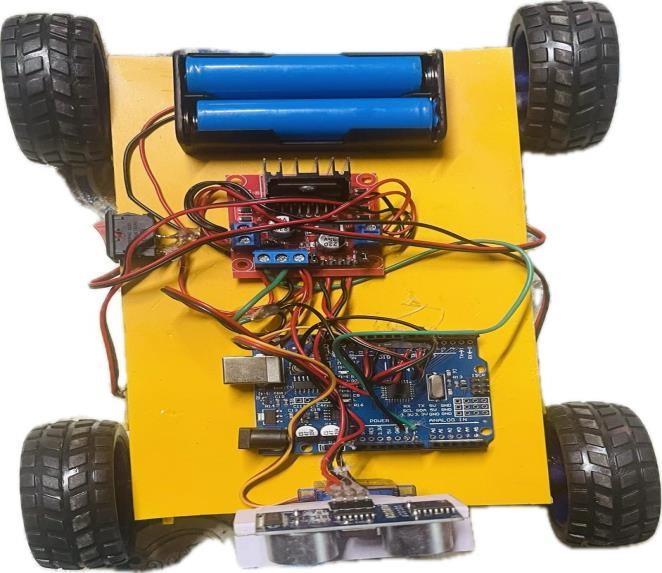
The SolarBot is equipped with a microcontroller (e.g., Arduino, Raspberry Pi, or similar), which serves as the brain of the system. The microcontroller performs the followingfunctions:
• Receivesreal-timedatafromtheultrasonicsensor.
• Processes the data to determine the presence and locationofobstaclesandpotholes.
• Executes pre-programmed algorithms to make navigation decisions, such as stopping, turning, or rerouting.
• Controls the motors and other actuators to execute the desiredmovements.
The SolarBot’s movement is controlled by DC motors, which are driven by the microcontroller based on the navigation decisions. The motors are connected to the wheels,enablingthevehicletomoveforward,backward,or turnleft/rightasrequiredtoavoidobstaclesandpotholes.
The SolarBot’s self-charging mechanism ensures continuousoperationby:
• Harvestingsolarenergyduringdaylighthours.
• Storing excess energy in the capacitor for use during lowlightconditionsorhighpowerdemand.
• Automatically switching to stored energy when solar powerisinsufficient,ensuringuninterruptedoperation.
International Research Journal of Engineering and Technology (IRJET) e-ISSN:2395-0056
Volume: 12 Issue: 02 | Feb 2025 www.irjet.net p-ISSN:2395-0072
Flowchart Diagram for
1.Start
• SystemInitialization
• PowerON(Solar-PoweredBatteryCheck)
2.SensorActivation
• ActivateUltrasonicSensors(ObstacleDetection)
• ActivateCamera/ImageSensor(PotholeDetection)
• ActivateGPSModule(LocationTracking)
3.DataCollection
• CollectObstacleData(Distance,Size,Position)
• CollectPotholeData(Depth,Width,Location)
• Collect Environmental Data (Light, Weather Conditions)
4.DataProcessing
• ProcessSensorDataUsingAI/MLAlgorithms
• ObstacleClassification(Static/Dynamic)
• PotholeSeverityAnalysis(Shallow/Deep)
• GenerateReal-TimeMaps(Obstacles&Potholes)
5. DecisionMaking
IfObstacleDetected:
• CalculateSafePath(AvoidanceManeuver)
• AdjustSpeed/Direction
IfPotholeDetected:
• RecordPotholeLocation&Severity
• MarkonMapforReporting
6. ActionExecution
• NavigateAroundObstacle
• ContinueMovementonSafePath
7. DataLogging&Reporting
• LogObstacleandPotholeData
• GenerateReportforAuthorities(GPSCoordinates, Severity,Timestamp)
8. SystemCheck
• CheckBatteryLevel(SolarChargingifLow)
• CheckSystemHealth(Sensors,Connectivity)
9. Repeat
• ContinueMonitoringandNavigation
10. End
• SystemShutdown(IfManualOverrideorLow Battery)
8. CONCLUSIONS AND FUTURE SCOPE
SolarBot represents a significant advancement in autonomous navigation and road condition monitoring, combining intelligent obstacle avoidance and pothole detection into a single, solar-powered system. By leveragingadvancedsensors,machinelearningalgorithms, and real-time data processing, SolarBot effectively identifies and navigates around obstacles while detecting and mapping potholes to improve road safety and maintenance. Its solar-powered design ensures sustainability and extended operational capabilities, making it suitable for various environments, including urbanandruralareas.
The system's ability to provide real-time feedback and generate detailed road condition reports makes it a valuabletool for municipalities, transportationauthorities, and autonomous vehicle developers. SolarBot not only enhances safety for drivers and pedestrians but also contributes to cost-effective and proactive road maintenance. In conclusion, SolarBot demonstrates the potential of integrating intelligent systems with renewable energy to address real-world challenges. Its innovative approach to obstacle avoidance and pothole detection paves the way for smarter, safer, and more sustainable transportation solutions. Future improvements could include enhanced AI capabilities, integration with smart cityinfrastructure,andscalabilityforlargerdeployments.
International Research Journal of Engineering and Technology (IRJET) e-ISSN:2395-0056
Volume: 12 Issue: 02 | Feb 2025 www.irjet.net p-ISSN:2395-0072
[1] World Health Organization (WHO), Global Status ReportonRoadSafety,2018.
[2] National Highway Traffic Safety Administration (NHTSA), Report on Road Debris and Obstacle-Related Accidents,2022.
[3] R. Patel et al., “Development of an Obstacle-Avoidance Robot Using Ultrasonic Sensors,” J. Robot. Autom., vol. 15,no.3,pp.123–130,2020.
[4] Y. Zhang et al., “High-Precision Obstacle Detection for AutonomousVehiclesUsingLiDARandCameras,” IEEE Trans.Intell.Transp.Syst.,vol.20,no.4,pp.1456–1465, 2019.
[5] E. Eze et al., “Pothole Detection Using Accelerometers and GPS Modules,” Int. J. Sens. Netw., vol. 12, no. 2, pp. 89–97,2021.
[6] S. Kumar et al., “Image Processing Techniques for PotholeDetectionfromCameraFootage,” J.Comput.Vis. Image Process.,vol.8,no.1,pp.45–52,2020.
[7] A. Singh et al., “Solar-Powered Robotic Vehicle for Agricultural Applications,” Renew. EnergyJ., vol. 14, no. 3,pp.210–218,2019.
[8] L. Wang et al., “Design of a Solar-Powered Drone with Energy-EfficientNavigationAlgorithms,” J.Aerosp.Eng., vol.25,no.4,pp.301–310,2021.
[9] V. Rao et al., “Energy Management in Solar-Powered Systems Using PN Junction Diodes and Capacitors,” J. Renew.EnergySyst.,vol.10,no.2,pp.78–85,2018.
[10] R. Gupta et al., “Design and Implementation of a 12V Boost Converter for Solar Powered Devices,” IEEE Trans. Power Electron., vol. 35, no. 6, pp. 4567–4574, 2020.
[11] J. Lee et al., “Advanced Obstacle Detection for Autonomous Vehicles Using Multi Sensor Fusion,” J. Auton. Syst.,vol.18,no.1,pp.56–65,2022.
[12] M. Ali et al., “Solar-Powered Autonomous Vehicle with Basic Navigation Features,” Int. J. Sustain. Energy, vol. 13,no.4,pp.189–197,2021.
[13] S.Thrun,“TowardRoboticCars,” Commun.ACM,vol.53, no.4,pp.99–106,2010.
[14] J. Borenstein and Y. Koren, “The Vector Field Histogram FastObstacleAvoidanceforMobile Robots,” IEEE Trans. Robot. Autom., vol. 7, no. 3, pp. 278–288,1991.
[15] M. A. Green, Solar Cells: Operating Principles, Technology, and System Applications, Prentice-Hall, 1982.