International Research Journal of Engineering and Technology (IRJET)
e-ISSN: 2395-0056
Volume: 04 Special Issue: 09 | Sep -2017
p-ISSN: 2395-0072
www.irjet.net
One Day International Seminar on Materials Science & Technology (ISMST 2017) 4th August 2017 Organized by
Department of Physics, Mother Teresa Women’s University, Kodaikanal, Tamilnadu, India
Nucleation kinetics and dielectric study on acetophenone thiosemicarbazone (APTSC) single crystals A. Sybil Emarance1, M. Akilan2, R. Ragu3, J. P. Angelena4, J. Mary Linet5, S. Jerome Das6 1,2,3,4,5,6Department of Physics, Loyola College, Nungambakkam, Chennai
-------------------------------------------------------------------------***----------------------------------------------------------------------
Abstract
solution was stirred well using magnetic stirrer and gently warmed until a clear solution was obtained. Filtered it and allow it to grow crystal in slow cooling solution grown technique.
-
Single crystals of acetophenone thiosemicarbazone (APTSC) is the potential organic nonlinearoptical material, which belongs to the ketone group of compound was grown from slow cooling solution grown technique. The growth condition was optimized using nucleation kinetics. The grown crystal was subjected to XRD study to determine the cell parameters and space group. Dielectric studies on the grown crystal estimatethe dielectric constant and dielectric loss withrespect to frequency. Key Words: Crystal growth, Nucleation Kinetics, Solution growth, Slow cooling technique and Dielectric properties.
1. INTRODUCTION semiorganic materials have been attracting a great deal of attention, as they have large optical susceptibilities, inherent ultra fast response time and good optical properties When compared with the inorganic, organic materials. Recently there has been considerable interest in the co-ordination chemistry of aryl hydrazones such as semicarbazones, thiosemicarbazones and guanyl hydrazones because of their importance for drug design [1] organocatalysis and for the preparation of hetero cyclic rings [2]. Further extensive electron delocalization reported in these types of structures helps the thiosemicarbazone complexes to acquire second harmonic generation (SHG) efficiency [3,4]. Single crystals of acetophenone thiosemicarbazone (APTSC) is the potential organic nonlinear optical materials, which belongs to the ketone group of compound.
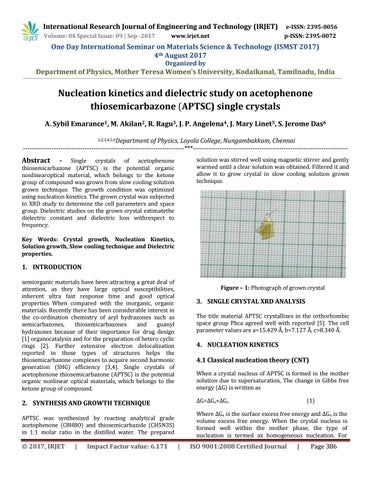
Figure – 1: Photograph of grown crystal
3. SINGLE CRYSTAL XRD ANALYSIS The title material APTSC crystallizes in the orthorhombic space group Pbca agreed well with reported [5]. The cell parameter values are a=15.429 Å, b=7.127 Å, c=8.340 Å.
4. NUCLEATION KINETICS 4.1 Classical nucleation theory (CNT) When a crystal nucleus of APTSC is formed in the mother solution due to supersaturation, The change in Gibbs free energy (∆G) is written as
2. SYNTHESIS AND GROWTH TECHNIQUE
∆G=∆Gs+∆Gv
APTSC was synthesized by reacting analytical grade acetophenone (C8H8O) and thiosemicarbazide (CH5N3S) in 1:1 molar ratio in the distilled water. The prepared
Where ∆Gs is the surface excess free energy and ∆Gv is the volume excess free energy. When the crystal nucleus is formed well within the mother phase, the type of nucleation is termed as homogeneous nucleation. For
© 2017, IRJET
|
Impact Factor value: 6.171
|
ISO 9001:2008 Certified Journal
(1)
|
Page 386
International Research Journal of Engineering and Technology (IRJET)
e-ISSN: 2395-0056
Volume: 04 Special Issue: 09 | Sep -2017
p-ISSN: 2395-0072
www.irjet.net
One Day International Seminar on Materials Science & Technology (ISMST 2017) 4th August 2017 Organized by
Department of Physics, Mother Teresa Women’s University, Kodaikanal, Tamilnadu, India homogeneous nucleation, the shape of the nucleus is reasonably assumed to be spherical since the nucleus contains few molecules in the initial stage. For the spherical nucleus,
(
∆G*diff is of the order 2kT and ʋ is of the order 1013 Hz. C(i)o was calculated from unit cell volume of APTSC.
(2)
3.2 Induction period measurement - Evaluation of surface energy σo
Where σo is the interfacial or surface energy per unit area ∆Gv is the volume excess free energy change per unit volume and it is a negative quantity. According to classical nucleation theory, the surface energy σo is assumed to be same throughout nucleation for simplicity. This is called capillarity approximation.
The induction periods were measured at temperature 308K for the supersaturation range 1.05 - 1.09 using constant temperature bath with an accuracy of ±0.001°C. The induction period (τ) is related to the steady state nucleation rate (J) as at a particular temperature T. Since the nucleation J is defined as the number of critical nuclei per unit time in a unit volume. We know
As the nucleus grows in size, ∆G increases, attains maximum and then starts decreasing. The size corresponding to maximum free energy change is called critical nucleus. At the critical stage, the condition d(∆G)/dr = 0 is applied to obtain the radius of the critical nucleus (r*) and critical Gibbs free energy change (∆G*). The expressions for nucleation parameters are thus obtained as Gv r* =
(
(
(11)
)
where B is a constant. Taking logarithms n both sides of equation (9)
(4)
(
The nucleation rate, according to Zeldovich and Frenkel [6] is given as
(12)
)
Substituting the value of
,
(5) (
where Z is Zeldovich factor or non-equilibrium factor, β is the impingement flux, S(i*) is the syrface area of the critical nucleus and C(i*) is the concentration of the critical nuclei. The nucleation rate is now written as (
(10)
)
(
and
J = ZβS(i*)C(i*)
(9)
)
And
(3)
∆G* =
(8)
)
where v is the specific volume of the crystal, σo is the surface energy per unit area, S is the supersaturation ratio and B is a constant.
(6)
)
(13)
)
The surface energy per unit area was also calculated from the following expression given by Nelson et al [8].
where the pre-exponential factor
σo = (
C(i)
)
where k is Boltzmann constant, T is the temperature, a 1 is the inter-ionoc distance and Xm is the mole fraction of the solute at temperature T.
The Zeldovich factor for a spherical nucleus was calculated using the following expression given by Turnbull and Fisher [7].
© 2017, IRJET
|
(14)
(7)
Impact Factor value: 6.171
|
ISO 9001:2008 Certified Journal
|
Page 387
International Research Journal of Engineering and Technology (IRJET)
e-ISSN: 2395-0056
Volume: 04 Special Issue: 09 | Sep -2017
p-ISSN: 2395-0072
www.irjet.net
One Day International Seminar on Materials Science & Technology (ISMST 2017) 4th August 2017 Organized by
Department of Physics, Mother Teresa Women’s University, Kodaikanal, Tamilnadu, India The inter-ionoc distance a1 was estimated from the lattie parameters of the crystal. a1 =
quality with lesser defects and this parameter plays a vital role for the fabrication of nonlinear optical devices because of low dielectric loss with high frequency for the samples (Fig. 3 (b) [10]).
(15)
Using the value σo, the nucleation parameters were calculated.
and
The predicted critical supersaturations are found to be 1.065 at room temperature 308 K using the classical nucleation theories. Table 1: Nucleation parameters of APTSC single crystal Surface Temperature energy (K) (σo) mJ/m2 308
2.353
S
-∆Gv (J/m3) 106J/m3
r* (nm)
1.05 1.06 1.07 1.08 1.09
0.522 0.623 0.724 0.823 0.922
7.55 6.32 5.44 4.79 4.27
X 10
-19
J
4.71 3.30 2.45 1.89 1.51
(∆G*/KT)
Figure - 3: (a) Dielectric constant and (b) loss vs log f
110.70 77.61 57.56 44.49 35.48
6. CONCLUSION The APTSC single crystal was grown by slow evaporation technique. From XRD data, it is observed that the grown crystal belongs to orthorhombic system with space group Pbca.The values of nucleation parameters critical radius (r*), the free energy of formation of critical nucleus, the number of molecules in the nucleus (i*) and nucleation rate (J) have been evaluated by classical nucleation theories. Dielectric studies on the grown crystal estimate the dielectric constant and dielectric loss with respect to frequency.
20
log J
10 0 -10
1.04
1.06
1.08
1.1
-20 -30
ACKNOWLEDGEMENT
Supersaturation (S)
Figure - 2: Plot of nucleation rate versus supersaturation
The authors are thankful to Loyola College –Times of India Major Research project (3LCTOI14PHY002)
5. DIELECTRIC STUDIES
REFERENCES
The dielectric property of the APTSC crystals was studied at room temperature using HIOKI 3532 LCR HITESTER in the frequency region 50Hz - 5MHz. The variation of dielectric constant and loss with frequency is shown by Fig. 3 (a) and (b) respectively. The presence of electronic, ionic, dipolar and space charge polarizations in the material are the reasons for the high value of dielectric constant at low frequency. In accordance with Miller rule, the lower value of dielectric constant at higher frequency is a suitable parameter for the enhancement of SHG coefficient [9]. The crystal possesses enhanced optical
[1] Beraldo, H. & Gambino, “The wide pharmacological versatility of semicarbazones, thiosemicarba-zones and their metal complexes”,D. Mini - Rev. Med. Chem.4 (2004) 31–39.
© 2017, IRJET
|
Impact Factor value: 6.171
[2] Bondock, S., Khalifa, W. & Fadda, A. A. “Synthesis and antimicrobial evaluation of some new thiazole, thiazolidinone and thiazoline derivatives starting from 1-chloro-3, 4-dihydronaphthalene-2-carboxaldehyde”, Eur. J. Med. Chem.42 (2007) 948–954.
|
ISO 9001:2008 Certified Journal
|
Page 388
International Research Journal of Engineering and Technology (IRJET)
e-ISSN: 2395-0056
Volume: 04 Special Issue: 09 | Sep -2017
p-ISSN: 2395-0072
www.irjet.net
One Day International Seminar on Materials Science & Technology (ISMST 2017) 4th August 2017 Organized by
Department of Physics, Mother Teresa Women’s University, Kodaikanal, Tamilnadu, India [3] H. L. Bhat, “Growth and characterization of some novel crystals for nonlinear optical applications”, Bull. Mater. Sci. 17 (1994) 1233-1250. [4] Mary Linet J, Dinakaran S, Mary Nivas Priya S, Jerome Das S, “Growth and characterisation of pure and Hg2+ doped thiosemicarbazide cadmium chloride crystals”, Cryst. Res. Technol. 44 (2009) 173-176. [5] R. Santhakumari, K. Ramamurthi, G. Vasuki, Bohari M. Yamin, G. Bhagavannarayana, “Synthesis and spectral characterization of acetophenone thiosemicarbazone—A nonlinear optical material”, Spectrochimica Acta Part A 76 (2010) 369–375. [6] J B Zel’dovich, 1942 On the theory of formation of a new phase. Cavitation. J. Exp. Theor. Phys. 12, 525– 536. [7] A. E. Nielson, O. Sohnel, “ Interfacial tensions in electrolyte crystal-aqueous solution from nucleation data”, J. Cryst. Growth 11 (1971) 233-242. [8] Smyth, C. P., Dielectric Behavior and Structure, New York: McGraw-Hill, (1965) 132-201. [9] Sagadevan .S, Studies on optical, mechanical, dielectric properties of bisthiourea nickel bromide NLO single crystal” Optik -Int. J. Light Electron Opt. 125, (2014) 6746-6750.
© 2017, IRJET
|
Impact Factor value: 6.171
|
ISO 9001:2008 Certified Journal
|
Page 389