International Research Journal of Engineering and Technology (IRJET) e-ISSN: 2395-0056 Volume: 13 Issue: 05 | May 2026
www.irjet.net
p-ISSN: 2395-0072
IoT Enabled Smart Water Monitoring System for Sustainable Urban Water Conservation Sahil Singh1, Arpit Vyas2, Seema Jagtap3 1Sahil Singh, Dept of Civil Engineering, Thakur College of Engineering Kandivali, Maharashtra, India 2Arpit Vyas, Dept of Civil Engineering, Thakur College of Engineering Kandivali, Maharashtra, India
3Seema Jagtap, Dept of Civil Engineering, Thakur College of Engineering Kandivali, Maharashtra, India
---------------------------------------------------------------------***--------------------------------------------------------------------Abstract— With the rise in urban population and growing
are some of the key factors to be examined during this research.
need for water, efficient management of the resources is necessary in smart cities. This paper discusses about the design and development of IoT enabled Smart Water Monitoring System for urban water conservation. Comparative Analysis was made between water consumption with/without implementation of SWM technology. Monthly consumption pattern and savings achieved along with monitoring efficiency were evaluated through monthly water consumption of residential areas. Comparative analysis based on daily consumption patterns, average water usage, consumption per day and estimated cost was made. It can be concluded that implementation of SWM technology will help in reducing unnecessary consumption of water and achieve better monitoring and water management.
1.1. INTRODUCTION TO IOT Internet of Things (IoT) involves a network of interconnected physical objects which have the capability to communicate among themselves using the internet without requiring any human intervention. The devices feature software and sensors that enable realtime data analysis and monitoring. As a result of its capacity to increase efficiency levels and minimize wastage of resources, along with the data-driven nature of decision making, IoT technology has emerged as a significant element of modern smart infrastructures. In the recent past, the use of IoT has found application in several domains including health care, transportation, agriculture, energy management, and water management. The role played by IoT in smart cities has been crucial in terms of enabling monitoring of public utilities and efficient utilization of resources. One of the important uses of IoT technology has been realized in the field of Smart Water Meters.
Keywords— Smart Water Meter (SWM), Internet of Things (IoT), Water Conservation, Smart City Infrastructure, Water Consumption Monitoring
I.
INTRODUCTION
Water is among the crucial natural resources essential for human survival and development in the urban environment. Rapid urbanization, rising populations, and high demand for water have caused a significant problem in water management within smart cities. Traditional water supply and monitoring systems cause water wastage due to inefficiencies that include excessive consumption, leakages, incorrect billing, and poor monitoring capabilities. For this reason, there is a need to create intelligent and sustainable water management systems due to recent advancements in IoT technologies.
1.2. SMART WATER METER
The development of IoT technology has provided an opportunity for effective real-time monitoring of water resources. SWM systems incorporate IoT technology to enable the continuous monitoring of water consumption and data collection. It helps consumers and authorities to monitor their water consumption to minimize unnecessary wastage. This study aims to conduct a comparative analysis of water consumption before and after the application of Smart Water Meters technology within residential zones. Daily consumption patterns, total water usage, cost saving from using the smart meters, and water savings © 2026, IRJET
|
Impact Factor value: 8.315
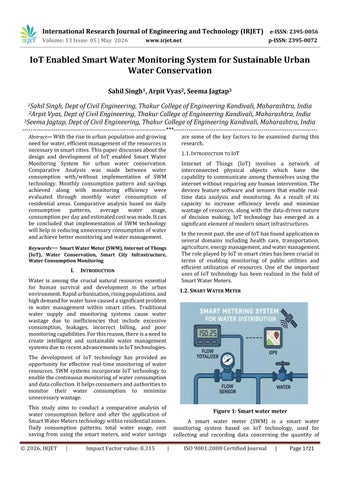
Figure 1: Smart water meter A smart water meter (SWM) is a smart water monitoring system based on IoT technology, used for collecting and recording data concerning the quantity of |
ISO 9001:2008 Certified Journal
|
Page 1721