
International Research Journal of Engineering and Technology (IRJET) e-ISSN: 2395-0056
Volume: 13 Issue: 03 | Mar 2026 www.irjet.net p-ISSN: 2395-0072
International Research Journal of Engineering and Technology (IRJET) e-ISSN: 2395-0056
Volume: 13 Issue: 03 | Mar 2026 www.irjet.net p-ISSN: 2395-0072
Prof. A. J. Vyavahare, Sankalp Handal, Omkar Mali, Mangesh Natkar
1Dept of Electronics and Telecommunication, Modern College of Engineering Pune - 05, Maharashtra, India 2,3,4 Savitribai Phule Pune University, Shivajinagar, Pune – 05.
Abstract - Falls are one of the most serious health risks faced by elderly individuals and often result in severe injuries, hospitalization, reduced mobility, and long-term disability. With the continuous growth of the aging population, ensuring the safety and independence of older adults has become an important challenge for modern healthcare systems. In recent years, several technological solutions have been developed to automatically detect fall events and provide immediate assistance. These solutions generally include wearable sensor-based systems, environmental monitoring techniques, and vision-based detection approaches. Among these methods, wearable devices equipped with accelerometers and gyroscopes have gained significant attention because they can continuously monitor body movements and identify abnormal motion patterns associated with falls. The integration of Internet of Things (IoT) technology further enhances these systems by enabling real-time data transmission, remote monitoring, and instant emergency alert generation to caregivers or medical services. Additionally, the application of machine learning and deep learning algorithms has improved fall detection accuracy by analyzing complex motion data and reducing false alarm rates. This review paper examines recent advancements in IoT-based fall detection technologies, wearable sensing devices, and intelligent data analysis methods used in elderly monitoring systems. The study also highlights the limitations of existing approaches, including privacy concerns, energy consumption, and limited real-world datasets. Furthermore, the paper discusses future research directions such as sensor fusion, cloud-based monitoring platforms, and advanced predictive analytics that can enhance the effectiveness and reliability of fall detection systems. Overall, IoT-enabled intelligent fall detection systems provide a promising solution for improving elderly safety, supporting independent living, and enabling smart healthcare monitoring in modernsociety.
Keywords: Elderly Monitoring, Fall Detection, Internet of Things, Wearable Sensors, Smart Healthcare, Machine Learning
Therapidgrowthoftheglobalelderlypopulationhascreatedsignificantchallengesforhealthcaresystemsandcaregivers. Amongvarioushealthissuesaffectingolderadults,fallsrepresentoneofthemostseriousandcommonproblems.Fallscan lead to severe physical injuries such as fractures, head trauma, and reduced mobility, which may result in long-term disability or hospitalization. In many cases, elderly individuals who live alone may not receive immediate medical assistance after a fall, which increases the risk of complications and mortality. Studies have reported that a significant percentageofindividualsagedsixty-fiveyearsandaboveexperienceatleastonefalleachyear,makingfalldetectionand preventionanimportantareaofresearchinhealthcaretechnology[1].
Severalresearchstudieshaveinvestigateddifferentstrategiestopreventanddetectfallsamongelderlyindividuals.Early work focused mainlyonidentifying risk factorsandclinical preventionstrategies. Thesestudieshighlightedthatbalance disorders, muscle weakness, medication side effects, and environmental hazards are among the major causes of fall incidents in older adults [2]. Preventive healthcare programs that include physical activity, strength training, and home environment modifications have been shown to reduce the risk of falls and improve the overall quality of life of elderly individuals[8].
With the advancement of sensing technologies and embedded systems, automated fall detection systems have been developedtoimproveelderlymonitoringandsafety.Falldetection techniquesaregenerallycategorizedintothreemajor groups: wearable sensor-based systems, environmental sensor-based systems, and vision-based monitoring systems. Vision-based approaches utilize cameras and image processing algorithms to analyze body posture and detect abnormal movements associated with fall events [3]. Although these systems can achieve high detection accuracy, they often raise privacyconcernsandrequirecomplexinstallationenvironments.
Environmental monitoring systems represent another approach to fall detection. These systems rely on sensors installedinlivingenvironmentssuchaspressure-sensitivefloors, vibration sensors,or acousticdetectors. Environmental sensing technologies can monitor movement without requiring the elderly person to wear anydevice.However,thesesystemsareoftenexpensivetoinstallandmayhavelimitedcoverageareas,whichrestricttheir large-scaleadoptioninresidentialenvironments[4].Recent advancements in wireless communication andembedded
International Research Journal of Engineering and Technology (IRJET) e-ISSN: 2395-0056
Volume: 13 Issue: 03 | Mar 2026 www.irjet.net p-ISSN: 2395-0072
computing have enabled the development ofwearable monitoring devices for fall detection. Wearabledevicessuchas smartwatches,fitnessbands,and sensor-equipped clothingcontainmotion sensors that continuously track body movement. Accelerometers andgyroscopes are commonly used sensors that measure linear acceleration and angular rotation of the humanbody. These sensors can detect sudden changes in bodymotion that occur during fall events, making wearabledevicesapracticalsolutionforreal-timemonitoring[9].
TheemergenceoftheInternetofThings(IoT)hasfurtherenhancedthecapabilitiesofhealthcaremonitoringsystems.IoT technology enables communication between wearable devices, smartphones, cloud platforms, and healthcare providers through wireless networks. IoT- based healthcare monitoring systems allow continuous data collection, remote monitoring,andrapidemergencyresponse,therebyimprovingpatientsafetyandreducingresponsetimeduringmedical emergencies[6].
In recent years, machine learning and deep learning techniques have been widely applied in fall detectionsystems. Intelligentalgorithmscananalyzemotionsensor data and learn complex movement patterns associated with fall events. These techniques help distinguish between fall incidents and normal daily activities such as walking, sitting, or bending, thereby reducing false alarm rates and improving system accuracy [7]. Advanced wearable systems combined with intelligentalgorithmshavedemonstratedpromisingresultsindetectingfalleventswithhigherreliability.
Furthermore, smartwatch-based fall detection applications havegainedattentionduetothewidespread use of wearable devices in daily life. Modern smartwatches contain multiple sensors and wireless communication capabilities that allow real-timemonitoringofbodymovements.Suchsystemscandetectfalleventsandautomaticallysendemergencyalertsto caregiversorhealthcareproviders[9].Deeplearning-basedfalldetectionframeworkshavealsobeenproposedtofurther improvedetectionaccuracybyanalyzinglargevolumesofmotiondatacollectedfromwearablesensors[10].
Apart from detection technologies, several studies emphasize the importance of integrating preventive strategies with monitoring systems. Exercise programs designed to improve balance and muscle strength have been shown to significantlyreducefallrisksamongelderlyindividuals[8].Combiningpreventivehealthcareapproacheswithautomated monitoringtechnologiescanprovideacomprehensivesolutionforelderlysafetyandhealthmanagement.
In addition, IoT-based automation systems have demonstrated the potential of integrating sensors, communication modules, and intelligent processing in various smart applications [12]. Similar architectures can be applied to develop reliable fall detection systems capable of transmitting real-time alerts and location information during emergency situations.
Therefore,theintegrationofwearablesensingtechnologies,IoTcommunicationframeworks,andintelligentdataanalysis algorithms has emerged as a promising solution for elderly fall detection. Such systems enable continuous monitoring, rapidemergencyresponse,andimprovedsafetyforelderlyindividualslivingindependently.Thisreviewpaperfocuseson analyzing recent advancements in fall detection technologies, wearable sensor systems, and IoT-based healthcare monitoringplatformstoprovideinsightsintocurrentresearchtrendsandfuturedevelopmentsinelderlysafetysystems.
Thestatisticalrepresentationoffalldetectionresearchindicatesanoticeablechangeinthetechniquesusedoverdifferent time periods. Earlier studies conducted between 1998 and 2012 mainly relied on simple threshold-based detection methods.Out ofa total of96researchstudiesanalyzed duringthis period,nearly71%ofthesystemsutilizedthresholdbased techniques for identifying fall events. These approaches were preferred because of their simplicity, low computational requirements, and ease of implementation in embedded devices. However, only about 4% of the studies applied machine learning techniques, showing that intelligent data-driven methods were still in the early stages of developmentatthattime.
In contrast, research trends observed between 2014 and 2019 show a significant increase in the adoption of machine learning approaches for fall detection. Among approximately 20 studies analyzed during this period, around 45% implemented machine learning algorithms for analyzing sensor data and detecting fall events. At the same time, the proportionofsystemsrelyingsolelyonthreshold-baseddetectionmethodsdecreasedtonearly35%.Additionally,about 15% of the research studies introduced hybrid approaches that combined threshold- based techniques with machine learningmodelstoachievebetterperformance.
International Research Journal of Engineering and Technology (IRJET) e-ISSN: 2395-0056
Volume: 13 Issue: 03 | Mar 2026 www.irjet.net p-ISSN: 2395-0072
This statistical comparison clearly demonstrates the evolution of fall detection technologies over time. Earlier fall detection systems primarily depended on simple acceleration thresholds to identify sudden movements. Although such methods were computationally efficient, they often produced false alarms because normal daily activities such as sitting quicklyorjumpingcouldgeneratesimilarsensorpatterns.
The analysis of recent research studies indicates a strong shift toward intelligent data analysis techniques. Machine learningalgorithmsarecapableoflearningcomplexmotionpatternsfromsensordataanddistinguishingfalleventsfrom normal human activities with higher accuracy. These algorithms also improve system adaptability and robustness when dealingwithreal-worldmovementvariations.
Furthermore, hybrid detection methods that combine threshold analysis with machine learning classification have emerged as an effective solution in modern fall detection systems. Such approaches benefit from the quick response of thresholddetectionwhilesimultaneouslyusingmachinelearningmodelstoverifyfalleventsandreducefalsepositives.
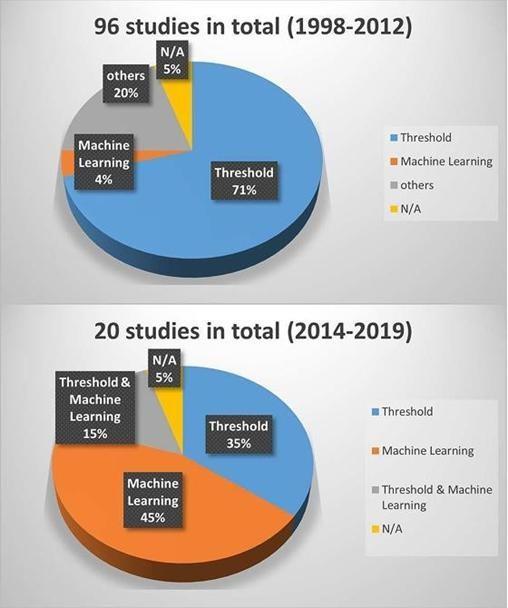
Therefore, based on the statistical analysis of published research trends, it can be concluded that intelligent and hybrid approaches arebecomingincreasinglyimportantinthedevelopmentofmodernfalldetectionsystems.Theintegrationof wearable sensors, machine learning algorithms, and IoT communication technologies provides a reliable framework for designing efficient elderly monitoring systems capable of delivering real- time emergency alerts and improving overall safety.
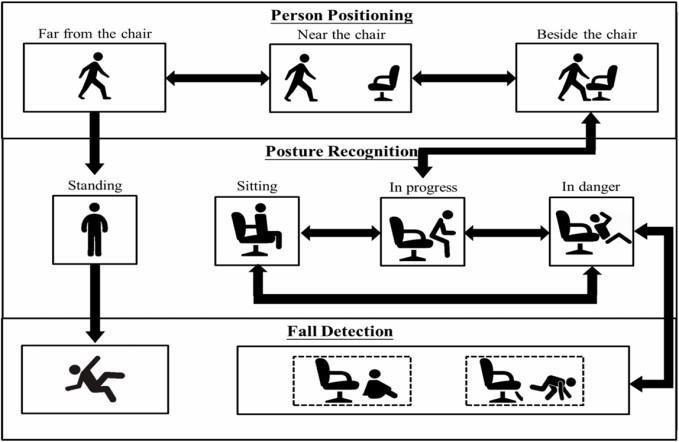
Elderly fall detection refers to the automatic recognition of a fall incident and the immediate generation of alerts to caregivers,familymembers,oremergencyservices.Thebasicconceptoffalldetectionsystemsistocontinuouslyobserve the physical movements and body posture of an elderly person and differentiate between normal daily activities and abnormal events such as falls. Continuous monitoring helps ensure that assistance can be provided quickly in case of an
International Research Journal of Engineering and Technology (IRJET) e-ISSN: 2395-0056
Volume: 13 Issue: 03 | Mar 2026 www.irjet.net p-ISSN: 2395-0072
emergency.
A fall event generally occurs in several stages, including loss of balance, rapid downward movement of the body, impact withtheground,andashortperiodofinactivity.Falldetectionsystemsaredesignedtorecognizethesemotionpatternsby analyzing sensor data collected during daily activities. Identifying these phases allows the system to distinguish fall incidentsfromroutinemovements
Wearablesensor-basedapproachesareamongthemostwidelyusedtechniquesforfalldetection.Thesesystemstypically employmotionsensorssuchasaccelerometersandgyroscopestomonitorchangesinacceleration,orientation,andbody movement.Whenasuddenincreaseinaccelerationorarapidposturechangefromastandingpositiontoalyingposition isdetected,thesystemmayclassifytheeventasapossiblefall.
Inadditiontowearablesensors,otherapproachesincludeenvironmentalmonitoringsystemsthatusesensorsinstalledin thesurroundingsoftheelderlyindividual.Examplesincludepressure-sensitivefloors,acousticsensors,radarsensors,or vibration detectors that can identify unusual activity patterns within a room. These systems allow monitoring without requiringtheusertowearanydevice.
Vision-basedmonitoringsystemsrepresentanotherapproachinfalldetectionresearch.Thesesystemsutilizecamerasand imageprocessingtechniquestoanalyzebodypostureandmovementpatterns. Bytrackingthepositionandorientationof the human body, computer vision algorithms can determine whether a fall event has occurred. However, such systems mayfacechallengesrelatedtoprivacyconcernsandenvironmentalconditionssuchaslightingandocclusion.
Recent advancements in sensing technologies and wireless communication have enabled the integration of wearable devices with smart healthcare systems. Devices such as smartwatches andsmartphones cancontinuously collect motion data and transmit it to monitoring platforms through wireless networks. This capability allows real-time analysis and fasterresponseinemergencysituations.
Furthermore,intelligentalgorithmsanddata analysistechniquesareincreasinglyusedtoenhancefalldetection accuracy. Machine learning models can analyze largeamounts of sensor data and identify patterns that differentiate fall events fromregulardailyactivities.Thishelpsreducefalsealarmsandimprovessystemreliability.Onceafalleventisconfirmed, thedetectionsystemtypicallyactivatesanemergencyresponsemechanism.Thismayincludesendingalertnotifications, triggering audible alarms, or sharing location information with caregivers through communication networks. Such rapid responsefeaturesplayanimportantroleinensuringtimelymedicalassistance.
Therefore, the fundamental principle of elderly fall detection systems involves continuous motion sensing, intelligent analysis of movement patterns, and rapid communication of emergency alerts. By combining sensing technologies with IoT-based connectivity, modern fall detection systems provide an effective solution for improving elderly safety and enablingindependentliving.
International Research Journal of Engineering and Technology (IRJET) e-ISSN: 2395-0056
Volume: 13 Issue: 03 | Mar 2026 www.irjet.net p-ISSN: 2395-0072
ThemainobjectiveofthisresearchistodesignandanalyzeanInternetofThings(IoT)basedfalldetectionandemergency alert system that improves the safety and health monitoring of elderly individuals. Falls are a major cause of injury and medical emergencies among older adults, andtheabilitytodetectsuch incidents quickly can help reduce the severity of injuriesandensuretimelymedical assistance.Therefore,thedevelopmentofanintelligentmonitoringsystem capableof identifyingfalleventsandgeneratingrapidalertsisessentialforsupportingindependentlivingamongelderlypeople.
Thespecificobjectivesofthisresearchareasfollows:
1. To study the major causes, consequences, and risk factors associated with falls in elderly individuals through analysisofexistingliterature.
2. To design a wearable fall detection system using motion sensors such as accelerometers and gyroscopes for continuousmonitoringofbodymovementandposture.
3. To implement an intelligent fall detection mechanism using threshold-based techniques and machine learning modelstoimprovedetectionaccuracyandreducefalsealarmrates.
4. To integrate IoT-based communication features for real-time alert generation and emergency notification to caregiversormedicalservices.
5. To enhance the system with additional safety features such as GPS-based location tracking and local alarm mechanismsforimmediateassistance.
6. To develop a cost-effective, user-friendly, and nonintrusive solution suitable for long-term elderly healthcare monitoring.
7. To evaluate the performance of the proposed fall detection system under different real-lifeactivity conditions and validateitseffectivenessintermsofaccuracy,responsetime,andreliabilityforelderlysafetymonitoring
4.1 Accelerometer-Based Motion Sensing
An accelerometer is one of the most important sensors used in wearable fall detection systems. It measures the linear acceleration of the human body along three perpendicular axes, commonly represented as x, y, and z directions. By analyzingtheaccelerationvaluesobtainedfromtheseaxes,thesystemcandeterminetheoverallmovementpatternofthe user.Duringregulardailyactivitiessuchaswalking,sitting,or standing,theaccelerationvaluestypicallyremainwithina predictable range. However, during a fall event, a sudden change in acceleration occurs due to rapid body movement followedbyimpactwiththeground.
Theoverallmagnitudeofaccelerationcanbedeterminedusingthevectormagnitudeequation:
A=(ax2+ay2+az2)1/2 (i)
Where:
1. A=resultantaccelerationmagnitude
2. ax=accelerationalongthex-axis
3. ay=accelerationalongthey-axis
4. az=accelerationalongthez-axis
Whenthecalculatedaccelerationmagnitudeexceedsapredefinedthresholdvalue,thesystemmayclassifytheeventasa potentialfall.Thisapproachformsthebasicprincipleofmanywearablefalldetectionsystems.
2395-0056
Volume: 13 Issue: 03 | Mar 2026 www.irjet.net p-ISSN: 2395-0072
A gyroscope is another important motion sensor used in fall detection systems to measure angular velocity and body orientation. While the accelerometer provides information about linear motion, the gyroscope helps detect rotational movementsofthehumanbody.Duringafall,theorientationofthebodyoftenchangesrapidlyfromanuprightpositionto a horizontal position. By analyzing the angular velocity data collected by the gyroscope, the system can detect sudden posturetransitions.
Thecombinationofaccelerometerand gyroscopesensors improves detection reliability because some normal activities, such as quickly sitting down or jumping, may produce acceleration patterns similar to fall events. However, when acceleration data is analyzed together with body orientation information, the system can moreaccurately distinguish betweennormalmovementsandactualfallincidents.
Internet of Things (IoT) technology plays a vital role in modern healthcare monitoring systems. IoT enables communication between wearable sensing devices, smartphones, cloud platforms, and healthcare providers through wirelesscommunicationtechnologies.InanIoT-basedfalldetectionsystem,sensordatacollectedfromwearabledevices isprocessedbyamicrocontrollerormobiledevice.
When a fall event is detected, the system automatically generates an emergency alert and transmits it to caregivers or familymembers.CommunicationtechnologiessuchasBluetooth,Wi-Fi,orGSMnetworksarecommonlyusedtosendalert notifications. IoT connectivity also enables real-time data transmission, remote monitoring, and integration with smart healthcare platforms. This capability significantly improvesresponsetimeduringemergencysituationsand enhances the overallsafetyofelderlyindividuals.
Global Positioning System (GPS) technology is used in many fall detection systems to provide the geographic location of the elderly individual during emergency situations. GPS works by receiving signals from multiple satellites orbiting the Earth.Bycalculatingthetimetakenforthesesignalstotravelfromthesatellitetothereceiver,thesystemcandeterminethe exactlocationofthedevice.
Thedistancebetweenasatelliteandthereceivercanbecalculatedusingthefollowingrelationship:
d=c Δt (ii)
Where:
1. d=distancebetweensatelliteandreceiver
2. c=speedoflight(3×10⁸m/s)
3. Δt=signaltraveltimedelay
Byobtainingdistancemeasurementsfrommultiplesatellites,thesystemcandeterminetheprecisepositionofthereceiver using a process known as trilateration. Integrating GPS technology with fall detection systems enables the automatic transmissionoflocationinformationtocaregivers,allowingfasterassistanceduringemergencies.
Fallsareconsideredoneofthemostcriticalhealthrisksforelderlyindividuals,astheymayleadtoseriousinjuriessuchas fractures,headtrauma,andlong-termhealthcomplications.Afalleventusuallyinvolvesasuddenimbalance followedby rapid downward movement of the body and impact with the ground. In many cases, elderly individuals may remain inactive after a fall and may not be able to seek immediate help. Therefore, the proposed system is designed to continuouslymonitorbodymovementandidentifyabnormalmotionpatternsassociatedwithfallincidents.
International Research Journal of Engineering and Technology (IRJET) e-ISSN: 2395-0056
Volume: 13 Issue: 03 | Mar 2026 www.irjet.net p-ISSN: 2395-0072
The proposed system uses wearable sensing technology combined with an Internet of Things (IoT) communication framework to enable real-time monitoring and emergency alert generation. Motion sensors such as accelerometers and gyroscopes are used to measure body movement, acceleration, and orientation changes. These sensor readings are continuously processed by the system to identify sudden variations in motion that may indicate a fall event. When the detected motionparametersexceedpredefinedthresholdlimitsor match fall-like patterns, the system generates an alert signal.
Inadditiontofalldetection,thesystemalsosupportsemergencycommunicationfeaturesthatallowcaregiverstoreceive notifications immediately after a fall event is detected. By integrating wireless communication technologies and location trackingcapabilities,thesystemhelpsensurethatassistancecanbeprovidedquicklyduringemergencysituations.
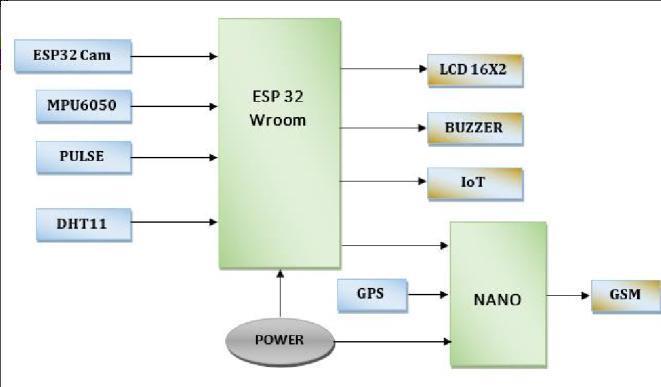
Thehardwarearchitectureoftheproposedfalldetectionsystemconsistsofseveralinterconnectedcomponentsthatwork together to monitor the physical condition and movement of the elderly individual. The system includes a wearable sensingdeviceequippedwithatriaxialaccelerometertodetectbodymotionandsuddenaccelerationchanges.Thesensor dataisprocessedusingamicrocontrollerthatperformsmotionanalysisandfalldetectionoperations.
Acommunicationmoduleisintegratedwiththemicrocontrollertotransmitalertnotificationswhenafalleventoccurs.The systemmaycommunicatewithsmartphonesorremotemonitoringplatformsthroughwirelesstechnologies.Additionally, aGPSmodulecanbeincorporatedtoprovidethereal-timegeographiclocationoftheelderlyindividualduringemergency situations.
For local alert generation, the system also includes a buzzer oralarm unit thatactivates whena fall is detected. An LCD display may also be used to show system status, warning messages, or emergency information. These hardware components together form a compact and efficient monitoring system capable of detecting falls and providing rapid emergencynotifications.
5.2
The proposed fall detection system utilizes several hardware components that support motion sensing, data processing, andemergencycommunication.AmicrocontrollersuchasESP32orArduinoNanoisusedasthecentralprocessingunitof thesystem.Itcollectssensordata,performsmotionanalysis,andcontrolscommunicationoperations.
A temperature sensor such as DHT11 can be used to monitor the surrounding environmental temperature, which may provide additional information about the user’s surroundings. A pulse sensor based on Photoplethysmography (PPG) technologyisusedtomeasuretheheartrateoftheelderlyperson.Monitoringheartratecanhelpdetectabnormalhealth conditionsthatmayoccurduringorafterafallincident.
A triaxial accelerometer sensor such as ADXL330 is used to measure acceleration along three axes. This sensor is responsiblefordetectingsuddenbodymovementsandimpacteventsassociatedwithfalls.AGPSmodulesuchasNEO-6M is used to determine the geographic location of the user, allowing the system to transmit location information during emergencies.
For communication purposes, a GSM module such as SIM800L is integrated with the system to send alert messages to
International Research Journal of Engineering and Technology (IRJET) e-ISSN: 2395-0056
Volume: 13 Issue: 03 | Mar 2026 www.irjet.net p-ISSN: 2395-0072
caregiversorfamilymembers.Abuzzerisincluded toprovideanaudiblewarningsignalwhenafalleventisdetected.An LCD display can also be used to show important information such as system status or alert notifications. The I2C communication interface is used to simplifycommunicationbetweenthemicrocontrollerand peripheral devices such as sensorsanddisplays.
Duringnormaldailyactivitiessuchaswalking,standing,orsitting,themotionsensorreadingsremainwithinastableand predictablerange.However,whenafalloccurs,thebodyexperiencesasuddenchangeinaccelerationfollowedbyarapid posturetransition.Theseabnormalmotionpatternsarecapturedbytheaccelerometerandgyroscopesensors.
The microcontroller continuously processes the sensor data and compares the measured acceleration values with predefinedthresholdlevels.Whenthedetectedmotionparametersindicateapossiblefallevent,thesystemconfirmsthe fallbyanalysingadditionalsensordatasuchasorientationchangeandinactivityperiod.
Once a fall event is confirmed, the system immediately activates the emergency response mechanism. The buzzer generatesanaudiblealerttoattractnearbyattention,whiletheGSMcommunicationmodulesendsanemergencymessage topredefinedcontacts.Atthesametime,theGPSmoduleprovidesthelocation oftheelderlyindividualsothatcaregivers canreachthelocationquickly.
This combination of motion sensing, intelligent data processing, and wireless communication enables the system to provide reliable fall detection and rapidemergencyassistance,therebyimprovingthesafetyandwell-beingofelderly individuals.
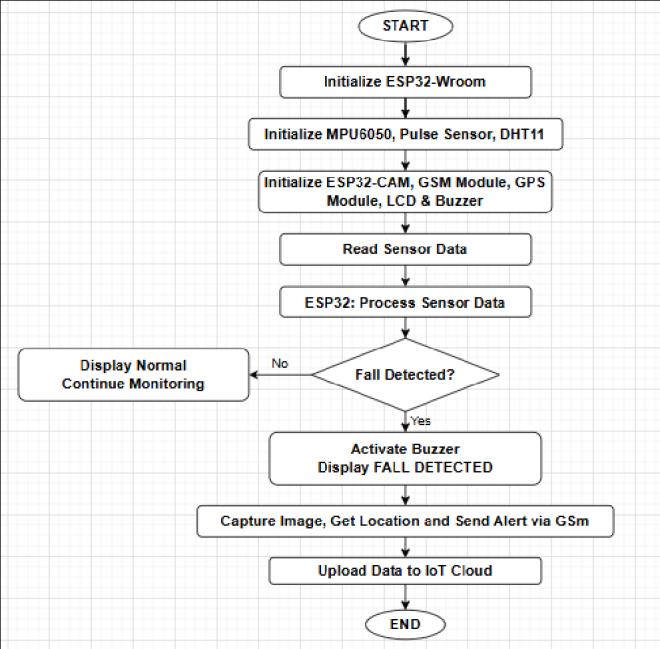
TheexperimentalevaluationdemonstratesthattheproposedIoT-basedfalldetectionsystemiscapableofidentifyingfall events effectively using wearable motion sensing and wireless communication technologies. The system utilizes accelerationandorientationdatacollectedfrommotionsensorstoanalysebody movementsanddetectabnormalpatterns associatedwithfallincidents.Theanalysisofsensorreadingsshowsthatfalleventsproducedistinctmotioncharacteristics comparedtonormaldailyactivities.Byprocessingthesesensor signalsthroughthemicrocontroller,thesystemisableto detectfalleventsandgenerateemergencyalertsinrealtime.
Theresultsobtainedfromtestingindicatethattheproposedsystemcansuccessfullydifferentiatebetweenroutinehuman activities and fall incidents. When a fall is detected, the communication module transmits alert messages along with locationinformationtocaregiversorpredefinedemergencycontacts.Thisrapidresponsecapabilityhelpsreducethetime required for providing assistance to elderly individuals during emergency situations. Overall, the experimental results confirm that combining motion sensing technologies with IoT communication modules provides a reliable and efficient solutionforelderlyfallmonitoring.
2395-0056
Volume: 13 Issue: 03 | Mar 2026 www.irjet.net p-ISSN: 2395-0072
To evaluate the performance of the proposed system, experimental testing was conducted under controlled conditions using volunteers performing various daily activities and simulated fall scenarios. The testing process included common activitiessuchaswalking,sitting,standing,andbendinginordertoobservethenormalmotionpatternsproducedbythese actions.
A total of 20 participants were involved in the experimental study. Each participant performed a combination of normal activities and simulated fall movements to generate motion data for analysis. Approximately 300 motion samples were collected during the experiments. The accelerometer and gyroscope sensors continuously recorded the movement data, whichwasprocessedbythemicrocontrollertodetectfallpatterns.
Duringthetestingphase,eachsimulatedfalleventwascarefullyobservedandcomparedwiththeoutput generatedbythe falldetectionsystem.Thepurposeofthiscomparisonwastoverifywhetherthesystemcorrectlyidentifiedfalleventsand minimizedincorrectdetectionsduringnormalactivities.
Theexperimentalobservationsindicatedseveralimportantcharacteristicsoffalldetectionusingmotionsensors:
1. Falleventsproducedsuddenspikesinaccelerationvaluesalongmultipleaxes,followedbyrapidchangesinbody orientation.
2. Normal daily activities such as walking, sitting, or bending generated relatively stable sensor readings that remainedwithinthepredefinedthresholdlimits.
3. The system successfully identified most simulated fall events by analyzing sudden acceleration changes combinedwithposturetransitions.
4. Whenafallwasdetected,theIoTcommunication module successfully transmitted emergency alertsalongwith GPS-basedlocationinformation.
5. The system demonstrated consistent performance during repeated testing, indicating its reliability for fall monitoringapplications.
Accidental falls among older adults continue to be one of the major healthcare challenges across the world. With the continuous growthof theaging population, maintaining safety,healthmonitoring,andindependentlivinghasbecomean important responsibility for modern healthcare systems. Such incidents often lead to injuries including fractures, head trauma, reduced mobility, and long-term medical complications. In many situations, individuals who live alone may not receiveimmediateassistanceafteranaccident,whichincreasestheseverityofinjuriesanddelaysmedicalcare.Therefore, thedevelopmentofintelligentmonitoringtechnologiescapableofidentifyingemergencysituationsandgeneratingtimely alertsisessentialforimprovingsafetyandhealthcaresupport.
his research presented the design and evaluation of an Internet of Things based monitoring framework intended for automatic identification of accident events and emergency notification. The proposed framework integrates wearable sensing technologies with wireless communication modules to continuously observe bodymovement and posture variations. Motion sensors such as accelerometers and gyroscopes play a significant role in capturing physical activity patterns. By analyzing rapid changes in acceleration along with sudden posture transitions, the framework can differentiateabnormalmovementpatternsfromroutinedailyactivitiessuchaswalking,sitting,orbending.
The study also highlights the importance of combining wearable sensing devices with intelligent motion analysis techniques.Traditionalmonitoringapproachesthatrelyonlyonfixedthresholdvaluesmaygenerateincorrectalertswhen normalactivitiesproducesimilarmovementcharacteristics.Intheproposedapproach,motiondatacollectedfromsensors is analyzed by the embedded controller to recognize unusual patterns associated with emergency events. This improves reliabilityandreducesunnecessarynotificationscausedbynormalmovements.
Another important aspect of the proposed framework is the integration of wireless communication capabilities through InternetofThingstechnology.TheconnectivityprovidedbyIoTplatformsenableswearabledevicestocommunicatewith external monitoring applications such as smartphones or remote healthcare services. When an abnormal activity is detected, the device automatically sends notification messages to caregivers or family members through wireless
International Research Journal of Engineering and Technology (IRJET) e-ISSN: 2395-0056
Volume: 13 Issue: 03 | Mar 2026 www.irjet.net p-ISSN: 2395-0072
communication networks. The addition of Global Positioning System technology further enhances the monitoring capabilitybytransmittingthereal-timegeographiclocationoftheuser.Thisfeaturehelpsresponderslocatetheindividual quicklyandprovideassistanceinemergencysituations.
Experimental evaluation carried out during testing demonstrated that motion sensing devices are capable of identifying abnormal movement patterns effectively. Multiple participants were involved in the testing process, performing both regular activities and simulated accident events. The recorded sensor readings showed noticeable differences between normal activities and emergency situations. Sudden peaks in acceleration and rapid orientation changes were clearly observed during accident events, while routine activities produced stable sensor readings. These observations confirm that the proposed monitoring approach can successfully recognize abnormal events while maintaining reliable performance.
Inadditiontoactivitymonitoring,theproposedframeworkalsoincorporateslocalalertmechanismssuchasabuzzerand information display through an LCD interface. These components enhance usability by providing immediate warning signals and basic status information to nearby individuals. The use of low-cost sensors and microcontroller-based architecturealsomakesthedesigneconomicalandpracticalforeverydayhealthcareapplications.
Overall, the presented monitoring framework demonstrates that combining wearable motion sensors with embedded processing and wireless communication technologies can provide an effective approach for personal safety monitoring. Continuous observation of body movement, automatic recognition of abnormalactivity patterns, and rapid alert communication help reduce response time during emergency situations. Such technological solutions contribute significantlytoimprovingpersonalsafetyandenablingindependentlivingforolderadults.
In summary, integrating wearable sensing technologies with IoT connectivity provides a promising direction for futurehealthcaremonitoring solutions.Withfurtheradvancementsinsensortechnology,artificialintelligencetechniques, and cloud-based data analysis, future monitoring platforms can become more accurate, energy efficient, and suitable for large-scale deployment. These developments will support the creation of advanced healthcare systems that enhance safety,independence,andoverallqualityoflifeforagingpopulations.
The proposed IoT-enabled monitoring framework provides a strong foundation for improving personal safety and healthcare support for aging individuals. However, several enhancements can be implemented in the future to further improve reliability, intelligence, and real-world usability. With the continuous advancement of sensing technologies, wireless communication, and intelligent data analysis techniques, the monitoring platform can be extended to support moreadvancedhealthcareservicesandproactivesafetymanagement.
Onepotentialdirectionforimprovementistheincorporationofadvancedmachinelearninganddeeplearningapproaches. Thecurrentdetectionapproachprimarilyreliesonpredefinedthresholdvaluesforidentifyingabnormalmotionpatterns. Althoughthistechniqueoffersefficientperformance,intelligentmodelssuchasArtificialNeuralNetworks(ANN),Support Vector Machines (SVM), and Long Short-Term Memory (LSTM) networks can provide more accurate classification of humanactivities.Theselearning-basedapproachescananalyzecomplexmotionpatternsanddistinguishaccidentalevents fromnormalactivitiesmoreeffectively. Training such models using large real-world datasets collectedfromdiverseuser groupswillenhancedetectionaccuracyandreducefalsealarmrates.
Another promising enhancement involves the integration of cloud-based data storage and analytics platforms. By connectingwearablemonitoringdeviceswithcloudinfrastructure,long-termactivityrecordscanbestoredandanalyzed continuously. This allows healthcare professionals and caregivers to monitor behavioral patterns over extended periods. Advanced data analytics techniques can also help identify early indicators of mobility decline or increased risk of accidents. Such predictive insights can support preventive healthcare strategies rather than responding only after emergencyeventsoccur.
Improving indoor localization capability is another important research direction. While Global Positioning System technology performs well in outdoor environments, its performanceislimitedinside buildings such as homes, hospitals, and assisted living facilities. Future monitoring platforms may integrate indoorpositioning solutions such as Wi-Fi fingerprinting,BluetoothLowEnergy(BLE)beacons,orUltra-Wideband(UWB)technology.Theseapproachescanprovide morepreciselocationinformationinsideenclosedspaces,allowingcaregiverstoidentifytheexactlocationofanindividual duringemergencysituations.
International Research Journal of Engineering and Technology (IRJET) e-ISSN: 2395-0056
Volume: 13 Issue: 03 | Mar 2026 www.irjet.net p-ISSN: 2395-0072
Energy efficiency and wearable comfort also represent important areas for further development. Continuous monitoring requiresdevicesthatcanoperateforextendeddurationswithoutfrequentcharging.Future designscanincorporateenergyefficientmicrocontrollers,optimizedwirelesscommunicationprotocols,andintelligentpower-managementtechniquesto reduce energy consumption. Additionally, the use of lightweight materials, compact sensor modules, and ergonomic wearabledesignscanimprovecomfortandencouragelong-termadoptionamongusers.
Overall, future advancements in intelligent sensing, data analytics, and communication technologies can transform the proposedframeworkintoacomprehensivehealthcaremonitoringplatform.Suchimprovementswillsupportmorereliable activity recognition, predictive risk assessment, and seamless connectivity with smart healthcare infrastructures. These developmentswillultimatelycontributetosaferlivingenvironmentsandimprovedqualityoflifeforagingpopulations.
[1] S. Kadam, P. Takawale, S. Shirolkar, and A. J. Vyavahare, “Trolligent simply intelligent trolley,” International ResearchJournalofEngineeringandTechnology(IRJET),vol.8,no.2,pp.2205– 2207,Feb.2021.
[2] A. Ungar, M. Rafanelli, I. Iacomelli, M. A. Brunetti, A. Ceccofiglio, F. Tesi, and N. Marchionni, “Fall preventionintheelderly,”ClinicalCasesinMineralandBoneMetabolism,pp.1–5,2013.
[3] K.L.LuandE.T.H.Chu,“Animage-basedfalldetectionsystemfortheelderly,”AppliedSciences,vol.8,no.10,p. 1995,Oct.2018.
[4] C. A. Pfortmueller, G. Lindner, and A. K. Exadaktylos, “Reducing fall risk in the elderly: Risk factors and fall prevention–Asystematicreview,”MinervaMedica,vol.105,no.4,pp.275– 281,Aug.2014.
[5] N. D. Manikrao and A. J. Vyavahare, “Disease detection of cotton crop using image processing technique: A survey,”InternationalJournalforResearchinAppliedScience&EngineeringTechnology(IJRASET),vol.3,no.6, pp.204–210, Jun.2015.
[6] P. Singh, “Internet of Things based health monitoring system: Opportunities and challenges,” International JournalofAdvancedResearchinComputerScience,vol.9,no.1,pp.224–228,2018.
[7] X.Wang,J.Ellul,andG.Azzopardi,“Elderlyfall detectionsystems:Aliteraturesurvey,”FrontiersinRoboticsand AI,vol.7,Article71,Jun.2020.
[8] E. Thomas, G. Battaglia, A. Patti, J. Brusa, V.Leonardi, A. Palma, and M. Bellafiore, “Physicalactivity programsforbalanceandfallpreventioninelderly:Asystematicreview,”Medicine,vol.98,no.27,pp. 1–9,2019.
[9] A.H.Ngu,P.T.Tseng,M.Paliwal,C.Carpenter,andW.Stipe,“Smartwatch-basedIoTfalldetectionapplication,” OpenJournalofInternetofThings,vol.4,no.1,pp.87–98,2018.
[10]T. R. Mauldin, M. E. Canby, V. Metsis, A. H. Ngu, and C. Cubero Rivera, “SmartFall: A smartwatch-based fall detectionsystemusingdeeplearning,”Sensors,vol.18,no.10,p.3363,Oct.2018.
[11]M. Balzer, M. Bremer, S. Schramm, D. Luhmann,andH.Raspe,“Fallspreventionforthe elderly,” GMS Health TechnologyAssessment,vol.8,pp.1–18,2012.
[12]S. Kadam, P. Takawale, S. Shirolkar, and A. J. Vyavahare, “Trolligent simply intelligent trolley,” International Research Journal of Engineering and Technology (IRJET), vol. 8, no. 2, pp. 2205–2207, Feb.2021.