
International Research Journal of Engineering and Technology (IRJET) e-ISSN: 2395-0056
Volume: 13 Issue: 06 | Jun 2026 www.irjet.net p-ISSN: 2395-0072

International Research Journal of Engineering and Technology (IRJET) e-ISSN: 2395-0056
Volume: 13 Issue: 06 | Jun 2026 www.irjet.net p-ISSN: 2395-0072
1Sankalp Handal, 2Omkar Mali, 3Mangesh Natkar, 4Prof. A. J. Vyavahare
1Dept of Electronics and Telecommunication, Modern College of Engineering Pune - 05, Maharashtra, India 2,3,4Savitribai Phule Pune University, Shivajinagar, Pune – 05.
Abstract - The rapid growth of the elderly population has increased the demand for intelligent healthcare technologies capable of ensuring safety and timely medical assistance. Falls among senior citizens are considered one of the major causes of severe injuries, hospitalization, and loss of independence. This research presents an IoT-enabled Elderly Fall Detection and Emergency Alert System designed to provide continuous monitoring and immediate emergency response. The proposed framework integrates wearable sensors, motion analysis modules, and machine learning techniques to identify abnormal body movements associated with falls. Accelerometer and gyroscope data are collected in real time and processed using classification algorithms to distinguish normal daily activities from accidental fall events with improved precision. Once a fall is detected, the system automatically transmits an emergency notification along with the user’s geographic location to caregivers or medical personnel through a wireless communication network. In addition to fall recognition, the system supports basic health monitoring features that enhance elderly safety and independent living. The proposed model emphasizes low-cost implementation, rapid response capability, energy efficiency, and user comfort, making it suitable for home-based healthcare environments. Experimental evaluation demonstrates that the system achieves reliable detection performance with reduced false alarm rates compared to conventional monitoring approaches. The developed solution contributes toward smart healthcare infrastructure by combining Internet of Things technology, real-time data processing, and intelligent alert mechanisms for protecting elderly individuals in emergency situations.
Keywords - Elderly Fall Detection, Internet of Things (IoT), Emergency Alert System, Machine Learning, Wearable Sensors, Health Monitoring, Smart Healthcare, Real-Time Monitoring.
Thecontinuousgrowthoftheelderlypopulationacross theworldhascreatedmajorchallengesinhealthcaremonitoringand emergencyresponsesystems.Agingindividualsaremorevulnerabletoaccidentalfallsbecauseofreducedmusclestrength,poor balancecontrol,neurologicaldisorders,andchronicmedicalconditions.Fallsareconsideredoneoftheleadingcausesofsevere injuries,fractures,disability,hospitalization,andmortalityamongolderadults [1],[2].Accordingtorecenthealthcarestudies, nearlyone-thirdofpeopleabovetheageof65experienceatleastonefalleveryyear,andtheriskincreasessignificantlywithage [3], [4]. Delayed medical attention after a fall can worsen injuries and may lead to life-threatening situations, especially for elderlypeoplelivingindependently.
To address these issues, researchers have focused on developing intelligent fall detection and monitoring systems capable of providing immediate emergency assistance. Early fall detection systems primarily depended on manual observation and conventionalalarmdevices,whichlackedreliabilityandcontinuousmonitoringcapabilities[5].Withadvancementsinwireless communication, wearable electronics, sensor technology, and the Internet of Things (IoT), modern healthcare systems are becoming smarter, more responsive, and more efficient [6]. IoT-based healthcare solutions allow interconnected sensors and smartdevicestocontinuouslycollectphysiologicalandmotion-relatedinformationforreal-timeanalysisanddecision-making [7].
Several approaches have been proposed for fall detection, including wearable sensor-based systems, environmental sensing techniques, and image-processing-based surveillance systems [8]. Wearable systems commonly use accelerometers and gyroscopesembeddedinsmartwatchesorbody-mounteddevicestoanalyzebodymovementandidentifyabnormalactivities associated with falls [9]. Image-based systems utilize computer vision and deep learning algorithms to monitor posture and movement patterns using cameras installed in indoor environments [10]. Although these systems demonstrate promising accuracy,challenges suchas falsealarms, computational complexity, privacyconcerns, and userdiscomfortstill remain major researchissues[11].
Machinelearninganddeeplearningtechniqueshavesignificantlyenhancedtheperformanceofmodernfalldetectionsystems. AlgorithmssuchasSupportVectorMachine(SVM),K-NearestNeighbor(KNN),RandomForest,ConvolutionalNeuralNetworks (CNN),andLongShort-TermMemory(LSTM)networksarewidelyusedfordistinguishingfalleventsfromnormaldailyactivities
-0056
Volume: 13 Issue: 06 | Jun 2026 www.irjet.net p-ISSN: 2395-0072
[12], [13]. Deep learning models can automatically extract meaningful features from sensor and video data, improving classificationaccuracyandreducingdetectionerrors[14].Inaddition,sensorfusionmethodscombiningwearablesensors,radar modules,andcamera-basedmonitoringhaveshownimprovedrobustnessandreliabilityinreal-timeenvironments[15].
Recentstudieshavealsoemphasizedtheimportanceofintegratingemergencyalertmechanismswithfalldetectionframeworks. Smart healthcare systems equipped with GSM, GPS, cloud platforms, and mobile applications can instantly notify caregivers, hospitals,orfamilymemberswhenanemergencysituationoccurs[16].Furthermore,wearablehealthmonitoringsystemsare capable of tracking heart rate, oxygen saturation, body temperature, and physical activity simultaneously, thereby supporting comprehensiveelderlyhealthcaremanagement[17].
The proposed research presents an IoT-enabled Elderly Fall Detection and Emergency Alert System designed to improve the safety and independence of elderly individuals. The system integrates wearable sensors, machine learning algorithms, and wirelesscommunicationtechnologiestodetectfallsaccuratelyandproviderapidemergencynotifications.Theobjectiveofthe proposed framework is to minimize response time, reduce false alarms, and ensure reliable real-time monitoring through an efficientandcost-effectivehealthcaresolution.
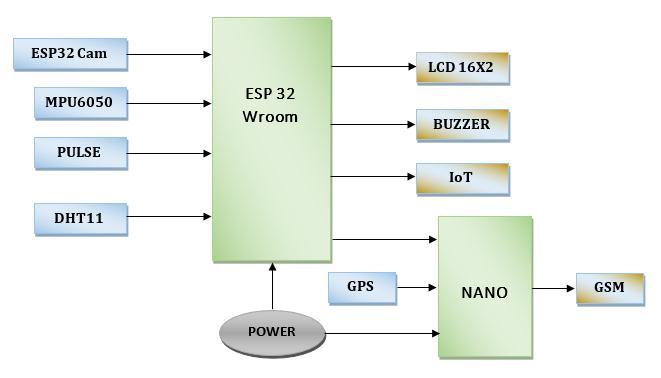
ThesystemdesignoftheproposedIoT-BasedElderlyPersonFallDetectionandEmergencyAlertSystemisfocusedonoffering ongoinghealthmonitoring,precisefalldetection,andquickemergencyresponseforolderadults.Itcombinesmotionsensing, health tracking, and wireless communication technologies to enhance the safety and ability of elderly people to live independently.
ThesystemkeepscollectingdataaboutbodymovementsandphysicalsignsthroughmultiplesensorsconnectedtotheESP32 microcontroller.Itreviewsthisinformationrightawaytodetectanystrangemovementsorifsomeonehasfallen.Whenafallis detected,thesystemautomaticallysendsoutanemergencyalertandsharestheuser'slocationwiththeircaregiversorfamily throughmessages.
Thesystemisdividedintotwomainparts:thehardwaredesignandthesoftwaredesign.Thehardwarepartincludessensors, communicationcomponents, displayscreens,and controllers that collectdata andsendoutalerts. Thesoftware part handles dataanalysis,detectsfalls,connectswithsensors,andusesIoTtechnologytomonitorinrealtimeandrespondtoemergencies. Thesystemisbuilttobedependable,affordable,easytocarry,andgoodforuseinsmarthealthcaresettings.
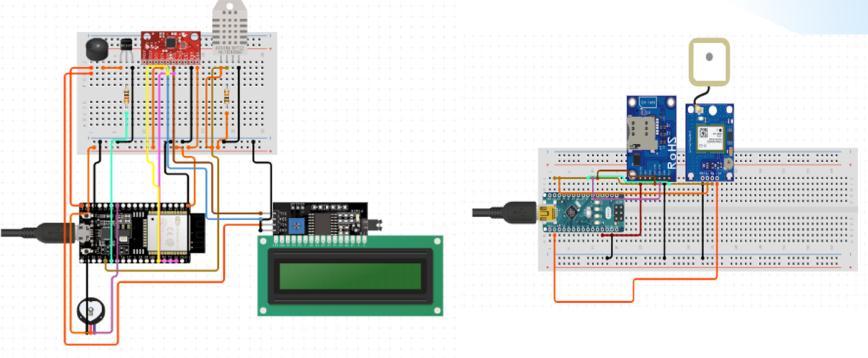
ThehardwaredesignoftheproposedIoT-BasedElderlyPersonFallDetectionandEmergencyAlertSystemusesvarioussensing, communication,andalertmodulestoaccuratelydetectfallsandquicklyrespondtoemergencies.ThesystemincludesanESP32 microcontroller,motionsensors,andhealthmonitoringsensors,communicationmodules,displayunits,andalertdevices.These hardwarepartsworkstogethertokeepaclosewatchonthemovementoftheelderlyperson’sbodyandtheirvitalhealthsigns. TheESP32-Wroomservesasthemainbrainofthesystem,handlingdatafromthesensors,processingit,andconnectingtothe internetthroughIoT.TheMPU6050sensorhelpsdetectsuddenmovement,changesinposition,andimpactsthatcouldindicate a fall. A pulse sensor checks the heart rate, and the DHT11 sensor measures body temperature and the surrounding environment.Incaseofanemergency,GSMandGPSmodulesareusedtosendalertsalongwiththeuser'scurrentlocation.The ESP32-CAMmoduletakespicturestoconfirmthesituationwhenneeded.AbuzzerandanLCDscreenalsoprovidelocalsound andvisualalerts.Thesystemisbuilttobeeasytocarry,dependable,inexpensive,andwell-suitedforsmarthealthcareuse.
Sr. No. Name of Component
Model Number
Function
1. Microcontroller ESP32-Wroom,ArduinoNano Maincontrollerusedforsensordata processingandIoTcommunication
2. Accelerometer&Gyroscope Sensor ADXL335 Detectsbodymovement,orientation,andfall events
3. PulseSensor PulseSensorModule Monitorsheartrateoftheuser
4. TemperatureSensor DHT11 Measurestemperatureandhumidity
5. CameraModule
ESP32-CAM CapturesVideosforvisualverificationduring emergencies
Volume: 13 Issue: 06 | Jun 2026 www.irjet.net
7. GPSModule
-ISSN: 2395-0072
-6MGPS Providesreal-timelocationtracking
8. LCDDisplay 16×2LCD Displayssystemstatusandalertmessages 9. Buzzer
BuzzerModule Generatesaudioalertwhenfallisdetected
The software part of the proposed IoT-Based Elderly Person Fall Detection and Emergency Alert System is made using EmbeddedCintheArduinoIDE.Thissoftwarehandlesreal-timedataprocessing,falldetection,sendingemergencyalerts,and monitoringthroughIoT.Itkeepscheckingthedatafromsensorstospotunusualmovementsandpossiblefallswithverylittle delay.
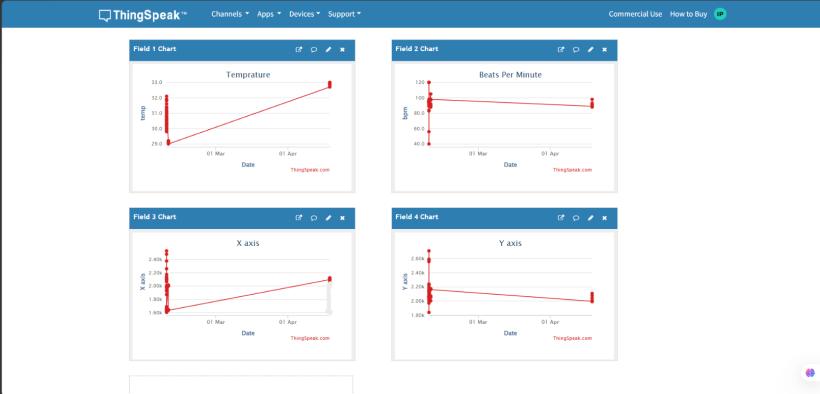
Whenafallisfound,thesoftwarestartsthealertsystemandsendsurgentmessages,includingtheuser'slocation,tocaregivers orfamily.Thesystemalsoletspeoplewatchthingsinreal-timeusingtheThingSpeakIoTplatform.Onthisplatform,valueslike heartrateand temperatureareshown withgraphs usingXandYaxes, makingit easierto analysehealthinformation froma distance.
Forbuildingandseeinghowthesystemworks,TinkerCadisusedtodesignandtestthehardwarecircuits.Canvas isusedto createtheblockdiagramandshowthewholeproject.Thesoftwareismadetobeeasytouse,dependable,andefficientforsmart healthcarepurposes.
3. WORKING
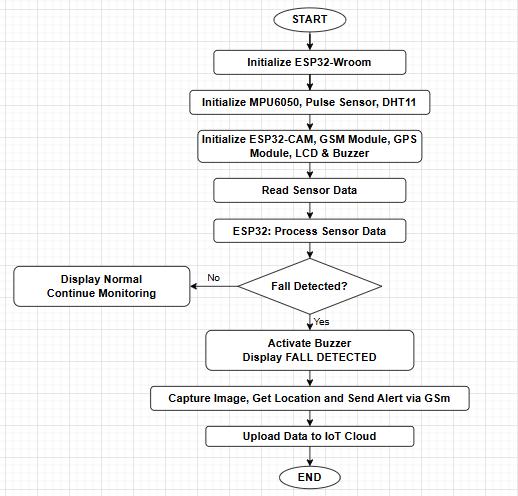
Duringeverydayactivitieslikewalking,standing,orsitting,themotionsensorsshowsteadyandpredictablereadings.Butwhen someonefalls,theirbodysuddenlychangesspeedandmovesinadifferentway.Theseunusualmovementsarepickedupbythe accelerometerandgyroscopesensors.Themicrocontrollerkeepscheckingthesensordataandcomparesitwithsetlimits.Ifthe movementseemslikeafall,thesystemchecksmoreinformation,suchashowthebodyispositionedandhowlongitstaysstill. Onceafallisconfirmed,thesystemstartsanemergencyresponse.Abuzzermakesaloudsoundtogetattention,andtheGSM
International Research Journal of Engineering and Technology (IRJET) e-ISSN: 2395-0056
Volume: 13 Issue: 06 | Jun 2026 www.irjet.net p-ISSN: 2395-0072
modulesendsamessagetosetcontacts.Atthesametime,theGPSmodulefindstheperson'slocationsocaregiverscangetthere quickly.Combiningmotionsensing,smartdataanalysis,andwirelesscommunicationhelpsthesystemdetectfallsandprovide fasthelp,makingitsaferandbetterforelderlypeople.
4.1. Normal Condition Monitoring Result
During normal operating conditions, the proposed IoT-Based Elderly Person Fall Detection and Emergency Alert System continuously monitored body movements and health parameters without generating any false emergency alerts. The system processed sensor data in real time and maintained stable performance throughout the monitoring process. The LCD display indicatednormalsystemstatus,whilethebuzzerremainedinactiveintheabsenceofanyfallevent.Additionally,pulserateand temperaturedataweresuccessfullyuploadedtotheThingSpeakIoTplatform,wherereal-timegraphicalrepresentationswere displayedusingX-axisandY-axisplotsforcontinuousremotehealthmonitoring.
4.2 X-
Result
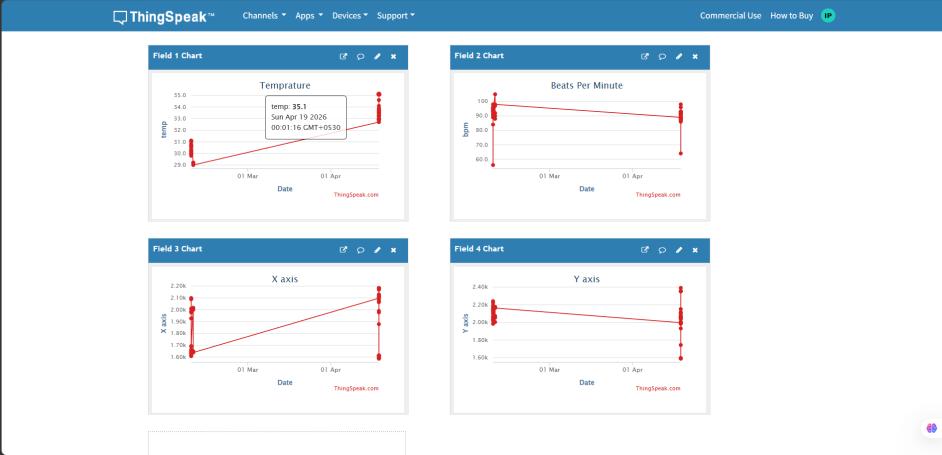
When the X-axis value of the accelerometerand gyroscopesensor was disturbed beyond the predefined threshold range, the systemsuccessfullyidentifiedtheabnormalbodymovementandtreateditasapossiblefallcondition.TheESP32processedthe sudden variation insensor orientation in real timeand immediatelyactivated thealert mechanism. The buzzer generatedan audiowarning,andemergencynotificationsalongwiththeuser’slocationdetailswerepreparedfortransmission.Thesensor readingswerealsoupdatedontheThingSpeakplatform,wherethevariationinX-axismovementcouldbeobservedgraphically throughreal-timedatavisualization.
Volume: 13 Issue: 06 | Jun 2026 www.irjet.net p-ISSN: 2395-0072
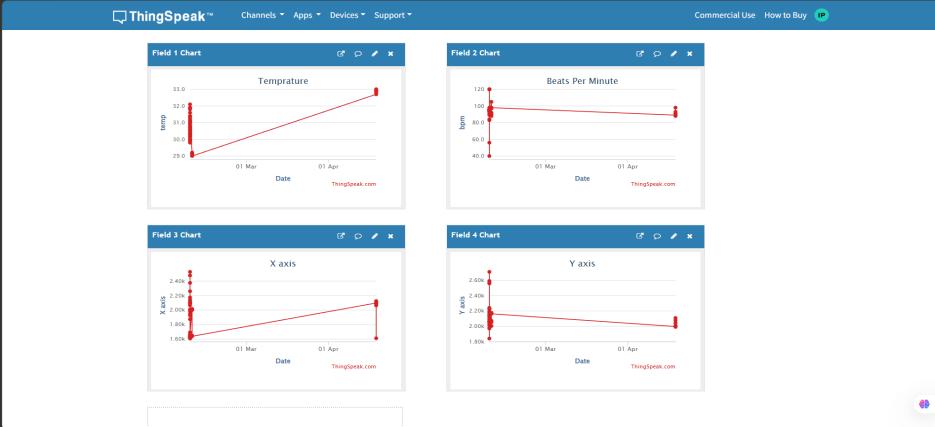
When the Y-axis value of the accelerometer and gyroscope sensor exceeded the predefined threshold limit, the system successfully detected abnormal movement associated with an unstable body posture or possible fall event. The ESP32 continuously monitored the sensor readings and processed the sudden change in Y-axis orientation in real time. Upon detection, the system activated the emergency alert mechanism, including buzzer notification and emergency message generation. The disturbance data was also updated on the Thing Speak IoT platform, where the Y-axis variation was displayedgraphicallyforreal-timemonitoringandanalysis.
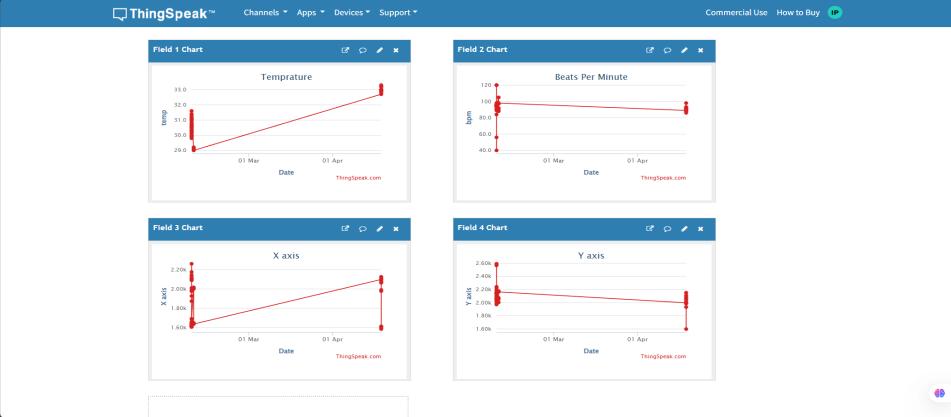
Whenabnormalpulseratevaluesweredetectedbeyondthenormalthresholdrange,thesystemsuccessfullyidentifiedthe irregular health condition and activated the monitoring process immediately. The pulse sensor continuously transmitted heartratedatatotheESP32,wherethereadingswereanalyzedinrealtime.Upondetectingabnormalpulsevariations,the systemgeneratedanalertindicationandupdatedthehealthstatusontheLCDdisplay.Thepulsedatawasalsouploadedto the Thing Speak IoT platform, where real-time graphical visualization using X-axis and Y-axis plots allowed continuous remotemonitoringoftheuser’shealthcondition.
Volume: 13 Issue: 06 | Jun 2026 www.irjet.net
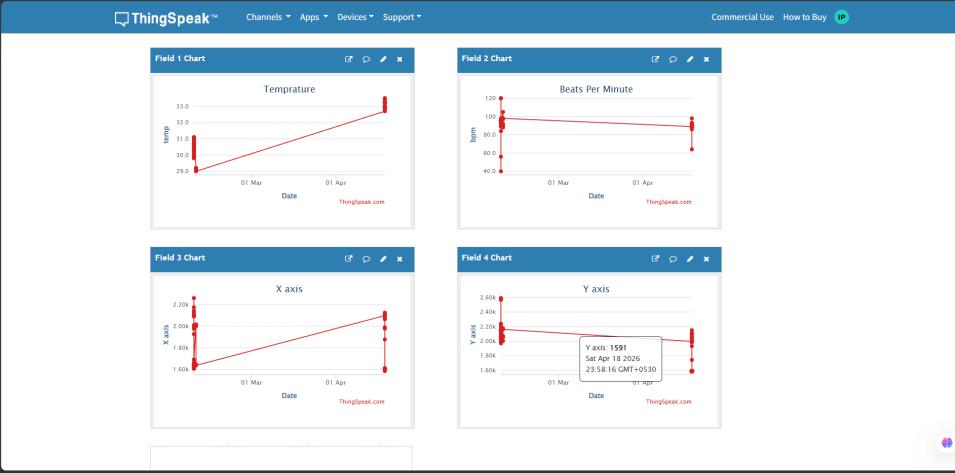
Whenthetemperaturevalueexceededthepredefinednormalrange,thesystemsuccessfullydetectedtheabnormalhealth conditionandinitiatedthe monitoringandalertprocess.Thetemperaturesensorcontinuouslymeasuredtheuser’sbody temperature, and the ESP32 processed the sensor readings in real time. Upon detecting unusual temperature variations, the system updated the alert status on the LCD display and activated the necessary notification mechanism. The temperature data was also uploaded to the Thing Speak IoT platform, where real-time graphical representation using XaxisandY-axisplotsenabledcontinuousremotehealthmonitoringandanalysis
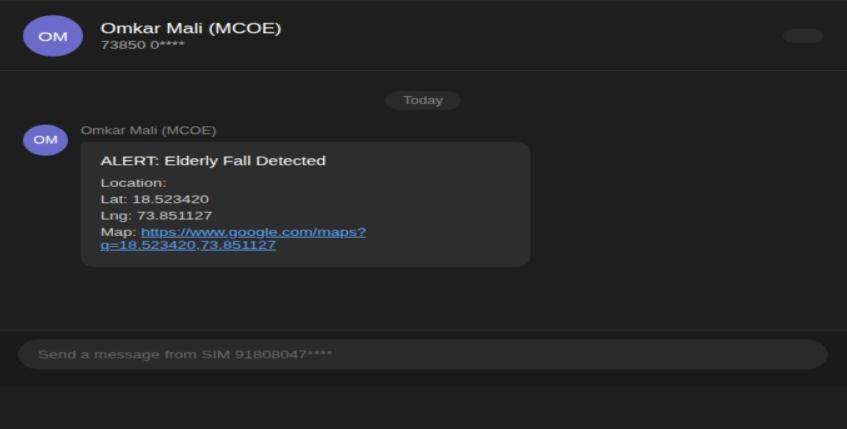
The GSM module successfully transmitted an emergency alert message immediately after detecting a fall event. The SMS contained the alert notification along with the real-time GPS coordinates and a Google Maps link for accurate location tracking. By accessing the provided map link, caregivers or family members can quickly identify the exact location of the elderlypersonandprovideimmediatemedicalassistanceduringemergencysituations.
Volume: 13 Issue: 06 | Jun 2026 www.irjet.net
4.7 Real-Time GPS Location Tracking Result
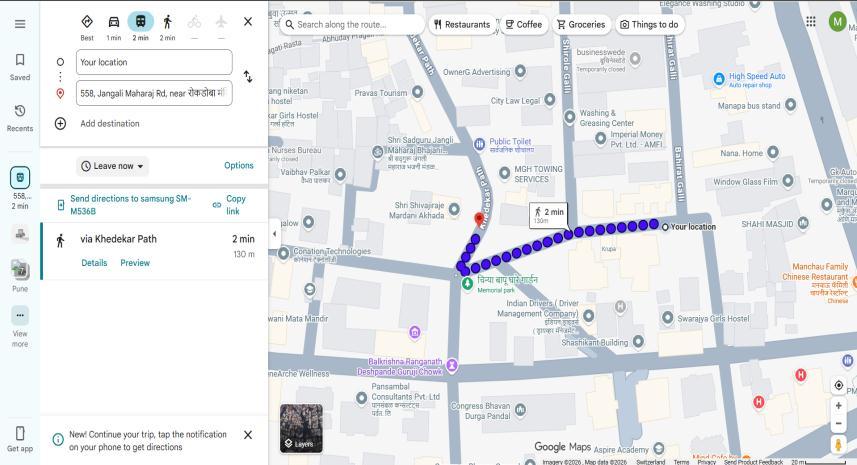
Theproposedsystemsuccessfullytrackedanddisplayedtheexactlocationoftheelderlypersonafterdetectingafallevent. The GPS module generated real-time location coordinates and shared them through a Google Maps link using the GSM module.Theaboveimageshowsthenavigationpathfromthecurrentlocationtothedetectedfalllocation,demonstrating thesystem’sabilitytoprovideaccuratelocationtrackingandquickemergencyassistance.
5. FUTURE SCOPE
1. Integration of Advanced AI and Machine Learning Algorithms
Advanced artificial intelligence techniques can be integrated to improve fall detection accuracy and reduce false alarm generationduringnormaldailyactivities.
2. Development of Mobile Application for Remote Monitoring
Adedicatedmobileapplicationcanbedevelopedtoprovidereal-timehealthmonitoring,emergencynotifications,andlive locationtrackingforcaregiversandfamilymembers.
3. Cloud-Based Healthcare Data Storage and Analysis
Cloudintegrationcanbeimplemented forsecurestorageofhealthrecordsandlong-termanalysisofuserhealthdata for predictivehealthcaremonitoring.
Volume: 13 Issue: 06 | Jun 2026 www.irjet.net
-ISSN: 2395-0072
Thecompletesystemcanbeconvertedintoacompactwearabledevicesuchasasmartwatchorsmartbandforimproved portabilityandusercomfort.
5. Voice Assistance and Two-Way Communication Support
Future systems can include voice alert features and two-way communication capabilities to allow elderly users to communicatedirectlywithcaregiversduringemergencysituations.
The proposed IoT-Based Elderly Person Fall Detection and Emergency Alert System present an intelligent, reliable, and cost-effectivesolutionforimprovingthesafetyandhealthcaremonitoringofelderlyindividuals.Fallsareoneofthemajor healthrisksfacedbyseniorcitizensandmobility-impairedpatients,oftenresultinginsevereinjuriesanddelayedmedical assistance. To overcome these challenges, the developed system integrates motion sensing, health monitoring, GPS tracking, and wireless communication technologies to provide continuous real-time monitoring and rapid emergency response.
The system continuously monitors body movements using accelerometer and gyroscope sensors and accurately detects abnormal movementsassociated with fall events. Inaddition to fall detection,thesystem alsomonitorsimportanthealth parameters such as pulse rate and temperature, enabling better healthcare supervision for elderly users. Whenever abnormalmovementorhealthconditionsaredetected,thesystemimmediatelyactivatestheemergencyalertmechanism and sends notifications along with the user’s real-time location details to caregivers or family members through GSM communication.
The integration of the Thing Speak IoT platform further enhances the effectiveness of the system by providing remote monitoring and graphical visualization of sensor data through X-axis and Y-axis plots. This feature allows continuous observation of pulse rate and temperature values from anywhere through an internet-based interface. The system also provides local audio and visual alerts using a buzzer and LCD display, ensuring immediate attention during emergency situations.
The developed prototype demonstrates stable operation, real-time response capability, portability, and low implementationcost,makingitsuitableforsmarthealthcareandassistedlivingapplications.TheuseofESP32technology, IoT communication, and integrated health monitoring improves the overall reliability and efficiency of the proposed system. Overall, the project successfully achieves its objective of enhancing elderly safety, reducing emergency response time,andsupportingindependentlivingthroughintelligenthealthcaremonitoringandemergencyalerttechnology.
1) N.El-Bendary,Q.Tan,F.C.Pivot,andA.Lam,“FallDetectionandPreventionfortheElderly:AReviewofTrends and Challenges,” International Journal on Smart Sensing and Intelligent Systems, vol. 6, no. 3, pp. 1230–1266, June2013.
2) Ungar, M. Rafanelli, I. Iacomelli, M. A. Brunetti, A. Ceccofiglio, F. Tesi, and N. Marchionni, “Fall prevention in the elderly,”ClinicalCasesinMineralandBoneMetabolism,vol.10,no.2,pp.91–95,2013.
3) K.-L.LuandE.T.-H.Chu,“AnImage-BasedFallDetectionSystemfortheElderly,”AppliedSciences,vol.8,no.10, pp.1995–2025,Oct.2018.
4) A. Pfortmueller, G. Lindner, and A. K. Exadaktylos, “Reducing fall risk in the elderly: risk factors and fall prevention,asystematicreview,”MinervaMedica,vol.105,no.4,pp.275–281,Aug.2014.
5) K. Balzer, M. Bremer, S. Schramm, D. Luhmann, and H. Raspe, “Falls prevention for the elderly,” GMS Health TechnologyAssessment,vol.8,pp.1–18,2012.
International Research Journal of Engineering and Technology (IRJET) e-ISSN: 2395-0056
Volume: 13 Issue: 06 | Jun 2026 www.irjet.net p-ISSN: 2395-0072
6) P. Singh, “Internet of Things Based Health Monitoring System: Opportunities and Challenges,” International JournalofAdvancedResearchinComputerScience,vol.9,no.1,pp.224–228,Jan.–Feb.2018.
7) P. Singh, “Internet of Things Based Health Monitoring System: Opportunities and Challenges,” International JournalofAdvancedResearchinComputerScience,vol.9,no.1,pp.224–228,Jan.–Feb.2018.
8) E.Thomas,G.Battaglia,A.Patti,J.Brusa,V.Leonardi,A.Palma,andM.Bellafiore,“Physicalactivityprogramsfor balanceandfallpreventioninelderly:Asystematicreview,”Medicine,vol.98,no.27,2019.
9) A.H.Ngu,P.-T.Tseng,M.Paliwal,C.Carpenter,and W.Stipe,“Smartwatch-BasedIoT Fall DetectionApplication,” OpenJournalofInternetofThings(OJIOT),vol.4,no.1,pp.87–98,2018.
10) T.R.Mauldin,M.E.Canby,V.Metsis,A.H.H.Ngu,andC.C.Rivera,“SmartFall:ASmartwatch-BasedFallDetection SystemUsingDeepLearning,”Sensors,vol.18,no.10,pp.3363–3381,Oct.2018.
11) Naik D.M.andA. J.Vyavahare,“Disease Detection ofCottonCropusingImage ProcessingTechnique:ASurvey,” InternationalJournalforResearchinAppliedScience&EngineeringTechnology(IJRASET),vol.3,no.6,pp.204–210,June2015.
12) R. Li, “A Review of Fall Detection Research Based on Deep Learning,” in Proceedings of the 5th International ConferenceonSignalProcessingandMachineLearning,2024,pp.93–102.
13) G. Santhanamari, S. Choudhary, S. M. M. PS, Gurusharan, and V. L., “A Smart Wearable-Based Fall Detection and HealthMonitoringSystemforElderlyCareUsingIoTandMachineLearning,”2024.
14) F. Hussain, M. B. Umair, M. Ehatisham-ul-Haq, I. M. Pires, T. Valente, N. M. Garcia, and N. Pombo, “An Efficient MachineLearning-basedElderlyFallDetectionAlgorithm,”inProceedingsofanInternationalConference,pp.1–6,2020.
15) K. H. M. and S. N. R., “Advanced Fall Detection System for Elderly Individuals Using Deep Learning and MultiSensorFusion,”InternationalAdvancedResearchJournalinScience,EngineeringandTechnology(IARJSET),vol. 11,no.7,pp.247–250,July2024.
16) A.Makhdoomi,M.Sarkhosh,andS.Ziaei,“PM2.5ConcentrationPredictionUsingMachineLearningAlgorithms: AnApproachtoVirtualMonitoringStations,”ScientificReports,vol.15,Art.no.8076,pp.1–11,2025.
17) T.R.Mauldin,M.E.Canby,V.Metsis,A.H.H.Ngu,andC.C.Rivera,“SmartFall:ASmartwatch-BasedFallDetection SystemUsingDeepLearning,”Sensors,vol.18,no.10,Art.no.3363,pp.1–19,Oct.2018.