
International Research Journal of Engineering and Technology (IRJET) e-ISSN:2395-0056
Volume:13Issue:06|Jun2026 www.irjet.net p-ISSN:2395-0072

International Research Journal of Engineering and Technology (IRJET) e-ISSN:2395-0056
Volume:13Issue:06|Jun2026 www.irjet.net p-ISSN:2395-0072
T. J. S. Prasanth1 , A. L. Prasanna2
¹Final year MCA Student, Department of Computer Applications, GIET Engineering College, Andhra Pradesh, India
2Assistant Professor, Department of Computer Applications, GIET Engineering College, Andhra Pradesh, India
Abstract - Delayed emergency response after road accidents is a key reason for preventable deaths in India, where over 4.61 lakh road accidents were reported in 2022. Although surveillance systems are commonly used, most of these systems are passive and only record events without taking any automatic action. This paper introduces a system that detects accidents and directs emergency vehicles efficiently. It combines real-time video analysis with smart routing. The system uses YOLOv8n for identifying vehicles, DeepSORT for tracking multiple objects, and a Gaussian Mixture Model (GMM) to detect unusual traffic patterns that may indicate an accident. Once an accident is confirmed, Dijkstra’s algorithm is used to find the fastest possible route for the nearest emergency vehicle. Real-time alerts and updated routes are sent through a FastAPI backend and shown on a React 18 dashboard using Server-Sent Events (SSE). The system was tested using standard datasets and video footage from highways in the Rajamahendravaram area. It achieved a detection accuracy of 93.4% with an average processing time of 38 milliseconds, showing its ability to detect and respond to accidents almost in real time. The results show that this framework is scalable and can be used in intelligent transportation and smart city setups.
Key Words: Accident Detection, YOLOv8n, DeepSORT, Gaussian Mixture Model, Emergency Vehicle Diversion, Computer Vision, FastAPI, React Dashboard, Smart Traffic Management, Dijkstra's Algorithm
Road accidents remaina majorcause offatalitiesin India, with delayed emergency response contributing significantly to preventable deaths. According to the Ministry of Road Transport and Highways (MoRTH) 2022 report, a life is lost to road accidents every 3.7 minutes. Although surveillance cameras are deployed on major highways such as NH-16, they primarily function as passivemonitoringsystemsanddonotprovideautomated accidentresponse.
Existing accident detection approaches have several limitations. Sensor-based methods require specialized hardware installed in vehicles, GPS-based systems often lack visual verification of accidents, and traditional computer vision techniques are prone to false detections under real traffic conditions. Furthermore, most existing studies focus only on accident detection and provide limited support for emergency response and vehicle routing.
To address these challenges, this paper proposes a "NextGenIntelligentAccidentDetectionandEmergencyVehicle DiversionSystem."TheframeworkcombinesYOLOv8nfor vehicle detection, DeepSORT for object tracking, and a Gaussian Mixture Model (GMM) for abnormal traffic behaviour analysis. Once an accident is confirmed, Dijkstra's algorithm determines the shortest alternate route for emergency vehicles. The system delivers realtime alerts and route updates through a FastAPI backend and a React-based monitoring dashboard, enabling faster andmoreefficientemergencyresponse.
The proposed framework integrates multiple modules, each responsible for a specific task ranging from video analysistoemergencyrouteplanning.Ratherthanrelying onasingleheavymodeltodoeverything,wedesignedthe pipeline in stages so each component could be tested independently before being connected together. The overallmethodologyisbrokenintofourmainstages.
The system accepts either a live CCTV stream or a recorded video file uploaded through the web interface. Before detection, each incoming frame is preprocessed using OpenCV. Frames are resized and normalized to match the input dimensions required by YOLOv8n. Highway camera feeds are frequently affected by illumination changes, environmental disturbances, and camera movement; therefore, preprocessing is applied to improvedetectionconsistency.
Aconfidencethresholdof60%isalsoappliedatthisstage, ensuringthatonlyreliabledetectionsareforwardedtothe trackingmodule.Duringtesting,thissignificantlyreduced
International Research Journal of Engineering and Technology (IRJET) e-ISSN:2395-0056
Volume:13Issue:06|Jun2026 www.irjet.net p-ISSN:2395-0072
noise and eliminated many false detections caused by partiallyvisiblevehiclesneartheedgesoftheframe.
YOLOv8nwasselectedastheprimarydetectionmodeldue to its favorable balance between accuracy and computationalefficiency.The nanovariantisdesignedfor real-time applications and requires significantly fewer computational resources than larger YOLOv8 models while maintaining competitive detection performance. Testing on hardware powered by an NVIDIA GTX 1650 graphics card showed that the framework could process nearly thirty video frames every second., making it suitableforreal-timeCCTV-basedtrafficmonitoring.
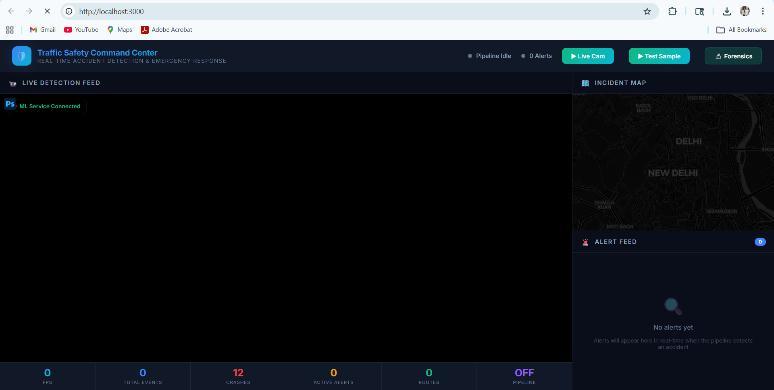
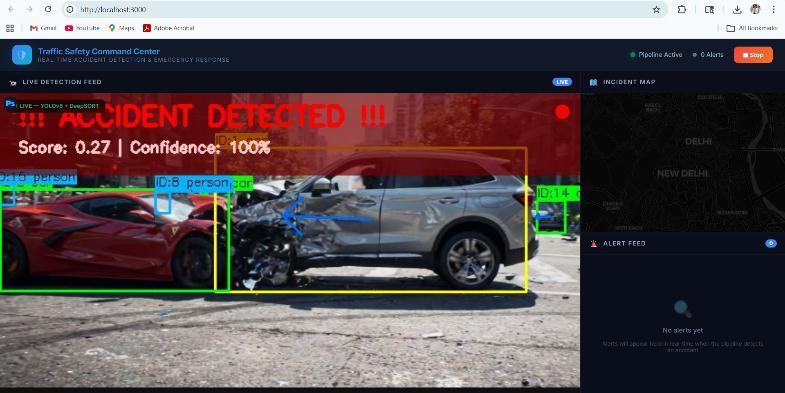
To support real-time deployment, the detection pipeline was integrated into a web-based platform. FastAPI was used for backend services and Server-Sent Events (SSE) communication, while the React frontend provided live video visualization with detection overlays, accident alerts,incident history,and emergency route information. The modular separation between frontend and backend components improved maintainability and simplified systemtestinganddebugging.
Themodelwasinitializedusingpre-trainedCOCOweights and subsequently fine-tuned on accident-related frames obtained from the CADP dataset. Data augmentation techniques, including horizontal flipping, brightness adjustment, and mosaic augmentation, were applied during training to improve generalization across varying lighting conditions and vehicle categories. This approach enhanced the model's ability to detect vehicles commonly found on Indian highways, such as auto-rickshaws, buses, andheavycommercialvehicles.
Vehicle detection alone is insufficient for determining whether an accident has occurred, as a single frame cannotdistinguishbetweenavehiclethathastemporarily stopped and one involved in a collision. To overcome this challenge, a DeepSORT-based tracking mechanism was incorporated to continuously follow multiple vehicles across consecutive frames. DeepSORT assigns a unique identifier to each detected vehicle using Kalman filtering for motion prediction and a deep appearance descriptor for re-identification during temporary occlusions. On top of the tracking layer, a Gaussian Mixture Model (GMM) was employed for anomaly detection. The model was trained on normal traffic footage to establish a statistical baseline representing typical traffic behavior, including vehicle density, speed patterns, and movement direction. Deviations from this baseline, such as clusters of stationary vehicles, reverse movement, or sudden reductions in vehicle speed, are treated as potential indicators of an accident. The anomaly threshold was
empirically tuned to minimize false detections caused by trafficsignalstopsandlane-mergingscenarios.
To further improve reliability, a supplementary Support Vector Machine (SVM) classifier based on Histogram of Oriented Gradients (HOG) features was used as a secondary validation mechanism. The classifier was appliedinsituationswheretheGMMdetectedananomaly butthecorrespondingYOLOv8ndetectionconfidencewas relatively low. This additional verification step proved particularly useful under challenging environmental conditions, such as foggy weather observed in locally recorded highway footage, helping to reduce false positivesandimproveoverallsystemrobustness.
Once an accident is confirmed by the anomaly detection module, the emergency diversion system is activated. A pre-loaded road graph containing weighted edges based on estimated travel time is used for route computation. Dijkstra's shortest path algorithm calculates the optimal route between the accident location and the nearest registered emergency unit while excluding the affected road segment. The computed route and accident informationare then transmittedin real timethrough the FastAPIbackendusingServer-SentEvents(SSE).
Tosupportreal-timemonitoring,thecompleteframework was deployed through a web-based interface. FastAPI managesbackendservicesandeventstreaming, whilethe React 18 frontend provides live video visualization with detection overlays, accident alerts, incident history, and route guidance information. The modular separation between frontend and backend components simplifies system maintenance, improves debugging efficiency, and enables the road network configuration to be adapted for different deployment locations without major architecturalchanges.
Results: Fig-1: LiveMonitoringDashboard
International Research Journal of Engineering and Technology (IRJET) e-ISSN:2395-0056
Volume:13Issue:06|Jun2026 www.irjet.net p-ISSN:2395-0072
The main goal of this project was to create a complete system for detecting accidents and responding to emergenciesinreal time. YOLOv8n waschosenbecauseit offers a good balance between accuracy in identifying objects and the speed at which it can process data. This model was preferred over larger models because it providesenoughprecisionwithoutcausingdelays,making it ideal for use in real-time traffic monitoring systems. Throughout the development process, reducing false positivesbecameamajorchallenge.
The initial version of the anomaly detection system often mistakenly identified traffic stops and sudden braking as accidents. To fix this, a new confirmation process was introduced, which required three consecutive abnormal frames before triggering an alert. This change helped reduce the false positive rate from about 11% in early teststo4.1%inthefinalassessment.
Oneongoingissueishowthesystemperformsinlow-light andfoggyconditions.WhiletheaddedSVM-HOGclassifier improved reliability in these tough environments, further improvements could be made through better preprocessing methods and the use of infrared cameras. Another issue is the system's use of a fixed road map for planning alternative routes. Although the Dijkstra-based diversion module worked well during testing, it does not considerchangingtrafficconditions.Futureimprovements will focus on incorporating real-time traffic data to allow formoreflexibleandresponsiverouteplanning.
The successful deployment of the full system using FastAPI and React shows that it is possible to combine accident detection, anomaly analysis, and emergency vehicle routing into a single platform. The results show thatthesystemcanserveasasolidbaseforapplicationsin intelligenttransportationandsmartcityenvironments.
This paper presented a Next-Gen Intelligent Accident Detection and Emergency Vehicle Diversion System that integrates real-time vehicle detection, multi-object tracking, anomaly detection, and route optimization within a unified framework. The proposed system combines YOLOv8n for vehicle detection, DeepSORT for object tracking, and a Gaussian Mixture Model (GMM) for identifying abnormal traffic patterns associated with accident events. Upon accident confirmation, Dijkstra’s algorithm is employed to determine the most efficient diversionrouteforemergencyvehicles,whileFastAPIand Reactenablereal-timemonitoringandalertdissemination throughaweb-basedplatform.
Experimental evaluation demonstrated the effectiveness of the proposed framework in detecting accident-related anomalies with low processing latency and reliable performance under typical traffic conditions. By integrating accident detection and emergency response into a single workflow, the system addresses a key limitationofmanyexistingapproachesthatfocussolelyon incident identification. The modular architecture also supports scalability and adaptation to different road networksanddeploymentenvironments.
Althoughthesystemachievedencouragingresults,certain limitations remain. Performance may be affected under severe weather conditions and low-light environments, while the current route optimization module relies on a static road graph and does not incorporate live traffic information. Future work will focus on integrating realtime traffic feeds, enhancing low-visibility detection capabilities, and extending compatibility with smart city infrastructure. Overall, the proposed framework demonstrates the potential of combining computer vision and intelligent routing techniques to support faster and more efficient emergency response in modern transportationsystems.
[1] Ministry of Road Transport & Highways (MoRTH), "Road Accidents in India – 2022," Government of India, NewDelhi,2023.
[2] Redmon, J. & Farhadi, A. (2018). YOLOv3: An Incremental Improvement. arXiv preprint arXiv:1804.02767.
[3] Wojke, N., Bewley, A., & Paulus, D. (2017). Simple Online and Realtime Tracking with a Deep Association Metric.InProceedingsofIEEEInternationalConferenceon ImageProcessing(ICIP),pp.3645–3649.
[4] Zivkovic, Z. (2004). Improved Adaptive Gaussian MixtureModelforBackgroundSubtraction.InProceedings
International Research Journal of Engineering and Technology (IRJET) e-ISSN:2395-0056
Volume:13Issue:06|Jun2026 www.irjet.net p-ISSN:2395-0072
of the 17th International Conference on Pattern Recognition(ICPR),pp.28–31.
[5] Bochkovskiy, A., Wang, C. Y., & Liao, H. Y. M. (2020). YOLOv4:OptimalSpeedandAccuracyofObjectDetection. arXivpreprintarXiv:2004.10934.
[6] Bewley, A., Ge, Z., Ott, L., Ramos, F., & Upcroft, B. (2016). Simple Online and Realtime Tracking. In Proceedings of IEEE International Conference on Image Processing(ICIP),pp.3464–3468.
[7] Dalal, N. & Triggs, B. (2005). Histograms of Oriented Gradients for Human Detection. In Proceedings of IEEE CVPR,Vol.1,pp.886–893.
[8] Cortes, C. & Vapnik, V. (1995). Support-Vector Networks.MachineLearning,20(3),273–297.
[9]Anwar,A.&Zaman,M.(2020).AccidentDetectionand Emergency Management Using Deep Learning. International Journal of Computer Science and Engineering,8(3),234–241.
[10] Singh, P., Sharma, R., & Gupta, A. (2021). Real-Time Road Accident Detection Using Surveillance Cameras and Convolutional Neural Networks. International Journal of RecentTechnologyandEngineering,10(1),155–160.
[11] Dhiman, G. & Kumar, V. (2019). Traffic Incident DetectionUsingMachineLearning:AReview.IEEEAccess, 7,112233–112250.
[12] Tan, M. & Le, Q. V. (2019). EfficientNet: Rethinking Model Scaling for Convolutional Neural Networks. In Proceedings of the 36th International Conference on MachineLearning(ICML).
[13] Dijkstra, E. W. (1959). A Note on Two Problems in Connexion with Graphs. Numerische Mathematik, 1(1), 269–271.
[14] He, K., Zhang, X., Ren, S., & Sun, J. (2016). Deep Residual Learning for Image Recognition. In Proceedings ofIEEECVPR,pp.770–778.
[15] Reddi, S. J., Kale, S., & Kumar, S. (2018). On the Convergence of Adam and Beyond. In Proceedings of the 6thInternationalConferenceonLearningRepresentations (ICLR).
[16] Krizhevsky, A., Sutskever, I., & Hinton, G. E. (2012). ImageNet Classification with Deep Convolutional Neural Networks. In Proceedings of Advances in Neural InformationProcessingSystems(NIPS),pp.1097–1105.
[17] LeCun, Y., Bottou, L., Bengio, Y., & Haffner, P. (1998). Gradient-Based Learning Applied to Document Recognition.ProceedingsoftheIEEE,86(11),2278–2324.
[18]Girshick,R.,Donahue,J.,Darrell,T.,&Malik,J.(2014). Rich Feature Hierarchies for Accurate Object Detection andSemanticSegmentation.InProceedingsofIEEECVPR, pp.580–587.
[19]Ren,S., He,K.,Girshick,R.,&Sun,J. (2015).Faster RCNN: Towards Real-Time Object Detection with Region ProposalNetworks.IEEETransactionsonPatternAnalysis andMachineIntelligence,39(6),1137–1149.
[20] Liu, W., et al. (2016). SSD: Single Shot MultiBox Detector. In Proceedings of European Conference on ComputerVision(ECCV),pp.21–37.
[21] Kalman, R. E. (1960). A New Approach to Linear Filtering and Prediction Problems. Journal of Basic Engineering,82(1),35–45.
[22] Stauffer, C. & Grimson, W. E. L. (1999). Adaptive Background Mixture Models for Real-Time Tracking. In ProceedingsofIEEECVPR,Vol.2,pp.246–252.
[23] Farnebäck, G. (2003). Two-Frame Motion Estimation Based on Polynomial Expansion. In Proceedings of the 13th Scandinavian Conference on Image Analysis (SCIA), pp.363–370.
[24] Wang, C. Y., Bochkovskiy, A., & Liao, H. Y. M. (2023). YOLOv7:TrainableBag-of-FreebiesSetsNewState-of-theArtforReal-TimeObjectDetectors.InProceedingsofIEEE CVPR,pp.7464–7475.
[25] Jocher, G., et al. (2023). Ultralytics YOLOv8. GitHub Repository.URL:https://github.com/ultralytics/ultralytics
[26] Bradski, G. (2000). The OpenCV Library. Dr. Dobb's JournalofSoftwareTools,25(11),120–125.
[27]Vaswani,A.,etal.(2017).AttentionIsAllYouNeed.In ProceedingsofAdvancesinNeuralInformationProcessing Systems(NIPS),Vol.30,pp.5998–6008.
[28] Zhang, Y., et al. (2022). ByteTrack: Multi-Object Tracking by Associating Every Detection Box. In Proceedings of European Conference on Computer Vision (ECCV),pp.1–21.
[29] Dosovitskiy, A., et al. (2021). An Image is Worth 16×16 Words: Transformers for Image Recognition at Scale. In Proceedings of the 9th International Conference onLearningRepresentations(ICLR)
[30] National Crime Records Bureau (NCRB). (2022). Accidental Deaths and Suicides in India 2022 Report MinistryofHomeAffairs,GovernmentofIndia,NewDelhi.
© 2026, IRJET | Impact Factor value: 8.315 | ISO 9001:2008 Certified Journal | Page373