
International Research Journal of Engineering and Technology (IRJET) e-ISSN: 2395-0056
Volume: 13 Issue: 04 | Apr 2026 www.irjet.net p-ISSN: 2395-0072
International Research Journal of Engineering and Technology (IRJET) e-ISSN: 2395-0056
Volume: 13 Issue: 04 | Apr 2026 www.irjet.net p-ISSN: 2395-0072
Prateek Kumar1 , Deepak Kumar2 , Sahaj Kashyap3 , A.K Madan4
123Under Graduate Student's, Delhi Technological University, Shahbad Daulatpur 4Professor, Delhi Technological University, Shahbad Daulatpur
Abstract: Predictive maintenance has become an essentialtechniqueinmodernindustriestoreducemachine downtime and improve operational efficiency. This paper presentsa machine learning based predictivemaintenance system developed using the AI4I 2020 dataset. The system utilizes key machine parameters such as temperature, rotational speed, torque, and tool wear to predict machine failure.
Multiple machine learning models including Logistic Regression, Decision Tree, Random Forest, Gradient Boosting, and XGBoost were implemented and evaluated. Feature engineering techniques such as temperature difference and power estimation were applied to improve model performance. A risk scoring mechanism was introducedtoclassifymachineconditionsintolow,medium, and high-risklevels.
A web-based application was also developed using Streamlit to simulate real time prediction and provide maintenance recommendations. Experimental results show that ensemble models such as Random Forest and XGBoost achieved high accuracy. The proposed system demonstratesthepracticalapplicationofmachinelearning inpredictivemaintenanceandsupportsdecisionmakingin industrialenvironments.
Keywords: Predictive Maintenance, Machine Learning, Random Forest, XGBoost, Risk Scoring, Industrial Systems,RiskAssessment,IndustrialAI
Introduction
Industrial machinery plays a vital role in ensuring continuous production in manufacturing and industrial systems. Unexpected machine failures can lead to production losses, increased maintenance costs, and safety risks. Therefore, efficient maintenance strategies are essential. Traditional approaches such as reactive and preventive maintenance are often inefficient. Reactive maintenance results in unexpected downtime, while preventive maintenance may lead to unnecessary service Predictivemaintenanceoffersabettersolutionby analyzing machine data to predict failures before they occur. With the advancement of machine learning, predictive maintenance systems have become more effective.
Machinelearningalgorithmscananalyzelargedatasets andidentifypatternsthatindicatepotentialfailures. This enables timely maintenance and reduces operationalcosts.
In this work, a machine learning based predictive maintenance system is developed using multiple models.Featureengineeringtechniquesareappliedto improve accuracy, and a risk scoring mechanism is introduced to enhance decision making. A web-based applicationisalsodevelopedtodemonstratereal-time prediction.
Theproposedsystemprovidesapracticalandefficient solution for predictive maintenance in industrial applications.
Several researchers have explored the application of machinelearningtechniquesinpredictivemaintenance systems to improve reliability and reduce unexpected failures.
Hector et al. (2024) studied the implementation of predictive maintenance in Industry 4.0 environments. Theirworkfocusedonintegratingdata-drivenmodels with smart manufacturing systems. The study highlighted that real-time monitoring and machine learning models significantly reduce downtime and improveoperationalefficiency.
Patel et al. (2024) investigated the use of Random Forestalgorithmsformachinefailureprediction.They demonstrated that ensemble models outperform traditional statistical approaches in handling complex industrial datasets. Their results showed improved prediction accuracy and robustness in classification tasks.
Sharma et al. (2023) developed an IoT-based predictive maintenance system where sensor data is continuously collected and analyzed. Their system coulddetectanomaliesinreal-timeandprovidedearly warningsignalsformachinefailures,therebyreducing maintenancecosts.
International Research Journal of Engineering and Technology (IRJET) e-ISSN: 2395-0056
Volume: 13 Issue: 04 | Apr 2026 www.irjet.net p-ISSN: 2395-0072
Lin et al. (2025) applied XGBoost along with SHAP (SHapley Additive Explanations) to improve model interpretability.Theirstudyemphasizedtheimportance of understanding feature contributions in predictive models, which helps in making better industrial decisions.
Rao et al. (2022) focused on feature engineering techniques for predictive maintenance datasets. They showed that derived features such as temperature difference and power-related parameters significantly improvemodelperformancecomparedtorawdata.
Zhang et al. (2019) provideda comprehensive review of machine learning techniques used in predictive maintenance and highlighted the importance of datadrivenapproachesinreducingdowntime.
Lee et al. (2018) discussedtheconceptofIndustrialAI anditsroleinimprovingoperationalefficiencythrough intelligentpredictivesystems.
Carvalho et al. (2019) conducted a systematic review of predictive maintenance models and concluded that ensemblelearningmethodsprovidehigheraccuracyand robustness.
Despite these advancements, most existing studies primarily focus on prediction accuracy and do not provide a comprehensive decision support system for practicalimplementationinindustries.
The literature review shows that significant progress hasbeenmadeinapplyingmachinelearningtechniques to predictive maintenance. However, most existing studies primarily focus on improving prediction accuracyandoftenprovideonlybinaryoutputs(failure ornofailure),whichlimitstheirusefulnessinreal-world industrialdecision-making.
Moreover, limited research has been conducted on integrating predictive models with user-friendly applications for real-time interaction and visualization. Inaddition,manystudiesrelymainlyonrawsensordata and do not fully explore advanced feature engineering techniques such as temperature difference and power estimation.
Toaddressthesegaps,thisstudyproposesapredictive maintenance system that combines machine learning with a risk scoring mechanism and a web-based application for real-time prediction and decision support, enhancing both accuracy and practical usability.
The proposed predictive maintenance system is designed to analyze machine conditions and predict potential failures using machine learning techniques. The methodology integrates data processing, model development, risk assessment, and application deploymentintoaunifiedframework.
The system follows a data-driven approach where historicalmachinedataisusedtotrainmultiplemachine learning models. The trained models are then used to predictmachinefailureandassignariskscore. Additionally, a web-based interface is developed to simulatereal-timepredictionanddecisionsupport.
2) System Architecture
The architecture of the proposed system consists of the followingstages:
•DataCollection
•DataPreprocessing
•FeatureEngineering
•ModelTrainingandEvaluation
•RiskScoringMechanism
•WebApplicationDeployment
The complete workflow ensures smooth transformationofrawdataintoactionableinsightsfor predictivemaintenance.
Input Data → Data Preprocessing → Feature Engineering → Model Training → Prediction → Risk Scoring→WebApp
3) Dataset Description
The dataset used in this study is the AI4I 2020 PredictiveMaintenancedataset,whichcontains10,000 instances of machine operating conditions. It includes bothnumericalandcategoricalfeatures.
InputFeaturesinclude:
•AirTemperature(K)
•ProcessTemperature(K)
•RotationalSpeed(rpm)
•Torque(Nm)
•ToolWear(min)
•MachineType
Thetargetvariablerepresentsmachinefailure,where:
0→NoFailure
1→Failure
The dataset is well-structured and suitable for classificationtasks.
International Research Journal of Engineering and Technology (IRJET) e-ISSN: 2395-0056
Volume: 13 Issue: 04 | Apr 2026 www.irjet.net p-ISSN: 2395-0072
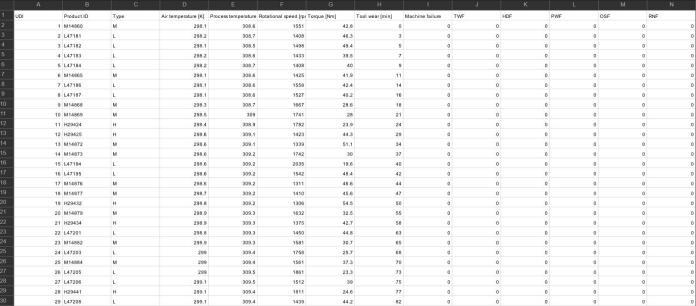
Fig1). DatasetPreview
4) Data Preprocessing
Datapreprocessingisperformedtocleanandpreparethe dataset for model training. The following steps are applied:
•RemovalofunnecessarycolumnssuchasUDIand ProductID
•Encodingofcategoricalvariables(MachineType)
•Handlingmissingvaluesandensuringdataconsistency
These steps improve data quality and enhance model performance.
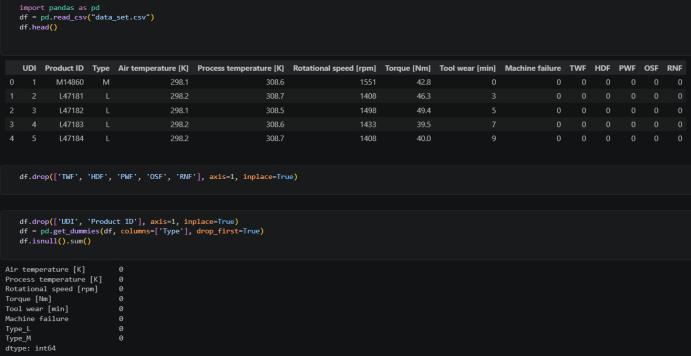
Fig2).DataPreprocessingcode
5) Feature Engineering
Toimprovepredictionaccuracy,newfeaturesarederived fromexistingdata:
•TemperatureDifference=ProcessTemperature–Air Temperature
•Power=Torque×RotationalSpeed
Power is calculated as the product of torque and rotational speed, representing the mechanical load on thesystem.
These engineered features capture hidden patterns and improvemodellearningcapability.
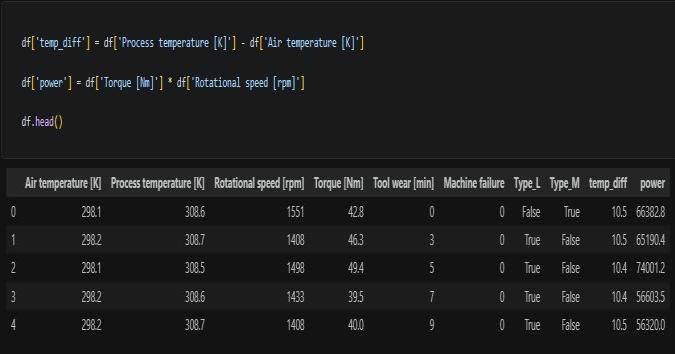
Fig3). FeatureEngineering
6) Model Development
Multiplemachinelearningalgorithmsareimplementedto compareperformance:
•LogisticRegression
•DecisionTree
•RandomForest
•GradientBoosting
•XGBoost
•The dataset is split into training (80%) and testing (20%) sets. Each model is trained and evaluated separately.
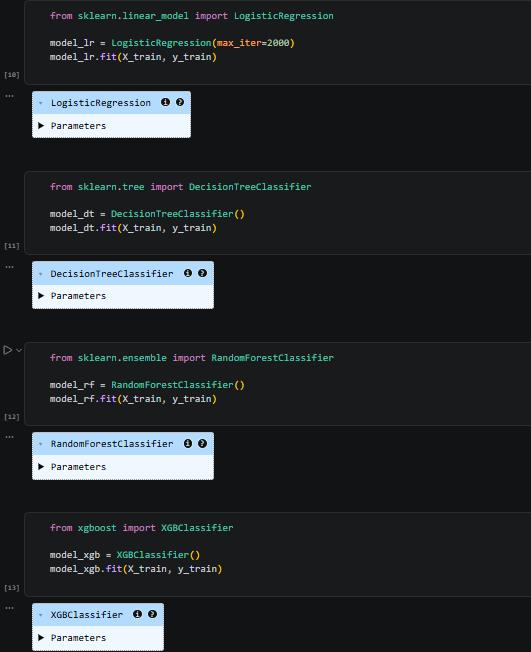
Fig4).Modeltraining
7) Model Evaluation
Modelperformanceisevaluatedusing:
•AccuracyScore
•ConfusionMatrix
•ROCCurve
•FeatureImportanceAnalysis
International Research Journal of Engineering and Technology (IRJET) e-ISSN: 2395-0056
Volume: 13 Issue: 04 | Apr 2026 www.irjet.net p-ISSN: 2395-0072
Thesemetricsprovideacomprehensiveunderstandingof modelperformance.
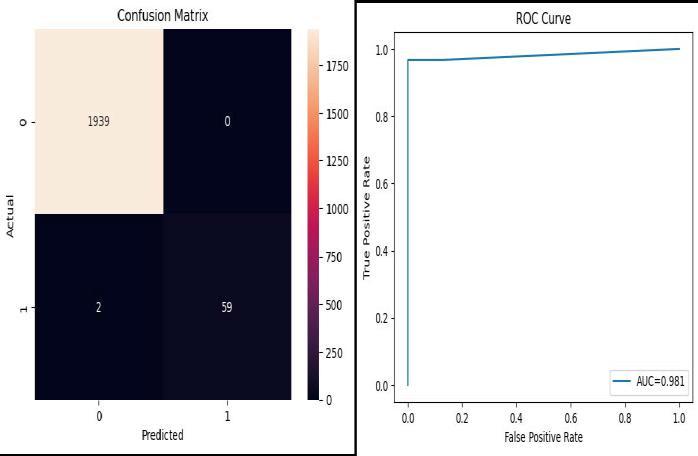
Fig5).ConfusionmatrixandROCgraph
8) Risk Scoring Mechanism
Ariskscoringsystemisintroducedtoenhancedecisionmaking. Instead of binary output, the model provides a probabilityscore.
Riskcategories:
•LowRisk(0–0.3)
•MediumRisk(0.3–0.7)
•HighRisk(0.7–1.0)
Thisapproachallowsbettermaintenanceplanning.
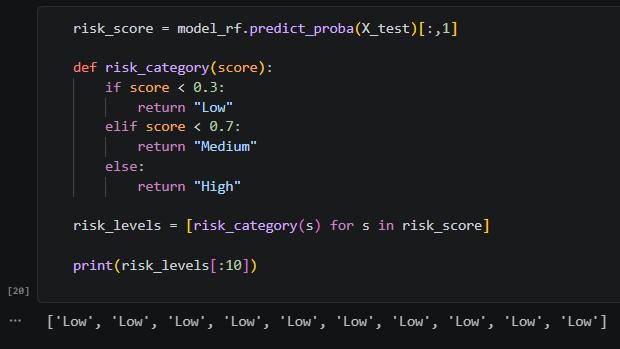
Fig6).Riskscorecodeand output
9) Application Development
A web-based application is developed using Streamlit to demonstratereal-timepredictivemaintenance.
Featuresoftheapplication:
•Userinputformachineparameters
•Real-timeprediction
•Riskscorevisualization
•Maintenancerecommendations
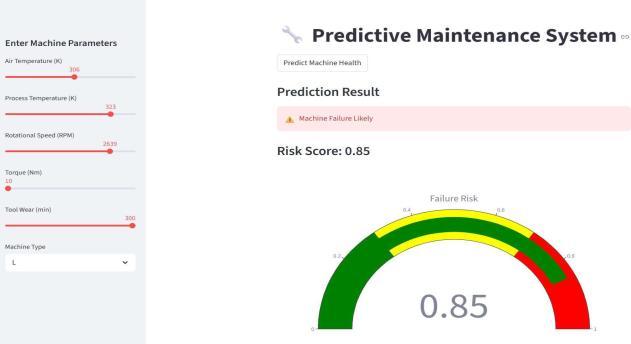
Fig7).AppUI
10) Tools and Technologies
•Python
•JupyterNotebook
•Scikitlearn,XGBoost
•Pandas,NumPy
•Matplotlib,Seaborn
•Streamlit
11) Summary
The methodology integrates machine learning models, feature engineering, and a user-friendly interface to provideaneffectivepredictivemaintenancesolution.The system not only predicts failures but also provides actionableinsightsthroughriskscoring.
1) Overview of Results
The developed predictive maintenance system was evaluatedusingmultiplemachinelearningmodels.The results demonstrate high prediction accuracy and effective risk classification.The integration of machine learning witha web-basedinterface providespractical usability.
2) Model Performance Evaluation
Differentmodelswereevaluatedbasedonaccuracy:
Table 1: Model Performance Comparison
LogisticRegression–0.999
Decision Tree – 0.996
Random Forest – 0.999
XGBoost–0.999
GradientBoosting–0.999
Analysis: The high accuracy obtained is influenced by the structured nature of the dataset. In real world industrial environments, model performance may vary duetonoiseanddynamicoperatingconditions.
EnsemblemodelssuchasRandomForestandXGBoost showed superior performance due to their ability to capture complex patterns. Decision Tree showed slightlyloweraccuracyduetooverfitting.
International Research Journal of Engineering and Technology (IRJET) e-ISSN: 2395-0056
Volume: 13 Issue: 04 | Apr 2026 www.irjet.net p-ISSN: 2395-0072
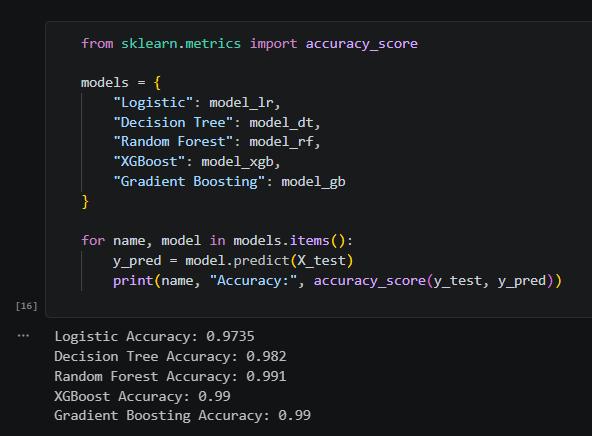
Fig8).Accuracycomparison
3) Confusion Matrix Analysis
The confusion matrix shows the classification performanceofthemodel.
Analysis:
•Hightruepositivesandtruenegatives
•Verylowmisclassification
•Strongpredictioncapability
4) ROC Curve Analysis
TheROCcurvedemonstratestheclassification capabilityofthemodel.
Analysis:
•AUCvaluecloseto1
•Excellentclassseparation
•Highmodelreliability
5) Feature Importance Analysis
Feature importance analysis identifies key parameters influencingpredictions.
KeyObservations:
•Power(Torque×Speed)isthemostsignificantfeature
•Temperaturedifferencealsoplaysanimportantrole
6) Risk Scoring Results
The risk scoring system provides a probability-based assessmentofmachinefailure.
Categories:
•LowRisk
•MediumRisk
•HighRisk
Analysis:
Risk scoring enhances interpretability and helps prioritizemaintenanceactions.
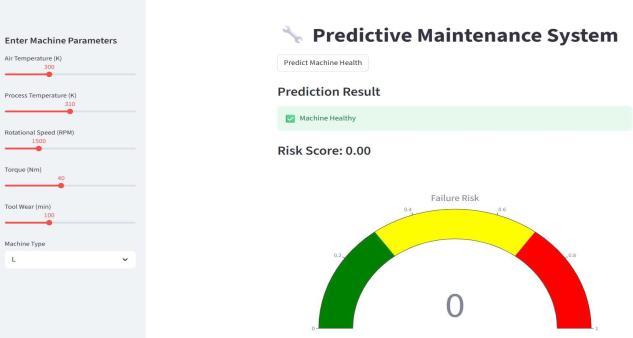
Fig9).Riskgauge
7)Application Results
The Streamlit application successfully simulates real-time predictivemaintenance.
ObservedFeatures:
•Real-timeinputhandling
•Instantpredictionoutput
•Riskvisualization
•Maintenancesuggestions
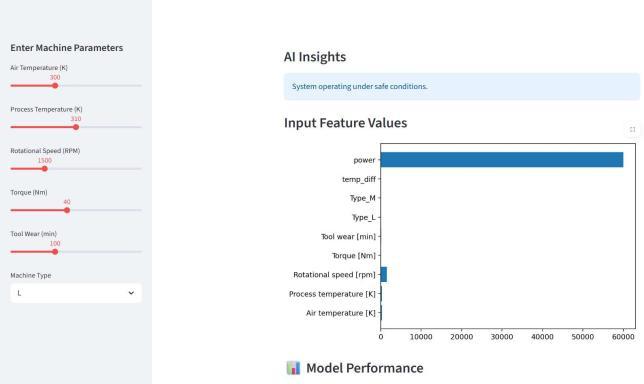
Fig10).AppUI
8)Discussion
The results indicate that machine learning models can effectively predict machine failures with high accuracy. However, the high accuracy is partly due to the structureddatasetusedinthisstudy.
Inrealworldindustrialenvironments,challengessuchas noisysensordata,missingvalues,andvaryingoperating conditionsmayreduceperformance.
Theintegrationofriskscoringandapplicationinterface improves usability and bridges the gap between
International Research Journal of Engineering and Technology (IRJET) e-ISSN: 2395-0056
Volume: 13 Issue: 04 | Apr 2026 www.irjet.net p-ISSN: 2395-0072
theoreticalmodelsandpracticalimplementation.
9)Summary
The proposed system demonstrates strong predictive performance and practical applicability. The combination of machine learning, feature engineering, and real-time interface makes it a robust predictive maintenancesolution.
Conclusion
Thispaperpresentsamachinelearningbased predictive maintenance system designed to predict machine failuresandassistinmaintenancedecision-making.The system utilizes the AI4I 2020 dataset and implements multiple classification models, including Logistic Regression, Decision Tree, Random Forest, Gradient Boosting, and XGBoost. Feature engineering techniques such as temperature difference and power estimation wereappliedtoenhancemodelperformance.
Experimental results show that ensemble models, particularly Random Forest and XGBoost, achieved superior accuracy and stability compared to other models. In addition to prediction, a risk scoring mechanism was introduced to classify machine conditions into low, medium, and high-risk levels, providingmoreinformativeinsightsthanasimplebinary output.
Furthermore, a user-friendly web application was developed using Streamlit to demonstrate real-time prediction and visualization of machine health. The integration of predictive models with an interactive interface improves the practical applicability of the system.
Althoughthemodelachievedhighaccuracyonthegiven dataset,itisimportanttonotethatreal-worldindustrial environmentsmaypresentadditionalchallengessuchas noisydataandvaryingoperatingconditions.Overall,the proposed system demonstrates the effective use of machinelearninginpredictivemaintenanceandprovides afoundationforfuturereal-timeindustrialapplications.
Theauthorswouldliketoexpresstheirsinceregratitude tothefacultyandprojectsupervisorfortheircontinuous guidanceandsupportthroughoutthedevelopmentofthis project. We also thank our institution for providing the necessaryresourcestocompletethisworksuccessfully.
[1]T. Chen and C. Guestrin, “XGBoost: A Scalable Tree BoostingSystem,”Proc.KDD,2016.
[2]L. Breiman, “Random Forests,” Machine Learning, vol. 45,no.1,pp.5–32,2001.
[3]F. Pedregosa et al., “Scikit-learn: Machine Learning in Python,”JMLR,2011.
[4]AI4I 2020 Predictive Maintenance Dataset, UCI Repository.
[5]J.Lee,H.Davari,J.Singh,andV.Pandhare,“IndustrialAI: Applications with Sustainable Performance,” IEEE Access,vol.6,pp.56415–56425,2018.
[6]S. Zhang, S. Ding, and L. Xie, “A Review of Machine Learning-BasedPredictive Maintenance,”IEEE Access, vol.7,pp.162837–162852,2019.
[7]D. B. Rawat et al., “Cyber-Physical Systems for PredictiveMaintenance,”IEEECommunications,2018.
[8]F. Chollet, “Deep Learning with Python,” Manning Publications,2018.
[9]A.Carvalho,R.Soares,R.Vita,R.Francisco,J.Basto,and S. Alcalá, “A Systematic Literature Review of Machine LearningMethodsAppliedtoPredictiveMaintenance,” Computers&IndustrialEngineering,vol.137,2019.