
International Research Journal of Engineering and Technology (IRJET) e-ISSN: 2395-0056
Volume: 13 Issue: 05 | May 2026 www.irjet.net p-ISSN: 2395-0072
International Research Journal of Engineering and Technology (IRJET) e-ISSN: 2395-0056
Volume: 13 Issue: 05 | May 2026 www.irjet.net p-ISSN: 2395-0072
Harish Lute1 , Suraj Phate2 , Gitesh Deore3
1Harish Lute, Department of Computer Science and Engineering, Sandip University
2Suraj Phate, Department of Computer Science and Engineering, Sandip University
3Gitesh Deore, Department of Computer Science and Engineering, Sandip University
Abstract - The evolution of digital ecosystems has transitioned from simple information retrieval to complex, personalized content discovery environments. This paper detailsthedevelopmentandimplementationoftheIntelligent Content Recommendation System (ICRS) v3.0, a highperformance enterprise platform designed to resolve the limitationsoftraditionalrecommendationengines.Thesystem architectureemploysasuper-hybridengineintegratingseven distinct algorithmic paradigms: SVD++ for latent factor modeling, Neural Collaborative Filtering for non-linear interaction learning, BERT4Rec for sequential behavior analysis, GraphSAGE for inductive graph representation, DuelingDeepQ-Networksforlong-termrewardoptimization, NSGA-II formulti-objectiveParetoefficiency,andRotatE for knowledge graph relational reasoning. To support these algorithms at scale, a real-time data pipeline utilizing the Kafka-Flink-ClickHouse (KFC) stack was implemented, providing sub-second processing for millions of concurrent events. Advanced features such as mood-aware personalization via affective computing and explainable AI throughtheSHAPframeworkareintegratedtoenhanceuser engagement and system transparency. Furthermore, the platform utilizes federated learning to ensure privacypreserving decentralized training. Experimental results validate the system's ability to significantly outperform baseline models in accuracy, diversity, and latency, establishing a new benchmark for enterprise-grade recommendationinfrastructures.
Key Words: Deep Learning, Hybrid Recommendation Systems, Explainable AI, Realtime Data Processing, Affective Computing, Federated Learning, Knowledge Graphs.
The evolution of digital ecosystems has transitioned from simple information retrieval to complex, personalized content discovery environments. This paper details the developmentandimplementationoftheIntelligentContent Recommendation System(ICRS)v3.0,a high-performance enterprise platform designed to resolve the limitations of traditional recommendation engines. The system architecture employs a super-hybrid engine integrating sevendistinctalgorithmicparadigms:SVD++forlatentfactor modeling, Neural Collaborative Filtering for non-linear interactionlearning,BERT4Recforsequentialbehavior analysis, GraphSAGE for inductive graph representation,
Dueling Deep Q-Networks for long-term reward optimization,NSGA-IIformulti-objectiveParetoefficiency, and RotatE for knowledge graph relational reasoning. To supportthesealgorithmsatscale,areal-timedatapipeline utilizing the Kafka-Flink-ClickHouse (KFC) stack was implemented,providingsub-secondprocessingformillions of concurrent events. Advanced features such as moodaware personalization via affective computing and explainableAIthroughtheSHAPframeworkareintegrated to enhance user engagement and system transparency. Furthermore, the platform utilizes federated learning to ensure privacy-preserving decentralized training. Experimental results validate the system's ability to significantly outperform baseline models in accuracy, diversity, and latency, establishing a new benchmark for enterprise-grade recommendation infrastructures. enterprisescaleandhandlemulti-modalcontentfortensof millionsofusers.
TheimplementationofICRS v3.0iscategorized intothree primarylayers:theAlgorithmicEngine,theReal-timeData Pipeline,andtheAdvancedPersonalizationModules.Each layer is designed for modularity and high availability, ensuringthattheenterpriseplatformcanscalehorizontally asuservolumeincreases.
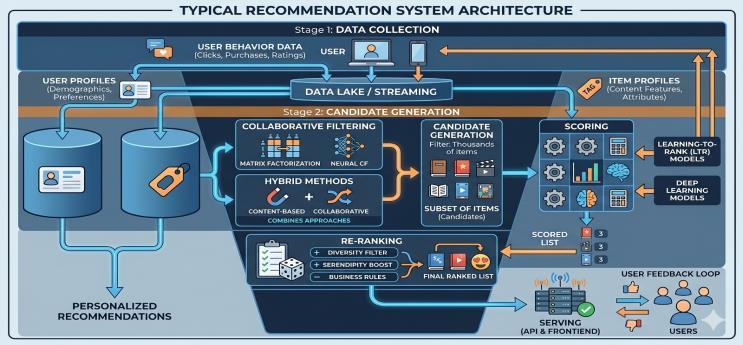
Fig -1:RecommendationSystemArchitecture.
The core of the ICRS v3.0 is a heterogeneous ensemble of seven algorithms. The rationale for this super-hybrid approach is the recognition that user behavior is multifaceted, requiring different mathematical structures to
International Research Journal of Engineering and Technology (IRJET) e-ISSN: 2395-0056
Volume: 13 Issue: 05 | May 2026 www.irjet.net p-ISSN: 2395-0072
capture latent, non-linear, sequential, and structural patterns.
Matrix factorization is the cornerstone of collaborative filteringinICRSv3.0.Specifically,thesystemutilizesSVD++, anenhancedversionofSingularValueDecompositionthat incorporates both explicit ratings and implicit feedback signals. Explicit feedback, such as a 5-star rating, is often sparse.Incontrast,implicitfeedback,suchasviewinghis toryordwelltime,isabundantbutnoisy.
To overcome the linear limitations of matrix factorization, ICRS v3.0 integrates Neural Collaborative Filtering. NCF replaces the inner product with a deep neural network architecturethatlearnstheinteractionfunctiondirectlyfrom data. The architecture consists of two parallel streams: a Generalized Matrix Factorization (GMF) layer that models linearinteractions,andaMulti-LayerPerceptron(MLP)that capturescomplexnon-linearities.
TheoutputsofGMFandMLPareconcatenatedandpassed throughafinalNeuMFlayertoproducetherecommendation score. This allows the system to recognize that user-item relationshipsareoftennon-monotonic;forinstance,auser’s interestinaspecificgenremightincreasewithintensitybut decreaseafteracertainthresholdofexposure.
2.1.3 Sequential Representation with BERT4Rec
Human behavior is chronologically dependent. ICRS v3.0 utilizes BERT4Rec, a bidirectional Transformer model, to analyze the sequence of user interactions. Unlike unidirectionalmodels(e.g.,GRUorLSTM)thatonlyconsider past history, BERT4Rec uses a bidirectional self-attention mechanismandaClozeobjective maskingrandomitemsin asequenceandtrainingthemodeltopredictthembasedon bothleftandrightcontext.
Theself-attentionmechanismallowsthesystemtoidentify whichhistoricalinteractionsaremostrelevanttothecurrent session. For example, in an e-commerce context, a user's purchaseofalaptopsixmonthsagomaybelessrelevantto theircurrentsearchforacoffeemachinethantheirbrowsing historyfromtenminutesago.
Enterprise systems are highly dynamic, with thousands of new items and users added daily. Traditional graph embeddingmethodsaretransductive,meaningtheycannot generateembeddingsfornodesnotpresentduringtraining withouta full retrain.ICRSv3.0solvesthisvia GraphSAGE (GraphSAmpleandaggreGatE).
GraphSAGE learns a set of aggregator functions that generalize from a node’s local neighborhood. When a new item is added, the system samples its attributes and the
attributes of its neighbors to generate a high-quality embedding immediately. This inductive capability ensures that the "cold-start" latency for new content is virtually eliminated.
While most recommenders optimize for immediate clicks, ICRS v3.0 aims for long-term user retention. The system implementsaDuelingDeepQ-Network(DQN)thattreatsthe recommendation process as a Markov Decision Process (MDP).The"agent"(therecommendationengine)takesan "action" (recommending an item) in a given "state" (user history and context) to maximize a "reward" (user satisfaction/retention).
TheDuelingarchitectureisparticularlyeffectivebecauseit separatelyestimatesthevalueofbeinginaspecificstateand theadvantageofchoosingaspecificaction.Thispreventsthe systemfromover-recommendingpopularitemsthatprovide high immediate rewards but lead to long-term "filter bubbles"anduserfatigue
Enterpriseobjectivesareoftencontradictory.Asystemthat maximizes accuracy might reduce diversity, leading to a repetitiveuserexperience.ICRSv3.0usestheNon-dominated Sorting Genetic Algorithm II (NSGA-II) to find a Paretooptimal balance between accuracy, diversity, novelty, and businessconstraints.
NSGA-IIevolvesapopulationofrecommendationstrategies, usingelitismandcrowdingdistancetoensurethatthefinal setofrecommendationsisnotonlyrelevantbutalsovaried andfresh.Thisensuresthattheplatformremainsengaging overextendedperiods.
2.1.7KnowledgeGraphRelationalReasoningwithRotatE
To incorporate external semantic knowledge, ICRS v3.0 utilizes Knowledge Graphs (KGs). Entities (users, actors, brands, genres) and theirrelationshipsare embedded ina complexvectorspaceusingtheRotatEmodel.RotatEmodels each relation as a rotation from the head entity to the tail entity.
This approach is superior to translational models (like TransE)becauseitcaneffectivelymodelcomplexrelational patterns such as symmetry (e.g., "is similar to"), antisymmetry(e.g.,"isaparentof"),andcomposition(e.g., "mother's husband is father"). This allows ICRS v3.0 to perform sophisticated reasoning, such as recommendinga film not because the user saw it, but because it shares a specific"director-style"relationshipwiththeirfavorites.
International Research Journal of Engineering and Technology (IRJET) e-ISSN: 2395-0056
Volume: 13 Issue: 05 | May 2026 www.irjet.net p-ISSN: 2395-0072
1:ComparisonofCoreAlgorithmsinICRSv3.0
Algorithm Paradigm Data Requirement Primary Strength
SVD++ Matrix Factorization Implicit/Explici tRatings Signal fusion efficiency
NCF DeepLearning Interaction Pairs Non-linear feature learning
BERT4Rec Transformer Event Sequences Bidirectional context awareness
GraphSAG E GNN (Inductive) Node Features/Edges Zero-latency cold-start
Dueling DQN Reinforcemen tLearning Sequential Feedback Lifetimevalue optimization
NSGA-II Evolutionary MOO Multi-metric Metrics Paretooptimal diversificatio n
RotatE Knowledge Graph TripletFacts Deep semantic reasoning
2.2 Real-time Data Pipeline: The KFC Stack
The"enterprise-grade"labelofICRSv3.0isearnedthrough its high-availability data architecture. The platform must processmillionsofeventspersecondwithsub-secondendto-endlatency.
2.2.1 Event Ingestion with Apache Kafka
Apache Kafka acts as the distributed event streaming backbone.Everyinteractionontheplatform froma page scrolltoasearchquery ispublishedasamessagetoKafka topics.Thesystemusesapartitionedarchitecturetoensure horizontal scalability, with production clusters supporting throughput of 1–2 GB/s. By utilizing Kafka Connect and Debezium,thesystemalsoingestschangesfromtransactional databases(CDC),ensuringtherecommendationenginehas accesstothemostrecentinventoryandprofileupdates.
2.2.2 Stateful Processing with Apache Flink ApacheFlinkprovidesthecomputationalengineforreal-time featureengineering.Flinkischosenforitssuperiorhandling of event-time processing and its "exactly-once" stateful semantics.FlinkprocessestheraweventstreamsfromKafka to:
SessionizeUserBehavior:Groupingclickswithina 30-minute inactivity window to identify current intent.
Maintain Fresh Feature Vectors: Updating user interest profiles (e.g., "Current Category Interest: Electronics")asneweventsarrive.
Anomaly Detection: Filtering bot traffic or anomalous interactions before they can bias the recommendationmodels.
Flink’s checkpointing mechanism ensures that the system state containingmillionsofuserprofilesnapshots canbe recoveredtotheexactmillisecondintheeventofacluster failure.
Processeddataandmodelevaluationmetricsarestoredin ClickHouse,acolumn-orienteddatabasedesignedforhighspeedOLAPqueries.ClickHouseallowstheICRSv3.0to:
Query Large Datasets in Milliseconds: Executing complex aggregations on billions of rows for realtimedashboardsandmodelmonitoring.
Manage Data Lifecycles: Utilizing TTL (Time-ToLive) policies to automatically expire or downsample old data, keeping storage costs manageablewhilemaintaininghistoricalfidelityfor batchtraining.
ClickHouse’svectorizedexecutionengineensuresthateven complexqueries suchas"Findthetop10trendingitemsfor usersinNewYorkwhohavea'Happy'mood" arereturned inunder100ms.
Table 2:PerformanceSpecificationsoftheICRSv3.0Data Pipeline
Layer Technolo gy Metric Target Performanc e
Ingestion Apache Kafka Message Through put 2-3M messages/s ec
Processing Apache Flink Processin gLatency 1-10ms per event
Storage/Qu ery ClickHou se Ingestion Rate 1M rows/sec pernode
International Research Journal of Engineering and Technology (IRJET) e-ISSN: 2395-0056
Volume: 13 Issue: 05 | May 2026 www.irjet.net p-ISSN: 2395-0072
Table 3:AffectiveStateMappingandContentAlignment
Mood Category Valence (V) Arousal (A) Recommended ContentFeatures
Analytics ClickHou se
End-to-End
2.3 Advanced Features: Mood-Awareness and Explainable AI
The"Intelligence"inICRSv3.0extendsbeyondalgorithmic complexity to encompass human-centric features like affectivecomputingandtransparentreasoning
2.3.1 Mood-Aware Personalization via Affective Computing
Mood-awarepersonalizationrecognizesthatauser'scontent preferenceisafunctionoftheiremotionalstate.Auserina "Relaxed"moodmaywantcalm,low-tempocontent,whilea userinan"Energetic"statemayseekhigh-intensitymedia.
TheMood-AwarenessEngine(MAE)inICRSv3.0usesmultimodalemotiondetection:
Sentiment Analysis: BERT-based NLP models extract emotional polarity from user-generated content(reviews,comments).
BehavioralDynamics: Analyzinginteractionspeed and patterns (e.g., rapid skipping vs. deep engagement)toinferstateslikeboredomorfocus.
Acoustic Processing: In voice-enabled deployments,thesystemanalyzesvocaltempoand pitch to detect emotions such as happiness or sadness.
ThesesignalsaremappedintoThayer’s2Dvalence-arousal space.ICRSv3.0alsousesanEmotionStateTransitionModel (ESTM)topredicthowaspecificrecommendationmighthelp the user transition to a target state (e.g., from "Sad" to "Neutral").
Relaxed High(+) Low(-) Low tempo, acoustic,melodic
Energetic High(+)
Focused
(0)
(+) Fasttempo,high energy,rhythmic
(-) Ambient, minimal, consistent
valence
(+) Cathartic, aggressive, lowarousal transition
To build trust and provide transparency, ICRS v3.0 implements the SHAP framework. SHAP assigns a contributionvaluetoeveryinputfeature,identifying why a particular item was recommended. This approach is mathematically rigorous, satisfying properties of local accuracy, missingness, and consistency from cooperative gametheory.
Thesystemgeneratestwotypesofexplanations:
Global Explanations: Aggregated SHAP values revealthegeneralbehaviorofthemodel(e.g.,"The systemgenerallyprioritizesyourbrowsinghistory overyourdemographicdata").
Local Explanations: Specific justifications for a single recommendation (e.g., "This item is recommendedbecauseyoupreviouslypurchaseda similarbrandandexpresseda'Happy'moodinyour lastreview").
ICRS v3.0 utilizes TreeSHAP for the XGBoost-based reranking layers and DeepSHAP for the neural network components,providingaunifiedexplanationlayeracrossthe entiresuper-hybridengine
International Research Journal of Engineering and Technology (IRJET) e-ISSN: 2395-0056
Volume: 13 Issue: 05 | May 2026 www.irjet.net p-ISSN: 2395-0072
Tomaintainenterprise-gradesecurityandcomplywithdata privacylaws,ICRSv3.0supportsfederatedlearning.Inthis paradigm, raw user data (e.g., precise location, reading history)remainsontheuser'sdevice.Thelocaldevicetrains a model update and only the gradient the mathematical direction for improving the model is sent to a central aggregator.
Theaggregatorcombinesthesegradientsfromthousandsof usersusingalgorithmslikeFedAvgtoupdateaglobalmodel, which is then sent back to the devices. This ensures that whilethesystemlearnsglobaltrends(e.g.,"Thisproductis popularwithgamers"),itneverlearnsindividualusersecrets.
The implementation of the Intelligent Content Recommendation System (ICRS) v3.0 marks a significant transition in recommendation technology from simple matching engines to comprehensive affective intelligence platforms. The super-hybrid architecture successfully synthesizes the strengths of seven distinct algorithmic paradigms, allowing the system to handle the inherent complexitiesofhumanbehavior rangingfromlong-term latent preferences to transient chronological shifts and complex semantic relationships. By orchestrating matrix factorization,deepneuralnetworks,andknowledgegraph embeddings,theplatformensureshighprecisionacrossall stages of the user lifecycle, effectively neutralizing the traditionalchallengesofdatasparsityandcold-startlatency.
Infrastructure is equally central to the v3.0 success. The adoptionoftheKafka-Flink-ClickHouse(KFC)stackprovides aresilient,high-throughputpipelinethatallowsthesystem to operate at an enterprise scale, processing millions of events with minimal end-to-end latency. This real-time capabilityisthefoundationforthesystem'smostinnovative features:mood-awarepersonalizationandexplainableAI.By integrating affective computing, the ICRS v3.0 creates a deeper emotional connection with users, adapting its suggestionstotheirpsychological contextandassistingin mood regulation. Simultaneously, the SHAP-based explainabilitylayertransformstheplatformfroma"blackbox" into a transparent partner, providing users and operators with clear, human-readable justifications for its decisions.
[1]Y.Koren, R.Bell,andC. Volinsky,"Matrix factorization techniques for recommender systems," Computer, vol. 42, no.8,Aug.2009,pp.30-37,doi:10.1109/MC.2009.263.
[2] S. D. Kalkar and P. M. Chawan, "A survey on recommendation system based on knowledge graph and machinelearning,"Int.Res.J.Eng.Technol.(IRJET),vol.09, no.06,Jun.2022,pp.427-431.
[3]Y.Hu,Y.Koren,andC.Volinsky,"Collaborativefiltering forimplicitfeedbackdatasets,"inProc.IEEEInt.Conf.Data Mining (ICDM), 2008, pp. 263–272, doi:10.1109/ICDM.2008.22.
[4] Varnika and K. Singh, "A survey of recent advances in recommendationsystems,"Int.Res.J.Eng.Technol.(IRJET), vol.07,no.04,Apr.2020,pp.4311-4315.
[5] S. M.Lundberg and S. I. Lee, "A unified approach to interpretingmodelpredictions,"inProc.NIPS,2017.
[6] J. Johnson, M. Douze, and H. Jégou, "Billion-scale similaritysearchwithGPUs,"IEEETrans.BigData,vol.7,no. 3,2019,pp.535–547,doi:10.1109/TBDATA.2019.2921572.
[7]R.Guo,P.Sun,E.Lindgren,Q.Geng,D.Simcha,F.Chern, and S. Kumar, "Accelerating large-scale inference with anisotropicvectorquantization,"inProc.ICML,2020.
[8] N. Hug, "Surprise: A Python library for recommender systems,"J.OpenSourceSoftw.,vol.5,no.52,2020,p.2174, doi:10.21105/joss.02174.
[9] X. He, L. Liao, H. Zhang, L. Nie, X. Hu, and T. S. Chua, "Neural collaborative filtering," in Proc. WWW, 2017, doi:10.1145/3038912.3052569.
[10] F. Sun, J. Liu, J. Wu, C. Pei, X. Lin, W. Ou, and P. Jiang, "BERT4Rec:Sequentialrecommendationwithbidirectional encoder representations from transformer," in Proc. ACM CIKM,2019,pp.1441–1450,doi:10.1145/3357384.3357895.
[11] W. L.Hamilton, R. Ying, and J. Leskovec, "Inductive representation learning on large graphs," in Proc. NIPS, 2017.
[12] V. Mnih et al., "Human-level control through deep reinforcement learning," Nature, vol. 518, 2015, pp. 529–533.
[13]K.Deb,A.Pratap,S.Agarwal,andT.Meyarivan,"Afast andelitistmultiobjectivegeneticalgorithm:NSGA-II,"IEEE
Furthermore, the integration of federated learning demonstrates that high-performance personalization and stringentdataprivacyarenotmutuallyexclusive.Bytraining models on decentralized data through secure gradient aggregation,ICRSv3.0establishesanewstandardforethical AIintheenterprisesector.Futuredevelopmentwillfocuson the incorporation of Large Language Models (LLMs) to enhancetheconversationalinterfaceandtheexplorationof cross-domain federated learning to leverage collaborative insightsacrossorganizationalboundarieswhilemaintaining total data sovereignty. In summary, ICRS v3.0 provides a robust, scalable, and trustworthy framework for the next generationofintelligentdigitalexperiences.
International Research Journal of Engineering and Technology (IRJET) e-ISSN: 2395-0056
Volume: 13 Issue: 05 | May 2026 www.irjet.net p-ISSN: 2395-0072
Trans.Evol.Comput.,vol.6,no.2,Apr.2002,pp.182-197, doi:10.1109/4235.996017.
[14] Z. Sun, Z. H. Deng, J. Y. Nie, and J. Tang, "RotatE: Knowledge graph embedding by relational rotation in complexspace,"inProc.ICLR,2019.
[15] A. Sattar, "Building a real-time data platform: Kafka, Kafka Connect, Kafka Streams, and ClickHouse," Medium, 2026.
[16]S.Khurana,"Systemdesignseries:ApacheFlinkfrom 10,000feetandbuildingaFlink-poweredrecommendation engine,"TowardsDataScience,2026.
[17]P.Carbone,A.Katsifodimos,S.Ewen,V.Markl,S.Haridi, and K. Tzoumas, "Apache flink™: Stream and batch processinginasingleengine,"IEEEDataEng.Bull.,vol.36, no.4,2015,pp.28-38.
[18] ClickHouse Team, "Lightning fast analytics for everyone,"inProc.VLDB,Apr.2026.
[19] T. Hasan and R. Bunescu, "A survey of affective recommender systems: Modeling attitudes, emotions, and moodsforpersonalization,"ArXivpreprint,2025.
[20]R.Basu,"Privacy-preservingrecommendationsystem usingfederatedlearning,"M.S.thesis,Dept.Data Sci.,New JerseyInst.Technol.,Newark,NJ,2020.
2026, IRJET | Impact Factor value: 8.315 |