
International Research Journal of Engineering and Technology (IRJET) e-ISSN: 2395-0056
Volume: 13 Issue: 03 | Mar 2026 www.irjet.net p-ISSN: 2395-0072

International Research Journal of Engineering and Technology (IRJET) e-ISSN: 2395-0056
Volume: 13 Issue: 03 | Mar 2026 www.irjet.net p-ISSN: 2395-0072
Musti Sri Sahithi1, Saya Mumbaikar1, Neelanjana Nambiar1, Nousheen Sayed1, Prof. Harsha Ghadge2
1Final-year students of Pillai College of Engineering, New Panvel, Department of Electronics and Telecommunication Engineering
²Assistant Professor, Department of Electronics and Telecommunication Engineering, Pillai College of Engineering, Navi Mumbai, Maharashtra, India ***
Abstract - This project represents the Smart Lab system that modernizes laboratory management. It incorporates a smart notice board, automated attendance tracking, and automation of fans through a web portal. Attendance is based on QR code. Teachers can manage and monitor attendance and access multiple services through web portals. Experimental results show an average QR recognition delay of 5 seconds, fan control response time of 1 second via the web portal. Compared to the traditional systems, this smart system reduces record keeping errors, transparency, and enables real time tracking of laboratory activities.
Key Words: Smart Lab, QR Code Attendance, Web Portal, AWS Database, Schedule Management, Notice Board, Dot-Matrix Display, Real-time Feedback
Traditional laboratories rely on manual methods to track attendance, documents, notices, and schedules, which can be time-consuming and error prone. The Smart Lab project aims to integrate multiple services to efficiently automate laboratory management. It features automated attendance through a QR code-based system, accessible via web portals, along with document tracking, notice posting, and schedule management. The teacher’s portal alsofunctionsasacentralizednoticeboard,integratingall these services in a single interface. All data and services are seamlessly managed through a backend database hosted on AWS, ensuring secure storage, easy access, and centralized control. This integrated approach improves operational efficiency, enhances transparency, and provides a modernized laboratory experience for both teachersandstudents.
A review of existing literature reveals significant advancements in laboratory management systems, particularly through the development of Laboratory Information Management Systems (LIMS) and intelligent data-drivenplatforms.
Patel et al. (2013) presented a comprehensive review of LIMS, highlighting its role in automating laboratory workflows, managing large volumes of data, and
improving information dissemination across organizations. The study emphasizes that LIMS significantly enhances productivity by reducing manual effort and enabling efficient data handling, making it a foundational component in modern laboratory environments. Similarly, a study by Wadai et al. (2024) discusses how LIMS streamlines operations in medical laboratories by integrating data management, ensuring regulatory compliance, and improving decision-making. The paper further highlights the integration of emerging technologies such as Artificial Intelligence (AI) and the Internet of Things (IoT), which extend the capabilities of traditional lab systems toward intelligent and automated environments.
Craig et al. (2017) introduced Leaf LIMS, a flexible and modular system designed for complex laboratory workflows, particularly in synthetic biology. The system supports comprehensive tracking of samples, materials, and experimental processes, demonstrating the importance of configurable and scalable architectures in handling diverse laboratory requirements. This work underscores the need for adaptable systems capable of managing multi-user and multi-project environments. In another study, Tolopko et al. (2010) developed Screensaver, an open-source LIMS for high-throughput screeningfacilities,whichfocusesonmanaginglarge-scale experimental data and improving throughput efficiency. Thestudyhighlightshowautomationand structureddata handling can significantly reduce human errors and enhanceexperimentalreliability.
Furthermore,Swaffordetal.(2017)proposedMetaLIMS,a low-cost,open-sourcesolutionaimedatsmalllaboratories lacking dedicated IT infrastructure. The study demonstrates the importance of accessibility, ease of deployment, and customization in laboratory systems, especially in academic settings where resources may be limited. Collectively, these studies indicate that while existingsystemseffectivelyaddressdatamanagementand workflow automation, they often lack advanced analytics, personalization,andcontext-awarecapabilities.
Overall, the literature suggests a clear research gap in developing an integrated platform that combines laboratory management with intelligent analytics and user-centricfeatures.Thisgapmotivatesthedevelopment
2026, IRJET | Impact Factor value: 8.315 | ISO 9001:2008 Certified Journal | Page 1507
International Research Journal of Engineering and Technology (IRJET) e-ISSN: 2395-0056
Volume: 13 Issue: 03 | Mar 2026 www.irjet.net p-ISSN: 2395-0072
ofadvancedsystemssuchasIntelliLabSuite,whichaimto incorporate automation, data analytics, and smart decision-supportmechanismsintoaunifiedframework.
1.2
The primary objective of the Intelli Lab Suite is to design and develop an integrated and intelligent platform for efficient laboratory management and advanced analytics. The system aims to streamline and automate routine laboratory operations, including equipment scheduling, resource allocation, and user management, thereby reducing administrative overhead and improving operational efficiency. It seeks to facilitate real-time monitoringandtrackingoflaboratoryassets,experiments, and user activities to ensure transparency and effective control. Additionally, the platform focuses on leveraging data analytics techniques to extract meaningful insights from laboratory data, enabling data-driven decisionmakingandperformanceoptimization.
Furthermore,thestudyaimstoincorporatemethodsfor analysing user behaviour and operational patterns to enhance system responsiveness and adaptability. Emphasis is also placed on feature extraction and data processing techniques to improve analytical accuracy and support intelligent functionalities. The Intelli Lab Suite is designed to enhance user experience through a centralized, intuitive interface with context-aware features tailored to different stakeholders, including students, researchers, and administrators. The system is evaluated using standard performance metrics to assess itseffectiveness,reliability,andscalabilityinacademicand research environments. Ultimately, the objective is to establish a robust, secure, and scalable lab management and analytics framework that improves resource utilization, operational efficiency, and overall laboratory productivity.
The proposed system is an integrated Intelligent Lab Suite designed for automation, attendance management, and centralized monitoring by combining embedded hardware, web technologies, and database-driven applications.
Raspberry Pi 4: Acompact andhigh-performancesingleboardcomputerthatactsasthecentralprocessingunitof the system, hosting the web server, processing user commands, managing QR code operations, and coordinating communication between all connected modules.
Camera Module (Webcam): Captures real-time video input for QR code scanning, enabling automated attendancetrackingthroughpersonalizedQRcodes.
Dot Matrix Display: Adotmatrixdisplayusedasavisual interface to present real-time information. It dynamically displays the student’s name and roll number upon successful attendance capture through the camera by scanning the personalized QR code, providing immediate confirmationanduserfeedback.
P10 LED Display: A high-brightness LED matrix display used for showing dynamic information such as notifications, alerts, and system messages, ensuring clear visibilityoverlongerdistances.
NodeMCU ESP8266: A Wi-Fi-enabled microcontroller module that facilitates wireless communication, enabling efficient data transfer between the central system, database,anddisplayunits.
Arduino Uno: Acts as an intermediary control unit that receives commands from the Raspberry Pi via serial communication and converts them into appropriate controlsignalsforhardwareexecution.
Solid State Relay (SSR-25DA): An electronic switching device used to control AC loads such as ceiling fans, enabling safe, silent, and efficient automation without mechanicalwear.
Protection Circuit (MOV + RC Snubber): Asafetycircuit implemented on the AC side of the relay, where a Metal OxideVaristor(MOV)suppressesvoltagespikesandanRC snubber network minimizes switching transients and electricalnoise,ensuringreliableandprotectedoperation.
Apache NetBeans IDE 24: An integrated development environment used for designing, developing, and managing the application. It provides tools for GUI creation,codemanagement, debugging,andintegrationof varioussystemmodules.
Programming Language (Java – Swing & AWT): Java is used to develop the application logic and user interface. Swing and AWT frameworks are utilized to create an interactive and user-friendly dashboard for monitoring, control,andattendancemanagement.
MySQL: Arelationaldatabasemanagementsystemusedto store and manage student data, attendance records, QR code information, and system logs, ensuring efficient data handlingandretrieval.
International Research Journal of Engineering and Technology (IRJET) e-ISSN: 2395-0056
Volume: 13 Issue: 03 | Mar 2026 www.irjet.net p-ISSN: 2395-0072
Arduino C: A programming language used to develop embedded code for the Arduino Uno. It enables serial communication with the Raspberry Pi and controls the SolidStateRelayfordeviceautomation.
Embedded C (NodeMCU ESP8266): Usedtoprogramthe NodeMCU ESP8266 for Wi-Fi communication, allowing data exchange between the central system, database, and displaymodulesoverawirelessnetwork.
The overall architecture is organized into three primary layers: the User Interface Layer, the Processing andControlLayer,andtheHardwareExecutionLayer.
The User Interface Layer serves as the primary point of interactionbetweenusersandthesystem.Itconsistsofan application interface that provides a centralized dashboard for monitoring and control. Through this interface, users can access features such as QR code generation and scanning for attendance management. During each session, the system generates a unique QR code, which students scan using the application to mark their attendance. This layer ensures smooth and efficient interaction between students, teachers, and the backend infrastructure.
The Processing and Control Layer forms the core of the system’scomputationalfunctionality.Acentralprocessing unit (PC) is responsible for handling incoming data from the application and QR scanning module, processing attendance records, and updating system information. A webserveractsasthecommunicationbridgebetweenthe frontend interfaces and backend systems, hosting both teacherandstudentportalswhilemanagingdatarequests. The database stores all essential information, including attendance records, uploaded study materials, announcements, and notices, ensuring reliable and centralizeddatamanagement.
Within this layer, portal-based functional modules are implementedtoproviderole-specificaccess.Theteacher’s portal enables instructors to upload materials, view attendance records, access documents, post announcements, manage display content, and control lab equipmentsuchasfans.Thestudentportalallowsusersto view QR codes, check attendance status, and access important notices, thereby enhancing accessibility and transparency.
The Embedded Control Subsystem integrates IoT-based hardware components to enable real-time automation. TheRaspberryPi4functionsasalocalcontrollerandedge device, facilitating communication between the web server and hardware modules while sending control signals to the Arduino. The NodeMCU ESP8266 provides wireless communication capabilities, allowing real-time updatestoperipheralssuchastheP10dotmatrixdisplay.
The Arduino is responsible for low-level hardware operations, executing control commands received from theRaspberryPi.
The Hardware Execution Layer is responsible for implementing physical actions based on system commands. A Solid-State Relay (SSR) is used to safely switch high-power AC loads and is controlled by the Arduino. The fan automation system utilizes this setup to enable efficient and automated control of electrical appliances, improving energy management. Additionally, the display system, implemented using a P10 dot matrix module, presents real-time information such as announcements,attendanceupdates,andnotices.
The overall system operation follows a structured data flow. Users interact with the application dashboard to initiate actions such as QR code generation. Attendance data collected through QR scanning is transmitted to the PC and web server for processing and storage in the database. Teachers and students can then access relevant information through their respective portals. Control commands generated through the interface are transmitted via the Raspberry Pi to the Arduino, which activates the SSR to control devices such as fans. Simultaneously, important updates are communicated to theNodeMCU, whichdrivesthe displaysystemto present real-timeinformation.
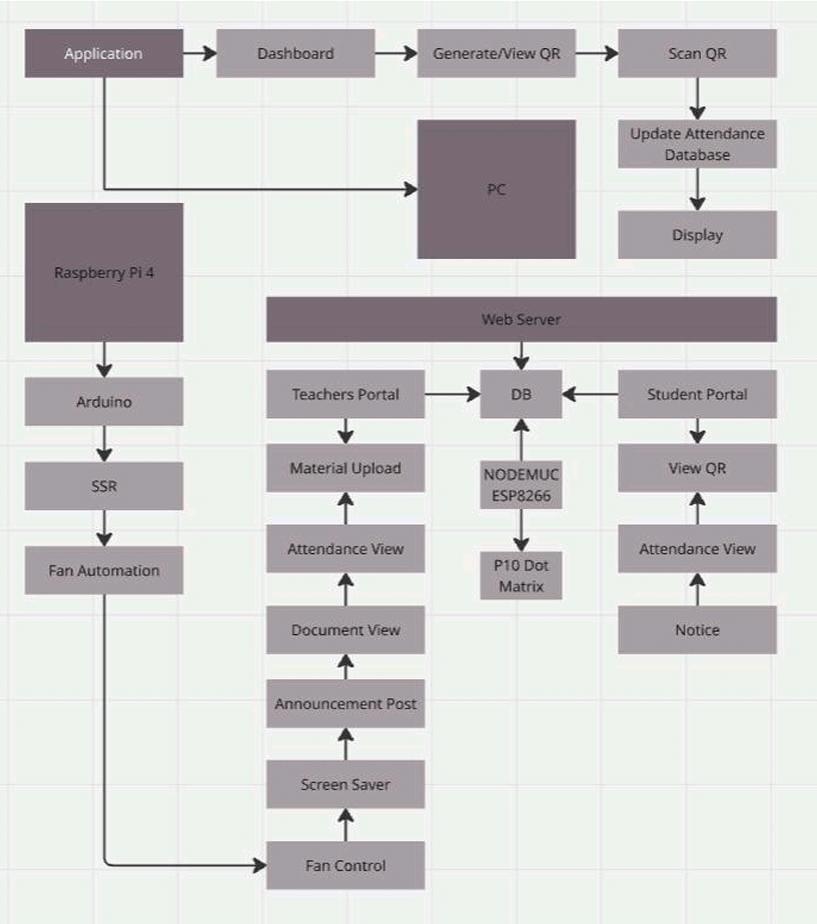
Fig -2.1:BlockDiagramOfIntelliLabSuite
Volume: 13 Issue: 03 | Mar 2026 www.irjet.net p-ISSN: 2395-0072
The implementation of the Intelli Lab Suite system demonstrated effective and reliable performance during testing under real-time conditions. The QR code-based attendance system accurately detected and processed personalizedQRcodesusingthecameramodule,withdata being seamlessly updated in the database. The processing handled by the Raspberry Pi 4 ensured smooth execution of tasks including image processing, command handling, and system coordination. The dot matrix display successfully provided immediate feedback by displaying the student’s name and roll number upon successful attendance capture, enhancing user interaction and confirmation.
The automation module performed efficiently, where the Arduino Uno controlled the Solid State Relay (SSR-25DA) based on commands received from the web interface, enablingreliableoperationofelectricalappliancessuchas ceiling fans. The P10 LED display effectively presented real-time information such as lab notifications and schedules by synchronizing data through the NodeMCU ESP8266, ensuring continuous wireless communication. The integration between the Java-based application, web portal, and MySQL database maintained consistent data synchronization across all modules, providing a unified andresponsivesystem.
Performance evaluation of the system indicated that the average QR code scanning and recognition latency was approximately5seconds.Theresponsetimefordisplaying studentinformationonthedotmatrixdisplaywasaround 0.95seconds,ensuringnearreal-timefeedback.Therelaybased fan control system exhibited a switching delay of approximately 1 second from the initiation of a web request. Additionally, database synchronization operations were completed within a range of 0.8 to 1.2 seconds, demonstrating efficient backend communication. Overall, the system achieved a high level of functional completion with reliable performance in attendance tracking, real-time display, and lab automation, indicating strong potential for deployment in smart laboratory environments, with scope for further optimization in processingspeedandscalability.
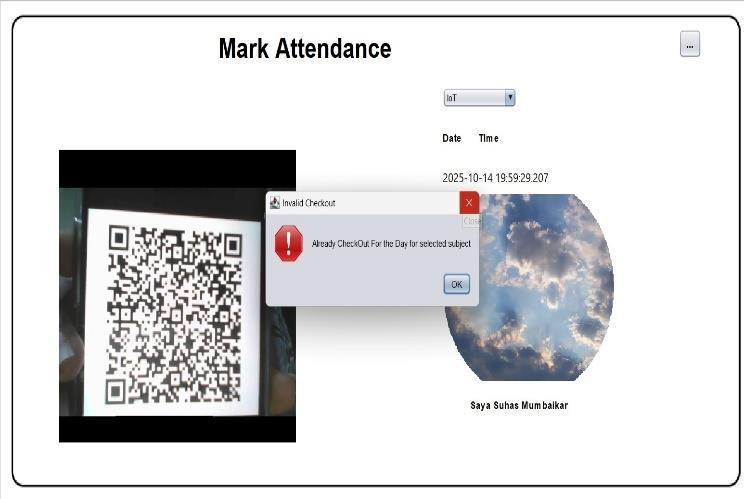
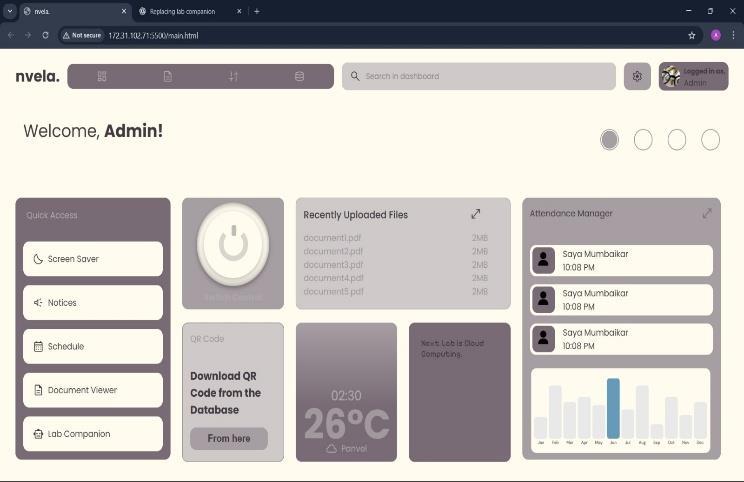
The Intelli Lab Suite demonstrates an effective integration of embedded systems, IoT, and automationforsmartlaboratorymanagement.Using the Raspberry Pi 4, Java, and MySQL, the system enables accurate QR-based attendance andreal-time data synchronization. Automation through the Arduino Uno and NodeMCU ESP8266 ensures efficientcontroloflabdevices.Theprojecthighlights a reliable and scalable solution for modern labs, reducing manual effort and improving efficiency. Futureimprovementscaninclude AI-based analytics andcloudintegrationforenhancedfunctionality.
The Intelli Lab Suite can be enhanced by integrating AI and machine learning for predictive analytics, improving attendance tracking and resource optimization. Advanced computer vision techniques can further improve QR detection and enable facial recognitionformulti-factorverification.
International Research Journal of Engineering and Technology (IRJET) e-ISSN: 2395-0056
Volume: 13 Issue: 03 | Mar 2026 www.irjet.net p-ISSN: 2395-0072
Cloud integration can provide remote access, centralized storage, and real-time synchronization across multiple labs. Additionally, expanding IoT integration can enable control of more lab equipment,creatingafullyautomatedenvironment.
Further improvements can include real-time alert systems for abnormal activities, energy monitoring for efficient power utilization, and integration of voice-based control for better user interaction. The system can also be extended to support multi-user role management with advanced access control and audittracking.
Security enhancements such as end-to-end encryption and secure authentication mechanisms can improve data protection. The development of a mobile application and cross-platform support can furtherenhanceaccessibility.Overall,thesystemcan evolve into a scalable, intelligent, and fully autonomoussmartlaboratorymanagementsolution.
[1] S. Patel, M. Shah, and N R. Mehta, “A Review on Laboratory Information Management Systems (LIMS),” International Journal of Advanced Research inComputerScience,vol.4,no.7,pp.120–125,2013.
[2] [2] M. Wadai et al., “Modern Laboratory Information Management Systems and Their Role in Medical Laboratories,” Journal of Healthcare Informatics Research,vol.8,no.2,pp.145–160,2024.
[3] [3]J.Craig,A.K.Densmore,andT.Ellis,“LeafLIMS:A flexible laboratory information management system for synthetic biology,” ACS Synthetic Biology, vol. 6, no.6,pp.1004–1010,2017.
[4] [4] D. Tolopko et al., “Screensaver: A Laboratory InformationManagementSystemforHighThroughput Screening Facilities,” BMC Bioinformatics, vol. 11, no. 260,2010.
[5] [5] A. D. Swafford et al., “MetaLIMS: A simple, opensource laboratory information management system for small laboratories,” BMC Bioinformatics, vol. 18, no.1,2017.
[6] [6] Fotek Corporation, “SSR-25DA Solid State Relay Datasheet,”2018.
[7] [7] Denso Wave Incorporated, “QR Code Essentials,” 2014.
2026, IRJET | Impact Factor value: 8.315 | ISO 9001:2008