
International Research Journal of Engineering and Technology (IRJET) e-ISSN: 2395-0056
Volume: 13 Issue: 06 | Jun 2026 www.irjet.net p-ISSN: 2395-0072
International Research Journal of Engineering and Technology (IRJET) e-ISSN: 2395-0056
Volume: 13 Issue: 06 | Jun 2026 www.irjet.net p-ISSN: 2395-0072
Dr. CH. Sarada Devi, M. Tech, Ph. D1, Ms. D. Rejitha, M. E, (Ph. D)2, Abinaya. S3
1Head of the Department, Department of Computer Science and Engineering, Meenakshi College of Engineering K. K. Nagar Chennai, India
2Assistant Professor Department of Computer Science and Engineering, Meenakshi College of Engineering
K. K. Nagar Chennai, India
3Department of Computer Science and Engineering, Meenakshi College of Engineering K. K. Nagar Chennai, India
Abstract-The FOD-R Dataset consists of images representing common types of Foreign Object Debris (FOD) typically found on airport runways and taxiways. The dataset is primarily annotated with bounding boxes to support object detection tasks. An enhanced version, known as the FOD-xR Dataset, incorporates an additional feature in the form of color-coded labels that indicate the difficulty of debris removal. Green labels represent lightweight objects that are easier to remove, whereas red labels indicate heavier objects that require greater effort. This centralized labeling approach improves coordination among maintenance teams by enabling efficient planning and management of FOD removal operations. As a result, organizations can reduce operational delays, minimize aircraft damage, and improve overall airport safety. The FOD-R and FODxR datasets serve as valuable resources for developing intelligentFODdetectionandremovalsystems.
Index Terms-Foreign Object Debris (FOD), centralized management, dataset, bounding box annotation, object detection, color coding.
Foreign Object Debris (FOD) poses a significant threat to aviation safety, as it can lead to aircraft damage, operational disruptions, injuries, and even fatalities. The financial losses associated with FOD incidents are also substantial due to aircraft repairs, flight delays, and maintenance costs. To address these challenges, researchers have increasingly explored the use of Machine Learning (ML) and Computer Vision (CV) techniques for the automatic detection and classification of FOD. The development of accurate and reliable ML-based detection systems requires highquality datasets containing diverse FOD images captured under realistic operating conditions. Such datasets play a vital role in improving the accuracy, robustness, and efficiency of intelligent FOD detection
models.
To facilitate research in this domain, the FOD-A dataset was introduced as a comprehensive benchmark for training and evaluating machine learningandcomputervisionalgorithms.Theobject categories included in the dataset were selected based on recommendations from the Federal Aviation Administration (FAA) and findings from previous research, ensuring that the dataset representsabroadrangeofdebriscommonlyfound on airport runways and taxiways. Images were collected under varying environmental conditions, including different lighting levels and rainfall scenarios, to simulate real-world airport environments and improve the generalization capabilityofdetectionmodels.
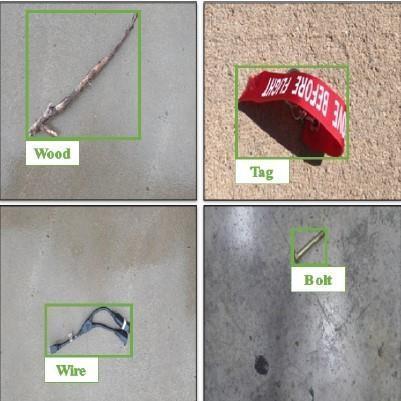
The FOD-A dataset was also designed with scalabilityin mind,allowingnewimagesandobject categories to be incorporated while preserving annotation consistency. Multiple versions of the dataset are maintained to ensure that it remains comprehensive and up to date. Researchers can evaluate detection algorithms using a standardized version of the dataset and subsequently utilize newerreleasestodevelopenhancedmodelscapable of recognizing additional FOD categories. Figure 1 illustrates a sample image from the FOD-A dataset withannotatedboundingboxes.
Although several publicly available image datasets contain common object categories such as vehicles, furniture, and household items, they do not adequately represent the specialized debris encountered in airport environments. Important FOD categories, including aircraft components, maintenance tools, luggage items, and metallic fragments, are largely absent from these generalpurpose datasets. Therefore, only limited comparisons with conventional object detection datasets are presented, as they cannot effectively
International Research Journal of Engineering and Technology (IRJET) e-ISSN: 2395-0056
Volume: 13 Issue: 06 | Jun 2026 www.irjet.net p-ISSN: 2395-0072
supportairport-specificFODdetectiontasks.
Theremainderofthispaperisorganizedasfollows.
Section II reviews the existing literature on FOD detection and related machine learning approaches. Section III describes the construction of the FOD-A dataset, including data collection procedures, annotation methodology, dataset statistics, and expansion strategies. Section IV presents the software packages, machine learning techniques, andevaluationmethodsusedintheanalysis.Finally, SectionVsummarizesthekeyfindings,discussesthe limitations of the current work, and outlines future research directions. The major contributions of this study include the development of a publicly accessible FOD-A dataset, the implementation of a scalable framework for image dataset generation, and the design and evaluation of advanced algorithmsforautomatedFODdetection Asaresult, FOD-AismoresuitableforFODdetectiontasksasit provides a more accurate representation of airfield terrainandagreatervarietyofobjectcategorieswith moredescriptiveobjectorders.
Several studies and official publications have addressed thedetection,classification,andmanagementofForeign Object Debris (FOD) in airport environments. Among these, the guidelines published by the Federal Aviation Administration(FAA)serveastheprimaryreferencefor identifying and categorizing FOD objects [1], [7], [10], [12], [17]. Since the FAA provides standardized
definitionsandrecommendationsforFODmanagement, theobjectclassesincludedintheproposeddatasetwere selected based on these guidelines. The methodology adopted for choosing the object categories is discussed indetailinSectionIII-A.
A number of publicly available datasets have been developed for FOD detection; however, many of them arelimitedintermsofobjectdiversity.Onewidelyused dataset primarily focuses on recognizing materials such as metal, plastic, and concrete [18]. Although these categories are useful for material classification, they do not represent the complete range of Foreign Object DebrisidentifiedbytheFAA.ImportantFOD categories, including maintenance tools, brightly colored debris, natural objects,runwayfragments,pavementchips,and other airport-specific materials, are not adequately representedinthesedatasets[1],[7].
To address these limitations, the FOD-A dataset was developed as a more comprehensive benchmark for airport FOD detection. Unlike existing datasets, FOD-A contains31distinctobjectcategories,providingbroader coverage of debris commonly encountered on airport runways and taxiways. The complete list of object categoriesisillustratedinFigure3.
Another key difference between the existing material recognition dataset and FOD-A lies in the image characteristics and annotation strategy. The material recognition dataset mainly consists of close-up images and includes only three object categories, making it unsuitable for detecting the wide variety of debris encountered in real airport environments. In contrast, the FOD-A dataset contains wide-angle images annotated with bounding boxes and includes additional environmental information, such as lighting and weather conditions, to better simulate real-world operationalscenarios.
Furthermore, the existing dataset contains approximately500annotatedobjectsamplesdistributed across three material categories. In comparison, FOD-A provides more than 1,376 annotated object instances spanning 31 different object classes. The increased number of samples, greater category diversity, and richer annotation make FOD-A a more effective resource for training and evaluating advanced machine learning and computer vision models for automated FODdetection.
International Research Journal of Engineering and Technology (IRJET) e-ISSN: 2395-0056
Volume: 13 Issue: 06 | Jun 2026 www.irjet.net p-ISSN: 2395-0072
In this study, data visualization techniques are employedtopresentcomplexinformationinaclearand intuitive manner, enabling better interpretation of the dataset. The visualization primarily illustrates the distributionofimagesacrossthetwopredefinedclasses: high-risk and low-risk FOD categories. Such graphical representations help researchers understand the balance of the dataset and identify class distributions beforemodeltraining.
To generate these visualizations, the program first retrieves the list of category folders from the dataset directory using the command os.listdir (data_path). The retrieved folder names are stored in the variable categories,whichcontainsthetwoclasses: high risk and low risk. Numerical labels are then assigned to each category by generating a sequence of integers corresponding to the number of classes. Finally, a dictionary is created to map each category to its respective numerical label, resulting in the assignments high risk → 0 and low risk → 1. This labeling scheme facilitates efficient preprocessing and training of machine learning models by converting textual class namesintonumericalrepresentations.
The Foreign Object Debris (FOD) dataset consists of a diverse collection of objects that commonly appear on airport runways and taxiways. These objects include aircraftfastenerssuchasnuts,bolts,washers,andcords used in aircraft assembly and engine maintenance. The datasetalsocontainsaircraftcomponents,includingfuel caps,landinggearfragments,andotherstructuraldebris thatmaydetachduringaircraftoperations.
In addition to aircraft-related objects, the dataset incorporates maintenance tools and equipment frequentlyusedbygroundpersonnel,alongwithfeeding materialsandotherflight-lineaccessories.Furthermore, it includes fragments of runway infrastructure such as concrete pieces, asphalt particles, rubber expansion joints,flexiblerubberfittings,jointsealmaterials,fibers, and filaments. Environmental debris generated from constructionactivities,includingdustandash,aswellas weather-related contaminants such as snow, ice, and othernaturalpollutants,arealsorepresented.Thiswide variety of object categories ensures that the dataset closely reflects real-world airport conditions and supports the development of robust machine learning
modelsforaccurateFODdetectionandclassification.

Fig. 2. TheprovidedimagesdepictFODobjectsunder differentlight-level categories in FOD-A. Specifically, the left image represents an example of abrightcondition, themiddleimagedepictsadimcondition,andtheright imageshowsadarkcondition.
The FOD-A dataset categorizes environmental conditions into dry and wet weather classes, which collectively represent the majority of weather scenarios encountered inairportoperations.Inadditiontotheprimaryboundingboxannotationsusedforobjectdetection,thedatasetalso includes supplementary annotations describing weather conditions and lighting levels. These additional labels provide contextual information that can support the development of more robust detection models capable of operatingundervaryingenvironmentalconditions.
The dataset consists of 1,376 images, including 690 images containing high-risk FOD objects and 686 images containing low-risk FOD objects.Analysisofthe datasetindicatesthatmostdebrisobjectsoccupyrelatively small regions within the images, making accurate detection a challenging task. Figure 1 illustrates sample images and highlights the predominance of small-sized objects.
To create the dataset, images of commonly occurring FOD were collected using both handheld cameras and Unmanned Aerial Vehicles (UAVs). UAV-based image acquisition enabled the collection of data from different heights and distances, while handheld cameras captured closer views with greater variations in viewing angles. Data collection was initially performed in video (MP4) format to facilitate large-scale acquisition. However, not every video frame contained relevant debris objects, resulting in the presence of unnecessary or empty frames thatcouldnegativelyaffectdatasetquality.
To overcome this limitation, a dedicated command-line utility was developed to streamline the data preparation process. The tool automatically trims videos to relevant intervals, extracts individual frames as image files, and removes unnecessary data. Additionally, the utility
International Research Journal of Engineering and Technology (IRJET) e-ISSN: 2395-0056
Volume: 13 Issue: 06 | Jun 2026 www.irjet.net p-ISSN: 2395-0072
standardizes image formats and resolutions, thereby improving dataset consistency and simplifying future dataset expansion. This automated workflow significantly enhances the efficiency of image collection and preprocessing.
TensorFlow is a widely adopted open-source framework used for implementing machine learning and deep learning applications across various domains, including computer vision, speech recognition, natural language processing, and sentiment analysis. In the proposed system, TensorFlow serves as the primary backend framework for developing and training the Convolutional Neural Network (CNN) model. It is also utilized for image preprocessing operations such as data reshaping and tensormanipulation.Beyondcomputervisionapplications, TensorFlow has been extensively employed in research areas including information retrieval, geographic data analysis, text summarization, drug discovery, and defect detection.
The proposed model utilizes Keras, a high-level deep learninglibrarybuiltontopofTensorFlow,tosimplifythe design, implementation, and deployment of neural network architectures. Keras provides an intuitive interface for constructing CNN models and supports scalableexecutionacrossdifferentcomputingplatforms.In thiswork,KerasisusedtodefinetheCNNlayers,configure modelparameters,compilethenetwork,andperformdata preprocessing operations such as converting categorical labels into binary class matrices. Its modular design facilitates rapid experimentation and efficient model development.
OpenCV (Open Source Computer Vision Library) is an open-source software library extensively used for image processing, computer vision, and machine learning applications. It offers a wide range of functionalities for image enhancement, feature extraction, object detection, andimageanalysis.InFODdetectionapplications,OpenCV can be employed for tasks such as edge detection, image enhancement using histogram analysis, and object feature extraction. Within the proposed framework, OpenCV is primarily used for image preprocessing operations, including resizing images, converting color formats, and
preparing image data for input into the deep learning model. These preprocessing steps contribute to improved modelperformanceandcomputationalefficiency
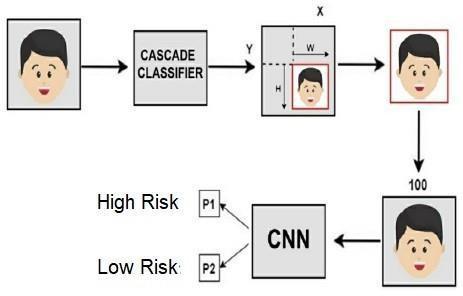
The proposed framework consists of two major components: a cascade classifier for preliminary object localization and a pre-trained Convolutional Neural Network (CNN) for object classification. The CNN architecture comprises two two-dimensional convolutional layers followed by fully connected dense layers that perform the final classification of Foreign ObjectDebris(FOD)intopredefinedriskcategories.
Input: A labeled image dataset containing two classes: High Risk and Low Risk Output: A classified runway image indicating the detectedcategoryofforeignobjectdebris.
For every image in the dataset, the following operations areperformed:
1. Display and categorize the images into high-risk and low-risk classes.
2. Convert the original RGB image into a grayscale image.
3. Resizethegrayscaleimagetoafixedresolutionof 100 × 100 pixels
4. Normalizethepixel valuesandreshapetheimage into a four-dimensional tensor suitable for CNN input.
Theclassificationmodelisbuiltusingthefollowing sequenceoflayers:
1. A two-dimensional convolution layer containing 200 filters
2. Asecondconvolutionlayerwith 100 filters
3. A Flatten layer to transform extracted feature mapsintoaone-dimensionalfeaturevector.
4. A fully connected (Dense) layer consisting of 64 neurons
5. A final output layer with two neurons, corresponding to the High Risk and Low Risk classes.
International Research Journal of Engineering and Technology (IRJET) e-ISSN: 2395-0056
Volume: 13 Issue: 06 | Jun 2026 www.irjet.net p-ISSN: 2395-0072
Afterconstructingthenetwork architecture, thedataset is divided into training and testing subsets, and the CNN model is trained to classify runway images based on the detectedforeignobjects.
Data preprocessing is a crucial stage in machine learning thattransformsrawdataintoastructuredformatsuitable for analysis and model training. The primary objective of preprocessing is to improve data quality, remove inconsistencies,andorganizetheinformationintoaformat that accurately represents the relationships among data elements.Properpreprocessing enhancesthe efficiency of feature extraction and improves the overall performance ofmachinelearningmodels.
In the proposed system, the input data consists of images and video frames containing Foreign Object Debris. The preprocessing operations are implemented using the NumPy and OpenCV libraries. These tools provide efficient methods for extracting useful information from visual data through operations such as image segmentation, resizing, filtering, normalization, and thresholding. The processed images serve as structured input for the CNN model, enabling more accurate feature learningandobjectclassification.
Data visualization is employed to represent the distribution of images within the dataset in an intuitive and easily interpretable manner. Visual representations assist in understanding class balance and identifying patternsbeforetrainingtheclassificationmodel.
Initially, the program retrieves the list of category folders from the dataset directory using the os.listdir() function. Eachcategoryisthenassigneda numerical label based on its index position. A mapping dictionary is subsequently generated by pairing the category names with their correspondinglabelsusingthezip()function.Thisprocess producesalabeldictionarythatassociateseachclassname with its numerical representation, facilitating efficient datasetmanagement duringmodeltraining.
Color images are converted into grayscale before feature extraction to reduce computational complexity while preserving the essential structural information required for object recognition. Since most image recognition algorithms rely primarily on texture, shape, and intensity
rather than color information, grayscale images are generallysufficientforeffectiveclassification.
Removing color channels decreases the dimensionality of the input data, reduces memory requirements, and shortensthetrainingtimeoftheCNNmodel.Furthermore, grayscale conversion minimizes redundant information and enables more efficient extraction of discriminative image features, thereby improving the overall performanceoftheobjectdetectionsystem.
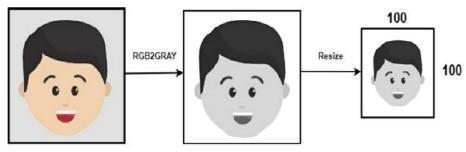
Fig. 3. TheprocessofconvertinganRGBimagetoa grayscaleimageof 100x100size.
3)Grayscale Conversion and Image Resizing
Theconversionofcolorimagesintograyscaleisperformed using the cv2.cvtColor() function provided by the OpenCV library. This function accepts the original image and a conversion flag as input parameters. In the proposed approach, the cv2.COLOR_BGR2GRAY conversion code is applied to transform RGB images into grayscale representations. Since grayscale images contain only intensity information, they reduce computational complexity while preserving the essential features requiredforobjectrecognition.
Deep Convolutional Neural Networks (CNNs) require all input images to have identical dimensions. Therefore, eachgrayscaleimageisresizedtoafixedresolutionof 100 × 100 pixels usingthecv2.resize()function.Standardizing image dimensions ensures compatibility with the CNN architecture and enables efficient batch processing during modeltraining.
4)Image Scaling
Image scaling and normalization are essential preprocessing operations that prepare images for deep learning.Eachimageisrepresentedasathree-dimensional tensor, where the pixel values correspond to intensity information. Although images may differ in content, all inputs supplied to the CNN must possess the same dimensionalstructure.
To satisfy this requirement, the pixel intensity values are
International Research Journal of Engineering and Technology (IRJET) e-ISSN: 2395-0056
Volume: 13 Issue: 06 | Jun 2026 www.irjet.net p-ISSN: 2395-0072
normalized to the range 0–1, improving numerical stability and accelerating the learning process. The normalized images are subsequently reshaped into fourdimensional tensors using the np.reshape() function. The resultingtensorhastheformat:
(Number of Images, Image Height, Image Width, 1) where the final dimension represents the single grayscale channel.
Since the proposed classification problem involves two outputclasses(High Risk and Low Risk),thetargetlabels areconvertedintocategorical formatbeforetraining.This representationenablestheCNNtoperformefficientmulticlass prediction using an appropriate classification loss function.
Convolutional Neural Networks (CNNs) have become one of the most widely adopted deep learning models for imageclassificationandobjectrecognitionbecauseoftheir ability to automatically learn discriminative visual features. In this work, Sequential CNN architecture is implemented to classify Foreign Object Debris images accordingtotheirrisklevel.
The model construction begins by initializing a Sequential CNN framework, followed by the addition of the first convolutional layer responsible for extracting low-level imagefeaturessuchasedgesandtextures.Apoolinglayer is then incorporated to reduce the spatial dimensions of the extracted feature maps while preserving the most significant information.
Subsequently, two additional convolutional layers are introduced to capture higher-level semantic features from theimages.Theresultingfeaturemapsareflattenedintoa one-dimensional feature vector, which serves as the input to the fully connected (dense) layers. These dense layers perform the final classification by learning complex relationships among the extracted features. Finally, the outputlayerproducesprobabilityscoresforthetwotarget classes High Risk and Low Risk allowing the model to accuratelycategorizeeachinputimage.
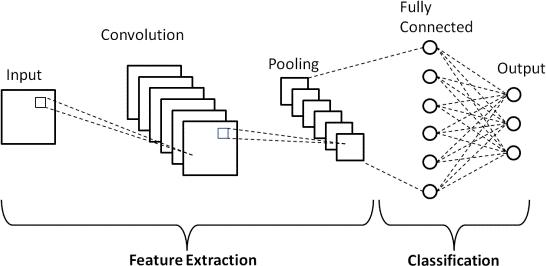
The output shape can be calculated using the formula (input size - pooling windowsize+ 1)/Leaps, wherethe defaultvalueofLeapsis(1,1)[7].
1) Dividing the data into separate sets and training theCNNmodel: Partitioningthedataintoatrainingand testing set is a crucial step in developing reliable predictive models. To achieve this, a train-test split is performedwherethedatasetissplitintotwopartitions, one for training the model and the other for evaluating itsperformance.Inthiscase,thedataset issplitintotwo parts, where 10% of the data is set aside for testing while the remaining 90% is used for training. The confirmation loss is monitored during the training process using Model Checkpoint. The Sequential model isthentrainedandtestedonthesesets,with20%ofthe training data being used for validation. To avoid overfitting, the model undergoes 20 epochs during the training process, this value is chosen as a compromise between achieving high accuracy and avoiding the potential risk of overfitting. The proposed model is visuallyrepresentedinFigure5.
Thedatasetwasutilizedtotrain,validate,andtestthe model, which achieved an accuracy rate of 95.77%. (as shown in Figure 7). One of the primary reasons for the model’s high accuracy down-sampling is the primary reasonforachieving
International Research Journal of Engineering and Technology (IRJET) e-ISSN: 2395-0056
Volume: 13 Issue: 06 | Jun 2026 www.irjet.net p-ISSN: 2395-0072
Fig. 5. OverviewoftheModel high accuracy in detecting foreign objects in images. This technique reduces the dimensional space of the input image and grants translation in variance to the model’s internal representation, resulting in a reduced numberofparametersthatthemodelneedstolearn.
Inthisspecificcase,anidealnumberof64neuronsis used, which is not too excessive, as too many neurons and filters can negatively impact the model’s performance. Additionally, optimized stride values and pool size are employed to filter out the main componentsoftheimage,allowingforprecisedetection oftheforeignobjectwithoutcausingover-fitting.
Figure 6 provides evidence that achieving high accuracy in object detection significantly reduces the cost of errors. This figure may show a comparison between the cost of errors for models with different levelsofaccuracyor highlight the economic impact of misclassifications in this domain. By demonstrating theimportanceofhighaccuracy,thefigureemphasizes the need for techniques like down-sampling, optimized stride values, and pool size, as mentioned in the paragraph, that can improve the model’s performance and accuracy in detecting foreign objects. Ultimately, achieving high accuracy is vital for minimizing errors’ cost in this context, where accuracy is crucial for ensuringsafetyandsecurity.
The FOD system incorporates weather and light categorizationinputs,andexperimentswereperformed to evaluate their efficiency using wet and dry weather inputs. The model with two inputs was effective in distinguishing between wet and dry backgrounds in FOD-A images, and its precision rapidly improved on confirmation data. However, some unusual predictions were observed in the testing data, and it could be challenging to combine categorization and bounding box detection for advanced algorithms. Nevertheless, the weather and light inputs may have practical applicationsinthefuture.
The paper starts by providing a clear explanation of the reason behind the work, and the learning and performance objectives of the model are presented in an easy-to-understandmanner.Themodelhasachieved high accuracy using basic machine learning tools and simplified approaches. The system has various applications, including preventing accidents and rapidly detectingandeliminatingforeignobjects.
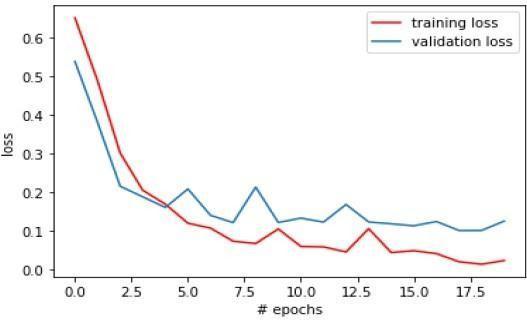
Fig. 6. Thisreferstoagraphthatshowstherelationship betweenthe number oftrainingepochsandtheloss observedinthedatasetduring training.
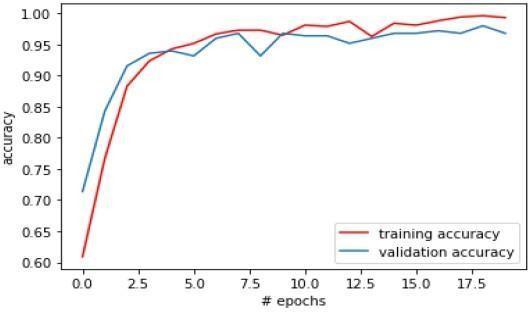
Fig. 7. Thisreferstoagraphorchartthatshowsthe relationship betweenthe numberofepochsused duringthetrainingprocessandthe accuracyattained onthetrainingdatasetduringthetrainingprocess.
In the future, this model could potentially be integrated with robots,whichcouldprioritizethetime taken to clean materials based on the level of threat posedbyforeignobjectdebris.
Additionally,thistechnologycouldbeusefulinspace missions to prevent foreign objects from obstructing the path of rockets. However, this would be a challengingtask, asit
TABLE I ACHIEVED SCORING INDICATORS
Dataset
International Research Journal of Engineering and Technology (IRJET) e-ISSN: 2395-0056
Volume: 13 Issue: 06 | Jun 2026 www.irjet.net p-ISSN: 2395-0072
LowRiskObjects 0.99 1.00 0.99
wouldrequiretheintegrationofdedicatedservers tosupportthesystem.
[1]Munyer, T., Huang, P. C., Huang, C., & Zhong, X. (2021, October 6). FOD-A: A Dataset for Foreign ObjectDebrisinAirports.
[2]S. Srinivasan, R. Rujula Singh, R. R. Biradar and S. Revathi,”COVID-19MonitoringSystemusingSocial Distancing and Face Mask Detec-tion on Surveillance video datasets,” 2021 International Conference on Emerging Smart Computing and Informatics(ESCI),Pune,India,2021.
[3]N.Saurabhetal.,”EfficientFaceMaskDetectionFor DifferentSurveil-lanceApplicationsUsingPython”,
[4]A. Das, M. Wasif Ansari and R. Basak, ”Covid-19 FaceMask Detection Using TensorFlow, Keras and OpenCV”.
[5]Dey, S.K., Howlader, A., Deb, C. (2021). MobileNet Mask:AMulti-phaseFaceMaskDetectionModelto Prevent Person-To-Person Trans-mission of SARSCoV-2.
[6]H. Adusumalli, D. Kalyani, R. K. Sri, M. Pratapteja andP.V.R.D.P. Rao,”FaceMaskDetectionUsingOpenCV”,
[7]N. Yonemoto, S. Futatsumori, A. Kohmura, K. Morioka and N. Miyazaki, ”Multi-static Millimeter Wave Radar Connected by Radio over Fiber for ForeignObjectDetectiononRunways”.
[8]Annie Silviya S H, Pathmanaban J, Kingsley S, Sriman B, Suryaa Narayanan K and Santhosh Kumar E, ”Prediction and Prevention Analysis Using Machine Learning Algorithms for Detecting theCrime Data”.
[9]G. Harriat Christa, J. J, A. K and K. M. Sagayam, ”CNN-basedMask DetectionSystemUsingOpenCV andMobileNetV2,”.
[10]Y. Wang, Q. Song, J. Wang and H. Yu, ”Airport Runway Foreign Object Debris Detection System BasedonArc-ScanningSARTechnology,”.
[11]Yadav, Shashi. (2020). Deep Learning based Safe Social Distancing and Face Mask Detection in Public Areas for COVID-19 Safety Guidelines Adherence. International Journal for Research in AppliedScienceand EngineeringTechnology.
[12]M.Ote,S.JeongandM.M.Tentzeris,”ForeignObject Detection for Wireless Power Transfer Based on MachineLearning,”.
[13]Sneha Sen and Khushboo Sawant 2021 IOP Conf. Ser.: Mater. Sci. Eng. 1070 012061. DOI 10.1088/1757-899X/1070/1/012061
[14]K.Suresh,M.PalangappaandS.Bhuvan,”FaceMask Detectionby usingOptimisticConvolutionalNeural Network,”.
[15]I.B.Venkateswarlu,J.KakarlaandS.Prakash,”Face mask detection using MobileNet and Global PoolingBlock,”.
[16]W. Vijitkunsawat and P. Chantngarm, ”Study of the Performance of Machine Learning Algorithms for FaceMaskDetection,”.
[17]N. Yonemoto, S. Futatsumori, A. Kohmura, K. Morioka and N. Miyazaki, ”Multi-static Millimeter Wave Radar Connected by Radio over Fiber for ForeignObjectDetectiononRunways,”.
[18]Federal Aviation Administration,“Airport foreign objectdebrismanage-ment,”.
[19]Federal Aviation Administration, “Airport foreign object debris detection equipment,” Federal Aviation Administration, Tech. Rep., 09 2009, advisorycircular:150/5220-24
[20]C. M’Sila, R. Ayad and N. Ait-Oufroukh, ”Automated Foreign Object Debris Detection System based on UAV,”.
[21]J. Wang, S. Yan, L. Zhou, R. Fan, X. Han and X. Wang, ”Research on Application of New Technology in Foreign Object Debris Detection Field,”.
[22]W. Wang, B. Wu, S. Yang and Z. Wang, ”Road DamageDetectionand ClassificationwithFasterRCNN,”.
[23]D. Arya et al., ”Crowdsensing-based Road Damage DetectionChallenge (CRDDC’2022),”.
[24]X.Wang,Z.Lan,Z.Li,Y.LinandQ.Xiao,”APractical Application of Runway Foreign Object Debris DetectionSystemattheAirport,”.
[25]S. M. Zainab, K. Khan, A. Fazil and M. Zakwan, ”Foreign Object Debris (FOD) Classification Through Material Recognition Using Deep Convolutional Neural Network With Focus on Metal,”.
[26]H.Ali,M.Khursheed,S.K.Fatima,S.M.ShujaandS. Noor, ”Object Recognition for Dental Instrument
International Research Journal of Engineering and Technology (IRJET) e-ISSN: 2395-0056
Volume: 13 Issue: 06 | Jun 2026 www.irjet.net p-ISSN: 2395-0072
UsingSSD-MobileNet,”.