
International Research Journal of Engineering and Technology (IRJET) e-ISSN: 2395-0056
Volume: 12 Issue: 01 | Jan 2025 www.irjet.net p-ISSN: 2395-0072
International Research Journal of Engineering and Technology (IRJET) e-ISSN: 2395-0056
Volume: 12 Issue: 01 | Jan 2025 www.irjet.net p-ISSN: 2395-0072
Sandip Ashok Kardile
Sr.No. 173/1/1A Flat. No. 402 Sunshine Avenue Wakad Pune 411057
Professor: Dr. Pritam Malakar, Dept. of Civil Engineering, GH Raisoni University Amravati Maharashtra, India
Abstract - The NAINA (Navi Mumbai Airport Influenced Notified Area) project is indeed ambitious, aiming to create a well-integrated urban environment that provides essential services like water supply, wastewater management, stormwaterdrainage,andsolidwastemanagementforavast and developing area. The focus on designing and managing theseutilitieseffectivelyiscrucialforthesuccessoftheproject and for ensuring that the environmental impact of rapid urbanization is minimized.
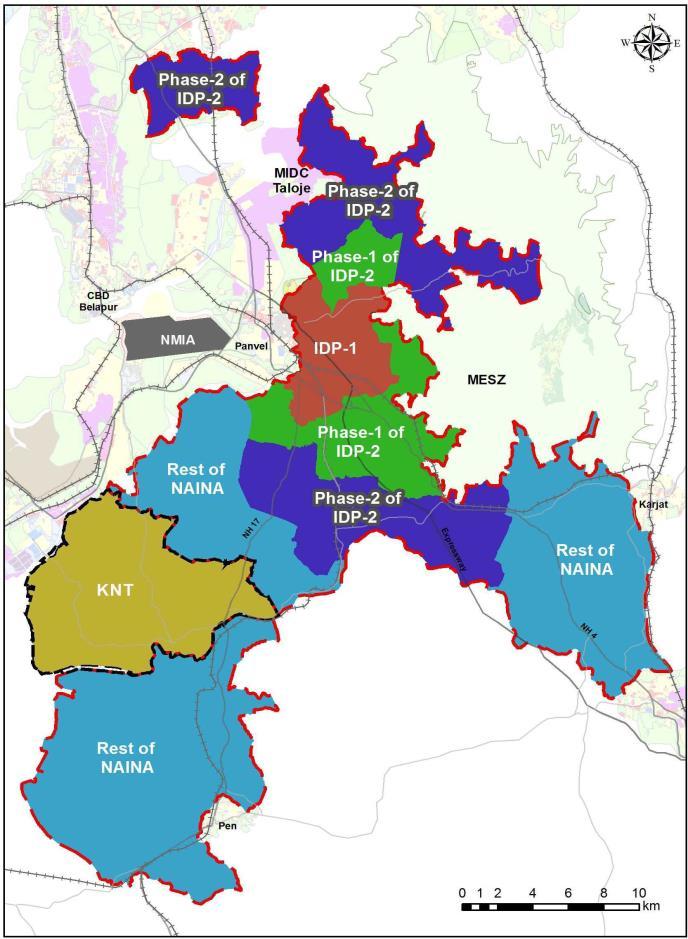
NAINA is larger than Navi Mumbai and is being developed in phases over the next 20 years, the challenge is to design the infrastructureinawaythataccommodateslong-termgrowth whileaddressingimmediateneeds.Itseemslikeamulti-phase; adaptive approach will be necessary to cater to both urban expansion and sustainability.
The detailed planning for water supply systems, wastewater, and stormwater drainage are all essential components that will need to be highly coordinated. Additionally, focusing on sustainability within the wet infrastructure design especially consideringthepotentialimpactsongroundwaterandsurface water resources is crucial for ensuring that the urbanization does not lead to resource depletion or environmental degradation.
Key Words: NAINA, Urban environment, Water supply, Wastewatermanagement,Stormwater drainage,Solidwaste management, Rapid urbanization, Infrastructure design
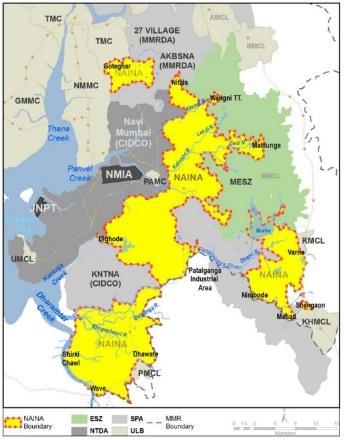
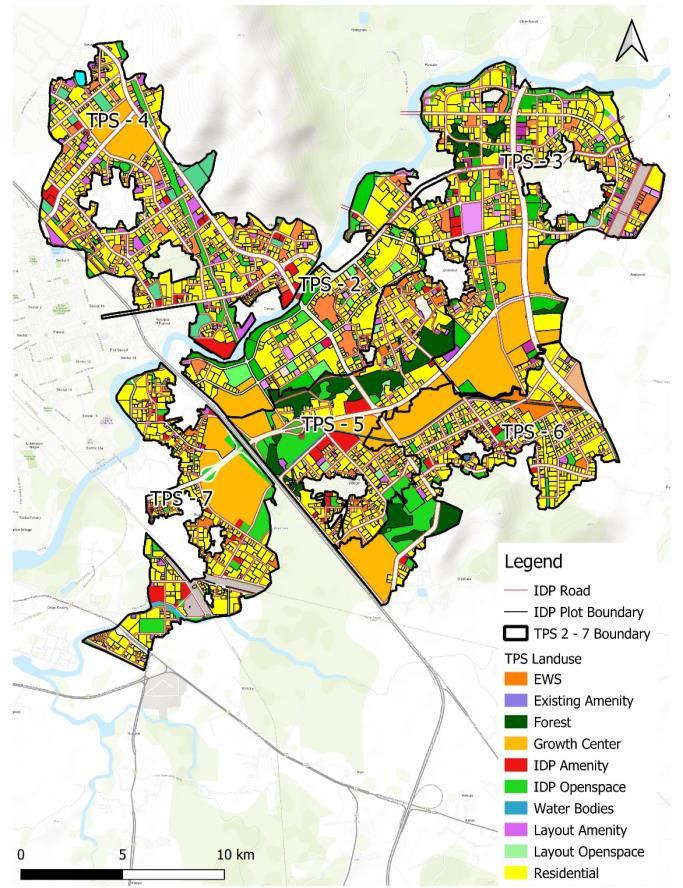
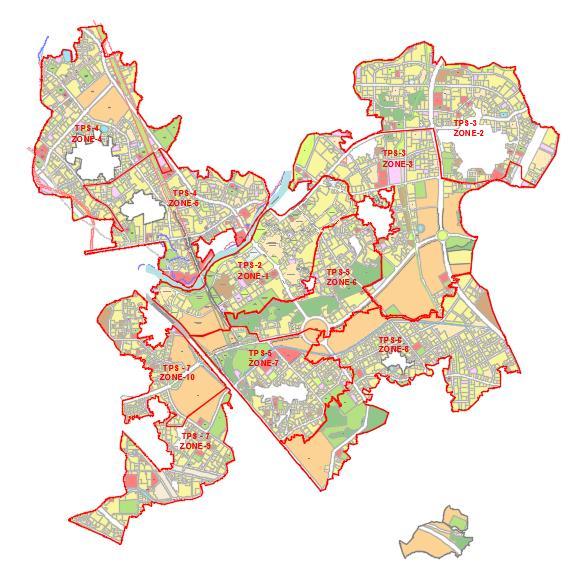
TheNAINAproject,asenvisionedbyCIDCO,isasignificant andstrategicdevelopmentinitiative,especiallyinthecontext ofitsproximitytotheNaviMumbaiInternationalAirportand itsboundarywithseveralkeymunicipalities.Thethoughtful planninginphases(PhaseIandPhaseII)helpsaddressboth theimmediateneedforinfrastructureinhigh-demandareas while also considering long-term urbanization. By designating Phase I as the priority area for infrastructure development,CIDCOcanaddressthemostpressingissuesof urbanization in those regions that are likely to experience rapidgrowthfirst.Thiswillensurethatserviceslikewater supply,wastewatertreatment,stormwatermanagement,and solidwastemanagementareprioritizedwheredevelopment
pressure is most intense. It also allows for a more manageable approach to the overall urbanization process, especially NAINA covers a large area of 474 km², which would be overwhelming to develop uniformly in just 20 years.
The mix of flatand hilly terrain, with riverslike Kalundre, Kirki,andGadhipassingthrough,addsalayerofcomplexity inplanningforinfrastructureparticularlywhenconsidering watermanagement,stormwaterdrainage,andenvironmental sustainability.Thenaturalwaterbodiespresentinthearea also require careful consideration to avoid disruption to ecosystemsandtoensuretheurbaninfrastructureintegrates wellwiththenaturallandscape.
Thedevelopmentoftheregion’sinfrastructurewillalsohave significantimpactsonthesurroundingareas,suchasPanvel Municipal Corporation (PMC), Ambernath, and other neighboringtowns.Theseimpactscouldincludechangesin realestatevalues,patternsofmigration,andthedemandfor services,allofwhichwillneedtobemanagedeffectively.
Thispaperaddressesthedesignandimplementationofthree critical urban infrastructure systems for NAINA describe below:
Water Supply Systems: Theobjectiveistoplananddesign various water utilities, including distribution and transmissionnetworks,servicereservoirs,pumpingstations, andalliedstructures.
Wastewater Management and Sewage Treatment: The objectiveistoplananddesigntheseweragesystem,which includesaseweragenetwork,intermediatepumpingstations, andsewagetreatmentplants(STPs).
Stormwater Management: The objective is to plan and design various Stormwater network design using Bentley SewerGEMS(StormModule).
International Research Journal of Engineering and Technology (IRJET) e-ISSN: 2395-0056
Volume: 12 Issue: 01 | Jan 2025 www.irjet.net p-ISSN: 2395-0072
International Research Journal of Engineering and Technology (IRJET) e-ISSN: 2395-0056
Volume: 12 Issue: 01 | Jan 2025 www.irjet.net p-ISSN: 2395-0072
2.1: Indore Water + City
Indore'sdesignationasIndia'sfirst"WaterPlus"citymarksa significantmilestoneinthenation'spursuitofcleanlinessand environmentalsustainability.Thisaccolade,awardedunder theSwachhSurvekshan2021,recognizesIndore'sexemplary efforts in managing its wastewater and ensuring the cleanlinessofitsriversanddrains.Toachievethisdistinction, Indoreimplementedrigorousmeasures,includingtreatingall wastewater before releasing it into the environment, connecting public toilets to sewer lines, and recycling a substantial portion of sewer water. By adhering to these criteria, Indore has not only enhanced its sanitation infrastructure but also set a precedent for other cities to follow. The city's success underscores the importance of holistic approaches to urban sanitation, emphasizing the needtoprotectwaterbodiesandpromotetheresponsible use of resources. Indore's achievement demonstrates that effective governance, community participation, and technologicalinnovationcanpavethewayforacleaner,more sustainablefutureforurbanenvironmentsacrossIndia.
Cape Town, South Africa, achieved remarkable success in waterconservationdespitea30%populationincreaseover 15years,reducingwaterusageby30%.Thisaccomplishment was attributed to a comprehensive water conservation program that targeted both behavioral change and technological advancements. The program included initiativessuchasadjustingwaterpressure,repairingpipes, installing water meters, and implementing efficient water metermanagementsystems.Furthermore,thecityconducted training sessions in 60 schools to promote water conservation awareness among students and staff. Additionally, Cape Town persuaded 95 parks to adopt the practice of reusing treated wastewater for irrigation purposes,demonstratingacommitmenttosustainablewater managementpracticesacrossvarioussectors.Theseefforts underscorethecity'sproactiveapproachtoaddressingwater scarcityanditsdedicationtopromotinga cultureofwater conservationandreuse.
2.3: Bangalore, Gwalior, Nagpur, Nashik – Best performing cities for wastewater reuse in India.
Some of the WWTPs of Bangalore, Gwalior, Nagpur, and Nashik cities have achieved 100% recycle and reuse of wastewater by discharging secondary treated wastewater into rivers and diverting it for irrigation purpose. Also, additionally Bangalore uses this treated WW for the horticulture&landscaping,publicofficegardeningetc.The saleoftreatedwaterhasreducedtheconsumptionoffresh water.Theamountspentonfreshwaterissavedandthesale oftreatedwastewateralsogenerateincomefortheULB.
95%ofthetreatedWWfromDelhi’sRithalaSTPissupplied to power plant and remaining is supplied for horticulture purposes.Also,byconvertingavailablepollutanttopoweras a non – conventional source of energy and generation of greenpowerthroughbio-gasengines.Meanwhile,Chennai hasitsenergyproducedfrombiogasplantisutilizedinthe wastewater treatment plant, which has resulted in energy costsavings.Enablesreuseoftreatedwastewatertoreduce theburdenonfreshwater-relevantespeciallyinacitylike Chennaiwhichdependsongroundwater
ThewatersupplysystemforNAINAisdesignedfora24x7 operation, ensuring equitable distribution with minimal losses.
Storage and Distribution: CentralWaterReservoirs(CWR) and Elevated Service Reservoirs (ESR) are strategically placedbasedonpopulationdensityandterrain.
Population Forecasting: BasedonFSI,occupancyrates,and masterplansfordesignyears2027,2057,and2077.
Demand Projections: Waterdemandcalculatedforultimate designyear2057,accountingforresidential,commercial,and institutionalneeds.
Hydraulic Design: Designed24x7Distributionsystemwith usesofDIK-9PipeandMSpipeswithpeakfactorsof1.5and residualpressuresof7–10mtoensurereliability.
The wastewater management system includes a decentralized sewerage network and advanced treatment technologies.
Sewerage Collection Network:Designedsewernetworkfor aminimumself-cleansingvelocityof0.6m/sandinfiltration allowanceof10%.
Materials: RCCpipeswithaminimumdiameterof250mm wereselectedfordurability.
Peak Factors: Adjustedbasedonpopulationsizefordesign year2057.
STP Design: SequencingBatchReactor(SBR)technologyis recommended for its modular scalability, automation, and costefficiency.
Reuse of Treated Water: Treated effluent is reused for irrigation, toilet flushing, and construction, reducing freshwaterdependency.
The stormwater management system integrates hydraulic modelling,floodmitigation,andeco-friendlyinfrastructure. Drainage Network: Designed to handle peak flows with optimizedpipesizesandoutfalllocations.
International Research Journal of Engineering and Technology (IRJET) e-ISSN: 2395-0056
Volume: 12 Issue: 01 | Jan 2025 www.irjet.net p-ISSN: 2395-0072
Flood Mitigation: HighFloodLevel(HFL)assessmentsguide theplacementofdetentionbasinsandembankments.
Sponge City Practices: Greenroofs,permeablepavements, andbio-swalesenhanceinfiltrationandreducerunoff.
Rainwater Harvesting: Modular systems at strategic locationsreducerelianceonfreshwaterresources.
4.1
Thewaterandwastewaterinfrastructurerequirementsare basedondetailedpopulationprojections.By2057,theNAINA area isexpectedtohosta population ofapproximately3.3 million, including residents, growth canters,and gaothans. Thefreshwaterdemandisprojectedtoincreasefrom21.29 MLDin2027to275.20MLDby2057.Similarly,treatedwater demand for purposes such as flushing and irrigation is estimated at 60.06 MLD, while sewerage generation will reach 162.94 MLD. These figures underline the need for a strategicandphasedinfrastructuredevelopmentapproachto catertobothimmediateandfutureneeds.
Thewatersupplysystemhasbeenmeticulouslyplannedto ensure uninterrupted access to potable water across the NAINAarea. The transmission main,designed for the year 2057,willutilizeDIK9pipesfordiametersupto800mmand MS pipes for larger diameters. The system will leverage gravity-fed hydraulics from the Kondhane Dam to zonal reservoirs,minimizingenergyconsumption.
Central to the supply chain is the Central Water Reservoir (CWR) near Kondhane Dam, located at an elevation of 50 meters. This reservoir will act as the primary storage structure, facilitating the distribution of water to Elevated Service Reservoirs (ESRs) and Ground Service Reservoirs (GSRs)withinvariouszones.Eachreservoirisdesignedwith a retention capacity of eight hours, ensuring an adequate bufferduringpeakdemandperiods.Thedistributionsystem is planned as a 24/7 operation, maintaining residual pressuresbetween7and10meters,withaminimumpipe diameterof150mmtoensureefficientflow.
Adedicatedtreatedwatersupplysystemhasbeenproposed toaddressthedemandfornon-potableusessuchasflushing andirrigation.Thissystemwillrelyontertiary-treatedwater sourcedfromstrategicallylocatedSewageTreatmentPlants (STPs).Storagestructures,primarilyRCCGSRs,willbebuilt atSTPsiteswitharetentioncapacityof10hours.
Thetreatedwaterdistributionsystemisdesignedtomaintain residual pressures between 7 and 10 meters, with a minimumpipediameterof100mm.Thisensuresconsistent and reliable water delivery for its intended purposes. By
2057,thetreatedwatersupplyisprojectedtomeetatotal demand of 60.06 MLD for flushing and 21.5 MLD for irrigation,aligningwiththeproject'ssustainabilitygoals.
The seweragesystem isdesigned to manage the projected generationof162.94MLDofsewageby2057.Thecollection network,constructedwithRCCpipesofaminimumdiameter of 250 mm, will operate on a gravity-based system to transport sewage efficiently. The system is engineered to maintainvelocitiesbetween0.6to3m/s,ensuringoptimal flowandpreventingblockages.
Intermediate Pumping Stations (IPS) will be strategically locatedatlowpointswithinseweragezonestofacilitatethe transfer of sewage to STPs. Each IPS is designed with a retention period of 30 minutes to handle peak inflows effectively. Sewage Treatment Plants will be modularly designedtoaccommodateincrementalcapacities,withatotal capacityof162.94MLDby2057.
To ensure high-quality effluent suitable for reuse, the SequencingBatchReactor(SBR)technologyisrecommended. Thistechnologyoffersacompactdesign,adaptabilitytoflow variations, andcost-effectiveness. The treated effluent will meetstringentstandards,withBODlevelsbelow6mg/Land TSSlevelsbelow10mg/L,makingitsuitablefornon-potable applications.
The stormwater drainage system for the NAINA project is meticulously designed to manage peak runoff, minimize flooding, and integrate sustainable drainage practices. It followstheguidelinessetbytheCPHEEOManualandCIDCO norms, ensuring a robust, efficient, and environmentally sensitiveinfrastructure.
4.5.1 Hydrological Design Principles: The design of the drainage system is based on the Rational Method, which calculatespeakrunoffusingtheformula.
Here, Q representsthe peak dischargein cubic meters per second, C is the runoff coefficient reflecting the imperviousnessofthesurface,Iistherainfallintensity,and Ais the catchment area. The runoff coefficient varies dependingonthetypeofsurface,withvaluesrangingfrom 0.15 for lawnsand parksto0.92 for urbanizedareas. This ensuresaccuraterepresentationofdifferentlanduseswithin the catchment. Rainfall intensity is calculated based on historicaldataandintensity-duration-frequency(IDF)curves, whilethecatchmentareaisdeterminedthroughdetailedsite analysis.
4.5.2 Time of Concentration: Time of concentration is a critical parameter representing the duration required for
International Research Journal of Engineering and Technology (IRJET) e-ISSN: 2395-0056
Volume: 12 Issue: 01 | Jan 2025 www.irjet.net p-ISSN: 2395-0072
rainwatertotravelfromthefarthestpointofthecatchment totheoutlet.CalculatedusingKirpich'sformula,itconsiders catchmentslopeandflowlength.CIDCOhasstandardizedthe time of concentration for Navi Mumbai at 30 minutes, ensuringconsistencyacrossdesigns.
4.5.3 Return Period: Thesystemisdesignedtohandlea10yearreturnperiodforurbandrainage,aligningwithCPHEEO norms for residential and commercial areas. This ensures adequatecapacityforstormeventswhilebalancingeconomic feasibility.
4.5.4 Hydraulic Design Parameters: The stormwater drainagenetworkoperatesongravityflowprinciples,with Manning’s equation governing the design of velocity and discharge.TheformulaisexpressedasV=1/n⋅R²/³⋅S¹/²
WhereVisvelocity,Risthehydraulicradius,Sistheslopeof the hydraulic gradient, and n is Manning’s coefficient of roughness. The minimum velocity of 0.6 m/s ensures selfcleansing to prevent sediment deposition, while the maximum velocity of 3 m/s avoids channel erosion. Freeboard, the additional height above the design flow, is incorporated to account for uncertainties and debris accumulation.
4.5.5 Design Software: Advanced tools, including Bentley Storm CADand Civil 3D, areutilized for precise modelling andanalysis.Theseenableaccuratetopographicassessments, hydraulicsimulations,anddetailedcross-sectionaldesigns.
4.6 Sustainable Practices
Sustainability is at the core of the NAINA project. Treated waterwillbereusedextensivelyforflushingandirrigation, reducing the dependency on freshwater resources. The tertiary treatment process will include ultrafiltration and chlorination to ensure water quality meets required standards. Sludge management is another critical aspect. ExcesssludgegeneratedfromSTPswillbedewateredusing centrifuge or filter press systems, achieving a solid concentrationof18-20%.Thedewateredsludgewillundergo pathogen reduction treatments, enabling safe disposal or potentialreuseasasoilconditioner
4.7 Implementation Phases
Theprojectwillbeimplementedinthreedistinctphasesto alignwiththeregion'sdevelopmenttrajectory:
Phase 1 (2027): Theinitialinfrastructurewillcaterto20% oftheprojectedpopulation,withmodularSTPsinstalledto manage12.68MLDofsewage.
Phase 2 (2042): Infrastructure will be expanded to serve 40%ofthepopulation,increasingSTPcapacityto54.49MLD.
Phase 3 (2057): The final phase will achieve full-scale infrastructuredevelopment,accommodatingapopulationof 3.3millionwithanSTPcapacityof162.94MLD.
The NAINA Township Development Project is a strategic initiative aimed at establishing a sustainable and efficient watermanagementsystemfortherapidlyurbanizingregion influenced by the Navi Mumbai International Airport. The projectfocusesonthreekeyareas:watersupply,wastewater management, and stormwater drainage. A well-structured water distribution network ensures continuous (24x7) supply, while sewage treatment plants (STPs) utilizing advanced technologies like SBR, MBBR, and MBR enable efficientwastewatertreatmentandreuse.Thestormwater managementsystemincorporatessustainableurbandrainage solutions, rainwater harvesting, and flood mitigation measures to prevent waterlogging and optimize water conservation.Integratinginnovativeinfrastructureandsmart planning,theprojectensureswatersecurity,environmental sustainability, and resilience against climate challenges, settingabenchmarkforfutureurbandevelopmentinIndia.
This study provides a replicable framework for urban planners to address infrastructure challenges in rapidly growingurbanareas.Byintegratingadvancedtechnologies and sustainability principles, NAINA serves as a model for futureurbandevelopments.
References
1)IndiaInfrastructureReport2023.(n.d.). PressInformation Bureau, Government of India. https://pib.gov.in/PressReleseDetailm.aspx?PRID=1982803.
2) UNEP - UN Environment Programme (n.d.). Integrated urban planning. https://www.unep.org/topics/cities/integratedplanning/integrated-urbanplanning#:~:text=Integrated%20planning%20is%20a%20p owerful,%2C%20housing%2C%20health%20and%20biodiv ersity
3) CPHEEO: Central Public Health and Environmental Engineering Organization Manual on Water Supply and Treatment.
4) Urban Shift. (n.d.). Integrated urban planning. https://www.shiftcities.org/integrated-urban-planning
4) City Monitor. (n.d.). ESG for cities. https://citymonitor.ai/esg/esg-for-cities
5) CIDCO - Navi Mumbai Airport Influenced Notified Area MasterPlan.
International Research Journal of Engineering and Technology (IRJET) e-ISSN: 2395-0056
6) ResearchGate. (n.d.). Water-sensitive cities framework: The urban water transition phases. https://www.researchgate.net/figure/Water-sensitive-citiesframework-the-urban-water-transitionphases_fig1_259515870
7)AMCAdopts'SpongeCity'PlantoTackleUrbanFlooding, TheTimesofIndia
8) SPC Water Resource Centre. (n.d.). Integrated water resource planning. https://www.spc.int/resourcecentre/integrated-water-resource-planning
Volume: 12 Issue: 01 | Jan 2025 www.irjet.net p-ISSN: 2395-0072 © 2025, IRJET | Impact Factor value: 8.315 | ISO 9001:2008