
International Research Journal of Engineering and Technology (IRJET) e-ISSN: 2395-0056
Volume: 13 Issue: 06 | Jun 2026 www.irjet.net p-ISSN: 2395-0072
International Research Journal of Engineering and Technology (IRJET) e-ISSN: 2395-0056
Volume: 13 Issue: 06 | Jun 2026 www.irjet.net p-ISSN: 2395-0072
Gaurav Jamdar1 , Rakshit Iyengar2 , Vivek Kawale3 , Romit Kanse4 , Karthik Moolya5
1,2,3,4,5Department of Automobile Engineering, Ajeenkya DY Patil School of Engineering, Pune, India Corresponding
Abstract-Vehicle fire incidents continue to pose a significant risk to human safety and property. Conventional vehicle fire protection methods mainly depend on manual intervention, which may delay response during emergency conditions. This paper presents an automated vehicle fire detection and suppression system intended to reduce fire escalation at an early stage. The proposed system integrates a microcontroller-based control unit with multiple sensing elements temperature, smoke, and flame sensors to improve detection reliability through multi-sensor confirmation logic. Once a fire condition is validated, the system activates a fire suppression module, isolates selected electrical loads, unlocks vehicle doors, and transmits an emergency alert with location information through a GSM/GPS communication module. A conditionalwindowventilationstrategyisproposedasan additionalsafetyfeature.Thearchitectureisapplicableto both internal combustion engine vehicles and electric vehicles with suitable sensor and nozzle placement. Prototype-level evaluation indicates rapid detection and responseperformance,demonstratingthepotentialofthe systemasacost-effectiveenhancementtovehiclesafety.
Key Words: Vehicle fire safety, automatic fire suppression, multi-sensor detection, GSM alert, automotive safety, electric vehicle fire protection.
Vehicle fires remain a critical safety concern despite advances in automotive engineering. Common causes include electrical short circuits, overheating, fuel leakage, mechanical failures, and battery-related faults in electric vehicles [1][2]. Once ignition occurs, the confined geometry of a vehicle and the presence of combustible materials can accelerate flame spread and smokeaccumulation[3].
Traditional fire extinguishers require manual operation and depend on driver awareness, accessibility, and reaction time. In severe cases, electrical failures may also affect door locking systems and communication functions.Theselimitationscreateaneedforautomated systems capable of detecting fire conditions and initiatingimmediateprotectiveactions[4],[5].
This paper proposes a practical automated vehicle fire extinguisher system that combines early fire detection,
suppression, electrical isolation, door unlocking, and remote emergency notification in a single integrated platform.
Several studies have investigated fire safety systems for automobiles. Sensor-based vehicle fire detection platforms using temperature and gas sensors have been proposed for early warning applications [6][7]. IoTenabled systems using GSM and GPS modules have been developedtotransmitemergencyalertsandlocationdata [8]. Real-time fire and smoke monitoring frameworks combiningsensorarrayswithautomatedsafetyresponses have similarly been demonstrated for passenger vehicles [11].
Other studies have focused on automatic suppression mechanisms, including extinguisher actuation modules andrelay-controlled shutdownsystems[2][9]. In electric vehicles, increasing attention has been given to battery thermalrunawaydetectionandcooling-basedmitigation strategies [1]. Cost-effective automatic extinguishing architectures targeting EV battery fires triggered on combined flame/smoke sensing have also been reported [10].
Although prior research has demonstrated individual functionssuchasdetection,alerting,orsuppression,fewer systems integrate these into a unified low-cost architecture.Thepresentworkaddressesthisgapthrough acoordinatedmulti-sensorcontrolapproach.
Table-I: Comparisonof Related Work and Identified Gaps
al.[4]
ke sensing, automatic door opening Nosuppressionactuation or GSM/GPSalerting
[9] IoT-based suppressionwith GSMalertand speedmonitoring Noloadisolationor door/windowsafety response
International Research Journal of Engineering and Technology (IRJET) e-ISSN: 2395-0056
Volume: 13 Issue: 06 | Jun 2026 www.irjet.net p-ISSN: 2395-0072
Kulkarniet al.[10]
Joyetal. [11]
Proposed System
EVextinguisher on flame/smoke
Real-timesensorarraymonitoring withsafety response
Multi-sensor, suppression,load isolation,door unlock,window, GSM/GPS
Single-classfocus;no cabin ventilationor alerting
Suppressionactuation not primaryfocus
Unifiedarchitecture; prototype-stageonly
Vehicle firesmay progress rapidlyfroma localizedfault to a major hazard within a short time. Delays in detection or response increase damage to the vehicle and surrounding property. Manual extinguishing methods may not always be practical during emergencies.Theproposedsystemisthereforedesigned tofulfillthefollowingobjectives:
A.Detectfireconditionsquicklyandreliably
B. Reduce false alarms caused by isolated sensor anomalies
C.Activatesuppressionautomaticallywithout humaninput
D. Isolate selected electrical sources to prevent secondaryignition
E.Unlockvehicledoorsforrapidpassengeregress
F. Roll down windows to improve cabin ventilation(stationaryonly)
G. Notify emergency contacts with vehicle GPS location
Avehiclefiretypicallybeginsasalocalizedeventbefore developing into a hazard affecting the entire vehicle. Ignitiongenerallystartswithintheenginebay,triggered byafuelleakcontactingahotsurfaceorbyanelectrical faultsuchasashortcircuitordamagedwiringinsulation [13].Atthis stagethe flame is smallandconfined, butif left unaddressed it begins to spread along nearby combustible materials including wiring harnesses, hoses,andtrimcomponents.
As combustion continues, visible smoke starts escaping throughgapsaroundthehood.Continuedheatexposure begins to affect nearby components: tires can soften, deform, or burst under elevated temperature, and glass surfaces may crack once thermal stress exceeds structurallimits[13].
Oncestructuralbarriersarecompromised,thefiregains
new pathways into the passenger cabin. Heat and flame travel fasteralongtheuppersectionsofthevehicle body due to convective upward flow. If the fire reaches the cabin,smokedensityincreasessharply,reducingvisibility andbreathableair.Thisstagedprogressionisthebasisfor the detection and response timeline targeted by the proposedsystem.
Table -II: Stages of Vehicle Fire Development and Associated Events [13]
Stage Fire Event Description
InitialIgnition Fireoriginatesinenginebaydueto fuelor electricalfault
EarlyFlame
Spread Flamesemergefromengineopenings and cracks
SmokeGeneration Densesmokebeginstoemitfrom vehicle hood
Component Failure Tiresandnearbycomponents degradedue toheat
FireGrowth Fireintensifiesandspreadstoward passengercabin
Cabin
Involvement
Passengercompartmentbecomes engulfed inflames
FirePropagation Firespreadstoadjacentvehicleor surroundings
The proposed system consists of three functional units. Sensorsareinstalledincriticalzonesincludingtheengine compartment, battery area, and passenger cabin. Fig. 2 presents the system architecture block diagram illustrating the interconnection between the sensing, control,andexecutionunits.
Sensing Unit
A.Temperaturesensorsforheatrisedetection
B.Smoke/gassensorsforcombustionby-products
C.Flamesensorsfordirectflameradiationdetection
Control Unit
A microcontroller processes sensor signals continuously. Detection logic compares measured values against predefined thresholdsandvalidatesfire conditionsusing multi-sensorconfirmationrules.
ExecutionandAlert Unit
Upon confirmation of fire conditions, the control unit performsthefollowingactionssimultaneously:
A.Activatesthefireextinguishermodule
B.Disconnectsselectedelectricalloadsthroughrelays
C.Unlocksvehicledoorsforpassengeregress
International Research Journal of Engineering and Technology (IRJET) e-ISSN: 2395-0056
Volume: 13 Issue: 06 | Jun 2026 www.irjet.net p-ISSN: 2395-0072
D.Rollsdownwindows(stationaryconditiononly)
E. Sends emergency alerts via GSM/GPScommunication
A. SensorSelection and Justification
Temperature Sensor: LM35-type sensors identify abnormal heat rise in engine or battery zones. Automotive-grade NTC/PT100 sensors are recommendedforproductiondeployment.
Smoke/Gas Sensor: MQ-2 sensors provide early warning during smoldering or incomplete combustion stagesandaresuitableforprototypevalidation.
Flame Sensor: IR or UV-based flame sensors detect direct flame radiation and provide rapid confirmation duringignitionevents.
Multi-Sensor Strategy: Fire conditions are validated onlywhenatleasttwosensingindicatorsexceedcritical limits within a defined time window, consistent with multi-signature alarm algorithms shown to reduce nuisancealarmsincontrolledtesting[15].
Table -III: Sensor Comparison for Prototype and Deployment
Temperature Sensor LM35 Automotive NTC/PT100 Heatrise
FlameSensor IRFlame Module UV-IRDual Spectrum Fastflame detection
Smoke/Gas Sensor MQ-2 Electrochemica l Gas Early warning
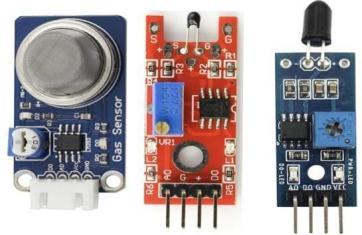
Fig.1:MQ-2SmokeSensor,LM35Temperature Sensor,and IR Flame Sensor
B. Microcontroller
Arduino Uno is used as the central control unit for processing sensor inputs and controlling suppression and safety actuators. It interfaces with relay modules, motor drivers, the GSM/GPS module, and the alarm systemthroughitsdigitalandanalogI/Opins.
The Fire Extinguisher Module is a mechanical-electrical actuation system designed to automatically discharge a fire extinguishing agent when a fire is detected. This module is controlled by the microcontroller without humanintervention.Fabrication-levelstudiessupportthe feasibility of relay-actuated extinguisher modules for vehicularuse[12].
The Motor Driver Module is an interface circuit used to control DC or gear motors through the microcontroller. SincetheArduinocannotsupplysufficientcurrenttodrive motorsdirectly,themotordriveractsasapoweramplifier forwindowanddooractuators.
A. Door Unlock Control-Upon fire detection, the microcontrolleractivatesarelaythattriggersthevehicle's central locking system to unlock all doors automatically, ensuringimmediatepassengerevacuation.
B. Window Roll-Down-Upon confirmed fire detection and cabin smoke presence, the microcontroller partially lowers the power windows under stationary conditions, reducingsmokeaccumulationandimprovingvisibilityfor occupants.
C. GSM Alert System-The GSM module sends real-time emergency notifications containing vehicle GPS coordinates to predefined contacts including vehicle owners, emergency services, or fleet management systems.
D. Alarm Buzzer-An audible alarm buzzer and status LEDs provide warning signals indicating normal operation,alert,orconfirmedfiredetectionstates.
E. Automatic Fire Suppression-The microcontroller triggers the extinguisher module, which releases the extinguishingagentthroughstrategicallyplacednozzlesin high-riskareassuchastheenginecompartment.
The system operates in a continuous monitoring loop. Sensor data are sampled periodically by the microcontroller. Threshold comparison and rate-of-rise logic are applied to temperature signals, while smoke concentration and flame detection outputs are evaluated simultaneously.Theoperationalflowchartispresentedin Fig.3.
A fire event is confirmed when at least two independent indicatorsarepresent:
A.Hightemperature+smokedetection
B.Flamedetection+smokedetection
International Research Journal of Engineering and Technology (IRJET) e-ISSN: 2395-0056
Volume: 13 Issue: 06 | Jun 2026 www.irjet.net p-ISSN: 2395-0072
C.Rapidtemperaturerise+flamedetection
After confirmation, relay modules disconnect selected electrical circuits to reduce secondary ignition risks. Doorlocksarereleasedandwindowsmaybeloweredif the vehicle is stationary. The communication module then transmits an emergency message with GPS coordinatestopredefinedcontacts.
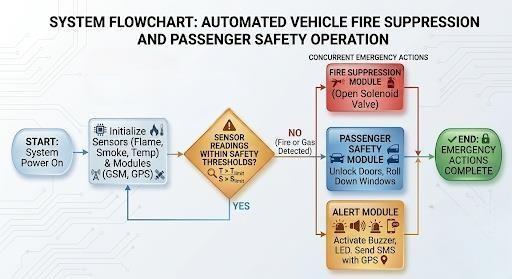
Fig.3:SystemFlowchart-Automated VehicleFire Suppression and Passenger Safety Operation
9. RESULTS AND DISCUSSION
Prototypetesting was conducted using an Arduino Uno, an LM35 temperature sensor, an MQ-2 smoke/gas sensor, and an IR flame sensor module, with relaydrivenoutputsrepresentingthesuppressionvalve,door lock,andwindowmotorcircuits.Heat,smoke,andflame conditions were introduced individually and in combination using controlled artificial sources under indoor ambient conditions. Each test condition was repeatedfivetimesandresultsrepresenttheaverageof thosetrials.
Table-IV: Typical Prototype Response
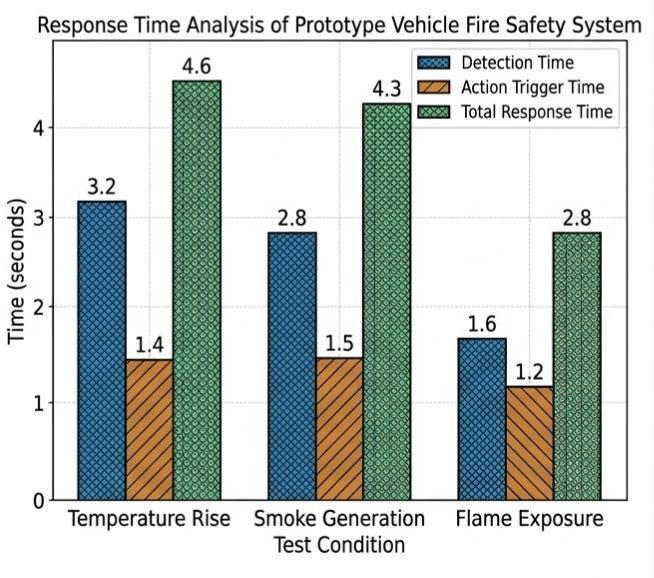
4: Response Time Analysis of Prototype Vehicle Fire SafetySystem
Forinternalcombustionvehicles,suppressionnozzlescan be directed toward engine and fuel-system zones. For electric vehicles, emphasis may be placed on battery enclosure monitoring and localized suppression support, an area where gas- and aerosol-based sensing for early thermal runaway detection has shown strong earlywarningperformance[14].
Advantages
A. Early automated fire response without human intervention
B.Improveddetectionreliabilitythroughmulti-sensor fusion
C. Remote alert capability with GPS location transmission
D.AdaptabletomultiplevehicletypesincludingEVs
E. Scalable, low-cost architecture suitable for mass deployment
Applications
A.Passengerandcommercialvehicles
B.Electricandhybridvehicles
C.Publictransportbuses
D.Industrial,military,andautonomousvehicles
The flame sensor produced the fastest confirmation responseat2.8stotal,whiletemperatureriseproduced the slowest at 4.6 s. Multi-sensor confirmation reduced unintended triggering during isolated heat or environmental smoke conditions. Fig. 4 illustrates the comparison of detection, action trigger, and total responsetimesacrossallthreetestconditions.
Futureimprovementsmayinclude:
A.ThermalrunawaypredictionforEVbatterypacks usinggasoff-gassingandvoltagesignatures
B. Integration with the vehicle CAN bus for direct accesstoengineandbatterytelemetry
C. Automatic eCall-style emergency initiation in parallelwithGSM/GPSalerting
D.Firelocalizationalgorithmstoidentifythespecific zoneoforiginwithinthevehicle
International Research Journal of Engineering and Technology (IRJET) e-ISSN: 2395-0056
Volume: 13 Issue: 06 | Jun 2026 www.irjet.net p-ISSN: 2395-0072
E. Camera-based fire detection as a supplementaryconfirmationchannel
F. Cloud-based fleet monitoring forcommercialand publictransportapplications
G. Machine learning modelstrainedonmulti-sensor datatofurtherreducefalsealarmrates
H. Automotive-grade, vibration- and temperatureratedsensormodulesfordeploymentreadiness
This paper presented an automated vehicle fire extinguisher system designed to improve fire response capability in modern vehicles. By combining temperature, smoke, and flame sensing with multisensor validation logic, the proposed system provides reliabledetectionwhilereducingfalsealarms.Automatic suppression, electrical isolation, door unlocking, a conditional window ventilation strategy, and remote emergency alerts collectively enhance overall safety response. Prototypelevel evaluation demonstrates promising performance with total response times ranging from 2.8 s to 4.6 s across all three test conditions, supporting further development toward practical automotive implementation.
[1] M. Sonnad, M. Saqhib, M. H. Khan, H. Jha and P. Sudhakar, "Design of Automatic Fire Extinguisher System for Electric Vehicles," in Proc. 1st Int. Conf. ISPES,pp.125-130,2023.
[2] S. Kiruthika, P. Sakthi, K. Manoj, R. N. Vishwash, I. T. HariDurgesh,
M. Vijaykumar and N. Parkunam, "Automatic Fire Extinguisher System with Safety Features for Vehicles," E3SWebofConferences, vol.399,p.05001,2023.
[3] M. Safar, "Car Safety: Automatic Fire Extinguisher System," Bachelor's Thesis, Hungarian University of AgricultureandLife Sciences,2024.
[4] T. Yuvaraj, K. Deenathayalan, M. Gokulraj, S. Mahendiran and K. Mahendran, "Design and ImplementationofCarFireDetectionand AutomaticCar Door Opening Using IoT," IJAEM, vol. 4, no. 7, pp. 388392,2022.
[5] J.J.Mathavan,N.U.A.Basith,A.W.FaslanandW.V. S. D. Wanigasinghe, "Hardware implementation of fire detection,control andautomatic doorunlockingsystem forautomobiles,"Universityof Jaffna,SriLanka.
[6] C.Subramanian,D.Sujith,M.Anish,P.DhanuDeepak and P. Manoj, "AI Based Automatic Fire Extinguisher SysteminVehicle," IARJSET,vol.11,no.3,2024.
[7] S. S. Bolbhat and A. S. Bhosale, "Fire Monitoring and
Automatic Suppression System for Vehicles," IJCRT, 2020.
[8] M. Gawde, A. Paudamal, A. Patil, S. Desai and N. Palsapagar, "Automatic Fire Extinguisher Car Module," V.E.S.Polytechnic.
[9] P.K.Nonda,S.Hosen,S.A.M.Jibon,M.U.Kulsumand M. Khatun, "IoT-Based Vehicle Fire Suppression System with Emergency Alerts, Speed Monitoring, and Location Tracing,"IJSDR,2023.
[10] M. Kulkarni, N. Kadam, H. Kate, H. Kulkarni and M. Herlekar, "Automatic Fire Extinguishing System for ElectricVehicle,"JETIR, vol.7,issue4,Pune,India,2020.
[11] R.JoyP,P.S.Subha,A.Arther,A.Nourin,S.S.Fathima and U. Abhi, "Real-Time Fire and Smoke Monitoring in Vehicles through an Automated Safety System," IJRASET, vol.13,no.V,2025.
[12] K.S.VeereshKumar,K.Gurubasavaraja,G.Karthik,J. Sameer Ahmed and R. Suresh, "Fabrication of Automatic FireProtection System,"Dept.ofMechanicalEngineering, JainInstituteof Technology.
[13]D.Li,G.Zhu,H.Zhu,Z.Yu,Y.GaoandX.Jiang,"Flame Spreadand SmokeTemperatureofFull-ScaleFireTestof Car Fire," Case Studies in Thermal Engineering, vol. 10, pp.315-324,2017.
[14]Sensors for Electrical Vehicle Thermal Runaway Detection, IEEE Conference Publication, IEEE Xplore, 2023.
[15] J. A. Milke, M. E. Hulcher, C. L. Worrell, D. T. Gottuk and F. W. Williams, "Investigation of Multi-Sensor Algorithms for Fire Detection," Fire Technology, Springer,vol.39,pp.363-382,2003.