
International Research Journal of Engineering and Technology (IRJET) e-ISSN: 2395-0056
Volume: 13 Issue: 04 | Apr 2026 www.irjet.net p-ISSN: 2395-0072
International Research Journal of Engineering and Technology (IRJET) e-ISSN: 2395-0056
Volume: 13 Issue: 04 | Apr 2026 www.irjet.net p-ISSN: 2395-0072
Yashashree Pradhan1 , Tanvi Kalantre2 , Yashaswi Kamble3 , Monica Charate 4
123Undergraduate Students, Dept. of Computer Science and Technology , Usha Mittal Institute of Technology, SNDTWU, Mumbai, Maharashtra, India
4Assistant Professor, Dept. of Computer Science and Technology, Usha Mittal Institute of Technology, SNDTWU, Mumbai, Maharashtra, India
Abstract - Existing educational management systems are largelyinefficientdue totheirfragmentedandpartiallydigital nature. Many institutions still depend on manual processes or multiplestandalone applications for taskssuch asattendance tracking,timetable scheduling,and assignmentmanagement. This lack of integration leads to data redundancy, inconsistencies,delayedupdates,andincreasedadministrative workload. Furthermore, these systems often lack real-time synchronization, centralized data storage, and proper rolebased access control, resulting in poor communication and limited coordination among students, teachers, and administrators. The inability to effectively manage both structuredand unstructureddatafurtherreducestheiroverall efficiency and scalability.
Toaddressthesechallenges,thispaperproposesacloud-based Educational Management System that centralizes academic op-erations into a unified platform. The system incorporates role-based access control, real-time updates, and integrated modules for attendance, assignments, and scheduling. By improving data management and communication, the proposed systemreduces redundancyandprovidesascalable, efficient solution for modern educational environments.
Key Words: Educational Management System, CloudBased Systems,Real-TimeSynchronization,Role-Based Access Control, Academic Automation, Data Management, Digital Education
Theincreasingcomplexityofacademicschedules,faculty assignments, and resource allocation in educational institutions has made traditional scheduling methods increasingly inadequate. Manual timetables and static spreadsheetsarepronetoconflicts,duplication,andhuman error.Theseinefficienciesoftenleadtowastedtime,higher administrative workload, reduced productivity, and confusionamongstudents,faculty,andadministrators.The Integrated Cloud-Based Educational Schedule Manager is designedtoaddressthesechallengesthrough a centralized and automated approach. By leveraging cloud technology, the system enables real-
time updates, automated conflict detection, and seamless accessfromanydeviceorlocation.Thiseliminatesversion inconsistenciesandensuresthatall stakeholders relyona single, accurate source of information. The platform also supportsdynamicschedulingadjustments.Anymodification such as a class reschedules or faculty reassignment is instantly reflected across the system. Push notifications ensure that users are immediately informed of changes, minimizingmiscommunicationandoperationaldelays.Rolebasedaccesscontrolfurtherenhancesefficiencyandsecurity. Students, faculty, and administrators each interact with customizeddashboardstailoredtotheirresponsibilities.This structuredaccessmodelsimplifiesusabilitywhileprotecting sensitive data. Cloud-based platforms have already transformed multiple industries by improving scalability, reliability,andaccessibility.Bycentralizingschedulingdata withinascalablecloudenvironment,educationalinstitutions can support hundreds of concurrent users without performancedegradation,ensuringarobustandfuture-ready academicmanagementsystem.
[1] Sikarwaretal.[1]presentasystematicreviewand bibliographic analysis of cloud-based Learning ManagementSystems,highlightinghowplatforms like Moodle and Google Classroom offer scalable, adaptivesolutions.However,thestudyfocuseson theoreticaladvantagesandlacksaspecificempirical frameworkformulti-cloudinteroperability.
[2] Marar et al. [2] develop a cloud-based LMS featuringauto-matedquizgenerationandrealtime communication tools via Nodemailer to enhance teacher-parent engagement. While effective for administrative transparency, the system is primarily designed for K-12 environments and may lack the complexity required for higher education research management.
[3] Jambhulkar et al. [3] explore a cloud-based LMS architecture that eliminates local server
International Research Journal of Engineering and Technology (IRJET) e-ISSN: 2395-0056
Volume: 13 Issue: 04 | Apr 2026 www.irjet.net p-ISSN: 2395-0072
dependenciestoprovideseamlessremoteaccessto educational resources. However, the paper provides limited technical detail on the security protocolsnecessarytoprotectsensitivestudentdata inapubliccloudenvironment.
[4] Shetty et al. [4] introduce a cloud-native Student ManagementSystem(SMS)designedtocentralize academicrecordsandautomateattendancetracking with role-based access con-trol. Although it improvesoperationalefficiency,thestudydoesnot fullyaddressthechallengesofmigratinglegacydata fromtraditionalon-premisessystems.
[5] Lutfullayevna[5]analyzesemergingtrendsinLMS development, such as AI integration and learning analytics, tosupportpersonalizededucationinthe digital era. While identifying future research directions,theworkisaqualitativetrendanalysis andlacksquantitativeperformancemetricsforthe mentionedtechnologies.
[6] Mishraetal.[6]proposeanLMSbuiltontheMERN stack designed for both academic and corporate training,emphasizingauser-friendlyandinteractive interface.However,theimplementationiscentered on a specific tech stack, which may limit its adaptability to institutions with existing diverse infrastructure.
[7] C¸ aylı and Yılmaz [7] integrate AI and multiobjective decision support to optimize smart classroom scheduling and resource allocation in competitive educational markets. Despite the technical sophistication, the complexity of theAI models may pose significant implementation barriers for smaller institutions with limited technicalstaff.
[8] Techie-Menson and Nyagorme [8] design and implementaweb-basedtimetablesystemtosolve the logistical challenges of scheduling in higher education. While it successfully re-duces manual errors, the system’s reliance on centralized web architecturemayfacescalabilityissuesduringpeak registrationperiods.
[9] Ojika et al. [9] leverage AI and data science to enhance collaboration and access in cloud computing education, proposing a framework to overcomefacultyexpertisebarriers.However,the proposed framework remains largely conceptual andrequiresfurtherlarge-scalelongitudinalstudies toproveitslong-termeducationalimpact.
[10]Priyadarshini and Swamydoss [10] develop a centralizedstudentportalapplicationtoautomate manual academic processes and facilitate facultystudent communication. While improving accessibility,thepaperfocusesmoreonfront-end functionalityandlacksadeepanalysisofback-end databaseoptimizationforhigh-concurrencyusage.
Current scheduling systems in educational institutions predominantly rely on manual methods, standalone applications, or spreadsheets, leading to several key inefficiencies:
• HighErrorRates: Manualdataentryoftenresultsin schedulingconflictsandmismanagement.
• Fragmented Systems: Most institutions use multiplein-dependenttoolsfordifferentpurposessuch asattendance,assignments,andscheduling.Thislack ofintegrationleadstoinconsistenciesandduplication ofdata.
• Lack of Real-Time Synchronization: Updatesare notimmediatelyreflectedacrossthesystem.
• Resource Inefficiency: Allocating classrooms and facultyaretime-consuminganderrorprone
• Manual Data Handling: Attendance is often recorded manually, and assignment submissions are managedthroughinformalchannels.Theseprocesses aretime-consumingandpronetohumanerror.
• Limited Accessibility: Existingsystemslackcloudbasedcapabilities,makingremoteaccessdifficult.
• Manual Data Handling: Notifications regarding timetablechanges,assignmentdeadlines,oracademic eventsarenotdeliveredinstantly.Thisdelayresultsin confusionandmissesdeadlines.
• LimitedAccessibility: Traditionalsystemsareoften restricted to specific locations or devices, reducing flexibil-ityforstudentsandfacultymembers.
• InefficientFileManagement: Handlingdocuments such as assignments, reports, and instructional materials is often unorganized,makingretrievaland trackingdifficult.
• Lack of Role-Based Control: Existing systems do not always enforce strict access control, leading to unauthorizedmodificationsordatamisuse.
Currentacademicmanagementpracticesexhibitseveral limitations that hinder efficiency and scalability. These limitationshighlighttheneedforacentralized,automated, and real-time system capable of addressing these challengeseffectively.
International Research Journal of Engineering and Technology (IRJET) e-ISSN: 2395-0056
Volume: 13 Issue: 04 | Apr 2026 www.irjet.net p-ISSN: 2395-0072
Theproposedarchitecturesupportsasynchronousevent handling, ensuring real-time updates across all stakeholderswithoutblockingsystemoperations.
The proposed system presents a comprehensive cloudbased academic scheduling and management platform aimedattransformingtraditionaleducationaloperations intoafullyautomated,intelligent,andscalableecosystem. The system is designed to address the inefficiencies of existing solutions by integratingadvancedtechnologies such as cloud, real-time data synchronization, and AIdrivenoptimizationtechniquesintoaunifiedframework. The system is centralized and designed to unify and automate academic operations within an institution. It provides a single platform that enables seamless interaction between students, teachers, and administratorswhileensuringcontrolledaccess,real-time updates,andefficientdatamanagement.
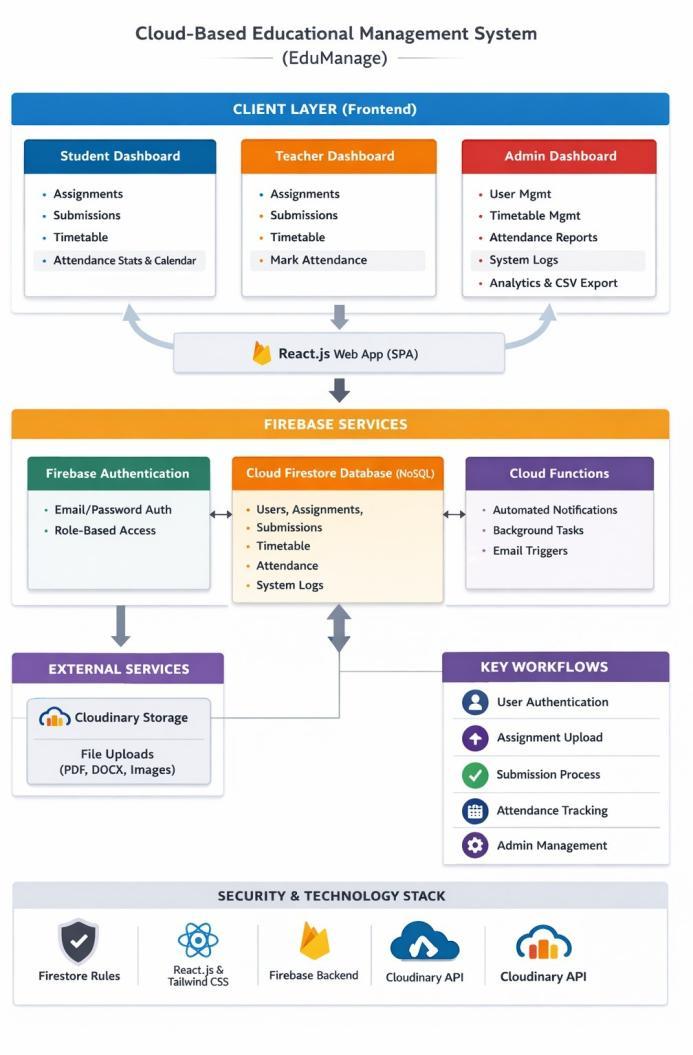
At its core, the system follows a modular and layered architecture,typicallyconsistingofapresentationlayer(user interface),applicationlayer(businesslogic),anddatalayer (database management). This separation of concerns enhances maintainability, scalability, and system performance. The use ofcloud infrastructure ensureshigh availability,faulttolerance,andseamlessscalability,enabling the system to support a growing number of users and institutional requirements without degradation in performance.
4.1 System Concept
Thesystemreplacesfragmentedandmanualacademic processeswithanintegrateddigitalplatform.Itensures thatall academicactivities suchasattendance tracking, assignmenthandling,timetablescheduling,andacademic event management are performed within a unified environment.
The system operates on a role-based interaction model, where each user category is provided with a dedicatedinterfaceandrestrictedaccesstofunctionalities relevanttotheirresponsibilities.
4.2 System Architecture Overview
Thesystemisdesignedasacentralizedplatformwith clearlydefinedlayers:
• User interaction layer
• Application logic layer
• Data management layer
• External resource handling layer
Eachlayeroperatesindependentlywhilemaintaining seamlesscommunicationwithothers.
1) Administrator
• Manage useraccounts androles
• Controlandmodify timetableschedules
• Overseesystem-wideoperations
This structured role distribution ensures clarity of responsibilitiesandpreventsunauthorizedaccess.
4.3 System Features
The proposed system includes the following key features:
1) Centralized Academic Management
All academic information is stored and managed within a unified system, eliminating redundancy and improvingconsistency.
International Research Journal of Engineering and Technology (IRJET) e-ISSN: 2395-0056
Volume: 13 Issue: 04 | Apr 2026 www.irjet.net p-ISSN: 2395-0072
2)
Anychangeinthesystemisinstantlyreflectedacross allusers,ensuringthatinformationremainscurrentand synchronized.
3) Controlled Access Mechanism
Accesstofunctionalitiesisstrictlygovernedbased onuserroles,ensuringdataintegrityandsecurity.
4) Modular Design
The system is divided into independent modules thathandlespecificacademicfunctions,allowingeasy scalabilityandmaintenance.
1) Assignment Module
Thismodulefacilitatesthecreation,distribution,andsubmission of assignments. Teachers provide assignment details, while students submit their work through the system.Allinteractionsaretrackedandupdatedinrealtime.
2) Timetable Module
Thetimetablemoduleallowsadministratorstomanageand update academic schedules. To maintain operational discipline, modifications are restricted by predefined time constraints.Allupdatesarecommunicatedinstantlytousers.
3) Academic Calendar Module
Thismoduleallowsauthorizeduserstoscheduleacademic events such as examinations, deadlines, and institutional activities.Itensuresthatallstakeholdersareinformedabout upcomingeventsinatimelymanner.
4) Attendance Module
Thismoduleenablesauthorizeduserstorecordstudent attendance. The recorded data is stored centrally and made immediately accessible to students. The system ensures accuracy and prevents unauthorized modifications.
Thesystem adopts a dual data-handling strategy:
• StructuredData:Includesorganizedinformation suchasuserrecords,schedules,andattendance logs
• UnstructuredData:Includesdocuments,images, andassignmentfiles
This separation ensures efficient storage, retrieval, and scalability.
The proposed system follows a modular and layered approach,ensuringscalability,maintainability,andefficient dataflow.Themethodologyfocusesonsystemdesign,data organization,userinteraction,andreal-timeprocessing.
5.1
The systemfollows a modularandlayereddesign approachtoensurescalabilityandmaintainability.The architectureisdividedintothefollowinglayers:
Presentation Layer: Handles user interaction and interfacerenderingApplicationLayer:Processesuser requestsandenforcessystemlogicDataLayer:Manages storage and retrieval of information Communication Layer: Handles synchronization and notification delivery
Each layer operates independently while maintaining seamlesscoordination.
5.1.1
Thesystemdefinesthreeprimaryuserroles:
• Student
– Viewsattendancerecords
– Submitassignments
– Accessestimetableandacademiccalendar
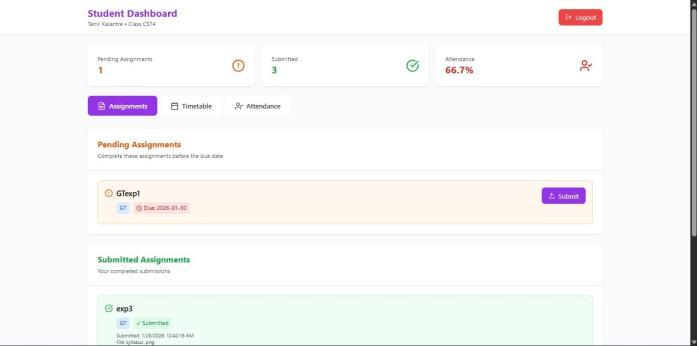
Fig -2:StudentDashboard
• Teacher – Marksattendance
– Uploadsassignments
– Updatesacademiccalendar
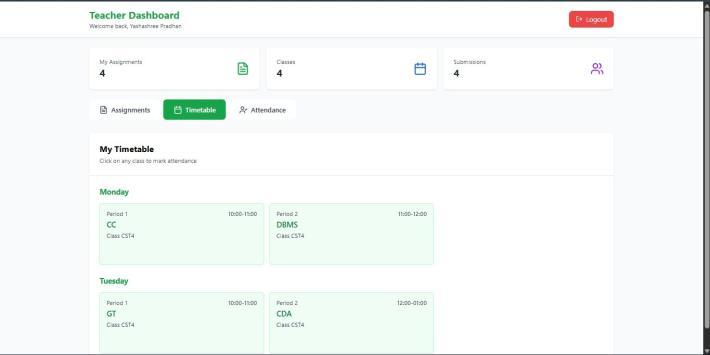
Fig -3:Teacher’sDashboard
International Research Journal of Engineering and Technology (IRJET) e-ISSN: 2395-0056
Volume: 13 Issue: 04 | Apr 2026 www.irjet.net p-ISSN: 2395-0072
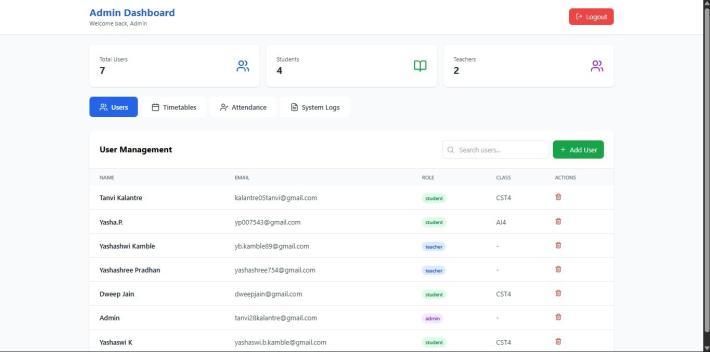
• Administrator – Managesusers
– Controlstimetablescheduling – Overseessystem-wideoperations
Access permissions are strictly enforced to maintain dataintegrityandpreventunauthorizedactions.
5.2
The system is designed around structured processes that definehowdatamovesandoperationsareexecuted. The system is designed around structured processes that definehowdatamovesandoperationsareexecuted,starting withauserauthenticationprocesswheretheuserprovides credentials, the system verifies identity, a role is assigned basedonusertype,andaccesstothedashboardisgranted. In the attendance recording process, the teacher selectsa class or session, attendance data is entered, the system validatestheinput,dataisstoredinacentralrepository,and students can immediately view updated records. For the assignment handling process, the teacher creates an assignment with instructions, the system publishes it, students receive notifications, submit responses, and the systemstoresandtracksthosesubmissions.Thetimetable update process involves an administrator initiating a modification,thesystemcheckingfortimeconstraints,andif valid, accepting the update, modifying the schedule, and sendingnotificationstoallusers.Finally,theacademicevent managementprocessallowsanauthorizedusertocreateor update an event, which the system validates, stores, schedules,andsendsnotificationsabouttousers.
Thesystemimplementsacontinuoussynchronization mechanism:
• Anydatamodificationtriggersanupdateevent
• The systemprocesses the change instantly
• Updateddata is propagated toallrelevant users
• Notificationsaregeneratedautomatically This ensures consistency and eliminates delays in communication.
To maintain system reliability and discipline, the followingconstraintsareenforced:
• Timetable modifications are restricted to a specific timewindow
• Onlyauthorized roles canperform critical operations
• Datavalidationisapplied beforestorage
• Conflict resolutionmechanismsprevent inconsistent up-dates
The system employs an optimized data handling approach:
• Frequentlyaccesseddataisstructuredforquick retrieval
• Largefilesanddocumentsarehandledseparately
• Dataconsistencyismaintainedthroughvalidation checks
• Redundancyisminimizedthroughcentralized storage
Thesystemincorporatesmultiplesecuritymeasures:
• Role-basedaccesscontrol
• Authenticationandauthorizationmechanisms
• Datavalidationandintegritychecks
• Restrictedmodificationpermissions
These measures ensure that sensitive academic data remainsprotected.
Thesystemis designedto:
• Handleincreasing numbers ofusers
• Supportlargevolumesofdata
• Maintainperformanceunderhigh load
• Enablefuture enhancementswithout major redesign
The proposed system can be extended in several directionstoenhanceitscapabilities:
• Intelligent Analytics: Predictiveanalysisofstudent performanceandattendancetrends
• Automated Scheduling: Implementation of optimizationalgorithmsfortimetablegeneration
• Mobile Accessibility: Development of dedicated mobileplatformsforimprovedusability
• Communication Module: Inclusion of learning
International Research Journal of Engineering and Technology (IRJET) e-ISSN: 2395-0056
Volume: 13 Issue: 04 | Apr 2026 www.irjet.net p-ISSN: 2395-0072
re-sourcesandcoursematerials
• Performance Dashboards: Visualization toolsfor administratorsandteachers
• Task and Deadline Tracking: Reminders and notificationsforupcomingdeadlinesandevents.
• Grading and Feedback Module: Teachers grade sub-missionswithrubric-basedevaluation.
• Search and Filter Functionality: Search assignmentsbysubject/date,filterbystatus.
• Discussion Forum/Chat: Subject-wiseboardsand real-timechatviaFirebaseReal-timeDatabase.
Resource Library: Centralized study material repository categorizedbysubject/topic.
This paper presents a comprehensive cloud-based Educational Management System aimed at improving the efficiency and effectiveness of academic operations. By integrating multiple functionalities intoa unified platform, thesystemaddresses thelimitationsoftraditionalmethods andenhancescommunicationamongstakeholders. The role-based access model ensures data security and operational clarity, while real-time synchronization guarantees timely updates. The modular design allows scalabilityandadaptability,makingthesystemsuitablefor institutionsofvaryingsizes.
The integration of cloud technology ensures seamless schedule access, minimizing manual errors and administrativeworkload.Futureenhancementswillfocuson improved mobile experience, expanded AI-driven optimizations, and integration with other educational managementsystemsforamorecomprehensivesolution.
The proposed solution demonstrates how digital transformation can significantly improve academic management by reducing manual effort, enhancing transparency,andenablingdata-drivendecision-making
[1] P.Sikarwar,A.Tiwari,R.Joshi,andJ.Agrawal,“Cloud Computing in Education: A Revolution in Learning ManagementSystems,”*InnovareJournalofEducation*, vol.13,no.[citestart]5, 2025.[cite :1777]
[2]A.A.Marar,Y.Niharika,T.Akhila,V.Vaishnavi,andB. B. Ma, “Cloud Based Learning Management System,” *AmritaSchoolofComputing*,2024.[cite:1293]
[3] K. S. Jambhulkar, S. N. Biwal, G. S. Gawande, and S. A. Bachwani, “Cloud-Based Learning Management System,” *International Journal for Research in Applied Sci-ence EngineeringTechnology(IJRASET)*, vol.13,no.[citestart]X, 2025[cite :481, 482]
[4] T. Shetty, P. Shingote, S. Shedge, and P. Marulkar,
“Cloud Based Student Management System,” *International Journal of Research Publication and Reviews*,vol.6,no.[citestart]4, 2025[cite :1030]
[5] E. T. Lutfullayevna, “Development Trends of LMS Platforms in the Era of Digital Education,” *World Bulletin of Education and Learning (WBEL)*, vol. 2, no. [citestart]3, 2026[cite :259]
[6]A.K.Mishra,A.R.Yadav,V.N.Nayak,andA.Marathe, “LearningManagementSystem(LMS),”*ThakurCollege ofEngineeringandTechnology*,2024.[cite:1]
[7] O.C¸ aylıandA.Yılmaz,“SmartClassroomScheduling andResourceOptimizationforEducationalInstitutions: In-tegrating AI and Multi-Objective Decision Support,”
*The European Journal ofResearchandDevelopment*, vol.5,no.[citestart]1, 2025[cite :2402, 2403]
[8] H.Techie-MensonandP.Nyagorme,“DesignandImplementation of a Web-Based Timetable System for HigherEducation Institutions,” *International Journal of Educa-tionalResearchandInformationScience*,vol.7, no.[citestart]1, 2021.[cite :2960, 2961]
[9] F. U. Ojika, W. O. Owobu, O. A. Abieba, O. J. Esan, B.C.Ubamadu,andA.I.Daraojimba,“TransformingCloud ComputingEducation:LeveragingAIandDataSciencefor EnhancedAccessandCollaborationinAcademicEnvironments,” *Journal of Frontiers in Multidisciplinary Research*,vol.4,no.[citestart]1, 2023[cite :3894]
[10] V. Priyadarshini and D. Swamydoss, “Student PortalApplication,”*IndianJournalofComputerScience and Tech-nology*, vol. 3, no. [citestart]2, 2024[cite : 5260]