
International Research Journal of Engineering and Technology (IRJET) e-ISSN: 2395-0056
Volume: 13 Issue: 03 | Mar 2026 www.irjet.net p-ISSN: 2395-0072
INFLUENCE OF CLIMATE CHANGE ON SOIL SHEAR STRENGTH
Kartik Bakle1 , Apurva Nikam1 , Pratiksha Pimple1 , Harshada Wagh1 , Shubham Paradhe2
Diploma students, Department of Civil Engineering, Marathwada Institute of Technology, Polytechnic, Chhatrapati Sambhajinagar, Maharashtra, India.
Lecturer,Department of Civil Engineering, Marathwada Institute of Technology, Polytechnic, Chhatrapati Sambhajinagar, Maharashtra, India.
Abstract - Climate change has introduced significant variations in temperature, rainfall intensity, and groundwater levels, which directly influence soil behaviour. Among the various geotechnical properties, the shear strength of soil plays a critical role in determining the soil bearing capacity. This study focuses on analysing the effects of climate-induced factors such as increased precipitation, extreme drought conditions, and rising temperatures on the shear strength and overall bearing capacity of soil. Laboratory testing methods, supported by field data and literature review, are used to evaluate changes in cohesion, internal friction angle, and soil suction under different climatic scenarios. The results indicate that higher moisture content and groundwater rise generally reduce shear strength, while temperature-related drying cycles may lead to cracking and loss of structural stability. The study highlights the need to incorporate climate- responsive soil behaviour in future foundation design and geotechnical engineering practice.
Key Words: Soil, Shear strength, Climate change, Moisture content, Effective stress
1.INTRODUCTION
Soil shear strength is a key parameter controlling the stability of foundations and earth structures. Traditional design assumes soil properties remain constant, but climate change causes variations in rainfall, temperature, and groundwater levelsthataltersoilbehavior.Excessrainfallincreases porewaterpressureandreduceseffectivestress,leadingtolower shear strength and higher failure risk. Droughtconditions causeshrinkageandcrackingincohesive soils, further reducing strength. Repeated wetting–drying cycles also weaken soil structure over time. Therefore, climate-resilient geotechnical design such as proper drainage, groundwater control, and soil stabilization is essential to maintain long-term foundationstability.
1.1 Shear Strength of Soil and the Influence of Climate Change
Soil shear strength is a critical parameter in geotechnical engineering that determines the ability of soil to support structural stresses without failure, excessive settlement, or instability. Conventional foundation design relies on soil propertiesobtainedfromfieldandlaboratoryinvestigationsconductedunderrelativelystableenvironmentalconditions,were parameterssuch as cohesion,angleofinternal friction, and moisture content are assumed to remain constant over time. However, climate change has introduced significant variability in environmental conditions, including changes in rainfall patterns,temperaturefluctuations,andgroundwaterlevels,whichdirectlyaffectsoilbehaviorandshearstrength.
1.2 Effect of Climate Change–Induced Soil Moisture Variations on Shear Strength and Stability
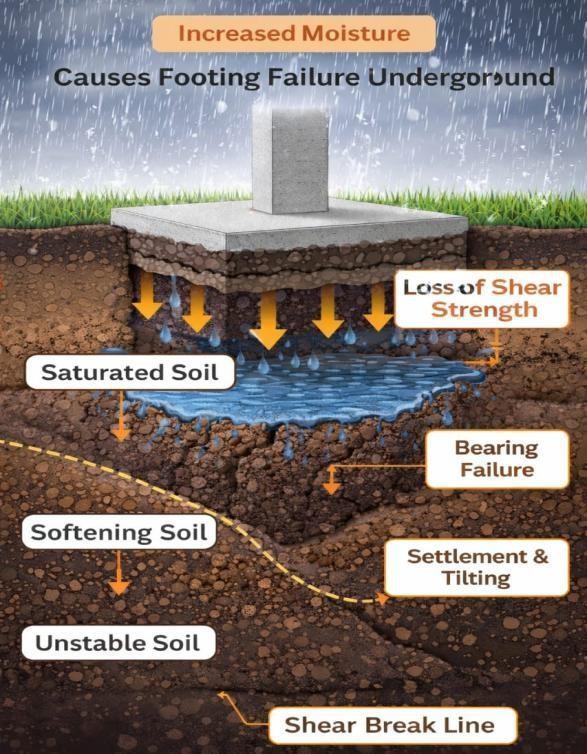
Climate change–induced variations in soil moisture content play a major role in altering soil strength and stability. Increased rainfall can lead to soil saturation, raising pore water pressure and reducing effective stress, which ultimately decreases shear strength and may cause settlement or failure. Conversely, prolonged dry periods result in shrinkage, cracking, and structural degradation of soils, particularly in clays, leading to differential settlement and reduced stressbearing capacity. Repeated wetting– drying cycles further weaken soil fabric, making foundations more vulnerable to instabilityunderchangingclimaticconditions.
International Research Journal of Engineering and Technology (IRJET) e-ISSN: 2395-0056
Volume: 13 Issue: 03 | Mar 2026 www.irjet.net p-ISSN: 2395-0072
1.3 Need to Incorporate Climate Change Effects in Geotechnical Design
Given the growing impact of climate change on soil behavior, it is essential to incorporate these effects into geotechnical design practices. Traditional approaches based on constant soil properties are no longer sufficient, and engineers must adopt climate-resilient strategies that consider long-term variability in moisture, temperature, and groundwater conditions. This includes the use of improved drainage systems, soil stabilization techniques, enhanced site investigation methods,andadaptivesafetyfactorstoensurethestability,durability,andreliabilityofstructuresthroughouttheirservice life.
2. AIM AND OBJECTIVES
1. ToexaminetheimpactofclimatechangeonShearstrengthofthesoil.
2. TocomparetheshearstrengthbehaviorofBlackCottonSoilandMediumStiffSoil.
3. Todeterminethephysicalpropertiesofsoil.
3. LITERATURE REVIEW
Bo Wang et al. (2025) has investigated the shear behavior of frozen soil–structure interfaces using high-pressure direct sheartestsundervaryingnormalstressesandfreeze–thawconditions.Thestudyfoundthathighernormalstressincreases peakshearstrength,whilehigherthawingtemperaturesreduceinterfacialbondingandshear resistance,shiftingbehavior fromstrain-softeningtostrain-hardening.
Ming Lu et al. (2024) hasinvestigatedthenanoscaleshearbehaviorofkaoliniteclayusingmoleculardynamicssimulations. The study found that the presence of water films interparticle significantly friction (up reduces to 98%), changing soil behavior from brittle to ductile. Wettability and water content strongly influence shear resistance and clay failure mechanisms.
Joris Eekhout et al. (2022) hasconductedaglobal reviewofsoil erosion models andfoundthatclimatechange islikely to increase soil erosion, especially in semi-arid regions. However,landmanagement practicessuchasreforestation and soil conservationcaneffectivelyreducetheseimpacts.
Sudeshna Mondal et al. (2021) has reviewed the effects of climate change on soil fertility and properties. Rising temperatures and changing rainfall patterns were found to alter soil structure, organic matter, and moisture conditions, potentiallyleadingtolong-termsoildegradationifnotproperlymanaged.
International Research Journal of Engineering and Technology (IRJET) e-ISSN: 2395-0056
Volume: 13 Issue: 03 | Mar 2026 www.irjet.net p-ISSN: 2395-0072
Maurizio Barbieri et al. (2021) has emphasized that climate change, land use, and human activities are major factors affecting groundwater and surface water quality. The studyhighlights increasing problems such as chemical pollution, eutrophication, and microbial contamination. It also stresses the need for more research, long-term monitoring, and better groundwatermanagementtoaddressclimatechangeimpacts.
4. SYSTEM DEVELOPMENT
Thepresentstudyinvolvesasystematicexperimentalinvestigationofthephysical,index,andshearstrength propertiesof two commonly encountered soils Black Cotton Soil and Medium Stiff Soil selected due to their contrasting engineering behavior,particularlyintermsofmoisturesensitivity,strengthvariation,andvolumechangecharacteristics.Blackcotton soil, known for its expansive nature and shrink–swell behavior, poses significant challenges for foundation stability, whereasmediumstiffsoilexhibitsrelativelymoderatecompressibilityandbetterstress-bearingcharacteristics.Disturbed soil samples were carefully collected from identified locations, processed to remove impurities, and prepared under controlled laboratory conditions. All experimental procedures were conducted in accordance with IS 2720 standards to ensurereliabilityandconsistencyofresults.
A comprehensive laboratory testing program was carried out, including determination of moisture content by (oven drying method),in-situdensity(corecuttermethod),specificgravity(pycnometermethod),andshearstrength(directsheartest).The evaluatedproperties includedmoisturecontent, bulk and dry density, void ratio, porosity, degree of saturation, and shear strengthparametersundervaryingmoistureconditionsandnormalstresses.TheresultsindicatethatBlackCottonSoilhas lowermoisturecontentandhigherdrydensitycomparedtoMediumStiffSoil,whilebothsoils exhibitsignificantvariation inshearstrengthwithchangesinmoisture.Thesefindingsprovideadetailedunderstandingofsoilbehaviorandformthebasis for analyzing the influence of environmental factors, particularly climate-induced moisture variations, on soil stability and foundationperformance.
5. RESULTS AND DISCUSSION
5.1 Black cotton soil
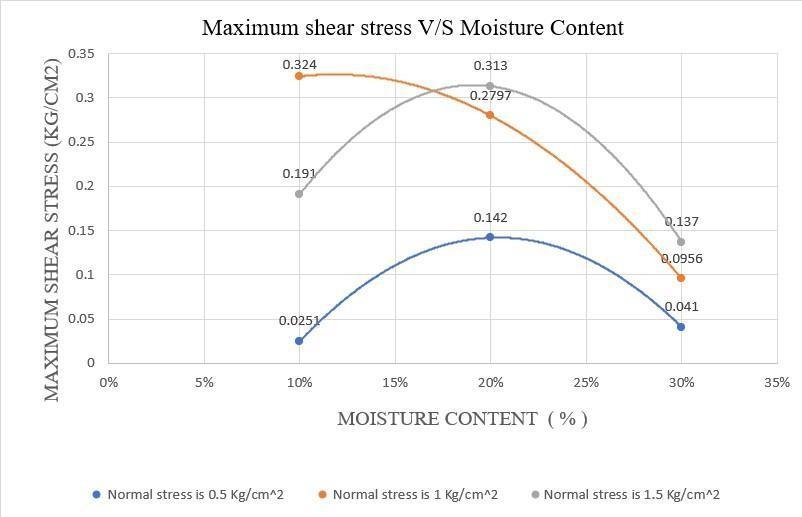
ThegraphindicatesthattheshearstrengthofBlackCottonSoilvariessignificantlywithmoisturecontentunderdifferent normal stresses. For all stressings, shear stress increases with water content and reaches a maximum at about 20% moisturecontent.Thepeakshearstrengthincreasesasthenormalstressincreasesfrom0.5kg/cm2to
1.5 kg/cm2. Beyond the optimum moisture content, shear strength decreases due to excess water and loss of soil interlocking.Overall,BlackCottonSoilshowsmaximumshearstrengthnearoptimummoisturecontent,andhighernormal stressesresultinhighershearstrength.
International Research Journal of Engineering and Technology (IRJET) e-ISSN: 2395-0056

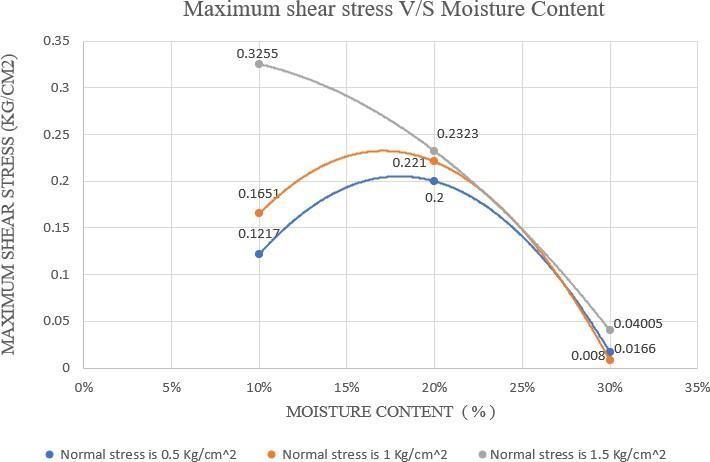
Chart 2. Maximum shear stress v/s Moisture content tested on 2nd gear of Direct shear test apparatus
Thegraph shows that the shearstrength ofBlack Cotton Soil increases with moisture content up to an optimum value of about18–20%forallnormalstresses.Themaximumshearstressincreasesasthenormalstressincreasesfrom0.5kg/cm2 to1.5kg/cm2 .Beyondtheoptimum moisturecontent,shearstrengthdecreasessharplydue to excesswaterandreduced soil friction. Overall, Black Cotton Soil exhibits maximum shear strength near its optimum moisture content, and higher normalstressesresultinhighershearstrength.
5.2 Medium stiff soil
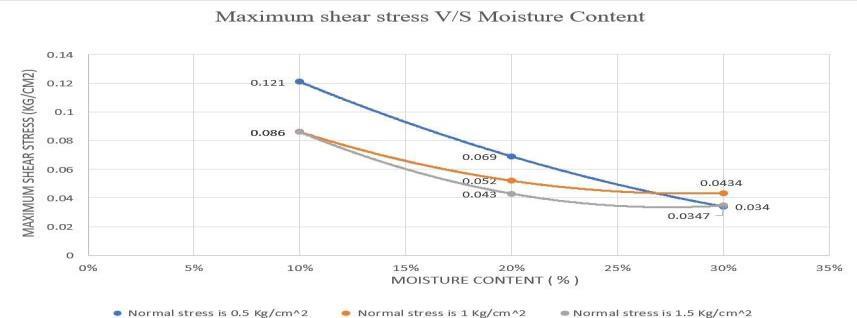
Chart 3 Maximum shear stress v/s Moisture content tested on 1st gear of Direct shear test apparatus
Thegraphindicatesthatformediumstiffsoil,shearstrengthdecreaseswithincreaseinmoisturecontentforallnormal stresses.Highershearstressisobservedatlowermoisturecontent,anditreducessteadilyasmoistureincreasesdueto loss of interparticle friction. Shear strength increases with increase in normal stress, but moisture content has a dominantweakeningeffect.Overall,mediumstiffsoilshowsbettershearstrengthunderdrierconditions.
Volume: 13 Issue: 03 | Mar 2026 www.irjet.net p-ISSN: 2395-0072 © 2026, IRJET | Impact Factor value: 8.315 | ISO 9001:2008 Certified Journal | Page1104
International Research Journal of Engineering and Technology (IRJET) e-ISSN: 2395-0056
Volume: 13 Issue: 03 | Mar 2026 www.irjet.net p-ISSN: 2395-0072
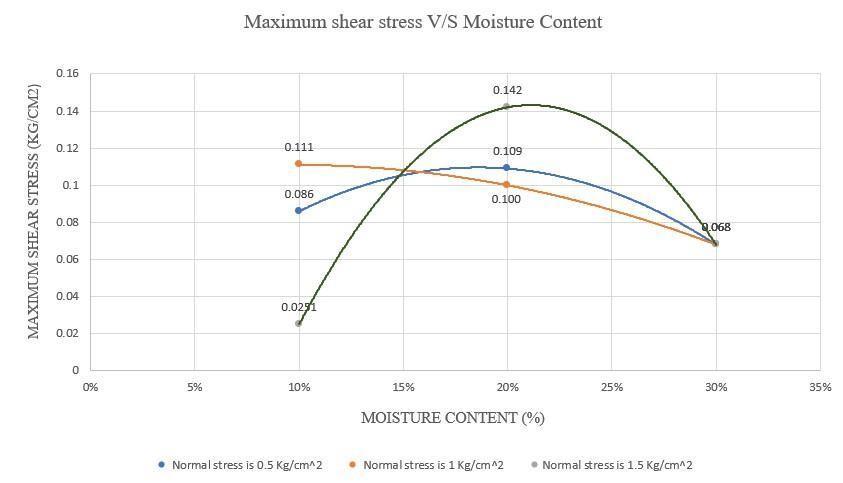
Chart 4 Maximum shear stress v/s Moisture content tested on 2nd gear of Direct shear test apparatus
The graph shows that for medium stiff soil; shear strength increases with moisture content up to an optimum value of about20%forallnormalstresses.Themaximumshearstress increasesasthenormalstressincreasesfrom0.5kg/cm2to 1.5 kg/cm2. Beyond the optimum moisture content, shear strength decreases due to excess water reducing soil friction. Overall, medium stiff soil exhibits maximum shear strength near its optimum moisture content under higher normal stresses.
4. CONCLUSIONS
TheresultsandgraphsshowhowtheshearstrengthofsoilchangeswithbothMoisturecontentandNormalstress.Incase of Black cotton soil, shear strength first increases with moisture content and then decreases after a certain limit. Higher normal stress generally gives higher shear stress. In case of Medium stiff soil, shear strength gradually decreases when moisture content increases. Therefore, soil is strongest at an optimum moisture level, and too much water reduces its strength.
REFERENCES
1. Bo Wang et al.,Directsheartestingoffrozensoil–structureinterfaceunderhighnormalstressandfrozen–thawing conditions,SoilsandFoundations,Volume65,2025,ArticleNo.101660,pp.1–7.
2. Ming Lu et al., Nanoscale shear behavior of hydrated kaolinite: Effects of water content and surface wettability, AppliedClayScience,Volume65,2024,ArticleNo.106087,pp.2843–2854.
3. Joris Eekhout et al., Global impact of climate change on soil erosion and potential for adaptation through soil conversation,Earth-ScienceReviews,Volume226,2022, ArticleNo.103921,pp.01–12.
4. Sudeshna Mondal et al.,ImpactofClimateChangeonSoilFertility,JournalofSoilScience,Vol.63 ,2021,pp.551–569.
5. Maurizio Barbieri et al., Climate change and its effect on ground water quality, Environmental Geochemistry and Health,Vol.45,2021,pp.1133–1144.
International Research Journal of Engineering and Technology (IRJET) e-ISSN: 2395-0056
Volume: 13 Issue: 03 | Mar 2026 www.irjet.net p-ISSN: 2395-0072
BIOGRAPHIES

Kartik Bakle, Diploma students, Department of Civil Engineering, Marathwada Institute of Technology, Polytechnic, Chhatrapati Sambhajinagar, Maharashtra,India.

Apurva Nikam, Diploma students, Department of Civil Engineering, Marathwada Institute of Technology, Polytechnic,ChhatrapatiSambhajinagar, Maharashtra,India

Pratiksha Pimple, Diploma students, Department of Civil Engineering, Marathwada Institute of Technology, Polytechnic, Chhatrapati Sambhajinagar, Maharashtra,India.

Haradasha Wagh, Diploma students, Department of Civil Engineering, Marathwada Institute of Technology, Polytechnic, Chhatrapati Sambhajinagar, Maharashtra,India.

Shubham Paradhe, Lecturer, Department of Civil Engineering, Marathwada Institute of Technology, Polytechnic, ChhatrapatiSambhajinagar,Maharashtra