International Research Journal of Engineering and Technology (IRJET)
e-ISSN: 2395-0056
Volume: 13 Issue: 05 | May 2026
p-ISSN: 2395-0072
www.irjet.net
IMPROVISING RED SOIL’S GEOTECHNICAL PERFORMANCE WITH POLYPROPYLENE AND GYPSUM 1Sikander Kumar , 2Md. Shariq , 3Karan Sahani, 4Kamil Ulla Khan, 5Ujjwal Mishra, 6Harshit dixit 1,2Assistant Professor, Dept. of Civil Engineering, Axis Institute of Technology and Management, Rooma Kanpur, India
3,4,5,6U.G. Student, Dept. of Civil Engineering, Axis Institute of Technology and Management, Rooma Kanpur, India ---------------------------------------------------------------------------***----------------------------------------------------------------------------
Abstract - In civil engineering, the foundation plays a
Soil stabilization is a critical component of various civil engineering projects. Without removing the entire soil, the most effective technique is to use appropriate accessible. methods and materials to enhance the soil qualities. As a result, soil stabilization is thought to be the best strategy for improving soil geotechnical parameters. Chemical additives, thermal energy, compaction, and plant-based or synthetic fiber reinforcing are all common stabilization approaches. Straw, coir, palm, sisal, and jute are examples of plant-based fiber reinforcement materials that are inexpensive. Synthetic fiber reinforcing materials, such as polypropylene, nylon, rubber, or plastic, can also help reduce waste. Research into the use of waste materials to stabilize soil is currently a global trend, as surplus waste materials pose public safety and logistical issues in terms of disposal.
vital role in ensuring the stability and safety of any structure, as it must safely transfer all imposed loads to the ground without failure. However, in many regions, natural soils possess inadequate strength and require improvement through stabilization techniques. Soil stabilization becomes essential in such cases to enhance properties like strength, durability, and load-bearing capacity. Red soil, which covers approximately 10.6% of India’s geographical area, is characterized by its reddish color due to the high iron oxide content. In this study, red soil has been selected to evaluate its engineering behavior and improve its properties using additives. The soil sample was collected from Rath district in Uttar Pradesh and transported to the laboratory for testing. Polypropylene fibers were added in varying proportions of 1%, 1.5%, and 2%, along with a constant 5% gypsum content, to study their combined effect on soil properties. Various geotechnical tests such as compaction, California Bearing Ratio (CBR), and strength tests were conducted to assess improvements in performance. The study aims to evaluate the effectiveness of these additives in enhancing soil stability, reducing plasticity, and improving its suitability for construction applications such as subgrade and pavement layers.
2. MATERIAL USED
In this study, the following materials were used: i) Red Soil ii) Polypropylene iii) Gypsum 2.1 RED SOIL
Key Words: Soil stabilization, red soil, polypropylene, Gypsum, CBR etc.
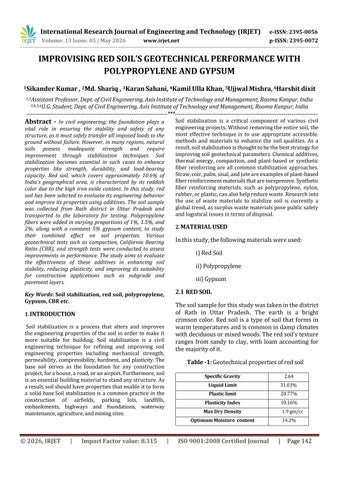
The soil sample for this study was taken in the district of Rath in Uttar Pradesh. The earth is a bright crimson color. Red soil is a type of soil that forms in warm temperatures and is common in damp climates with deciduous or mixed woods. The red soil's texture ranges from sandy to clay, with loam accounting for the majority of it.
1. INTRODUCTION Soil stabilization is a process that alters and improves the engineering properties of the soil in order to make it more suitable for building. Soil stabilization is a civil engineering technique for refining and improving soil engineering properties including mechanical strength, permeability, compressibility, hardness, and plasticity. The base soil serves as the foundation for any construction project, for a house, a road, or an airport. Furthermore, soil is an essential building material to stand any structure. As a result, soil should have properties that enable it to form a solid base.Soil stabilization is a common practice in the construction of airfields, parking lots, landfills, embankments, highways and foundations, waterway maintenance, agriculture, and mining sites.
© 2026, IRJET
|
Impact Factor value: 8.315
Table -1: Geotechnical properties of red soil
|
Specific Gravity
2.64
Liquid Limit
31.03%
Plastic limit
20.77%
Plasticity Index
10.16%
Max Dry Density
1.9 gm/cc
Optimum Moisture content
14.2%
ISO 9001:2008 Certified Journal
|
Page 142