
International Research Journal of Engineering and Technology (IRJET) e-ISSN: 2395-0056
International Research Journal of Engineering and Technology (IRJET) e-ISSN: 2395-0056
Aishwarya S S
, Manikanta Prasad J2 , Chaithra I V3 , Arpitha C N4
1 PG Scholar, Department Of CSE, Adichunchanagiri Institute of Technology, Chikkamagaluru India
2 Assistant Professor, Dept. Of CSE, Adichunchanagiri Institute of Technology, Chikkamagaluru India
3Assistant Professor, Dept. Of CSE, Adichunchanagiri Institute of Technology, Chikkamagaluru India
4Assistant Professor, Dept. Of CSE, Adichunchanagiri Institute of Technology, Chikkamagaluru India ***
Abstract:
AmazonWebServices (AWS)istheleadingtoppl atformforprovidingwebservicesforavarietyofdomains. AWSfollowsthetrendsindigitalITandappearstobestru gglingwithoptimizedservicesthatcoverawiderangeofs ervices,fromcomputingtostorage.Coversawiderangeof customersacrossavarietyofdomainsandscalesyourbus inessprocesses.ThisarticlecoversAWSbasicsandITbusi nessscope.AWSstandsforAmazonWebServices.Thisis AmazonCompany'sextendedcloudcomputingplatform.A WSoffersawiderangeofservices,includingmemory,com putingpower,databases,machinelearningservices,andm ore,withpricemodelsusedasPaiseovertheInternet.AW Smakesiteasierforbusinessesandindividualuserstous eavarietyoftoolsandservicesthatimprovetheflexibility ofeffectivelyhostingapplications,storingdata,andmana gingIT resources. Theclose relationship betweencontinu ousintegration,continuous delivery,andcontinuousdeliv erycanbeconfusing,especiallywhenknowninacircular processknownasCI/CD.Itisimportanttounderstandthe differencesbetweenallapproaches.ContinuousIntegratio n (CI) focuses on the early stages of the software develop mentpipelinewherecodeiswrittenandinitialtestingisp erformed.Severaldevelopersworksimultaneouslyonthe samecodebaseand frequentlycommit tothecodereposit ory.Constructionfrequenciesarelocatedinpartofthepro ject'slifecycle,eitherdailyorseveraltimesaday.CDsare alsostronglybasedontoolsandautomationthatcreatebu ildsthroughenhancedtests,suchasfeatures,useraccepta nce,configuration,andloadtesting.Theseensurethatthe buildmeetstherequirementsandisreadyintheproducti onenvironment.
Key Words: CI/CD pipeline, AWS, Jenkins, automation, cloud deployment, DevOps, continuous integration, continuous deployment, AWS CodeCommit, AWS EC2, softwaredelivery.
1.INTRODUCTION
In advanced development of software, Continuous Integration (CI) and Continuous Deployment (CD) have become essential for automating the build, test, and deployment processes. Jenkins, an open-source automation server, is widely used for setting up CI/CD
pipelines,andwhenintegratedwithAmazonWebServices (AWS), it provides a highly scalable and efficient DevOps workflow.
AWS offers a range of cloud-based services that seamlessly integrate with Jenkins, enabling developers to automate software delivery. By leveraging AWS EC2, S3, CodeDeploy, and IAM, Jenkins can be used to manage deployments efficiently across cloud environments. This integration helps teams achieve faster software releases, reducedmanualintervention,andimprovedcodequality.
This paper discusses how to set up a CI/CD pipeline usingJenkinsonAWS,covering:
AutomatedcodeintegrationfromGitHub/GitLab
BuildingandtestingapplicationsinaJenkinspipeline
Deploying applications to AWS (EC2, S3, Lambda, orKubernetes)
EnhancingsecurityandscalabilitywithAWSservices
By implementing a Jenkins-based CI/CD pipeline on AWS, organizations can optimize their DevOps processes, ensuring seamless software deployment, minimal downtime,andenhanceddevelopmentefficiency.
Hyun et al. (2024) analyzed the impact of automation on deployment efficiency by comparing manual and automated deployment methods. Their findings indicated that Jenkins-based automation significantly reduced deployment time and error rates, enhancing overall softwarereliability(Sensors).Thestudydemonstratedthat organizations using Jenkins for automated deployment experienced improved software quality, fewer rollbacks, andfastertime-to-market.Italsohighlightedthereduction in human errors that commonly occur in manual deploymentprocesses.Oak et al.(2024) presentedan endto-end CI/CD pipeline solution integrating Jenkins and Kubernetes, demonstrating improvements in scalability and deployment flexibility (ResearchGate). Their research
Volume: 12 Issue: 04 | Apr 2025 www.irjet.net p-ISSN: 2395-0072 © 2025, IRJET | Impact Factor value: 8.315 | ISO 9001:2008 Certified Journal | Page366
International Research Journal of Engineering and Technology (IRJET) e-ISSN: 2395-0056
Volume: 12 Issue: 04 | Apr 2025 www.irjet.net p-ISSN: 2395-0072
detailedthetechnicalarchitectureofa Jenkins-Kubernetes setup, discussing its benefits in handling microservicesbased applications. The study also emphasized how Kubernetes' container orchestration, combined with Jenkins’ automation capabilities, simplifies software deploymentincloudenvironments.
Kim et al. (2023) conducted a survey on CI/CD best practices,discussingJenkinspluginsandGroovyscriptsfor pipeline automation (IRJMETS). Their findings highlighted key methodologies for optimizing software deployment workflows, emphasizing automation, continuous testing, and security integration. The study explored the use of Jenkins’declarativeandscriptedpipelines,explaininghow differentpluginsenhancetheautomationprocess.
Bollineni (2023) focused on Jenkins' role in optimizing build and release processes, demonstrating its effectivenessinacceleratingdevelopmentcycles(IJSR).The researchoutlinedvariousoptimizationtechniques,suchas parallel execution of builds, caching mechanisms, and distributed build setups, which significantly enhance Jenkins’ performance. It also compared Jenkins with other CI/CD tools, identifying its strengths in extensibility and communitysupport.
Kim et al. (2024) explored advanced automation techniques for enhancing Jenkins pipelines, proposing optimizationstrategiesthatimproveefficiencyandreduce manual intervention (IJNRD). Their study examined AIdriven automation for Jenkins, discussing how machine learning models can predict build failures and optimize resource allocation. The research also addressed the challenges of scaling Jenkins pipelines in large enterprises andprovidedsolutionsforperformancetuning.
CI/CD pipeline architecture involves a structured workflow that automates the process of integrating code changes, testing them, and deploying them to various environments. At its core, it begins with a version control system (VCS), where code is committed by developers. ThisactiontriggerstheCI/CDpipelinetostart.Continuous Integration and Continuous Deployment (CI/CD) is a software development practice that ensures code is automatically built, tested, and deployed with minimal humanintervention.
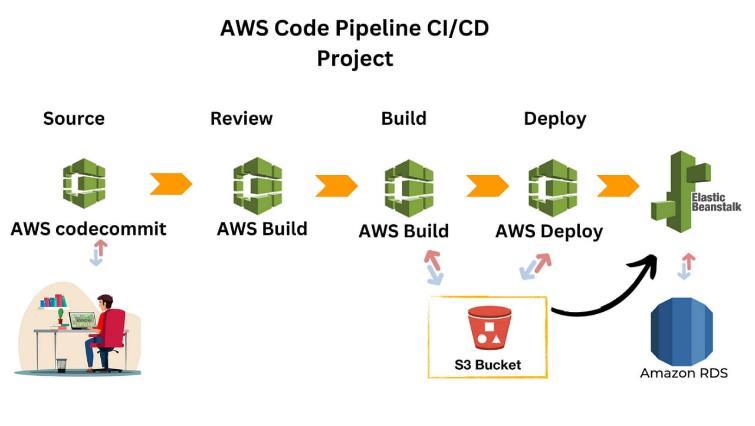
The fig-1 illustrates an AWS CodePipeline CI/CD project, which automates the process of software development, testing, and deployment using various AWS services. The pipelinebeginswithAWSCodeCommit,aGit-basedsource control service where developers push their code. Once the code is committed, it triggers the pipeline, moving to thereviewphase,handledbyAWSBuild.Here,thecodeis validated for quality, syntax correctness, and potential vulnerabilities.Afterpassingthereviewstage,it proceeds tothebuildphase,alsomanagedbyAWSBuild, wherethe source code is compiled, dependencies are resolved, and unit tests are executed to ensure stability. The final stage, deployment,ismanagedbyAWSDeploy,whichautomates the release process. The deployment targets include AWS Elastic Beanstalk, a platform-as-a-service (PaaS) for hosting web applications, ensuring seamless application deployment and scaling. Additionally, the pipeline interacts with Amazon S3, which stores static files or packaged applications, and Amazon RDS, a managed database service that ensures persistent data storage for applications.TheintegrationoftheseAWSserviceswithin the pipeline streamlines software delivery, reducing manual intervention and increasing efficiency, scalability, and reliability. This approach significantly enhances DevOps workflows by automating infrastructure provisioning, application deployment, and database management, making software updates faster and more consistent.
Jenkins, an open-source automation server, is one of the mostwidelyusedtoolsfor implementingCI/CDpipelines. It enables developers to automate various stages of the software development lifecycle, including integration, testing,anddeployment.Thismethodologyprovidesanindepth explanation of how a CI/CD pipeline is automated using Jenkins, covering its architecture, pipeline configuration, integration with tools, and deployment strategies.
International Research Journal of Engineering and Technology (IRJET) e-ISSN: 2395-0056
Volume: 12 Issue: 04 | Apr 2025 www.irjet.net p-ISSN: 2395-0072
A Jenkins-based CI/CD pipeline consists of several stages that automate the process from code commit to deployment.Thesestagesinclude:
1. Source Code Management (SCM): Jenkins integrates with GitHub, GitLab, Bitbucket, or other repositories where developers push their code.
2. Build Stage: Jenkins retrieves the code and compilesit to ensure there arenosyntax errors. This step involves dependency resolution and staticcodeanalysis.
3. Testing Stage: Automated unit tests, integration tests, and security tests are executed to ensure that the changes do not break the existing functionality.
4. Artifact Storage: Successfully built and tested artifactsarestoredinrepositoriessuchasNexus orAWSS3.
5. Deployment Stage: The final artifact is deployed to production or staging environments using cloud platforms like AWS, Kubernetes, or onpremiseservers.
6. Monitoring and Feedback: The pipeline continuously monitors the deployed application, gathering performance metrics and logs, enablingquickidentificationofissues.
3.2. Jenkins Pipeline Setup and Configuration
Jenkins provides different approaches to defining pipelines, allowing developers to automate the CI/CD process in a structured and efficient manner. A pipeline consists of multiple stages such as source retrieval, build, test,anddeployment.Jenkinsenablesautomationthrough configuration files where each step in the pipeline is predefined, ensuring consistency and repeatability in softwaredelivery.
3.3. Integration with CI/CD Tools
Jenkins integrates with multiple tools to enhance the CI/CDpipeline:
GitHub/GitLab/Bitbucket: Version control integrationforautomaticcodefetching.
Maven/Gradle: BuildtoolsforJavaapplications.
Docker: Containerization of applications for deploymentinanyenvironment.
Kubernetes: Orchestration of containers for scalabilityandloadbalancing.
SonarQube: Static code analysis to ensure code qualityandsecurity.
Selenium/JUnit: Automatedtestingframeworks.
AWS/Azure/GCP: Cloud platforms for deploying applications.
3.4. CI/CD Pipeline Workflow in Jenkins
Step 1: Code Commit and Version Control
Developers write and commit code to a Git repository(e.g.,GitHub,GitLab).
A webhook triggers Jenkins to start the CI/CD pipelineupondetectinganewcommit.
Step 2: Code Checkout and Static Code Analysis
Jenkinspullsthelatestcodefromtherepository.
Tools like SonarQube analyze the code for potential security vulnerabilities and code qualityissues.
Step 3: Build and Compile
Jenkins executes the build process using build automationtools.
If the build is successful, an artifact is generated andstoredinanartifactrepository.
Step 4: Automated Testing
Unittestsandintegrationtestsareexecuted.
Test reports are generated, and failures trigger notificationstodevelopers.
Step 5: Artifact Storage
Thesuccessfullybuiltandtestedartifactisstored inarepository.
Step 6: Deployment to Staging/Production
Jenkins deploys the application to a staging environmentfirst.
If no issues are found, the application is automaticallydeployedtoproduction.
Cloud and container orchestration platforms managedeployments.
International Research Journal of Engineering and Technology (IRJET) e-ISSN: 2395-0056
Volume: 12 Issue: 04 | Apr 2025 www.irjet.net p-ISSN: 2395-0072
Monitoring tools gather performance data and providealertsonfailures.
Rollbackstrategiesareexecutedifneeded.
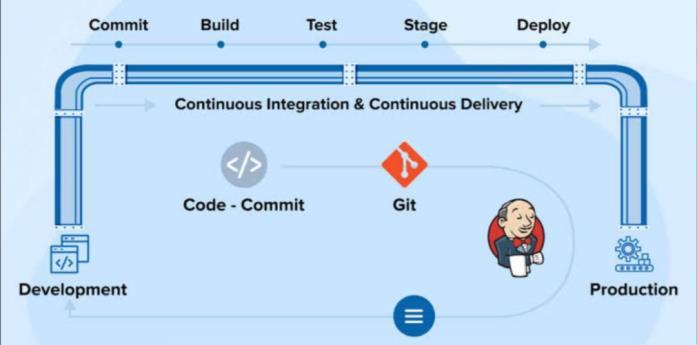
The fig 2 represents a CI/CD pipeline automation process using Jenkins, illustrating how code flows from development to production in a streamlined manner. The pipelinefollowsastructuredapproach,beginningwiththe commit stage, where developers write and push their codetoa versioncontrol system suchasGit.Thistriggers Jenkins to initiate the CI/CD process. The build phase compiles the code, resolves dependencies, and packages theapplicationtoensureitisreadyfordeployment.Ifany compilation errors occur, Jenkins provides immediate feedback to developers, allowing them to fix issues quickly.
Following the build, the test phase executes unit tests, integration tests, and other automated test cases to validate functionality and detect bugs early in the development cycle. If the tests pass, the pipeline progresses to the staging environment, where the application is deployed to a pre-production server for further validation, including performance testing and security checks. Once the staging environment confirms stability, the final deployment phase moves the application into the production environment, making it accessibletoend-users.
Jenkins automates this entire process by continuously integrating new code changes and ensuring reliable delivery through defined workflows. It interacts with Git repositories to fetch code updates, triggers builds and tests, and facilitates smooth deployments using various plugins and integrations. This approach enhances software delivery efficiency, reduces manual intervention, and minimizes errors, leading to faster release cycles and improved product quality. By automating CI/CD pipelines with Jenkins, development teams can achieve continuous integration and continuous delivery (CI/CD), ensuring faster and more
reliable software deployments while maintaining code qualityateverystageofthedevelopmentlifecycle.
Automating a CI/CD pipeline using Jenkins provides a structured and efficient approach to software developmentanddeployment.ByintegratingJenkinswith various tools, developers can ensure seamless build, testing, and deployment processes. The use of structured pipelines simplifies configuration, while advanced techniques like blue-green deployments and automated rollbacksenhancereliability.
CloudWatch Alarms trigger alerts for failed builds, allowing immediate intervention to prevent deployment issues. These alarms notify teams via SNS (Simple Notification Service) when critical failures occur. The CloudWatch Dashboard provides a graphical visualization of pipeline health, offering a centralized view of key metrics for better decision-making. By integrating AWS CloudWatch with Jenkins, teams can enhance their CI/CD pipeline automation with proactive monitoring, quicker issue resolution, and improved reliability, ultimately ensuringseamlesssoftwaredelivery
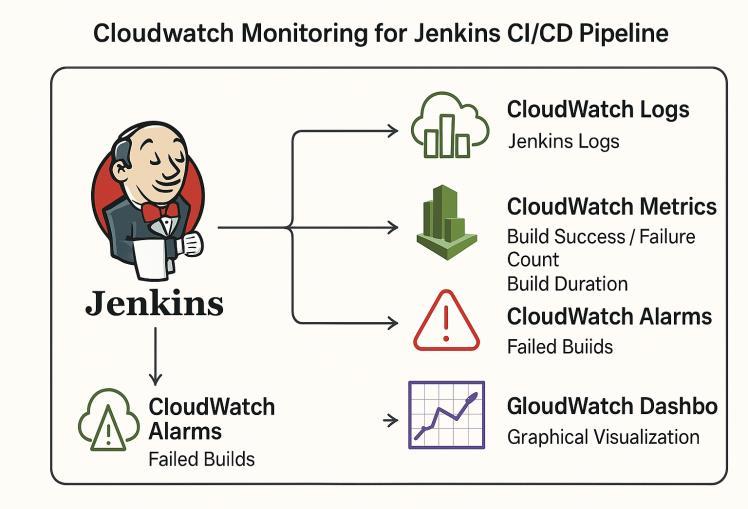
Fig-3:CloudwatchmonitoringforJenkinsCICDPipeline
The fig 2 illustrates CloudWatch Monitoring for a Jenkins CI/CD Pipeline, highlighting how AWS CloudWatch integrates with Jenkins to track and analyze pipeline performance. In a CI/CD automation workflow, Jenkins orchestrates the build, test, and deployment processes, and CloudWatch provides real-time insights into pipeline execution. CloudWatch Logs collect Jenkins job logs, enabling detailed debugging and tracking of build executions.CloudWatchMetricsmonitorkeyperformance indicators such as build success/failure rates and build duration, helping teams identify trends and optimize pipelineefficiency.
International Research Journal of Engineering and Technology (IRJET) e-ISSN: 2395-0056
Volume: 12 Issue: 04 | Apr 2025 www.irjet.net p-ISSN: 2395-0072
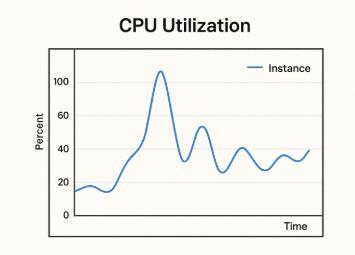
In a CI/CD pipeline using Jenkins, CPU utilization is a crucial indicator of pipeline efficiency and resource consumption. The provided graph shows fluctuations in CPUusageovertime,whichcanbelinkedtovariousstages of the pipeline. The sharp spikes in CPU utilization often occurduringintensivetaskssuchascodecompilation,unit and integration testing, Docker image building, and deployment processes. These activities require significant processing power, leading to high CPU usage. Conversely, the lower CPU utilization periods indicate idle or lightweighttasks,suchasfetchingsourcecode,logging,or waiting for new commits to trigger the next pipeline execution.
FluctuationsinCPUusagemayalsobecausedbymultiple parallel Jenkins jobs running simultaneously, where different branches execute CI/CD tasksconcurrently. This can result in resource contention, especially if Jenkins shares computing resources with other services like databasesormonitoringtools.TooptimizeCPUutilization, Jenkins administrators can implement several strategies, such as distributing workloads across multiple nodes using Jenkins agents, enabling build caching to reduce redundantwork,dynamicallyscalingresourcesusingAWS Auto Scaling, and monitoring CPU performance with CloudWatch alarms. Additionally, parallelizing test execution can help minimize build times and CPU load, ensuringasmootherandmoreefficientpipeline.
By continuously monitoring CPU utilization and optimizing resource allocation, teams can prevent performance bottlenecks, reduce build failures, and enhance overall pipeline efficiency. Ensuring that CPU resourcesareusedeffectivelyleadstofasterdeployments, improved system reliability, and cost savings on cloud infrastructure.
The right CI/CD tools leverage automation and best practices to create a streamlined integration and deployment pipeline. With simplified processes, fewer
errors, and more reliable delivery, CI/CD tools revolutionize your organization’s software development. Withtherighttoolsandprocesses,businessescanleverage workflowstoachievebetterresults.Sohelpyourbusiness succeedbylearningaboutWorkingofCI/CDpipelinesand different types required.Anticipate the integration of artificialintelligence(AI)intoCI/CDpipelines,allowingfor more intelligent decision-making and automated optimization of development processes. AI algorithms could analyze historical data to predict potential issues, optimizebuildconfigurations,andenhanceoverallpipeline efficiency. With the ever-growing threat landscape, CI/CD pipelines will likely incorporate more advanced security measures. Expect the integration of machine learning algorithms for proactive threat detection, as well as advancements in secure coding practices to mitigate emerging risks effectively.The rise of serverless architectureislikelytoinfluenceCI/CDpipelines,enabling more dynamic scaling and resource utilization. Serverless CI/CD could potentially reduce infrastructure costs, improve scalability, and streamline the deployment of microservices.
[1] "The Impact of an Automation System Built with Jenkins on Deployment Efficiency”, Authors: Giwoo Hyunetal., Sensors,2024
[2] "AnEnd-to-EndCI/CDPipelineSolutionUsingJenkins andKubernetes,JiwonOak et al., ResearchGate, 2024
[3] "A Survey Paper on Design and Implementation of CI/CD",KunwooKim et al., IRJMETS, 2023
[4] "Leveraging Jenkins to Optimize Your Build and ReleaseProcesses",SatyadeepakBollineni,IJSR, 2023
[5] "Enhancing CI/CD Pipelines with Advanced Automation",DonghoonKimetal., IJNRD


Aishwarya S S is currently pursuing M.Tech in Computer Science at AIT, Chikkamagalur. She holds a strong academicinterestinAI,DevopsPractices. She is Passionate about improving software delivery processes through frameworks. A dedicated and goaloriented individual who learns new technologies