International Research Journal of Engineering and Technology (IRJET)
e-ISSN: 2395-0056
Volume: 13 Issue: 05 | May 2026
p-ISSN: 2395-0072
www.irjet.net
Implementation of a Hybrid Voice and Gesture Recognition System for Intelligent Robotic Vehicles Divyansh Singh1, Adityaraj Deokar2, Shubham Dhavane3, Tanuja Abhang4, Ankush Kadu5 1,2,3,4 UG Student, Department of Electronics and Telecommunication Engineering, Dr. D. Y. Patil School of
Engineering, Pune, Maharashtra, India
5Professor, Department of Electronics and Telecommunication Engineering, Dr. D. Y. Patil School of Engineering
and Technology, Pune, Maharashtra, India ---------------------------------------------------------------------***---------------------------------------------------------------------
Abstract - Recent advancements in embedded systems and
human–machine interaction technologies have increased the demand for intuitive robotic control systems. This paper presents the development of a smart robotic vehicle operated through both speech commands and hand gesture recognition. The proposed system combines an ESP32-based robotic platform with a Raspberry Pi-enabled control interface to achieve wireless real-time navigation. Voice commands are interpreted using a predefined speech recognition mechanism for directional control, while hand movements are detected through an MPU6050 accelerometer and gyroscope sensor for continuous gesture-based operation. Wi-Fi communication is utilized for reliable data transfer between the controller and robotic vehicle. The implemented dual-mode architecture enhances operational flexibility and allows users to switch between speech and gesture control according to environmental conditions. Experimental testing indicates that the gesture recognition module provides stable and accurate performance, whereas speech recognition efficiency varies depending on surrounding noise levels and voice clarity. The developed system offers a cost-effective and user-friendly solution suitable for robotic assistance, surveillance applications, educational projects, and smart automation systems. Key Words: Speech Recognition, Gesture Recognition, Human–Machine Interaction, ESP32, MPU6050, Robotic Vehicle, Embedded Systems, Multimodal Control.
1. INTRODUCTION Robotic systems have become an important part of modern technology in applications such as industrial automation, surveillance, healthcare assistance, defense systems, disaster management, and intelligent transportation. As robotic platforms continue to evolve, the demand for efficient and intuitive Human-Machine Interaction (HMI) techniques has increased significantly. Conventional robotic control systems based on joysticks, switches, and remote controllers require continuous manual operation and often provide limited flexibility in dynamic environments. To overcome these limitations, researchers have increasingly focused on natural interaction methods such as speech recognition and gesture recognition for robotic control applications [10], [14].
© 2026, IRJET
|
Impact Factor value: 8.315
|
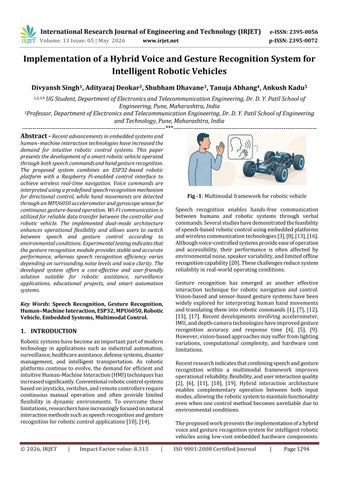
Fig -1: Multimodal framework for robotic vehicle Speech recognition enables hands-free communication between humans and robotic systems through verbal commands. Several studies have demonstrated the feasibility of speech-based robotic control using embedded platforms and wireless communication technologies [3], [8], [13], [16]. Although voice-controlled systems provide ease of operation and accessibility, their performance is often affected by environmental noise, speaker variability, and limited offline recognition capability [20]. These challenges reduce system reliability in real-world operating conditions. Gesture recognition has emerged as another effective interaction technique for robotic navigation and control. Vision-based and sensor-based gesture systems have been widely explored for interpreting human hand movements and translating them into robotic commands [1], [7], [12], [15], [17]. Recent developments involving accelerometer, IMU, and depth-camera technologies have improved gesture recognition accuracy and response time [4], [5], [9]. However, vision-based approaches may suffer from lighting variations, computational complexity, and hardware cost limitations. Recent research indicates that combining speech and gesture recognition within a multimodal framework improves operational reliability, flexibility, and user interaction quality [2], [6], [11], [18], [19]. Hybrid interaction architecture enables complementary operation between both input modes, allowing the robotic system to maintain functionality even when one control method becomes unreliable due to environmental conditions. The proposed work presents the implementation of a hybrid voice and gesture recognition system for intelligent robotic vehicles using low-cost embedded hardware components. ISO 9001:2008 Certified Journal
|
Page 1294