International Research Journal of Engineering and Technology (IRJET)
e-ISSN: 2395-0056
Volume: 13 Issue: 05 | May 2026
p-ISSN: 2395-0072
www.irjet.net
Implementation and Performance Evaluation of a Fixed Thermal Sensing Device for Ship Safety and Operations Sanjai A1, R. Satheesh Raja2, A. Murugan3, A.C. Mariappan4 1 Final year B.E Marine Cadet, PSNCET, Tamil Nadu, India. 2Professor, Dept of B.E Marine Engineering, PSNCET, Tamil Nadu, India. 3Professor, Dept of B.E Marine Engineering, PSNCET, Tamil Nadu, India.
4 Associate Professor, Dept of B.E Marine Engineering, PSNCET, Tamil Nadu, India -----------------------------------------------------------------------***-------------------------------------------------------------------------------
ABSTRACT-The maritime industry continuously seeks
thermal sensing devices offer a more advanced approach by continuously monitoring surface temperatures and detecting abnormal heat patterns before they develop into serious problems.
advanced technologies to improve safety, operational efficiency, and equipment reliability. Thermal sensing systems have emerged as an effective solution for monitoring temperature variations in critical shipboard spaces. This study presents the implementation and performance evaluation of a fixed thermal sensing device installed onboard a cargo vessel. The system utilizes infrared thermal sensors to continuously monitor temperature changes in locations such as the engine room, electrical compartments, battery rooms, and bridge control areas. Temperature data were collected and analyzed over a three-month operational period. The system successfully detected abnormal temperature conditions, enabling early identification of potential fire hazards, equipment overheating, and machinery malfunctions. Results indicate that the thermal sensing device provides reliable real-time monitoring with a low false-alarm rate and high detection accuracy. Integration with the ship's alarm and monitoring system improved crew response time and enhanced situational awareness. The study demonstrates that fixed thermal sensing technology can significantly contribute to maritime safety, predictive maintenance, and operational reliability while reducing maintenance costs and downtime.
Infrared thermal sensing technology measures thermal radiation emitted by objects without physical contact. These systems can detect temperature variations instantly and provide visual temperature mapping of monitored spaces. Their ability to identify hot spots and overheating equipment makes them highly suitable for marine applications. The objective of this study is to evaluate the effectiveness of a fixed thermal sensing device installed on board a cargo ship and determine its capability in enhancing safety, supporting predictive maintenance, and improving operational efficiency.
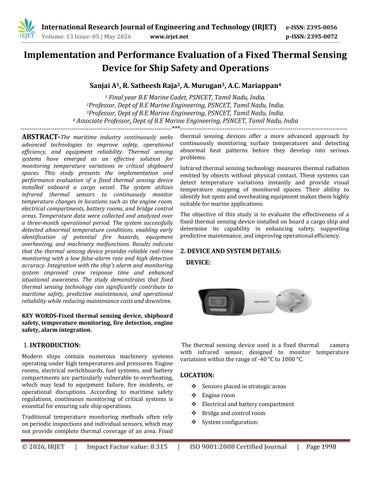
2. DEVICE AND SYSTEM DETAILS: DEVICE:
KEY WORDS-Fixed thermal sensing device, shipboard safety, temperature monitoring, fire detection, engine safety, alarm integration.
1. INTRODUCTION:
The thermal sensing device used is a fixed thermal camera with infrared sensor, designed to monitor temperature variations within the range of -40 °C to 1000 °C.
Modern ships contain numerous machinery systems operating under high temperatures and pressures. Engine rooms, electrical switchboards, fuel systems, and battery compartments are particularly vulnerable to overheating, which may lead to equipment failure, fire incidents, or operational disruptions. According to maritime safety regulations, continuous monitoring of critical systems is essential for ensuring safe ship operations.
LOCATION:
Traditional temperature monitoring methods often rely on periodic inspections and individual sensors, which may not provide complete thermal coverage of an area. Fixed
© 2026, IRJET
|
Impact Factor value: 8.315
|
Sensors placed in strategic areas Engine room Electrical and battery compartment Bridge and control room System configuration:
ISO 9001:2008 Certified Journal
|
Page 1998