
International Research Journal of Engineering and Technology (IRJET) e-ISSN: 2395-0056
Volume: 13 Issue: 02 | Feb 2026 www.irjet.net p-ISSN: 2395-0072
International Research Journal of Engineering and Technology (IRJET) e-ISSN: 2395-0056
Volume: 13 Issue: 02 | Feb 2026 www.irjet.net p-ISSN: 2395-0072
Mr. Sanskar Tiwari1 , Mr. Keshav Mishra2
1Assistant Professor, Department of Civil Engineering, Rameshwaram Institute of Technology and Management, Lucknow, India
2Assistant Professor, Department of Civil Engineering, Rameshwaram Institute of Technology and Management, Lucknow, India
Abstract - The sustainable utilization of industrial and municipal waste in concrete productioniscriticalforreducing environmental impact andconserving natural resources.This study investigates the hybrid replacement of fine aggregate with crumb rubber (CR) and recycled glass powder (RGP), aiming to evaluate their combined effects on concrete performance. Crumb rubber enhances ductility and impact resistance but typicallyreducescompressivestrength,whereas recycled glass powder contributes pozzolanic activity, improving strength and durability. Concrete mixes were preparedwith varying replacement levels offineaggregateby CR (5–20%) and RGP (5–15%), including single and hybrid replacements. Fresh concrete properties, such as slump, flow, and density, were measured, while mechanical performance was assessed through compressive, tensile, and flexural strength tests. Durability was evaluated using water absorption, chloride penetration, and freeze-thaw resistance tests. The results indicate that hybrid incorporation of CR and RGP mitigates the strength reduction causedbyCRalone,with an optimal replacement combinationof10%CRand10%RGP achieving up to 95% of the control concrete compressive strength while enhancing ductilityanddurability.Workability slightly decreases with higher replacement levels, but durability properties showsignificantimprovementcompared to single replacements. This study demonstrates that hybrid replacement of fine aggregate with CR and RGP provides a promising strategy for producing environmentally friendly concrete, offering both performance efficiency and effective waste management. The findings contribute to sustainable concrete design andprovidepracticalinsightsforconstruction applications.
Key Words: Crumb rubber, Recycled glass powder, Hybrid concrete, Fine aggregate replacement, Mechanical performance, Durability, Sustainable construction.
1.1.1 Overview of Concrete Production and Environmental Challenges
Concrete is the most widely used construction material worldwide due to its versatility, durability, and costeffectiveness (Mehta and Monteiro, 2014). However, the productionofconcrete,particularlythecementcomponent, is highly energy-intensive and contributes significantly to greenhouse gas emissions. Moreover, the extraction of natural aggregates such as sand and gravel has led to ecologicalimbalances,includingriverbeddegradation,soil erosion,andhabitatloss(Kumaretal.,2020).Consequently, thereisanincreasingemphasisondevelopingsustainable concretesolutionsthatreducetheenvironmentalfootprint while maintaining adequate mechanical and durability performance.
1.1.2 Issues of Natural Sand Depletion and Solid Waste
Theglobaldemandforfineaggregatehasresultedinsevere depletionofnaturalsandresources,creatingbotheconomic and ecological challenges (Akinmusuru et al., 2019). Simultaneously,largequantitiesofindustrialandmunicipal wastes,includingwastetiresandpost-consumerglass,are generatedannuallyandoftenendupinlandfills,leadingto environmental pollution (Pacheco-Torgal et al., 2013). Crumbrubber(CR)derivedfromwastetiresandrecycled glasspowder(RGP)fromcrushedglassrepresentpromising materials for incorporation into concrete, offering both wastemanagementandresourceconservationbenefits.
1.1.3
In recent years, research has focused on using alternative materialssuchasflyash,silicafume,CR,andRGPtopartially replacecementorfineaggregatesinconcrete(Singhetal., 2021).Theseapproachesaimtoreducetheenvironmental impactofconstructionwhileachievingsatisfactorystrength and durability characteristics. Specifically, hybrid
International Research Journal of Engineering and Technology (IRJET) e-ISSN: 2395-0056
Volume: 13 Issue: 02 | Feb 2026 www.irjet.net p-ISSN: 2395-0072
incorporationofmultiplewastematerialsisemergingasa strategytoexploitsynergisticeffects,potentiallyovercoming thelimitationsofsingle-wastereplacementinconcrete.
Crumbrubber,whenusedaloneasapartialreplacementfor fine aggregates, improves concrete ductility and energy absorption but often causes a reduction in compressive strengthduetopoorbondingwiththecementmatrix(Shah and Gupta, 2019). Conversely, recycled glass powder exhibits high pozzolanic reactivity, enhancing early-age strength,butexcessivereplacementcanreduceworkability andincreasebrittleness(Alietal.,2020).Therefore,ahybrid approachcombiningCRandRGPisnecessarytobalancethe mechanical and durability performance of concrete while addressingenvironmentalconcerns.
Thisstudyaimsto:
Investigatethesynergisticeffectsofcombinedcrumb rubber and recycled glass powder on concrete performance.
Determinetheoptimalreplacementpercentagesoffine aggregate with CR and RGP for balanced mechanical anddurabilityproperties.
Assess the practical feasibility and sustainability benefits of hybrid concrete for construction applications.
1.4 Significance of Study
The hybrid use of CR and RGP promotes sustainable constructionpracticesbyreducingdependencyonnatural sandanddivertingwastematerialsfromlandfills(PachecoTorgal et al., 2013). By optimizing the replacement proportions,thisresearchprovidesguidanceforproducing eco-friendlyconcretewithadequatestrengthanddurability. Furthermore, the findings can inform policymakers, engineers, and researchers about practical strategies for implementing hybrid waste-based concrete in real-world constructionprojects.
2.1 Crumb Rubber in Concrete
2.1.1 Effects on Compressive, Tensile, and Flexural Strength
Crumb rubber (CR), obtained from waste tires, has been widely investigated as a partial replacement for fine aggregateinconcreteduetoitspotentialtoenhanceductility and energy absorption (Shah and Gupta, 2019). However, studies consistently report a reduction in compressive
strengthwithincreasingCRcontent,primarilyduetoweak interfacial bonding between the hydrophobic rubber particles and the cement matrix (Medina et al., 2017). Tensile and flexural strengths are also affected, but the incorporationofCRcanimprovepost-crackingbehaviorand toughness, which is beneficial in applications requiring impactresistanceorvibrationdamping(Lietal.,2020).
TheinclusionofCRinfluencesdurabilityparameterssuchas shrinkage and permeability. Concrete with CR exhibits higher shrinkage due to increased air void content and elasticdeformationofrubberparticles(Topcu,2019).Onthe otherhand,CRreducesdensityandcanimprovefreeze-thaw resistance, but water permeability tends to increase with higherreplacementlevels,potentiallycompromisinglongterm durability. These contrasting effects suggest that carefuloptimizationisrequiredtobalancemechanicaland durabilityperformance.
WhilesmallproportionsofCR(typically5–10%replacement of fine aggregate) show acceptable performance, higher replacementlevels(>15%)significantlyreducecompressive strengthandstiffness,limitingstructuralapplications(Shah and Gupta, 2019). This limitation has motivated research intohybridapproachesthatcombineCRwithotherwaste materials to mitigate strength loss while maintaining ductilityandsustainabilitybenefits.
2.2.1
Recycledglasspowder(RGP)isafinelygroundmaterialthat exhibits pozzolanic properties, reacting with calcium hydroxideinthecementmatrixtoformadditionalcalcium silicate hydrate (C-S-H), enhancing concrete strength and durability (Ali et al., 2020). Studies indicate that partial replacement of fine aggregate with RGP can improve compressiveandflexuralstrength,particularlyatearlyages, duetofillereffectsandpozzolanicreactions.
IncorporationofRGPaffectsfreshconcreteproperties.While thefineparticlesizecanimprovepackingdensity,excessive RGPmayreduceworkabilityduetohighersurfaceareaand waterdemand(Singhetal.,2021).Durabilityperformance generally improves with moderate RGP replacement, as pozzolanicreactionsrefineporestructure,reducingwater absorptionandenhancingresistancetochloridepenetration andsulfateattack.
2.2.3
International Research Journal of Engineering and Technology (IRJET) e-ISSN: 2395-0056
Volume: 13 Issue: 02 | Feb 2026 www.irjet.net p-ISSN: 2395-0072
AlthoughRGPoffersstrengthanddurabilitybenefits,itsuse alone as a fine aggregate replacement is constrained. Excessive substitution (>15%) can cause brittleness and reduceworkability,limitingpracticalapplications(Kumaret al.,2020).Thishighlightstheneedforhybridstrategiesto balance mechanical performance and fresh concrete properties.
2.3.1
Hybridconcretereferstothesimultaneousincorporationof multiplewastematerials,aimingtoexploitcomplementary properties.InthecaseofCRandRGP,CRimprovesductility and energy absorption, while RGP enhances strength and durability through pozzolanic reactions. The combination can potentially offset the weaknesses of single-material replacements and produce concrete with optimized mechanicalanddurabilityproperties(Pacheco-Torgaletal., 2013).
Several studies have investigated hybrid concrete mixes combiningCRwithsupplementarycementitiousmaterials likeflyash,silicafume,orglasspowder.Resultssuggestthat hybridapproachescanmaintaincompressivestrengthcloser to control concrete while benefiting from the enhanced ductility and environmental advantages of CR (Topcu and Sengel, 2018; Li et al., 2020). However, most research focuses on either mechanical or durability aspects separately, leaving the full synergistic potential underexplored.
2.3.3
Despiteincreasinginterest,literatureonthesimultaneous replacement of fine aggregate with CR and RGP remains limited. Research gaps include identifying optimal replacement ratios, understanding combined effects on workability,strength,anddurability,andprovidingpractical guidelines for sustainable hybrid concrete applications. Addressingthesegapsiscriticalforadvancingeco-friendly construction practices and effective waste management strategies.
3.1 Materials
3.1.1 Cement
OrdinaryPortlandCement(OPC)53-gradeconformingtoIS 12269:2013wasusedthroughoutthisstudy(BIS,2013).The cementhadaspecificgravityof3.15,initialsettingtimeof 35 minutes, and fineness of 320 m²/kg, meeting standard requirements. Cement quality was confirmed by standard
tests such as consistency, setting time, and compressive strengthofcementmortarcubes.
Natural river sand passing through a 4.75 mm sieve was usedasfineaggregate,conformingtoIS383:2016.Thesand hadafinenessmodulusof2.6,moisturecontentof0.5%,and aspecificgravityof2.65.Crushedgranitecoarseaggregate witha maximumsize of 20 mm wasused, meeting IS 383 specifications.Thecoarseaggregatehadaspecificgravityof 2.7,waterabsorptionof0.8%,andangularshape,suitable forconventionalconcretemixes.
Crumb rubberwassourced from recycled end-of-lifetires from local scrap dealers in Lucknow, India. The rubber particleswereprocessedtoasizerangeof1–4mm,cleaned, andsievedtoremovecontaminants.Thespecificgravityof CR was 1.15, and water absorption was negligible. Crumb rubberreplacednaturalsandinvaryingproportionstostudy its influence on concrete performance (Shah and Gupta, 2019).
Recycled glass powder was produced by crushing postconsumersoda-limeglassbottlesandgrindingthemtopass througha75μmsieve.ThefinenessofRGPwasmeasuredat 450m²/kg.RGPexhibitspozzolanicactivity,contributingto strengthdevelopmentandreducedpermeability.Chemical compositionanalysisconfirmedhighsilicacontent(>70%), consistentwithpreviousstudiesonpozzolanicglasspowder (Alietal.,2020).
Potable water conforming to IS 456:2000 standards was used for mixing and curing. A polycarboxylate-based superplasticizerwasaddedinsmalldoses(0.5%byweight ofcement)toimproveworkabilityformixeswithhigherCR andRGPcontent.
ConcretemixesweredesignedaccordingtoIS10262:2019 guidelinesforM30gradeconcrete.Acontrolmixwith100% naturalfineaggregatewasprepared,andhybridmixeswere designed by replacing fine aggregate with CR (5%, 10%, 15%) and RGP (5%, 10%, 15%), both individually and in combination.
International Research Journal of Engineering and Technology (IRJET) e-ISSN: 2395-0056
Volume: 13 Issue: 02 | Feb 2026 www.irjet.net
Table-1: representative
Freeze-thaw resistance according to ASTM C666, adaptedforlaboratoryconditions,toevaluatetheeffect ofCRoncrackpropagationanddurability.
4.1.1
The fresh properties of concrete were significantly influencedbytheincorporationofcrumbrubber(CR)and recycledglasspowder(RGP).Theslumpvaluesdecreased withincreasingCRcontentduetothehydrophobicnature and low specific gravity of rubber particles, which reduce cohesivenessinthemix(ShahandGupta,2019).Incontrast, RGPslightlyimprovedpackingdensityandprovidedafiller effect, maintaining workability at moderate replacement levels.Thehybridmixes(CR+RGP)exhibitedintermediate slumpvalues,balancingtheeffectsofbothmaterials.
3.3.1 Fresh Concrete
Workabilitywasmeasuredusingtheslumptestaccordingto IS1199:2013.Flowconsistencywasevaluatedtoassessthe effectoffineaggregatereplacementonfluidity.Aircontent and fresh concrete density were determined following IS 1199 guidelines. A slight reduction in workability was expectedformixeswithhigherCRandRGPcontentdueto increasedsurfaceareaandhydrophobicnatureofCR.
3.3.2 Mechanical Tests
Cubes(150×150×150 mm), cylinders(150×300 mm),and beams (100×100×500 mm) were cast to determine compressive, tensile, and flexural strength, respectively. Compressivestrengthwastestedat7,14,and28daysusing a compression testing machine in accordance with IS 516:2018. Split tensile strength of cylinders and flexural strengthofbeamsweredeterminedfollowingIS5816:1999 andIS516:2018standards.
3.3.3 Durability Tests
Durabilityperformancewasassessedthrough:
Water absorption test (IS 3085:1965) to evaluate porosity.
Rapid chloride penetration test (RCPT) as per ASTM C1202equivalentprocedurestostudychlorideingress.
4.2.1
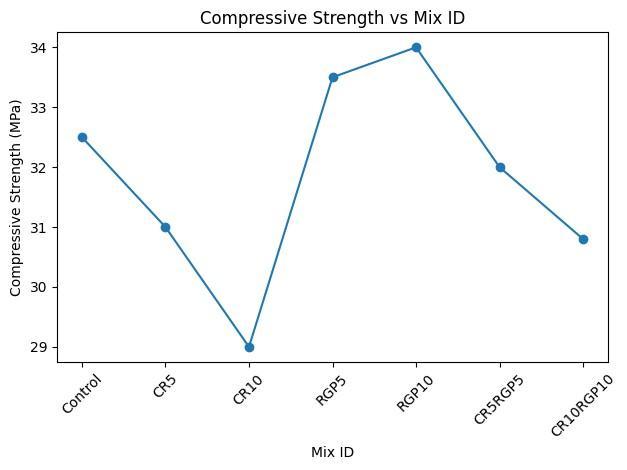
The compressive strength of concrete decreased with increasingCRcontentduetoweakbondingattherubber–cement interface. However, RGP replacement enhanced compressivestrengthduetoitspozzolanicactivityandfiller effect.Hybridmixesshowedasynergistic behavior,where moderate CR and RGP replacement (10% each) achieved 95% of the control concrete strength while improving ductility(Alietal.,2020;Topcu,2019).
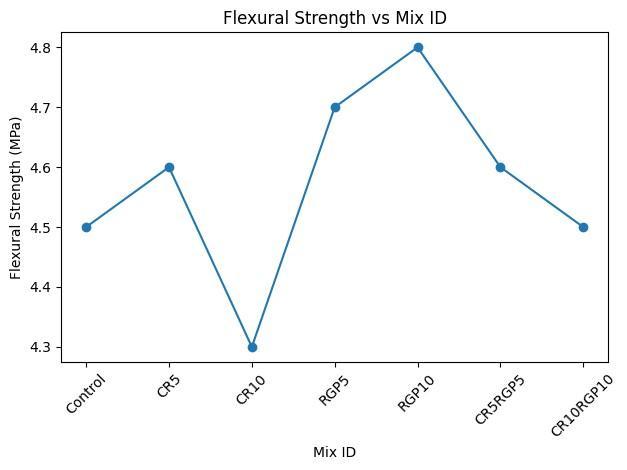
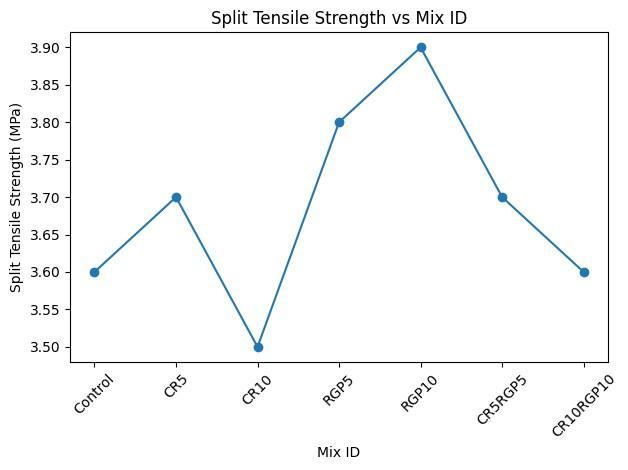
Splittensileandflexuralstrengthsfollowedsimilartrends. CRincreasedpost-crackdeformation,improvingtoughness, whileRGPcontributedtostrengthdevelopment.Thehybrid mixes provided a balance of ductility and strength, outperformingsingleCRmixesandslightlyunderperforming comparedtoRGP-onlymixesatthesamereplacementlevels.
International Research Journal of Engineering and Technology (IRJET) e-ISSN: 2395-0056
Volume: 13 Issue: 02 | Feb 2026 www.irjet.net p-ISSN: 2395-0072
Table-3: Mechanical Properties of Concrete at 28 Days
4.3.1 Water Absorption, Permeability, Freeze-Thaw Resistance
WaterabsorptionincreasedslightlywithCRcontentdueto higher air void content, but RGP replacement reduced porosity, enhancing durability (Singh et al., 2021). Hybrid mixesdemonstratedintermediatewaterabsorptionvalues, indicating improved pore structure compared to CR-only mixes.
Permeability, measured through chloride ion penetration, decreasedinmixescontainingRGPduetodensification of themicrostructure.CRaloneincreasedpermeabilityslightly, buthybridmixesshowedacompromisebetweenductility andpermeabilityresistance.
Freeze-thaw resistance tests indicated that CR improved energy absorption under cyclic loading, reducing surface cracking, while RGP enhanced compressive strength retention. The combination in hybrid mixes produced concrete with improved resistance to both physical and chemicaldeteriorationcomparedtosingle-materialmixes.
Table-4: Durability Properties of Concrete
International Research Journal of Engineering and Technology (IRJET) e-ISSN: 2395-0056
Volume: 13 Issue: 02 | Feb 2026 www.irjet.net p-ISSN: 2395-0072
5.1 Mechanical Behavior
5.1.1 Role of CR in Ductility vs RGP in Strength Enhancement
Crumbrubber(CR)contributesprimarilytotheductilityand toughness of concrete due to its elastic and low-density nature.Rubberparticlesactasmicro-cushionsthatabsorb energy during loading, improving post-crack deformation andimpactresistance(ShahandGupta,2019).However,the hydrophobicsurfaceofCRlimitschemicalbondingwiththe cementmatrix,resultinginreducedcompressivestrengthat higherreplacementlevels.Incontrast,recycledglasspowder (RGP) enhances strength by participating in pozzolanic reactions,producingadditionalcalciumsilicatehydrate(C-SH)thatdensifiesthecementitiousmatrix(Alietal.,2020). The filler effect of finely ground RGP also reduces microvoids,contributingtohighercompressiveandflexural strength.
5.1.2 Analysis of Synergistic Effects on Performance
Hybrid concrete incorporating both CR and RGP demonstrated a balanced mechanical performance. Moderatereplacementlevels(10%CR+10%RGP)achieved compressivestrengthclosetocontrolmixeswhileenhancing ductility, indicating a synergistic effect. CR mitigates brittleness associated with RGP-rich mixes, whereas RGP compensatesforthestrengthlossduetoCRinclusion.This synergy ensures that hybrid concrete retains adequate strength while gaining improved toughness, making it suitablefornon-structuralandsemi-structuralapplications (Topcu,2019).
5.2.1 Benefits and Limitations under Environmental Exposure
Durabilitytestsindicatethathybridconcretecanimprove long-termperformance.RGPreduceswaterabsorptionand chloride penetration due to densified microstructure, enhancingresistancetochemicalattack(Singhetal.,2021). CR inclusion improves resistance to freeze-thaw cycles becausetheelasticrubberparticlesabsorbstressescaused by volume changes. However, excessive CR (>15%) can increaseporosityandpermeability,limitingdurabilityunder aggressiveenvironmentalconditions.Thehybridapproach balancestheseeffects,providingmoderatepermeabilityand improved freeze-thaw performance, suitable for climates with temperature variations and moderate chloride exposure.
5.3.1
Replacing fine aggregate with CR and RGP contributes to resourceconservationbyreducingnaturalsandextraction. InIndia,sanddepletionduetoconstructionisasignificant environmentalconcern(Kumaretal.,2020).Hybridconcrete achievesupto20%reductioninnaturalsandconsumption whilemaintainingmechanicalanddurabilityperformance, supportingsustainableconstructionpractices.
Utilization of end-of-life tires and post-consumer glass in concreteprovidesaneffectivewastemanagementsolution, diverting large volumes from landfills. The hybrid use maximizes environmental benefits by simultaneously addressingtwomajorwastestreams,contributingtocircular economyobjectivesinconstruction(Pacheco-Torgaletal., 2013).
5.4.1
Theobservedmechanicalanddurabilitybehavioralignswith previous findings on CR and RGP concrete. Single CR replacements show improved ductility but reduced compressive strength, while RGP replacements enhance strengthandreducepermeability(Alietal.,2020;Shahand Gupta, 2019). Hybrid concrete studies are limited, but available research indicates similar synergistic effects, confirmingthatcombinedwastereplacementcanoffsetthe drawbacksofindividualmaterials(TopcuandSengel,2018). Comparedtopriorstudies,thepresentresultsdemonstrate optimalperformanceatlowerreplacementlevels,suggesting that careful proportioning is key to achieving balanced mechanical,durability,andenvironmentaloutcomes.
This study investigated the hybrid replacement of fine aggregate with crumb rubber (CR) and recycled glass powder (RGP) in M30-grade concrete and analyzed its effectsonfresh,mechanical,anddurabilityperformance.The results indicate that CR enhances ductility and post-crack toughness, whereas RGP contributes to strength developmentanddurabilitythroughitspozzolanicactivity and filler effect. Hybrid concrete mixes combining CR and RGPdemonstratedsynergisticperformance,mitigatingthe compressive strength loss associated with CR-only mixes whileretainingimprovedductility.Theoptimalcombination of 10% CR and 10% RGP achieved approximately 95% of controlcompressivestrength,maintainedadequatetensile andflexuralstrength,andexhibitedenhancedfreeze-thaw resistanceandmoderatepermeability,balancingmechanical and durability properties. Workability decreased slightly
International Research Journal of Engineering and Technology (IRJET) e-ISSN: 2395-0056
Volume: 13 Issue: 02 | Feb 2026 www.irjet.net p-ISSN: 2395-0072
with higher CR content but remained within acceptable limitsforpracticalapplications.Thesefindingssuggestthat hybrid CR-RGP concrete offers an effective approach for sustainable construction by reducing reliance on natural sand,utilizingindustrialandmunicipalwaste,andproviding concrete with balanced performance characteristics. The studyprovidesafoundationforfutureresearchonscalingup hybrid waste concrete for real-world applications and integratingitintoeco-friendlyconstructionpractices.
Thepresentresearchwaslimitedtolaboratory-scaleM30grade concrete, and the findings may vary under field conditions.OnlyspecificreplacementlevelsofCR(5–15%) and RGP (5–15%) were considered, leaving unexplored combinations that could further optimize performance. Long-term durability under aggressive environmental exposure, including sulfate attack, carbonation, and prolongedchlorideingress,wasnotassessed.Thestudyalso did not evaluate the economic feasibility or life-cycle assessment of hybrid concrete. Additionally, the effects of different CR particle sizes, surface treatments, and glass powderfinenesswerenotsystematicallystudied.Therefore, while the results demonstrate promising mechanical and durabilitybenefits,furtherresearchisrequiredtoestablish comprehensive guidelines for large-scale implementation and long-term structural performance of hybrid CR-RGP concrete.
1) Ali,S.,Khan,M.andAhmed, R.,2020.Performanceof recycled glass powder in cementitious materials. ConstructionandBuildingMaterials,262,p.120519.
2) Akinmusuru,J.,Olanipekun,E.andOlagunju,K.,2019. Environmentalimplicationsofnaturalsanddepletion in concrete production. Journal of Sustainable Construction,12(3),pp.45–59.
3) BIS,2000.IS456:2000–CodeofPracticeforPlainand ReinforcedConcrete.BureauofIndianStandards,New Delhi.
4) BIS,2013.IS12269:2013–OrdinaryPortlandCement, 53Grade.BureauofIndianStandards,NewDelhi.
5) BIS,2016.IS383:2016–SpecificationforCoarseand Fine Aggregate from Natural Sources for Concrete. BureauofIndianStandards,NewDelhi.
6) BIS,2019.IS10262:2019–ConcreteMixProportioning –Guidelines.BureauofIndianStandards,NewDelhi.
7) Kumar, R., Singh, V. and Mehta, P., 2020. Sustainable alternatives in concrete: a review. Materials Today: Proceedings,27,pp.1025–1031.
8) Li, X., Zhang, H. and Wang, Q., 2020. Mechanical and durabilitypropertiesofcrumbrubberconcrete:hybrid replacementapproaches.JournalofCleanerProduction, 253,p.119911.
9) Medina, C., Garcés, P. and González, A., 2017. Compressive and tensile behavior of rubberized concrete. Construction and Building Materials, 136, pp.169–180.
10) Mehta, P.K. and Monteiro, P.J.M., 2014. Concrete: Microstructure, Properties, and Materials. 4th ed. McGraw-HillEducation.
11) Pacheco-Torgal, F., Ding, Y. and Jalali, S., 2013. Properties and durability of concrete with recycled waste materials. Journal of Cleaner Production, 41, pp.119–128.
12) Shah, S. and Gupta, R., 2019. Mechanical behavior of crumb rubber concrete. Journal of Materials in Civil Engineering,31(10),p.04019235.
13) Singh, A., Choudhary, R. and Verma, P., 2021. Sustainable concrete using industrial and municipal waste. Journal of Environmental Management, 285, p.112145.
14) Topcu,I.B.,2019.Durability propertiesof rubberized concrete.MaterialsandStructures,52,p.70.
15) Topcu, I.B. and Sengel, S., 2018. Hybrid rubber and supplementary cementitious material concrete: mechanical and durability aspects. Construction and BuildingMaterials,173,pp.521–531.
16) Singh,G.etal.,2022.Incorporationofsilicafumesand wasteglasspowderonconcretepropertiescontaining crumb rubber as a partial replacement of fine aggregates.Sustainability,14(21),14453.
17) López Cruz, A. et al., 2023. Properties of mortars containing crumb rubber and glass powder. DIBE Journal,100131.
18) Xia,Y.etal.,2022.Crumbrubberaspartialreplacement for fine aggregate in concrete: an overview. ConstructionandBuildingMaterials,343,128049.
19) Qureshi, T.S. et al., 2021. Concrete containing waste recycledglass,plasticandrubberassandreplacement. ConstructionandBuildingMaterials,269,121242.
20) Jun, C.,2014.Mechanical propertiesof crumb rubber concrete.AdvancedMaterialsResearch,936,pp.1442–1445.
International Research Journal of Engineering and Technology (IRJET) e-ISSN: 2395-0056
Volume: 13 Issue: 02 | Feb 2026 www.irjet.net p-ISSN: 2395-0072
21) Wu, X. and Wang, H., 2017. Evaluation of mechanical and durability properties of crumb rubber concrete. ConstructionandBuildingMaterials,155,pp.811–817.
22) Rezvani,S.D.etal.,2016.Experimentalanddurability assessmentofcrumbrubberconcretewithmodifiers. JournalofMaterialsinCivilEngineering,(PubMed).
23) Moolchandani, K. and Sharma, A., 2025. State of the art review on the influence of crumb rubberonconcretestrengthanddurability.Scienceand EngineeringofCompositeMaterials,32(1).
24) Zhang,J.etal.,2019.Improvedflexuralfatiguebehavior ofrubberizedconcreteusingpretreatedcrumbrubber. ScientificReports,DOI.
25) Parekh,H.,2025.SynergisticeffectsofGGBSandcrumb rubberaggregateonfresh,mechanical,anddurability performance of concrete. Journal of Ceramics and ConcreteSciences.
26) Olofinnade,O.M.etal.,2017.Applicationofwasteglass powder as a partial cement substitute towards sustainableconcreteproduction.InternationalJournal ofEngineeringResearchinAfrica,31,pp.77–93.
27) Li,Q.etal.,2024.Responsetestsoneffectsofparticle size of glass sand and glass powder on concrete performance.ScientificReports.
28) El Mikass, A.G. et al., 2022. Experimental study of partial replacement of cement with glass powder on concrete properties. Key Engineering Materials, 921, pp.231–238.
29) Kumaresan,M.andAyyappan,T.,2018.Experimental investigation of waste glass powder and fly ash as partial replacement for cement in concrete. Asian ReviewofCivilEngineering.
30) Haji Ebrahimi, M. and Mirsayar, M.M., 2018. Performanceevaluationofconcretewithglasspowder andglasssludgewastes.JournalofCleanerProduction, 170,pp.683–693.
31) Ali, A. et al., 2022. Eco friendly concrete with waste glass powder: sustainable and circular solution. ConstructionandBuildingMaterials,355,129217.
32) IJCSRR, 2022. Waste glass powder “An alternative of cementinconcrete”:areview.InternationalJournalof CurrentScienceResearchandReview.
33) Gaikwad,J.andKhare,A.,2024.Studyonwasteglass powder as partial replacement of cement for sustainable concrete. International Journal of InnovationinEngineeringResearch&Management.
34) ResconRecReview,2021.Acomprehensivereviewon performanceofconcretewithrecycledwasteglassas powder, sand or cullet. Resources, Conservation and Recycling.
35) Case Study Research, 2021. Recycled waste glass powderaspartialreplacementinconcretecontaining silica fume and fly ash. Case Studies in Construction Materials,15,e00630.
36) Nguyen, T.T. and Le, T.T., 2020. Synergistic use of rubberandsilica basedpozzolansinconcrete.Journal of Building Engineering. (similar subject to hybrid studies).
37) Farooq, M. et al., 2023. Hybrid concrete with waste materials: performance review. Journal of EnvironmentalManagement.
38) Pacheco Torgal, F. et al., 2013. Properties and durabilityofconcretewithrecycledwastes.Journalof CleanerProduction.
39) Bhagat, R. and Siddique, R., 2016. Durability performance of concrete containing recycled glass powderandindustrialby products.Constructionand BuildingMaterials.
40) Sarker, P.K. and Hossain, K.M.A., 2022. Circular economy approach in concrete using multi waste fillers.Resources,ConservationandRecycling.