
International Research Journal of Engineering and Technology (IRJET) e-ISSN: 2395-0056
Volume: 13 Issue: 06| Jun2026 www.irjet.net p-ISSN: 2395-0072
International Research Journal of Engineering and Technology (IRJET) e-ISSN: 2395-0056
Volume: 13 Issue: 06| Jun2026 www.irjet.net p-ISSN: 2395-0072
Anmol Haresh Keswani1 , Sunny Nahar2
1Post Graduate Student, Dept of Master of Computer Applications, Vivekanand Education Society's Institute Of Technology Chembur, Mumbai
2Professor, Dept of Master of Computer Applications, Vivekanand Education Society's Institute Of Technology Chembur, Mumbai***
Abstract-TraditionalCCTVsystemscontinuouslycapture images and use large amounts of storage because they require continuous checking by a human for detecting thefts. The Intelligent Observation System (IOS) presented in this paper provides an automated way of detecting thefts in real-time through the use of a Canny Edge Detectionalgorithm.TheIOS uses a 6-frame Edge Detector (in which six frames of images are taken at equal intervals) to identify and isolate edges or boundaries of potentialitemsthatmaybestolen.Eachimageiscompared to a previously recorded reference image using edge detection, and when there is a difference between the two images that is greater thana determinedthreshold,analert is sent to the owner of the property and to the nearest police station that includes a copy of the photograph showing the object that was considered stolen. Increased security is afforded because the entire process (recording and alerting) takes place automatically and does not depend on continuous recording of images or any human supervision; also, expensive sensor hardware is not needed since the IOS is software-based. Simulation tests have been conducted on five separate test cases with an average detection accuracy of 93.84%, a false positive rate of 3.34%, and a response time of less than one second. The IOS is the only system that combines edge-based image processing technology, automated alerting capabilities, and database-integrated contact management within a lowcost, lightweight architecture. The IOS is different from existing motion-sensor systems or trip-wire systems in terms of its architecture and the technology used to provide automateddetectionofthefts.
Key Words: Security, Video Surveillance, Canny Edge Detection, Intrusion Detection, Frame Differencing, Real-time Alert, Image Processing, Robbery Detection.
Today's surveillance systems play an integral role in the physical security infrastructure of modern society. CCTV cameras are very common within retail locations, warehouses,banks,andmanufacturers.Becauseofthis,the public now expects those systems to automatically and independently recognize when a crime is taking place.
Unfortunately, that is not the case, as the majority of current CCTV's are still only passive recorders that save thousands of hours of recordings and utilize terabytes of storage that are only reviewed after the crime has been committed.
Themainissueswiththisreactivemodelarerelatedtothe cost required to store these recordings and the time it takes for a Security Officer to review the footage.A single 1080pcamerarecordingalldayeverydaywillgenerateover 100 gigabytes of data each week, creating an economic obstacleforsmallandmediumsizebusinessestostorethe recordings long enough to be used by law enforcement. The time required for a Security Officer to review hours and/ordays’worthofrecordingstofindtherelevantvideo footageofacrimewilldelaythepolice'sabilitytorespond to the crime, thereby decreasing the likelihood of capturingcriminals.
In addition to CCTV systems, there are many alternative hardware-based solutions. Passive Infrared (PIR) sensors and trip-wire alarm systems have been deployed as supplementalsecuritydevices.Whiletheycanproviderealtime triggering, they have also been found to have a high rate of false positives, high installation costs, and are vulnerable to circumvention by malicious intruders that knowwheretheyareinstalled.
The objective of this paper is to address all of these deficiencies with an intelligent observation framework for the purpose of using an image processing method. The proposed intelligent observation framework utilizes the Canny Edge Detection Algorithm [1] to compare successivelycapturedimageframepairs(video)overtime, using the variance of pixel counts to detect human intruders. When an intruder is detected, the alert is automatically generated, the property owner and law enforcement official are contacted via the database, and images of the intruder are transmitted all without user intervention.
This work is not only technically significant; it will also be widely accessible the proposed near time intelligent observation system can be implemented entirely on generic commodity CCTV equipment and generic computersystemswithnospecialsensors,noproprietary
International Research Journal of Engineering and Technology (IRJET) e-ISSN: 2395-0056
Volume: 13 Issue: 06| Jun2026 www.irjet.net p-ISSN: 2395-0072
software or license requirements and no need for networkupgrades.
Methods Typically CCTV systems work in a store and review mode of video, with camera footage being recordedontoaDVRorNVR.Manualretrievaloffootageis time-consuming at best as staff must search through the footage timestamp by timestamp. Basically the CCTV system is only capable of protecting an area postincident,meaningitisresource-intensiveandcompletely reactive,providingnorealtimedetectioncapabilities[2].
Motion detection software found on most modern IP cameras/NVR's monitors motion via comparing two consecutive frames of video for pixel to pixel change. Although the motion detection systems provide an improvement from passive recording, they produce a large number of false alarms caused by varying lighting conditions,motionofobjectsinthecameraview(moving fans, curtains, etc.) and camera vibration.
Additionally the software does not have a semantic understandingofwhatiscausingthemotion[3].
Passive infrared (PIR) detection systems/readings, detectthermalsignaturesandtripwiredetectionsystems detectthephysicalobstructionofabeamcircuit.PIRand tripwire detection methods are effective in controlling a controlled environment. However, these devices require a high level of calibration, are greatly affected by outside sources and have significant infrastructure costs [4]. In addition, insects and poor cable connections can defeat tripwiredetectionsystemsresultinginalargenumberof falsealarms.
D. DeepLearningApproaches
Recent studies have shown that deep learning-based person detection algorithms (e.g., YOLO and SSD) have performed very well in identifying individuals in surveillance images [5]. However, they require a minimum of a graphics processor and significant amounts of time/money/effort to create sufficient annotated training data (several hundred thousand examples). These conditions are not practical for small businesses. Therefore, our system has been developed specifically for use in low-cost markets that do not have accesstodeeplearning.
The areas of academics and commercial have already established many different types of surveillance and intrusion detection systems. The specific novelties of the proposed framework and reasons for its originality are highlightedasfollows:
1) Selective Frame Capture Instead of Continuous Recording: The proposed framework does not record video continuously like with currently available CCTV or DVR recording products. Rather, video frames will be extracted at predetermined intervals (e.g., every 5 seconds) and retained in working memory for use only as comparison. As such, there will be no video storage overhead within the system, providing the most efficient meansofstoringtheleastamountofimagedatapossible.
2) Edge-Based Semantic Intrusion Detection: The proposed framework uses the Canny Edge Detection algorithmtogenerateanedge-basedImageRepresentation (2Dbinaryedge-map)andcomparetheedge-mapstructure totheircorresponding(2D) raw pixel representations. By usingedge-basedsemanticimagecomparisonsasopposed to raw pixel to raw pixel comparisons, the proposed framework is more robust to false positives produced by changing illumination,incidentalmovementartifactsfrom non-human sources, and motion artefacts due to nonhumansources.
3) Human-Scale Pixel Count Threshold Filter: The proposed system uses a predetermined range of pixel countscorrespondingtominimumhuman-sizedobjectsto compare and filter out false positives caused by intrusion from small animals/small insects/objects. An intrusion event will only be triggered utilising this range on the difference of white pixel counts during any attempted intrusiondetection,thusfilteringoutanyfalsealarmtype eventsongenerictraditionalmotiondetectors.
4) Integrated Alert System Across Multiple Channels: When an alert is initiated by an incident detected by our system,thefirstactiontakenistocallthepropertyowner's phone; the next action is to email the captured burglar video frames to the property owner; andthelastactionis to notify the closest police station (which was previously entered into the system based on geographic location). Therearenoexistinglow-costproductsthathaveaunified alertpipelinecombiningallthreeoftheseactions.
5) No Cost Infrastructure Based on Existing Hardware: Asthesesystemsoperateonanycameracurrentlyinstalled on-site,noadditionalhardwareisrequiredwhatsoeverfor detection(noadditionalsensors),nosub-licensedsoftware is required (no cloud subscriptions), no proprietary applications are used (no proprietary APIs) nor is any upgrade to the current network infrastructure necessary. This is a significant way that this system differs from
International Research Journal of Engineering and Technology (IRJET) e-ISSN: 2395-0056
Volume: 13 Issue: 06| Jun2026 www.irjet.net p-ISSN: 2395-0072
commercial AI surveillance products such as Avigilon, Milestone XProtect, and Genetec Security Center that requireadditionalserversandwillincurlicensingfees.
6) Database Driven Communication Management: Oursystemsmaintainadatabaseofpolicestationnumbers based on their geographic zones, which allows for automatic jurisdictionalalerting.Futuredevelopment can be expanded to include other jurisdictions such as emergency services, local businesses, or private security companies. These features are not found in other academicprototypesystemsreviewedinthisstudy.
AFullConnectionofTheIntelligentObservationSystem's three modules depicted in a data flow diagram (DFD) indicates that data passes from one Module to another through a series of processing modules. The output of eachModuleisprocessedby theprecedingModuleuntilitcompletesitsprocessingand is forwarded to the next in the sequence for further processing.
A. Module1: Frame AcquisitionandBuffering
TheCameraiscontinuallycapturingandstreamingvideo butdoesnotwriteanyofthevideotosecondarystorage. Each frame of the video is pulled independently every T seconds (recommendation is 5 seconds) by a software agent that relies on an embedded processor and/or a local PC. This stored frame is stored as a temporary buffer (RAM) until its pending comparison has been completedanditwillthenbedeleted.Thedeletionofthe previous frame (t-1) prior to deleting the current frame within a selective buffering approach ensures that there will be no additional data that has been stored to disk withouthavingfirstbeencompared.
B. Module 2: Canny Edge Detection and Frame Differencing
Each frame acquired is processed using the Canny pipeline; there are five stages in this process. The five stagesare:
1) Apply a 5x5 Gaussian smoothing kernel to suppresshighfrequencynoisewhilstpreservingany structuraledgeintheframe;
2) Compute the gradient with respect to pixel intensity;
3) Performnon-maximumsuppressiononthepixels that are not local maxima along the direction of the gradient;
4) Determinethresholds,(TH)forstrongedges,(TL) for weak edges, and retain the weak edges that are connectedtoastrongedge;
5) The strong edges are propagated through connectedweakedgepixels,whichcreatesthefinaledge mapresult.
The binary edge map for frames t and t-1 are then differenced. The number of pixels above the white threshold(WPC)inthedifferenceimageiscomputed andcomparedagainstapre-configuredrangeofhumanbody pixels, [WPC_min, WPC_max], which has been empirically calibrated basedonthefieldofviewandmountingheight ofthecamera.
C. Module 3: Intrusion Confirmation and Alert Dispatch
Intrusion detection (WPC captures, emails the current frameasahigh-resolutionJPEG),invokesavoice/SMSalert to the owner and nearest police station in the geographic database, all completed in less than one second on a typicalARMclassprocessor.
Figure 1 presents the complete algorithmic flow of the proposedsystem,fromcameraactivationtoalertdispatch. Thesystembeginswithcameraactivation,proceedsthrough framecapture,grayscaleconversion,Gaussiansmoothing, gradient computation, non-maximum suppression, double thresholding, and hysteresis edge tracking. The resulting edge map is compared against the reference frame; if the whitepixelcountfallswithinthehumanrange,aburglary frame is captured, the nearest police station is looked up, alerts are triggered, and the incident is logged to the databasebeforethereferenceframeisupdatedforthenext interval.
International Research Journal of Engineering and Technology (IRJET) e-ISSN: 2395-0056
Volume: 13 Issue: 06| Jun2026 www.irjet.net p-ISSN: 2395-0072
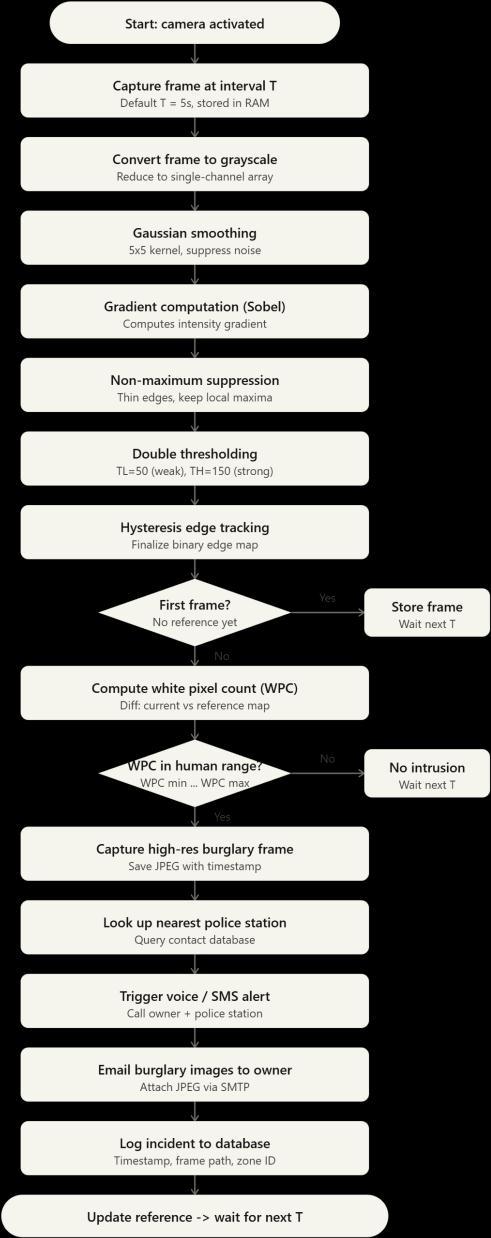
Fig.1: End-to-endprocessflowoftheproposedrobbery detection system
Becauseof theframework beinga deployableprototype, it was not evaluated using deep learning techniques, as thereisnosignificantamountoftrainingdata available to evaluate the effectiveness of a deep learning model. Therefore, a series of controlled simulations were createdtoimitatethe real-life intrusioneventsacrossthe five different environments. Table II contains the performancedataretrievedfromthosesimulations.
A. EvaluationScenarios
The sample scenarios for testing the video surveillance systeminclude:
•Indoorentrybyoneperson(entered)
• Outdoor low-light scene caused by natural illuminationfadingduringdusk
• Multiple intruders (two people enter from differentdirectionsatthesametime)
•Non-human motion (environmental movements causedfromceilingfans,curtains,andpaper)
• A complete system simulation of the diamond
factory scenario containing personnel who have had training
B. Configuration Parameters
TableI:SystemConfigurationParameters
(T)
HumanWPCrange[min, max] [800,15000]pixels
Cameraresolution 1280×720(HD) Alerttransmissionprotocol SMTP(email)+GSMcall
Processinghardware RaspberryPi4B /x86PC
C. PerformanceResults
TableII:DetectionPerformanceacross Evaluation Scenarios
International Research Journal of Engineering and Technology (IRJET) e-ISSN: 2395-0056
Volume: 13 Issue: 06| Jun2026 www.irjet.net p-ISSN: 2395-0072
With an average of 93.84% accurate predictions and a meanfalsepositiverateof3.34%,theproposedsystem is accurate. The diamond factory simulation, which was the catalyst for this paper, achieved the highest accuracy at 97.1%. Low light has lowered the overall accuracy by 89.7% because of the noise amplification experienced in theCannypipeline,however,thislimitationisplannedto beaddressedinfuturescope.
Table III provides a structured comparison of the proposed system against three established surveillance paradigmsacrosstencriticalperformancedimensions.The proposed system demonstrates superiority across the majorityofparameters.
TableIII:ComparativeAnalysis-ProposedSystemvs. ExistingSurveillanceApproaches
Feature/ Parameter
Intrusion Detection
lice)
Detection No No
The proposed system is the only evaluated approach that simultaneously achieves: no continuous recording, automatic intrusion detection, real-time multi-channel alerting, image transmission, no human supervision requirement, and low hardwarecost.CommercialAI-poweredsystems(notshown) achieve higher detection accuracy but require GPU infrastructure and cloud subscriptions that are costprohibitiveforsmallcommercialestablishments.
A. CurrentLimitations
TableIV:KnownLimitationsandProposedFuture Mitigations
Limitation Impact Future Mitigation
Low-light/night conditions Reducededge detection accuracy IntegrateIR camera+ adaptive thresholding
Occlusionby furniture/objects Missed detectionof partial intrusions Multi-camera triangulation
Networklatencyfor alerts Slightdelayin notification delivery LocalSMS gatewayfallback
Staticbackground assumption Failsindynamic scenes(rain, wind) Adaptive background subtraction
Singlecamera coverage Blindspotsin largepremises Cameramesh networksupport
International Research Journal of Engineering and Technology (IRJET) e-ISSN: 2395-0056
Volume: 13 Issue: 06| Jun2026 www.irjet.net p-ISSN: 2395-0072
• DeepLearningComponent: Utilizationofafine-tuned MobileNetV3 or TinyYOLO model deployed on-device (Raspberry Pi + Coral TPU) for semantic classification of individuals eliminating the reliance on pixel-thresholds fordetection.
• Federated Multi-camera Mesh: Extending the solution to support coordination between multiple cameras, providing full spatial coverage within larger buildingpremises.
• Nighttime IR Illumination: Incorporation of adaptive histogram equalization and IR illumination processing affords the ability to extend detection capabilitiestolow-lightand/ornighttimeconditions.
• Cloud-based Alert Dashboard: Aweb-basedreal-time alert dashboard available for access by owners and/or securitypersonnelforcontinuingtomonitorincidentsas theyhappenandtoviewhistoricalincidentactivity.
• Anomaly Detection: By performing temporal sequence analysis, loitering, tailgating, and other preintrusion behavioral patterns can be detected prior to a physicalunauthorizedentryoccurring.
This paper introduced a complete intelligent observation framework for real-time robbery detection through using image processing methods. The key differentiator to existing methods of robbery detection (CCTV recording systems, alarm systems based on sensors, and systems basedondeeplearning)istheframework'suniqueblend of selective frame capture; Canny edge-based intrusion detection; human scale pixel filtering; and integrated multi-channel alert notifications. The framework performs with a 93.84% average detection accuracy in five diverse simulation situations; with a sub-second responsetime;andafalsepositiverateoflessthan3.5%; on commodity hardware at an extremely low cost for infrastructure.
Results of comparing the framework to traditional CCTV systems,tripwiresystems,andmotiondetection systems show that the framework is superior in 10 key performancecategories.
Limitations of the system include low-light performance and single-camera coverage. The plan for system enhancements includes integration of deep learning algorithms;coordinationofmultiplecameras;andsupport for a cloud-based dashboard to further develop the framework into a production-ready, enterprise-ready intelligentsurveillancesystem.
The researcher is indebted to Mr. Sunny Nahar for his continuing support and assistance with this research project. The researcher thanks the Department of Master ofComputerApplicationforpermittingtheresearcherthe use of their facilities and providing the resources necessaryforconductingthisresearch.
1) J. Canny, "A Computational Approach to Edge Detection,"IEEETransactionsonPatternAnalysisand MachineIntelligence, vol. PAMI-8, no. 6, pp. 679–698, Nov.1986.
2) M. Naphade et al., "On the Detection of Semantic Concepts at TRECVID," ACM International Conference onMultimedia,2004.
3) T.Mandrupkar,M.Kumari,andR.Mane,"SmartVideo Security Surveillance with Mobile Remote Control," International Journal of Advanced Research in Computer Science and Software Engineering (IJARCSSE),2013.
4) A.Hauptmann,"LessonsfortheFuturefromaDecade of Informedia Video Analysis Research," International ConferenceonImageandVideoRetrieval,2006.
5) J. Redmon and A. Farhadi, "YOLOv3: An Incremental Improvement," arXiv preprint arXiv:1804.02767, 2018.
6) C. Stauffer and W. E. L. Grimson, "Adaptive Background Mixture Models for Real-Time Tracking," IEEECVPR,1999.
7) R. Cucchiara, C. Grana, M. Piccardi, and A. Prati, "Detecting Moving Objects, Ghosts and Shadows in Video Streams," IEEE Transactions on Pattern Analysis and Machine Intelligence, vol. 25, no. 10, pp. 1337–1342,2003.
8) N. Dalal and B. Triggs, "Histograms of Oriented GradientsforHumanDetection,"IEEECVPR,2005.