
International Research Journal of Engineering and Technology (IRJET) e-ISSN: 2395-0056
Volume: 13 Issue: 02 | Feb 2026 www.irjet.net p-ISSN: 2395-0072
International Research Journal of Engineering and Technology (IRJET) e-ISSN: 2395-0056
Volume: 13 Issue: 02 | Feb 2026 www.irjet.net p-ISSN: 2395-0072
Nimisha
Srivastava1 , Prisha Punjabi2
1Nimisha Srivastava, Student, Dept of Computer Engineering, Viva Institute of Technology, Virar
2Prisha Punjabi, Student, Dept of Computer Engineering, Viva Institute of Technology, Virar
3Karishma Datt, Dept of Computer Engineering, Viva Institute of Technology, Virar ***
Abstract – Heart-related diseases continue to be a major global health concern, with heart attacks claiming millions of lives each year. In many cases, delayed diagnosis and lack of awareness make the situation worse. With the growing availability of health data and advances in Artificial Intelligence, there is an opportunity to build smarter systems that can assist in early risk detection.
This paper presents HeartTalk: An AI-Based Heart Attack Prediction System with Chatbot Assistance, a practical and user-focused solution designed to estimate heart attack risk using machine learning techniques. The system evaluates essential health parameters such as age, blood pressure, cholesterol levels, heart rate, and lifestyle habits to generate real-time risk predictions. Multiple machine learning models, including Logistic Regression, Decision Tree, Random Forest, and Support Vector Machine, were trained and compared to identify the most reliable model.
Beyond prediction, HeartTalk integrates an AI chatbot that communicates results in simple language, offers preventive suggestions, and advises users to seek medical attentionwhen necessary. User authentication and encrypted data storage mechanisms are incorporated to ensure privacy and data security. Overall, the systemaimstoencourageearlydetection, improve health awareness, and make preliminarycardiacrisk assessment more accessible.
Key Words: Heart Attack Prediction, Machine Learning, Artificial Intelligence, AI Chatbot, Healthcare Analytics, Preventive Healthcare
Cardiovasculardiseasesremainoneoftheleadingcausesof death worldwide, and heart attacks often occur suddenly, sometimeswithoutnoticeableearlywarningsigns.Modern lifestyles characterized by stress, irregular sleep, unhealthyeatinghabits,andlimitedphysicalactivity have significantlyincreasedtheriskacrossdifferentagegroups. Even with advancements in medical technology, many individualsfailtorecognizesymptomsearlyorseektimely diagnosis.
Traditionaldiagnosticprocedurestypicallyrequirehospital visits, laboratory tests, and consultation with specialists. Whilethesemethodsareaccurate,theyarenotalwayseasily accessibleoraffordableforeveryone.Thisgaphighlightsthe
need for intelligent systems that can assist in preliminary riskassessmentbeforeconditionsbecomecritical.
Artificial Intelligence and Machine Learning have shown strong potential in healthcare applications, particularly in analyzingpatternswithinmedicaldata.Bystudyingpatient records and identifying relationships between health parametersanddiseaseoutcomes,thesetechniquescanhelp predictpotentialriskswithconsiderableaccuracy.
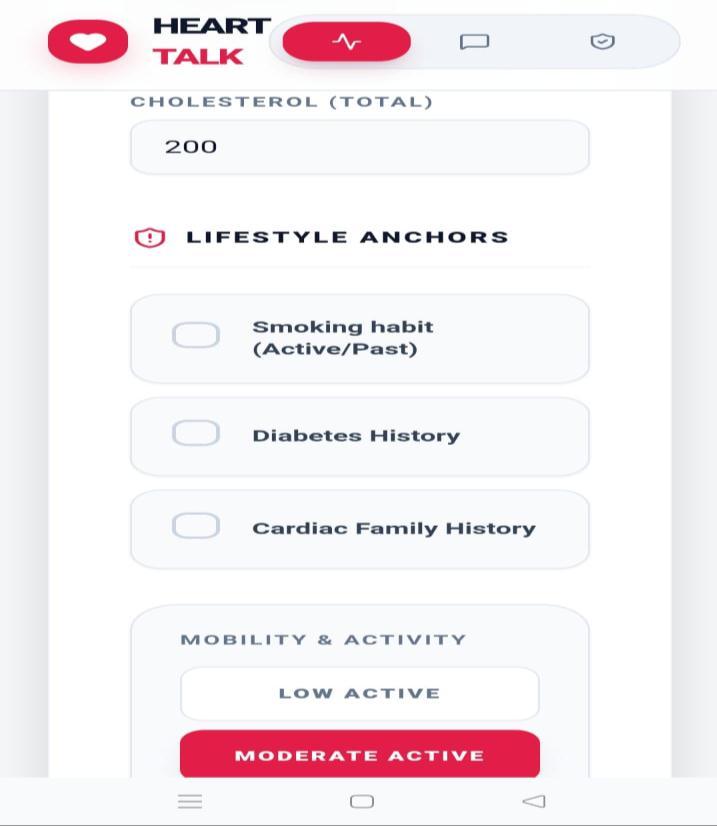
HeartTalkwasdevelopedwiththisgoalinmind.ItisanAIbased heart attack prediction system supported by an interactivechatbot.Usersenterbasichealthdetailssuchas age, blood pressure, cholesterol levels, heart rate, and certain lifestyle factors. The system processes this informationthroughtrainedmachinelearningmodelsand providesariskassessment.
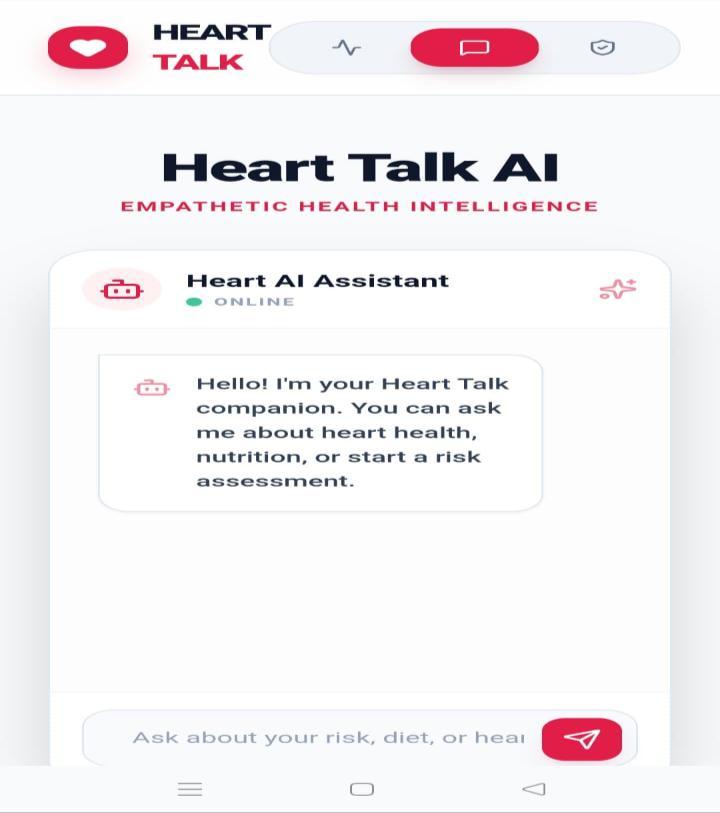
What makes HeartTalk distinctive is its chatbot feature. Insteadofsimplydisplayingapredictionresult,thechatbot explains the outcome in understandable terms, provides practical health suggestions, and recommends medical consultation when the risk appears high. By combining predictive analysis with conversational assistance and secure data handling, the system encourages proactive healthmonitoringandinformeddecision-making.
Overthepastfewyears,researchershaveactivelyexplored the use of Artificial Intelligence and MachineLearning for predictingcardiovasculardiseases. Deep learning techniques such as Convolutional Neural Networks (CNN), Recurrent Neural Networks (RNN), and LongShort-TermMemory(LSTM)modelshavebeenapplied toheartdiseasedatasetswithpromisingresults[1].Inmany cases,hybridmodelshavedemonstratedimprovedaccuracy comparedtostandalonealgorithms.
Traditional machine learning approaches including Logistic Regression, Decision Trees, Random Forest, KNearest Neighbors (KNN), and Support Vector Machines (SVM) have also been widely studied [2]. Ensemble techniques,inparticular,haveshownstrongperformancein handlingstructuredclinicaldata.However,researchersoften highlight challenges such as data imbalance, feature redundancy,andoverfitting.
Several review studies indicate that while many models achieve high accuracy in controlled environments, real-
International Research Journal of Engineering and Technology (IRJET) e-ISSN: 2395-0056
Volume: 13 Issue: 02 | Feb 2026 www.irjet.net p-ISSN: 2395-0072
world clinical validation is still limited [3]. Another major concern is interpretability. Medical professionals often requireclearreasoningbehindpredictionsbeforetrusting automatedsystems.
Toaddressthis,ExplainableAItechniquessuchasSHAPand LIME have been incorporated into predictive frameworks [4][5]. These approaches improve transparency and help users understand which features most influence the prediction.
Recent research has also introduced advanced and selfsupervisedlearningapproachestoenhancecardiovascular riskprediction[6][7].Atthesametime,studiesconfirmthat well-tuned traditional algorithms combined with proper preprocessingcanstilldelivercompetitiveperformance[8].
These findings emphasize the importance of balancing accuracy, interpretability, and usability principles that guidedthedevelopmentofHeartTalk.
The development of HeartTalk followed a step-by-step approachtoensurereliabilityandclarityinbothprediction anduserinteraction.
Phase
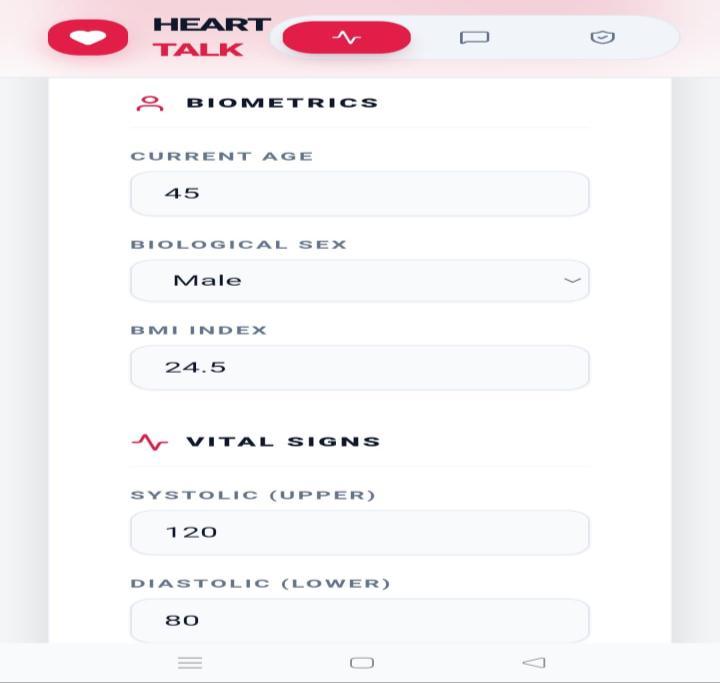
The system was designed to accept essential health parameterssuchasage,bloodpressure,cholesterollevels, andheartrate.Apubliclyavailableheartdiseasedatasetwas collectedandcleaned.Preprocessingstepsincludedhandling missing values, normalizing numerical features, and selectingrelevantattributestoimprovemodelperformance.
Phase 2: Model Development and Training
Multiplemachinelearningalgorithms LogisticRegression, Decision Tree, Random Forest, and Support Vector Machine were implemented and trained. Their performancewasevaluatedusingmetricssuchasaccuracy, precision,recall,andF1-score.Thebest-performingmodel wasselectedforintegrationintothefinalsystem.
Phase 3: AI Chatbot Integration
An AI chatbot module was added to enhance user interaction. The chatbot interprets prediction results, answersuserqueries,andprovidespreventiveadvicebased ontheassessedrisklevel.
Phase 4: Security and Data Management
To protect sensitive health information, secure login authenticationandencrypteddatastoragemechanismswere implemented.
Phase 5: Testing and Optimization
Thesystemwastestedunderdifferentinputconditionsto evaluatepredictionreliabilityandresponsetime.Necessary
adjustments were made to improve performance and usability.
A. Objectives
ThemaingoalofHeartTalkistosupportearlydetectionof potential heart attack risks using AI-driven analysis. The systemaimstoofferquickpreliminaryassessment,promote awareness,andprovideaccessibleguidancethroughchatbot interaction.
B. Application Flow
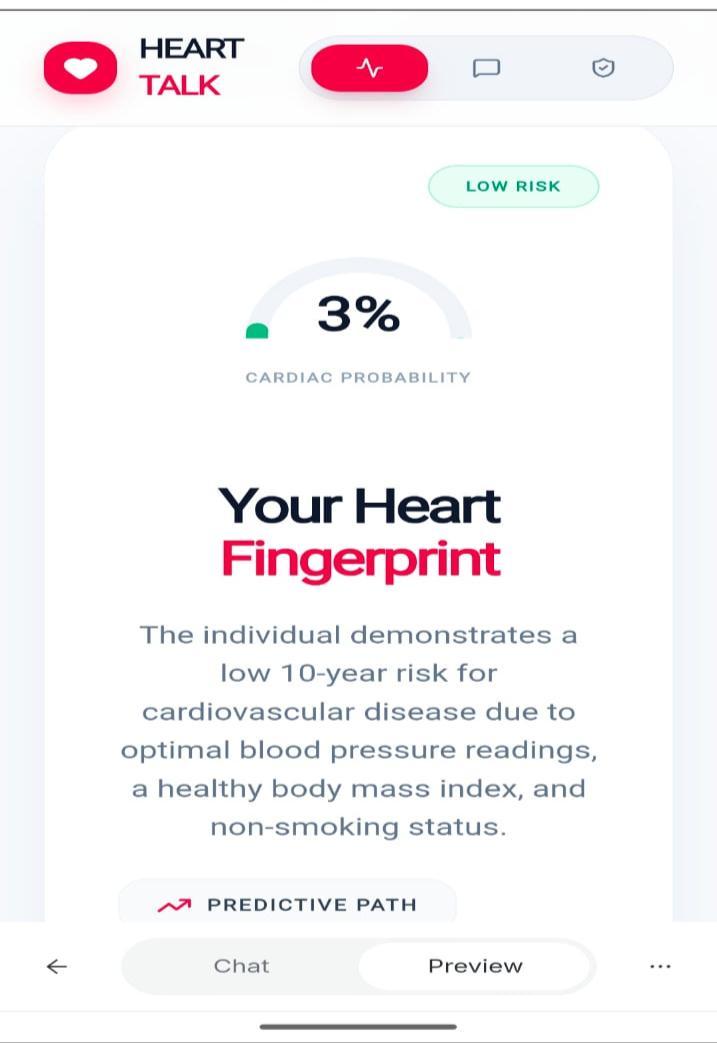
Users begin by registering and logging into the platform. After entering required health parameters, the system processes the data through the trained prediction model. Theresultingrisklevelisdisplayedclearly,andthechatbot providesadditionalexplanationandpreventivesuggestions. If a high-risk condition is detected, users are advised to consultamedicalprofessional.
C. Software Setup
ThesystemwasdevelopedusingPython.Librariessuchas NumPy, Pandas, and Scikit-learn were used for data preprocessingandmodeltraining.Acloud-baseddatabase manages user data securely. The chatbot utilizes basic Natural Language Processing techniques to ensure meaningfulinteraction.
D. Coding Overview
A modular coding structure was adopted, separating authentication,prediction,chatbotinteraction,anddatabase managementintoindependentcomponents.Thisapproach improvesmaintainabilityandscalabilityofthesystem.
ThesystemisdevelopedusingPythonformachinelearning modelimplementationanddataprocessing.Librariessuch as NumPy, Pandas, and Scikit-learn are used for data preprocessing,modeltraining,andevaluation.Thebackend is integrated with a cloud-based database for secure data storage and retrieval. A web-based or mobile interface is used for user interaction, while the AI chatbot is implementedusingnaturallanguageprocessingtechniques toensuremeaningfulandresponsivecommunication.Secure authenticationmechanismsareappliedtoprotectsensitive healthdata.
International Research Journal of Engineering and Technology (IRJET) e-ISSN: 2395-0056
Volume: 13 Issue: 02 | Feb 2026 www.irjet.net p-ISSN: 2395-0072
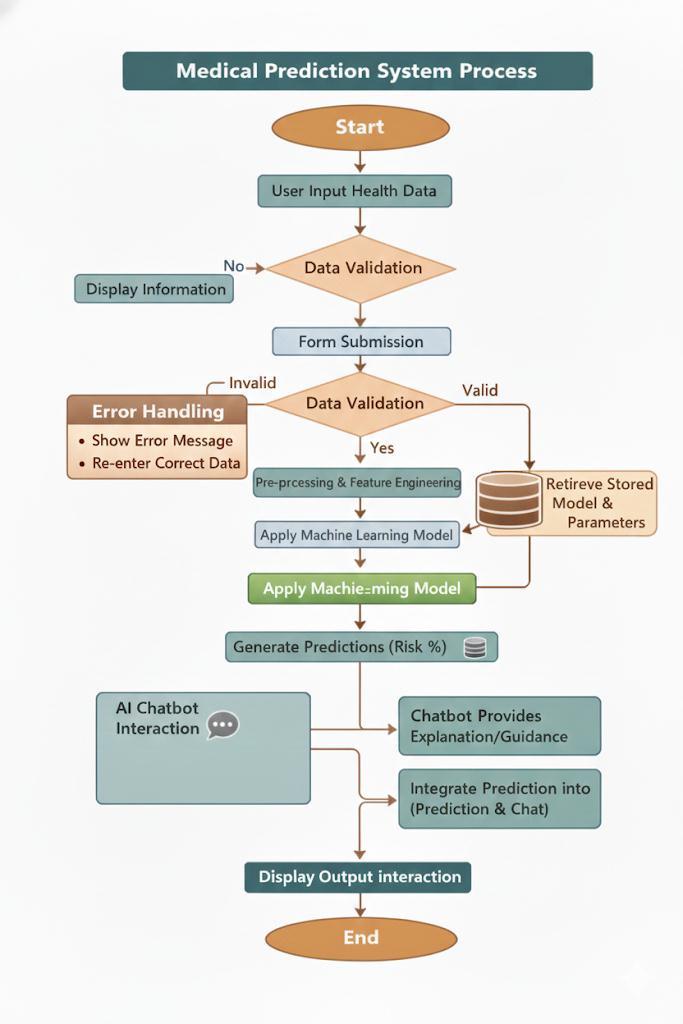
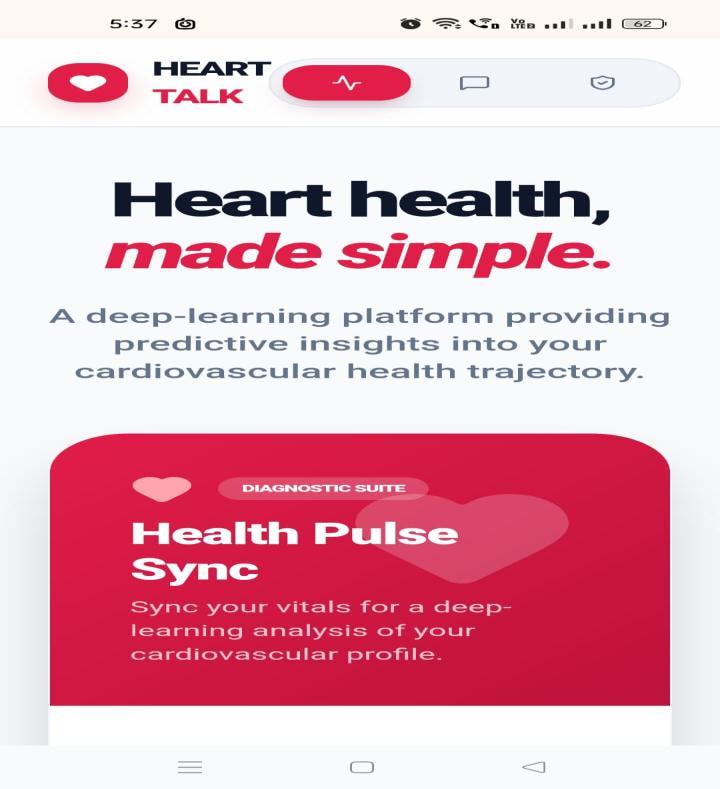
The HeartTalk system successfully integrates machine learning-basedpredictionwithconversationalAItoprovide efficientcardiovascularriskassessment.Thetrainedmodel demonstrates reliable performance across multiple test cases and effectively classifies users into appropriate risk categories.
The AI chatbot enhances user experience by translating complexmedicaloutputsintounderstandablelanguageand offeringpreventiverecommendations.Thesystemensures secure data handling and supports continuous health monitoring.
Overall, the results indicate that HeartTalk is an effective, scalable, and accessible tool for early heart attack risk predictionandpreventivehealthcaresupport.
International Research Journal of Engineering and Technology (IRJET) e-ISSN: 2395-0056
Volume: 13 Issue: 02 | Feb 2026 www.irjet.net p-ISSN: 2395-0072
Heart Talk presents a practical application of Artificial Intelligenceinpreventivehealthcare.Byintegratingmachine learningpredictionmodelswithaninteractivechatbot,the system provides not only risk assessment but also understandableguidanceforusers.Theplatformemphasizes accessibility,security,anduserawareness.Whileitdoesnot replace professional medical diagnosis, it serves as a supportive tool that encourages timely consultation and proactivehealthmanagement
Thesystemcanbefurtherenhancedbyintegratingwearable devices such as smartwatches to collect real-time data includingheartrateandbloodoxygenlevels.Incorporating advanced deep learning techniques could improve predictionaccuracy,especiallywithlargerdatasets.
International Research Journal of Engineering and Technology (IRJET) e-ISSN: 2395-0056
Volume: 13 Issue: 02 | Feb 2026 www.irjet.net p-ISSN: 2395-0072
Futureimprovementsmayalsoincludevoice-basedchatbot interaction,multilingualsupport,telemedicineintegration, andautomatedemergencynotificationsforcriticalcases.
[1] Overview of heart attack risk prediction using ML methods,PubMed.
[2] Comparative analysis of ML models for heart attack prediction,MDPI.
[3] Machine learning-based heart disease prediction with clinicalinputs
[4] Review of ML models and metrics for heart disease prediction,Springer.
[5] Systematic synthesis of ML research on heart disease prediction,PubMed.
[6]SurveyofMLtechniquesusedincardiologyclassification, Springer.
[7]AdvancedML approachesforheartdiseaseprediction, IJRASET.
[8]Predictingheartattackriskusingmachinelearning–A review,IJRASET.