
International Research Journal of Engineering and Technology (IRJET) e-ISSN:2395-0056
Volume: 12 Issue: 01 | Jan 2025 www.irjet.net p-ISSN:2395-0072

International Research Journal of Engineering and Technology (IRJET) e-ISSN:2395-0056
Volume: 12 Issue: 01 | Jan 2025 www.irjet.net p-ISSN:2395-0072
Dr. D. Banumathy1, Abinaya R2, Aarthi S3, Kaviya T4
1Professor, Dr. D. Banumathy, Department of Computer Science & Engineering, Paavai Engineering College, Namakkal, Tamilnadu, India
2Student, Abinaya R, Department of Computer Science & Engineering, Paavai Engineering College, Namakkal, Tamilnadu, India.
3Student, Aarthi S, Department of Computer Science & Engineering, Paavai Engineering College, Namakkal, Tamilnadu, India.
4Student, Kaviya T, Department of Computer Science & Engineering, Paavai Engineering College, Namakkal, Tamilnadu, India.
ABSTRACT:Peoplewithspeechandhearingproblemsusesignlanguageasasecondlanguagetocommunicate.Notable toIndividualsusenonverbalcommunicationmethods,suchasthesesignlanguagegestures,toexpresstheirthoughtsand emotions to everyday people. It may be quite difficult to communicate with those who are hard of hearing. When communicating, those who are Deaf or mute must utilise hand gestures, which makes it challenging for others to understand what they are saying. Therefore, it is necessary to have systems that can identify various signs and provide informationtothegeneralaudience.Butbecausetheseeverydaypeoplehavetroublecomprehendingwhatthey'resaying, havingproficientsignlanguageabilitiesisessentialfortrainingandeducational sessions,aswellasforlegalandmedical consultations.Theneedfortheseserviceshasgrownwithinthelastseveralyears.Otherservices,includingvideoremote human interpretation that uses a fast Internet connection, have been created. Despite having serious drawbacks, these programs offer a rudimentary sign language interpreting service that is helpful and may be utilised. To address this problem, apply artificial intelligence technology to determine the user's hand using finger detection. Create the visionbased system for this proposed system in practical environments. A deep learning technique called the Convolutional Neural Network algorithm (CNN) is then used to classify the sign and provide a label pertaining to the identified sign. A Pythonframeworkwasusedtocarryouttheproject'sdesign.
KEYWORDS: Hand image acquisition, Binarization, Region of finger detection, Classification of finger gestures, Sign recognition.
Theprocessoftranslatinga user'smovementsandsignsintowrittentextisknownassignlanguagerecognition. Those who are unable to interact with the larger community benefit from this approach. Raw photos or videos are convertedintoreadabletextbyusingneuralnetworksandimageprocessingtechniquestolinkthemotionswithmatching textinthetrainingdata.Peoplewhoaremutefrequentlystruggletocommunicatewithotherssincemostpeoplecanonly understandasmallportionoftheirbodylanguage.Thesepeoplecouldthushavetroubleinteracting withthewiderpublic inaneffectivemanner.Beingunabletocommunicateverbally,thosewhoaredeaforhardofhearingmostlyrelyonvisual communication. For people who are hard of hearing or unable to talk, sign language serves as their primary means of communication. It has its own vocabulary and syntax, much like other languages, but it uses images to communicate. Because most people are generally unaware of these grammatical norms, it can be difficult for deaf or mute persons to express themselves using sign language grammar. As a result, they frequently only communicate with their family membersorthedeafcommunity.Thegrowingsocialacceptabilityandsupportforinternationalprojectsdemonstratesthe importance of sign language. People who are deaf or hard of hearing are eager for a computer-based solution in this technological age. One step towards achieving this goal is enabling a computer to comprehend human voice, facial emotions,andgestures.Withoutusingwords,gesturesmayconveyinformation.Ahumanmaysimultaneouslyproducean endlessnumberofdifferentgestures.Computervisionresearchersareparticularlyinterestedinhumanmovementssince they are experienced through sight. The creation of a human-computer interface that can identify human motions is the aimofthisproject.Toturnthesemotionsintomachine-readablecode,acomplexprogrammingprocedureisrequired.In ordertoimproveoutputquality,thisstudymainlyfocusesonimageprocessingandtemplatematching.Thesymbolsused torepresentthelettersinsignlanguageformatareshowninFigure 1
International Research Journal of Engineering and Technology (IRJET) e-ISSN:2395-0056
Volume: 12 Issue: 01 | Jan 2025 www.irjet.net p-ISSN:2395-0072
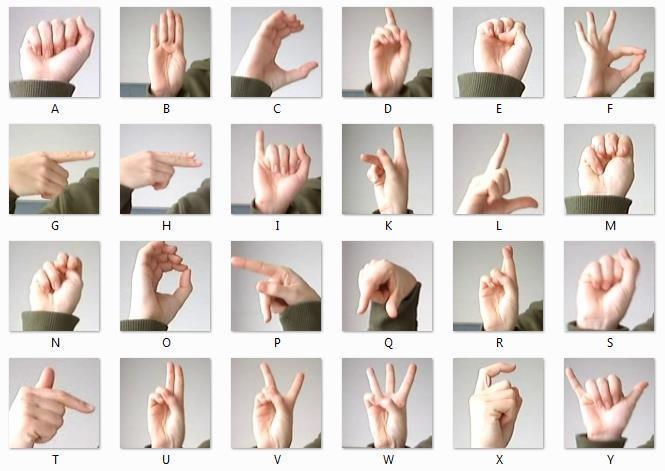
Figure1:SignLanguageforalphabets(refer:https://towardsdatascience.com/sign-language-recognition-with-highly developed-computer-vision-7b74f20f3442)
Tangfei Tao, Yizhe Zhao, et.al,…[1] The proposed review concentrated on the development, especially in the last few years, of algorithm-driven methods for sign language recognition. These models included both deep learning and conventionaltechniques,aswellassignlanguagedatasets,difficulties,andfuturedirectionsinsignlanguagerecognition. In order to clarify the structure of these methods, the paper examined and explained the fundamental ideas of several approaches from theviewpoints of temporal modelling and feature extraction. The gloss, which denotes a complete sign language word made up of several gestures, is the main informational element in a sign language video presentation. A constant stream of movements is used to deliver the sign language message, and each distinct gesture provides specific meanings in addition to the links between the motions. The main frameworks for recognising sign language, such as Convolutional Neural Networks (CNNs) and Transformers, as well as popular techniques for continuous sign language understanding, were presented in the deep learning section. In addition to these methods, the paper looked at the difficulties in sign language recognition and included assessment metrics and datasets from recent years. It also emphasised the use of feature extraction and temporal modelling in traditional sign language identification methods. Conventionaltechniquesdemonstratedsensitivitytoocclusionandillumination,andwerelimitedintheirabilitytoextract hand movement-specific characteristics. The manual feature design process was costly and timeconsuming, which resulted in accuracy restrictions. However, more interpretability was possible using older methodologies, which helped researchersappreciatetherelevanceofcertaintraitsfortheirstudy.
DeepR.Kothadiya,et.al,…[2]Toimprovetheprecisionofidentifyingisolatedsignals,theconvolution-basedmixed Inceptionarchitecturewascreated.TheprimarycontributionwastheimprovementofInceptionV4byemployinguniform connections for optimum back propagation. The resilience and recognition accuracy of individual sign language recognition systems were further increased by introducing an ensemble learning architecture that made use of several ConvolutionalNeuralNetworks.Todemonstratetheefficacyofthesuggestedlearningstrategies,abenchmarkdatasetof isolatedsignlanguagemotionswasused.Witharecognitionaccuracyof98.46percentandhigherrobustness,thefindings showed that the built ensemble model performed better in sign identification. The suggested deep learning approach helped lower communication obstacles for people with impairments by deciphering sign movements. Significant informationwascollectedfromtheisolatedsignframesbythestemmodule,thefirstpartofthearchitecture.Inorderto reduce the dimensionality of the input frames, it included convolutional, pooling, and normalisation layers. Using ensemblelearning techniques,theInceptionV4 model andthetopconvolutional neural networkswerestandardisedand evaluated. Because the ensemble model had fewer trainable parameters and a lower computing cost, training it was simpler.Asaresult,thesuggestedmodelshowedlesstrainingcomplexityandappearedtobewell-suitedfordynamicsign language recognition. An additional isolated sign language dataset was used to evaluate the created architecture. Larger andmorecomplexstructureswereproducedviaensemblemodels.
International Research Journal of Engineering and Technology (IRJET) e-ISSN:2395-0056
Volume: 12 Issue: 01 | Jan 2025 www.irjet.net p-ISSN:2395-0072
P. V. V. Kishore, et.al,.[3] The development of the multi-resolution convolutional neural network with spatial attention (MRCNNSA) had a major impact on the KL3DISL's ability to generate 3D sign language data. Online 3D datasets and standard deep learning models were used to test the suggested architecture for sign and action detection. Eight motion capturecamerasensorsandcutting-edge3Dmotioncapturetechnologieswereusedtocreatethissignlanguageskeleton data.Themodelwasspeciallycustomisedforourdataset,andagreatdealofstudywentintocreatingtheskeletonshown inFigure1.AlloftheIndiansignlanguagesymbolsmayberecognisedbythisskeleton.Tendistinctsignerscontributedto thecollection,withanaverageof550framespersignbeingcapturedduringeachcaptureevent.Theidentificationofany missingjointsineachsignwasmadepossiblebyameticulousreconstructionofthecollecteddata.TheBiomechanicsand VisionComputingResearchCentreatKLUniversityproducedthe3DsignlanguagedatasetknownasKL3DISL.Itincluded 500 indications from different categories that are often used. With 500 3D labels for skeletal signs overall, KL3DISL collectedapproximately25,000samplesfrom10subjectswhoperformedeachsignfivetimes.Theapplicationofoptional models to the datasets and the assessment measures were covered in detail in this section. Additionally, benchmark datasets and cutting-edge sign language (action) recognition models were used to compare with a number of common CNN designs as backbone networks. Furthermore, at various feature resolutions, an ablation analysis of the classifier's attentionmodelwasshown.
Bashaer Al Abdullah, et.al,…[4] To achieve the research goals, the created approach included formulating research questions,creatingqueries,choosingstudiesbasedonpredeterminedstandards,andretrievingpertinentdata.Moreover, enhancing recognition accuracy required the use of non-manual characteristics. To increase system accuracy and usefulness, it was recommended that future research concentrate on improving sophisticated deep learning models and adding non-manual features. For those who mostly utilised sign language, these ongoing developments offered the potential to revolutionise communication and remove barriers. With advancements in sensors found in wearable technologysuchasdatagloves,watches,andbands,significantstrideshavebeenmadeinhardware-basedsign language recognition.Inordertoefficientlyrecordhandmotions,orientation,andlocation,datagloveshavebeenusedextensively. On the other hand, electromyography (EMG) sensors tracked electrical muscle activity while signing to identify signals. Over the years, researchers have been trying to make these sensors smaller, which have resulted in the creation of wearable technology that is more comfortable. However, prolonged usage of these devices may result in pain. Furthermore, the costs associated with the research, maintenance, and manufacturing of these sensors continued to be high.
Vasileios Kouvakis, et.al,…[5] By investigating the reconstruction of discrete pictures in the context of American Sign Language (ASL) communication, the suggested approach addressed this problem. By using neural networks to parse feature vectors, the traditional method added needless complexity and inefficiency. Using a 24-QAM variant of the quadrature amplitude modulation (QAM) technology, a novel system model for image-based semantic communications waspresentedinordertogetaroundthesechallenges. Thismodulationtechnique, whichwascreatedbyremovingeight peripheral symbolsfrom the original 32-QAM collection,has been demonstrated toproduce better error performancein ASLapplications.Furthermore,asemanticencoderbasedonconvolutionalneuralnetworks(CNNs)wasshown,efficiently usingtheASLalphabet.Keypointsandred-green-bluelandmarksweresuperimposedonthetaken picturestoprovide a special dataset that improved the representation of hand locations. The suggested system's training, testing, and communication performance were evaluated using numerical data. This strategy encouraged interesting conversations and highlighted areas for development. To further improve the representation of hand locations, red-green-blue landmarks and important spots were added to the original dataset. Numerical findings that showed the system's performance improvementsandthe harmony between conventional andsemantic communication techniques were used toevaluatetheefficacyofthesuggestedsystem.
S.NO TITLE
1 SignLanguage Recognition:A Comprehensive Reviewof Traditionaland DeepLearning Approaches, Datasets, and
TTao,YZhao,T Liu,JZhu,2024 &IEEEACCESS
Artificial neural network It increasingly good results on largedatasets based on deep learning It requires great computation al cost.
International Research Journal of Engineering and Technology (IRJET) e-ISSN:2395-0056
Volume: 12 Issue: 01 | Jan 2025 www.irjet.net p-ISSN:2395-0072
Challenges
2 Hybrid InceptionNet BasedEnhanced Architecturefor Isolated Sign Language Recognition
3 JointMotion AffinityMaps (JMAM)and TheirImpacton DeepLearning Modelsfor3D Sign Language Recognition
DRKothadiya,CM Bhatt,HKharwa,F Albu,2024 & IEEE ACCESS
PVVKishore,DA Kumar,RC Tanguturi, 2024 & IEEEACCESS
InceptionNet framework The proposed studycan reducethesizeof the model to minimize computational time.
Jointmotionmodel The major advantage is the joint information coverage in 3D pose estimations usingthe3D motion capture data,which makesita reliablesystem forrealtime operation
The biggest drawback of these approaches is the dependencyon gloves
This disadvantage gets further magnifies during the training process which gives more attention to retracting joint features thanthe contracting ones.
4 Advancements inSign Language Recognition:A Comprehensive Reviewand Future Prospects
5 Semantic Communication s forImageBasedSign Language Transmission
4. EXISTING METHODOLOGIES
BAlAbdullah,G Amoudi,H Alghamdi ,2024 & IEEEACCESS
Recurrent neural networks This technique seldom attains good accuracies
V Kouvakis, SE Trevlakis, Bouloge orgos,2024&IEEE ACCESS
Quadrature amplitude modulation (QAM)
This approach notonly enhances regularization andreduces theprocessing
The corpora for gestures in sign language are limited
Itcreated computation al errors.
Assessors examined the interface and assessed whether or not it met usability criteria using heuristic evaluation with usability professionals. The discovered usability problems led to a revision of the system interfaces. Following that, deaf and hard-of-hearing users participated in usability testing, which assessed the program's most important features using bothobjectiveandsubjectiveapproaches.Indiansignlanguageisbeingemployedaspartofanongoingendeavourtoclose the communication gap between the general population and the deaf and dumb. It might accelerate the development of autonomoussystemsthatcanunderstandandhelpthedeafanddumb,aswellasmakingitsimplerandfasterforthemto interactwiththeoutsideworld,ifthisprogram issuccessfullyexpandedtoincorporatewordsandcommonphrases.The absenceofstandardiseddatabasescausesIndianSignLanguageresearchtolagbehindthatoftheUnitedStates.
5. PROPOSED METHODOLOGIES
SignLanguageuseshandmovements,handcompassreading,andfacialgesturesinplaceofauditorysoundpatterns.There areerraticpatternsinthislanguagethatdifferfrompersontopersonandarenotuniversal.However,sincemostpeople are not familiar with sign language, Deaf-mute people are finding it more difficult to communicate without some sort of translation. They feel as though they are being avoided. A commonly used method for interacting with the deaf-mute is
International Research Journal of Engineering and Technology (IRJET) e-ISSN:2395-0056
Volume: 12 Issue: 01 | Jan 2025 www.irjet.net p-ISSN:2395-0072
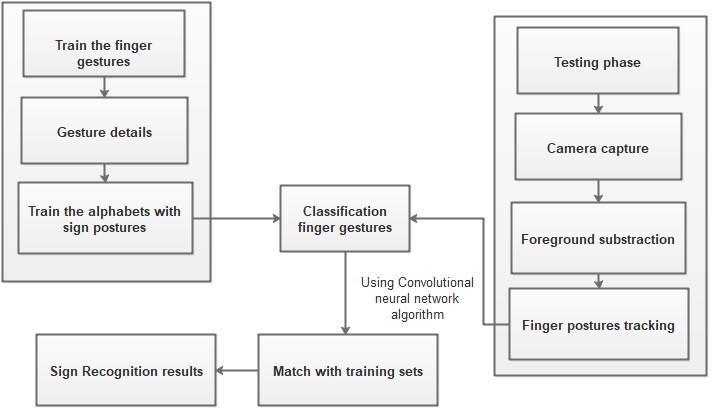
sign language recognition. There are two kinds of recognition models: sensor-based systems and computer vision-based systems.Computervision-basedsignrecognitionusesthecameraasaninputsource,andmotionsenteredarefirstimage processedbeforebeingrecognised.Anumberofmethods,includingtheregionofnoticealgorithmandtheneuralnetwork approach, are then used to identify the processed movements. The main drawback of a vision-based system for sign language identification is that its picture collection process is sensitive to several environmental factors, including backgroundconditions,cameraorientation,andlightningsensitivity.However,itislesscostlyandmoreusefulthanusing a camera and tracker to gather data. However, camera data is integrated into neural network techniques like the ConvolutionalNeuralNetworktoincreaseaccuracy.
CNN ALGORITHM: TodevelopaCNN(ConvolutionalNeuralNetwork)methodforsignlanguageidentification,youwould typicallydothefollowing:InformationGathering:Createasubstantiallibraryofsignlanguagefilmsorimages.Makesure the dataset includes a broad range of sign gestures and variants in order to improve the model's generalisation. Preprocessing data: Preprocess the collected data to enhance the model's learning process. Typical preparation steps includesplitting thedataset into trainingand testingsets,resizing the imagesto a consistentsize,andlevellingthe pixel values. Enhancement of Data: To increase the model's generalisation, use data augmentation techniques like flipping, scaling, and rotation to artificially increase the dataset's size. If you have a tiny initial data collection, this phase is quite beneficial. Model Architecture: Create your CNN model's architecture. It typically consists of convolutional, pooling, and fully linked layers. The convolutional layers extract relevant characteristics from the input images, which the fully connected layersutilisetodoclassification. Training: TrainyourCNN model usingthegiven dataset. In order toprovide correctpredictions,themodellearnstominimiseaselectedlossfunction,likecategoricalcross-entropy,whileoptimising its internal parameters during training. Evaluation: Use the testing dataset to assess the trained model's performance. Correctness, accuracy, recall, and F1 score are commonly used evaluation metrics for classification tasks. Fine-tuning: Consider altering the architecture, hyper parameters, or preprocessing techniques if the model's output is subpar. You may also consider techniques like transfer learning, which is applying a previously trained model from a large dataset (suchasImageNet)to a signlanguagedataset.Deployment:If youare satisfied withthe model'sperformance, use itfor real-world applications. This can entail incorporating it into a web service or mobile application that can take in information (such pictures or videos) and make predictions. To guarantee the accuracy and dependability of your CNN algorithm for identifying sign language, don't forget to annotate the dataset with the appropriate labels, include enough variationsinsignmotions,andcarryoutthoroughtestingandvalidation.
International Research Journal of Engineering and Technology (IRJET) e-ISSN:2395-0056
Volume: 12 Issue: 01 | Jan 2025 www.irjet.net p-ISSN:2395-0072
Sign language, a gesture-based communication method that varies by area and society, is used by deafmute people. Communicationchallengesarisebecausethegeneralpublicisnotwidelyfamiliarwithsignlanguage.Yourobjectiveisto create an SLR system that fillsthisgap by concentrating onvision-based recognition techniques that make use of neural networksandcameradata.
Efficiency=∑(Totalnumberoffavourableconditiononthebasicfeatures)/(Totalnumberofconditions)
Increasedefficiencyleadstomorepreciseandeffectiveresults.Thepresentationchartillustradingthis associationcan beseeninthefollowinggraph






7. CONCLUSION
Being able to see, hear, talk, and react correctly to situations was one of the most precious blessings a person could have. However, some unfortunate people are not afforded this chance. When people communicate their opinions, thoughts,andexperienceswithothersaroundthem,theycometoknoweachotherbetter.Thebestmethodfordoingthis istouse"Speech."Everyonehasexcellentpersuasivespeechcommunicationabilitiesandisunderstandingofoneanother. Our idea seeks to help blind individuals communicate by introducing a lowcost computer into the mix. This will make it possible to record, recognise, and translate sign language into spoken language. This article uses an image processing approach to identify the handmade motions. This application is an illustration of a contemporary integrated system designed for people with hearing loss. The camera-based zone of notice could make data collection easier for the user. Eachactionwillhavemeaninginandofitself.
[1] Tao, Tangfei, et al. "Sign Language Recognition: A Comprehensive Review of Traditional and Deep Learning Approaches,Datasets,andChallenges."IEEEAccess(2024).
[2] Kothadiya, Deep R., et al. "Hybrid InceptionNet based Enhanced Architecture for Isolated Sign Language Recognition."IEEEAccess(2024).
[3] Kishore, P. V. V., et al."Joint Motion Affinity Maps(JMAM)and their impact on deeplearning modelsfor 3Dsign languagerecognition."IEEEAccess(2024).
[4] Al Abdullah, Bashaer, Ghada Amoudi, and Hanan Alghamdi. "Advancements in Sign Language Recognition: A ComprehensiveReviewandFutureProspects."IEEEAccess(2024).
[5] Kouvakis,Vasileios,StylianosE.Trevlakis,andAlexandros-ApostolosA.Boulogeorgos."Semanticcommunications forimage-basedsignlanguagetransmission."IEEEOpenJournaloftheCommunicationsSociety(2024).
International Research Journal of Engineering and Technology (IRJET) e-ISSN:2395-0056
Volume: 12 Issue: 01 | Jan 2025 www.irjet.net p-ISSN:2395-0072
[6] Gu, Yutong, Hiromasa Oku, and Masahiro Todoh. "American Sign Language Recognition and Translation Using PerceptionNeuronWearableInertialMotionCaptureSystem."Sensors24.2(2024):453.
[7] Teran-Quezada, Alvaro A., et al. "Sign-to-Text Translation from Panamanian Sign Language to Spanish in ContinuousCaptureModewithDeepNeuralNetworks."BigDataandCognitiveComputing8.3(2024):25.
[8] Renjith, S., Manazhy Rashmi, and Sumi Suresh. "Sign language recognition by using spatio-temporal features." ProcediaComputerScience233(2024):353-362.
[9] Arooj, Sadia, et al. "Enhancing sign language recognition using CNN and SIFT: A case study on Pakistan sign language."JournalofKingSaudUniversity-ComputerandInformationSciences36.2(2024):101934.
[10] Al Khuzayem, Lama, et al. "Efhamni: A Deep Learning-Based Saudi Sign Language Recognition Application." Sensors24.10(2024):3112.
[11] Shah, Farman, et al. "Sign language recognition using multiple kernel learning: A case study of pakistan sign language."IeeeAccess9(2021):67548-67558.
[12] A. Wadhawan and P. Kumar, ‘‘Deep learning-based sign language recognition system for static signs,’’ Neural Comput.Appl.,vol.32,no.12,pp.7957–7968,Jun.2020.
[13] Sharma, Shikhar, and Krishan Kumar. "ASL-3DCNN: American sign language recognition technique using 3D convolutionalneuralnetworks."MultimediaToolsandApplications80.17(2021):26319-26331.