
International Research Journal of Engineering and Technology (IRJET) e-ISSN: 2395-0056
Volume: 13 Issue: 01 | Jan 2026 www.irjet.net p-ISSN: 2395-0072
International Research Journal of Engineering and Technology (IRJET) e-ISSN: 2395-0056
Volume: 13 Issue: 01 | Jan 2026 www.irjet.net p-ISSN: 2395-0072
C.GAYATHRI1 , S.TAMILMANI2 , K.THARANI3 , R.UMA4 .
1 , Assistant professor, Sri Vijay Vidyalaya college of Pharmacy, Nallampalli. 2,3,4, Students B. pharm , Sri Vijay Vidyalaya college of Pharmacy, Nallampalli.
ABSTRACT- This study reports the green synthesis of copper oxide nanoparticles (CuO NPs) using Vaccinium macrocarpon fruit extract and evaluates their antimicrobial efficacy. Green synthesis represents a sustainable, eco-friendly, and non-toxic alternative to conventional chemical synthesis approaches. The synthesized CuO nanoparticles were characterized using UV–Visible spectroscopy, X-ray diffraction (XRD), Fourier transform infrared spectroscopy (FTIR), and scanning electron microscopy coupled with energy-dispersive X-ray analysis (SEM–EDX). XRD analysis confirmed the monoclinic crystalline structure of the CuO nanoparticles, with an average particle size in the range of 37–43 nm. SEM images revealed predominantly cubic and flower-like morphologies.
The antimicrobial activity of the biosynthesized CuO nanoparticles was assessed against selected bacterial strains (Vibrio cholerae, Klebsiella pneumoniae, Staphylococcus epidermidis, and Enterococcus faecalis) and fungal strains (Aspergillus niger, Candida albicans, Candida glabrata, and Aspergillus brasiliensis) using the agar well diffusion method. The green-synthesized CuO nanoparticles demonstrated notable antibacterial and antifungal activity, particularly against Klebsiella pneumoniae and Candida albicans.The findings indicate that Vaccinium macrocarpon-mediated CuO nanoparticles possess strong antimicrobial potential and may serve as effective alternatives for various biomedical applications.
Keywords: Vaccinium macrocarpon, Copper oxide (CuO) nanoparticles, Antimicrobial activity, Calcination, UV–Visible spectroscopy.
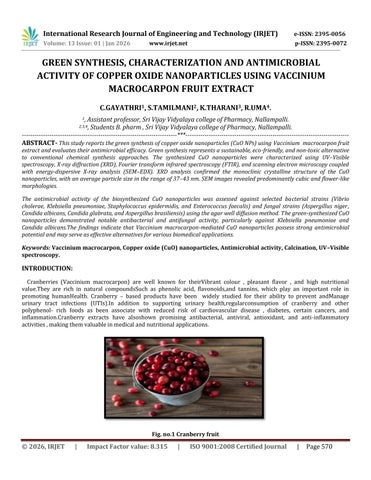
Cranberries (Vaccinium macrocarpon) are well known for theirVibrant colour , pleasant flavor , and high nutritional value.They are rich in natural compoundsSuch as phenolic acid, flavonoids,and tannins, which play an important role in promoting humanHealth. Cranberry – based products have been widely studied for their ability to prevent andManage urinary tract infections (UTIs).In addition to supporting urinary health,regularconsumption of cranberry and other polyphenol- rich foods as been associate with reduced risk of cardiovascular disease , diabetes, certain cancers, and inflammation.Cranberry extracts have alsoshown promising antibacterial, antiviral, antioxidant, and anti-inflammatory activities,makingthemvaluableinmedicalandnutritionalapplications.


International Research Journal of Engineering and Technology (IRJET) e-ISSN: 2395-0056
Volume: 13 Issue: 01 | Jan 2026 www.irjet.net p-ISSN: 2395-0072
In recent years , nanotechnology has emerged as a powerful field with Application in medicine , agriculture, industry, and environmentalscience.Nanoparticleswhichrangeinsizefrom1to100nm,exhibituniquephysical,chemical,andbio logical propertiesthatdifferfromtheirbulkcounterparts.Amongvariousnanoparticles,copper oxidenanoparticles(CuONPs)have gainedsignificantattentionduetotheirexcellentantimicrobial,antioxidant,andanticancerproperties.Theyarewidelyused infieldssuchasbiosensing,watertreatment,Foodpreservation,anddrugdeliverysystems.
Traditional methods for synthesizing nanoparticles often involve the use of toxic Chemicals and high energy process, which can be harmful to both human health and the Environment. To overcome these limitations, green synthesis method using plant extracts having Gained popularity. These eco-friendly approaches are cost-effective, safe, and sustainable. Plant extractactasnaturalreducingandstabilizingagent,enablingthesynthesisofnanoparticleswithoutharmfulby-products.
Cranberryfruitextractisparticularlysuitableforgreensynthesisduetoitsrichphytochemicalcontent.Inthisstudy, cranberry-mediated green synthesis copper oxide nanoparticles was carried out for the first time. The synthesized nanoparticleswerecharacterizedusingvariousanalyticaltechniques,andtheirantimicrobialpotentialwereevaluatedagainst selected bacterial and fungal pathogens. The findings of this research aims to contribute to the development of environmentallysafenanomaterialswitheffectiveantimicrobialapplication

MATERIALS AND METHODS
Materials for Green synthesis
Vacciniummacrocarponfruitpowder,Methanol,Distilledwater,Soxhletapparatus,Rotaryevaporator.
Identification and collection of Vaccinium macro carpon fruits
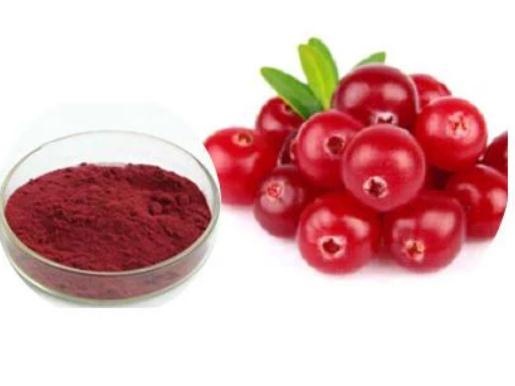
Vaccinium macrocarpon fruit powder was purchased from Maduras Herbals, Salem, Tamilnadu and authenticated by a botanist.Thepowderwasstoredinanairtightcontainerandkeptinacool,darkanddryplaceforfurtheranalysis.
Synthesis of copper oxide nano particles(CuO NPs)
Thechemical approachwasusedforthesynthesis ofCuONPsinwhichcopper chloridewasdissolvedindeionized water and continuous stirred on magnetic stirrer. The NaOH solution was prepared to attain the pH upto 11 of copper chloride solution. The prepared solution wascontinuouslystirredmagneticstirrerfor2 hrs toget black colorhomogeneous mixture. Afterthat,preparedsolutionwasfilteredusingafilterpaperwiththehelpofdeionizedwater.Finally,th
International Research Journal of Engineering and Technology (IRJET) e-ISSN: 2395-0056
Volume: 13 Issue: 01 | Jan 2026 www.irjet.net p-ISSN: 2395-0072

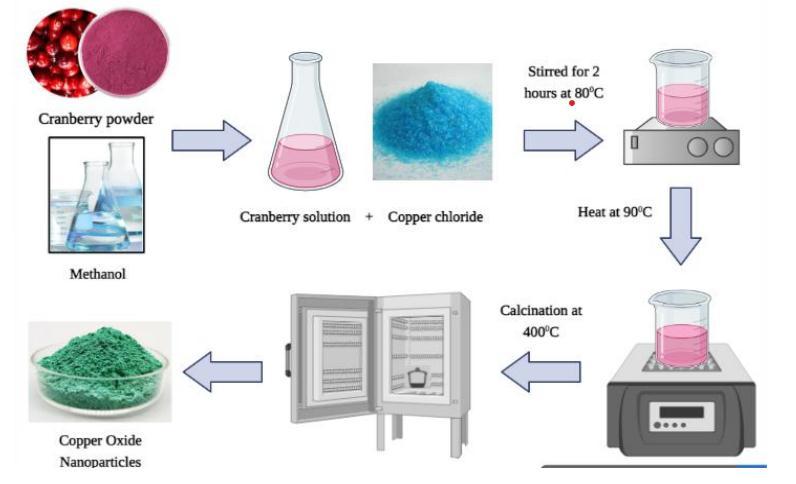
Fig.no.3 GreensynthesisofcopperoxidenanoparticlesusingaqueousVacciniummacrocarponfruitextract.
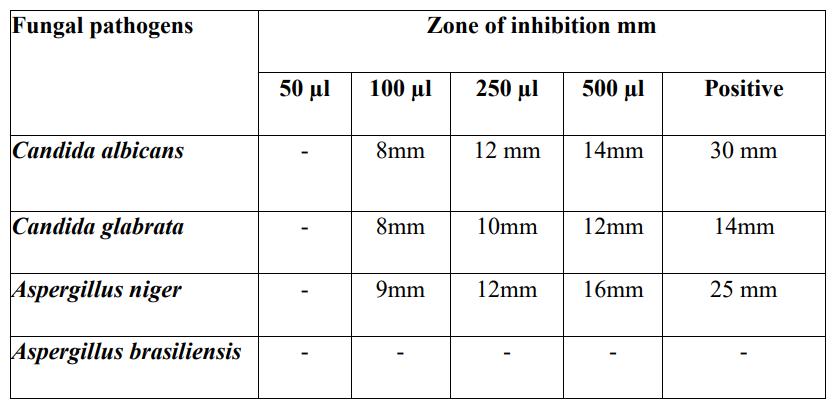
The antimicrobial activity of the Vaccinium marcocarpon was tested individually on gram-positive and gram-negative bacterial strains. The well diffusion method of antibacterial test was performed on eight microbial strains Vibrio cholerae, Klebsiella pneumonia, Staphylococcus epidermidis, Enterococcus faecalis, Aspergillus niger, Candida albicans, Candida glabrata,Aspergillusbrasiliensisstrains.
Culture preparation and media
Bacterial and fungal cultures were prepared using appropriate nutrient and growth media under sterile conditions. The cultureswereincubatedatsuitabletemperaturetopromoteoptimalmicrobialgrowthbeforeperformingantimicrobialassays.
UV-Visible Spectroscopy Analysis
The formation of copper oxide nanoparticles was confirmed using UV-Visible spectroscopy. The chemically synthesized CuO nanoparticles showed a characteristic absorption peak at 376 nm, while the green-synthesized nanoparticles exhibited a 377 ı O y values indicates that both synthesis methods produced comparable nanoparticles, with the green method showing equally efficientresults.
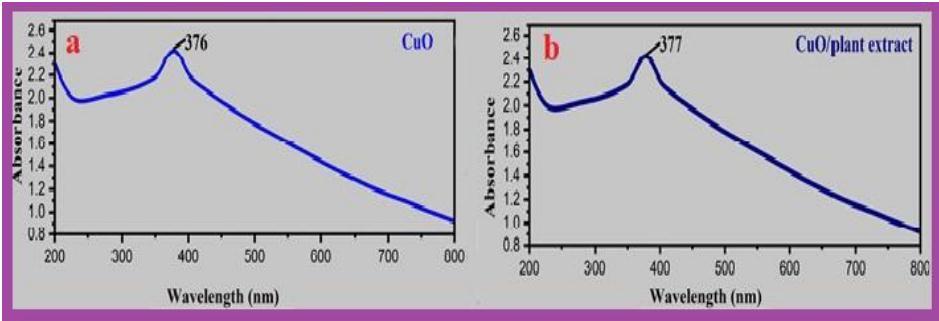
Fig.no.4 UV-Vis spectrum of copper oxide nanoparticles synthesized via a) chemical and b) green synthesis
2026, IRJET | Impact Factor value: 8.315 | ISO 9001:2008 Certified Journal | Page572
International Research Journal of Engineering and Technology (IRJET) e-ISSN: 2395-0056
Volume: 13 Issue: 01 | Jan 2026 www.irjet.net p-ISSN: 2395-0072
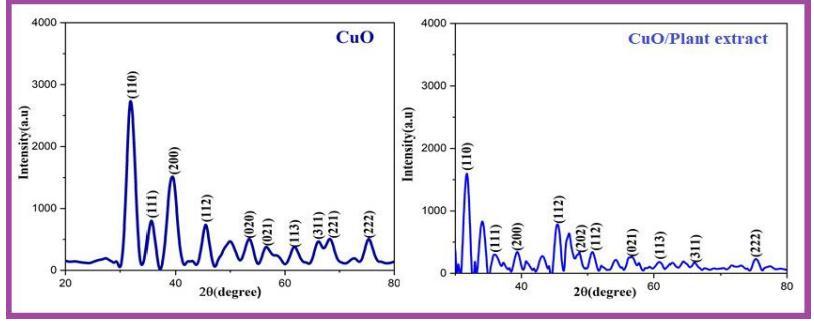
XRD analysis revealed that the synthesized copper oxide nanoparticles possessed a well-defined crystalline structure. The diffractionpeaksobtained matchedstandard reference patterns,confirmingthemonoclinicphaseofCuO.Noimpuritypeaks were detected, indicating high purity of the synthesized nanoparticles. The average particle size calculated using the DebyeScherrer equation was approximately 43 nm for chemically synthesized nanoparticles and 37 nm for green-synthesized nanoparticle.
ANTIMICROBIAL ACTIVITY
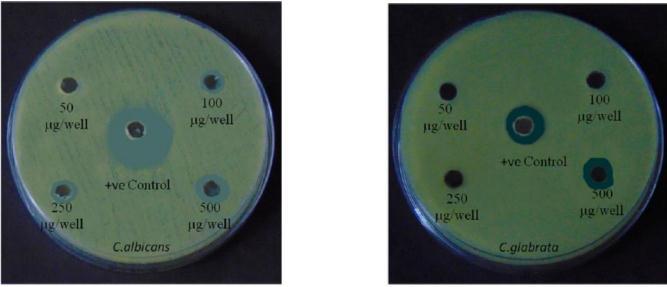
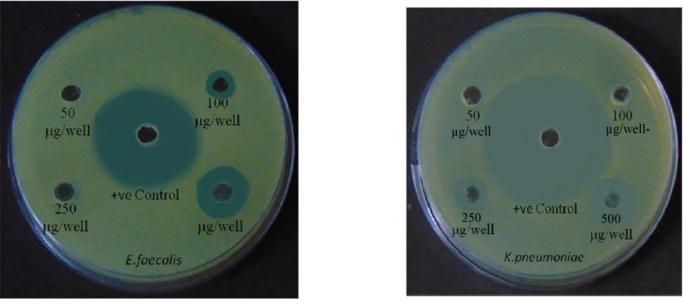
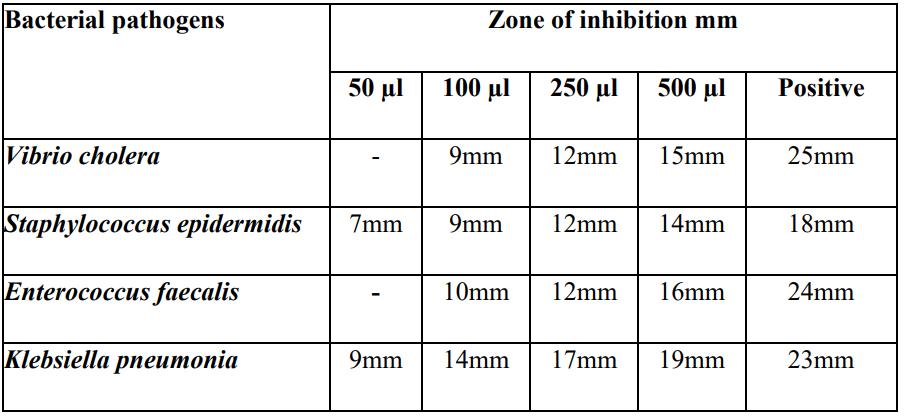
The antibacterial activity of copper oxide NPs synthesized using Vaccinium macro carpon extract was evaluated by the well diffusion method. A 24 hours old culture was inoculated for the assay. Four bacterial pathogens and four fungal pathogens wereintheantimicrobialstudy.
International Research Journal of Engineering and Technology (IRJET) e-ISSN: 2395-0056
Volume: 13 Issue: 01 | Jan 2026 www.irjet.net p-ISSN: 2395-0072
International Research Journal of Engineering and Technology (IRJET) e-ISSN: 2395-0056
Volume: 13 Issue: 01 | Jan 2026 www.irjet.net p-ISSN: 2395-0072
Copper oxide nanoparticles with a cubic morphology were successfully synthesized using the non-toxic and eco-friendly plant extract of Vaccinium macrocarpon. The synthesized copper oxide nanoparticles were characterized using UV–visible spectroscopyandX-raydiffraction(XRD)analysis.Greensynthesisofcopperoxidenanoparticlesusingnaturalresourcessuch as Vaccinium macrocarpon offersapromisingalternativetoconventionalchemicalsynthesismethods,asitisenvironmentally benignandfreefromhazardouspollutants.
The biosynthesized copper oxide nanoparticles exhibited significant antimicrobial activity against a wide range of microorganisms, including Staphylococcus epidermidis, Klebsiella pneumoniae, Vibrio cholerae, Enterococcus faecalis, Candida albicans, Candida glabrata, Aspergillus niger, and Aspergillus brasiliensis. These results demonstrate that the synthesized copperoxidenanoparticlesactaseffectiveantimicrobialagents.Basedonthesefindings,copperoxidenanoparticlesproduced throughgreensynthesismayhavebroadpotentialapplicationsinvariousscientificandtechnologicalfields
1. A. Azam, A.S. Ahmed, M. Oves, M. Khan, A. Memic, Size-dependent antimicrobial properties of CuO nanoparticles againstGram-positiveandnegativebacterialstrains,Int.J.Nanomed.7(2012)3527
2. .A.Khan,A.Rashid,R.Younas,R.Chong,Achemicalreductionapproachtothesynthesisofcoppernanoparticles,Int. NanoLett.6(2016)21–26.
3. A.T. Babu, R. Antony, Green synthesis of silver doped nano metal oXides of zinc and copper for antibacterial properties,adsorption,catalytichydrogenationandphotodegradationofaromatics,J.Environ.Chem.Eng.(2018).
4. AbboudYetal2014Biosynthesis,characterizationandantimicrobialactivityofcopperoxidenanoparticles(CONPs) producedusingbrownalgaextract(Bifurcariabifurcate)Appliednanoscience4571–6
5. Ahamed M et al 2014 Synthesis, characterization, and antimicrobial activity of copper oxide nanoparticles J. of nanomaterials201417
6. Ahamed S, Ahmad S, Bibi A, Ishaq MS, Afridi MS, Kanwal F et al (2014) Phytochemical analysis,antioxidant activity, fattyacidscomposition,andfunctionalgroupanalysisofHeliotropiumbacciferum.SciWorldJ:1–8.
7. Ahmed, S., Chaudhry, S.A., Ikram, S,: A review on biogenic synthesis of ZnO nanoparticles using plant extracts and microbes:aprospecttowardsgreenchemistry.J.Photochem,Photobiol,B166,272-284(2017).
8. Altikatoglu, M.; Attar, A.; Erci, F.; Cristache, C.M.; Isildak, I. Green synthesis of copper oxide nanoparticles using Ocimumbasilicumextractandtheirantibacterialactivity.FreseniusEnviron.Bull.2017,25,7832–7837.