
International Research Journal of Engineering and Technology (IRJET) e-ISSN: 2395-0056
Volume: 13 Issue: 04 | Apr 2026 www.irjet.net p-ISSN: 2395-0072

International Research Journal of Engineering and Technology (IRJET) e-ISSN: 2395-0056
Volume: 13 Issue: 04 | Apr 2026 www.irjet.net p-ISSN: 2395-0072
G Sravan Kumar1 , T Rishikesh Vardhan2 , G Pravalika3 , B Snigdha4
1Dept. of Electronics and Communication Engineering, MVSR Engineering College, Hyderabad, India
2Dept. of Electronics and Communication Engineering, MVSR Engineering College, Hyderabad, India
3Dept. of Electronics and Communication Engineering, MVSR Engineering College, Hyderabad, India
Abstract - The evolution of assistive robotics has significantly enhanced the independence of individuals with severe motor impairments. However, traditional control interfaces – such as joysticks or voice recognition – often present barriers in noisy environments or for users with limitedupper-limbstrength.Thisresearchaddressesthedual challengeofmobilityandenvironmentalcontrolbydeveloping a gesture – based ecosystem. By utilizing high-sensitivity flex sensorsintegratedintoawearableglove,weproposeasystem that translates finger kinematics into precise navigational commands for an automated wheelchair. Unlike standalone mobility aids, this architecture leverages the ESP-NOW protocol to create a low-latency bridge between the user and their immediate environment, allowing for the seamless control of the household appliances alongside physical movement. This integration aims to move beyond simple transport, fostering a holistic approach to ‘ Ambient Assisted Living’ ( AAL ).
Key Words: Wheelchairs, Home Automation, implementation,intelligentwheelchair.
Assistive mobility devices are essential for improving the quality of life of individuals who experience difficulty in independent movement. Wheelchairs are widely used to supportpeoplewithphysicaldisabilities,elderlyindividuals, orpatientsrecoveringfrominjuries.Traditionalwheelchairs aretypicallyoperatedmanuallyorthroughjoystick-based electroniccontrolsystems.However,thesemethodsmaynot always be convenient for users who have limited hand strength, restricted arm movement, or neurological disorders that affect motor control. With the rapid advancementofembeddedsystemsandsensortechnology, researches have started developing more intelligent and user-friendlycontrolmechanismsformobilitydevices.One suchapproachisgesture-basedcontrol,wherehumanbody movements are used as input commands to operate electronicsystems.Handgesturesareparticularlysuitable forassistivetechnologiesbecausetheyarenatural,intuitive, andrequireminimalphysicaleffort.
Inagesture-controlledsystem,wearablesensorsareusedto capture finger or hand movements and convert them into electrical signals. These signals are then processed by a microcontrollerthatinterpretsthemascontrolinstructions. Wireless communication technologies allow these
commandstobetransmittedtoareceiverunitthatperforms the required action. The proposed system introduces a gesture-controlledwheelchairintegratedwithabasicsmart homeautomationfeature.
Thesystemusesagloveequippedwithflexsensorstodetect finger bending. An ESP32 microcontroller processes the sensor readings and identifies predefined gestures. These commandsaretransmittedwirelesslyusingtheESP-NOW communicationprotocoltoanotherESP32unitmountedon thewheelchair.Thereceiverthencontrolsservomotorsthat simulatewheelchairmovement.
SeveralResearchersaroundtheworldhaveexploredvarious technologiestoenhancethefunctionalityandaccessibilityof intelligent wheelchairs. Early electric wheelchairs were mainly controlled using joysticks or mechanical switches. Althoughthesesystemsprovidedbasicmobilityassistance, they were not suitable for users who had limited hand coordinationormusclestrength.
Thelandscapeofsmartwheelchairresearchhashistorically transitioned from mechanical improvements to sophisticated human-machine interfaces (HMI). Early breakthroughs, such as the work by Kim et al. (1997), emphasized the necessity of 'shared control,' where the system assists the user in obstacle avoidance. While effective,thesesystemsoftenreliedonrigidinputmethods. Morerecentexplorationshaveshiftedtowardphysiological andkineticsignaling.StudiesbyWangandPopovic(2009) demonstratedthatwearablesensorscouldprovideamore intuitive 'language' for machine control compared to traditional joysticks. However, a recurring limitation in existing literature (such as the work discussed by Lu Tao regardingintelligenttrends)isthe'siloed'natureofthese devices; they focus either on mobility or on smart home interaction,butrarelyboth.
CurrentresearchintoBrain-ComputerInterfaces(BCI)offers high autonomy but suffers from high computational costs and user fatigue. In contrast, this project builds upon the efficiencyofMicro-Electro-MechanicalSystems(MEMS),as seeningesture-recognitionstudies,butoptimizesthedata transmissionlayer.ByreplacingstandardBluetoothorWi-Fi with the ESP-NOW protocol, we address the latency and powerconsumptiongapsidentifiedinpreviouswirelessHMI
International Research Journal of Engineering and Technology (IRJET) e-ISSN: 2395-0056
Volume: 13 Issue: 04 | Apr 2026 www.irjet.net p-ISSN: 2395-0072
implementations.Anotheradvancedapproachinvolvesthe useofbrain–computerinterfaces(BCI),wherebrainsignals are used to control assistive devices. These system offer promising possibilities but often require specialized equipment and complex signal processing techniques, makingthemexpensiveanddifficulttoimplementinlowcost applications. Gesture recognition has emerged as a practicalanduser-friendlymethodforcontrollingelectronic devices.
Manystudieshavefocusedontheuseofwearablesensors such as accelerometers, gyroscopes, cameras, and flex sensorstodetecthandgestures.Amongthesetechnologies, flexsensorsarewidelyusedinglove-basedsystemsbecause theydirectlymeasure finger bendingandprovide reliable inputsignals.
Theproposedsystemisdevelopedtocontrolawheelchair and a basic home appliance using hand gestures detected through wearable sensors. The methodology involves the integration of sensing devices, microcontrollers, wireless communication,actuators,andarelayswitchingmechanism. Thecompletesystemisdividedintotwomajorsections:the gesture detection (transmitter) unit and the wheelchair control(receiver)unit.Theoveralloperationofthesystemis achievedthroughasequenceofsensing,signalprocessing, wirelesscommunication,andactuatorcontrol.Thegesture detection unit consists of a wearable glove equipped with flexsensorsattachedtothefingers.Flexsensorsarevariable resistivedeviceswhoseresistancechangesdependingonthe bending angle of the sensor. When a finger bends, the sensor’s resistance increases, which produces a correspondingchangeintheoutputvoltage.
Eachflexsensorisconnectedtotheanaloginputpinsofthe ESP32microcontrollerusingavoltagedividerconfiguration. As the user moves their fingers, the ESP32 reads the changing analog values through its internal Analog-toDigitalConverter(ADC).Thesesensor readingsrepresent different finger positions and form the basis for gesture recognition. After acquiring the analog values from the sensors, the ESP32 processes the data by comparing the readingswithpredefinedthresholdvalues.Thesethreshold valuesdetermine whethera fingerisina bentorstraight position. Based on the detected finger movement, the systemassignsaspecificcommandtoeachgesture.
Forexample:
Index finger bending corresponds to the left movementcommand.
Little finger bending corresponds to the right movementcommand.
Ringfingerbendingindicatesaforwardmovement command.
Middle finger bending represents the backward movementcommand.
Thumb bending is used to toggle the home appliancecontrol.
The ESP32 converts these gesture interpretations into command messages that will be transmitted to the wheelchaircontrolunit.
To allow wireless interaction between the glove and the wheelchair system, the project uses the ESP-NOW communication protocol. ESP-NOW is a peer-to-peer wireless communication method supported by ESP32 devices,enablingdirectdataexchangewithouttheneedfor a traditional Wi-Fi network. In the transmitter unit, the ESP32 sends the generated command message to the receiver ESP32. The ESP-NOW protocol ensures fast data transfer and minimal communication delay, which is essentialforreal-timecontrolofthewheelchair.
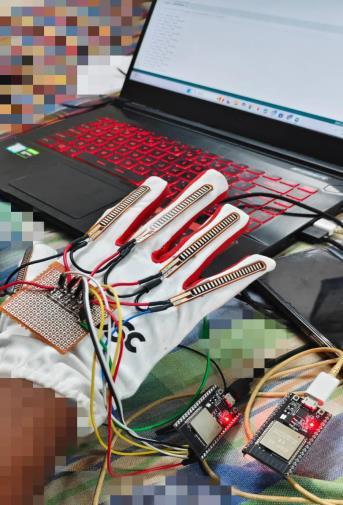
Overall,Thedecodedcommandisthenusedtocontrolthe actuators responsible for wheelchair movement and applianceoperation.TwoSG90servomotorsareusedinthe systemtosimulatewheelchairmovement.Oneservomotor isresponsibleforcontrollingthesteeringdirection(leftor right),whilethesecondservomotorcontrolstheforward andbackwardstepmovement.
Basedonthereceivedcommand:
IfthecommandisLEFT,thesteeringservorotates intheleftdirection.
IfthecommandisRIGHT,thesteeringservorotates intherightdirection.
International Research Journal of Engineering and Technology (IRJET) e-ISSN: 2395-0056
Volume: 13 Issue: 04 | Apr 2026 www.irjet.net p-ISSN: 2395-0072
IfthecommandisFORWARD,themovementservo performsaforwardmotion.
IfthecommandisBACKWARD,themovementservo performabackwardmotion.
System Workflow: StartSystem→GestureInput→Signal Acquisition→GestureDetection→CommandGeneration→ WirelessTransmission→CommandReception→Command Processing → Motor Control Execution → Wheelchair Movement→LoopContinuation
TheproposedGestureControlWheelchairwithSmartHome Automation is designed as an embedded system that integratesgesturesensing,wirelesscommunication,motion control,andapplianceswitching.Thesystemarchitectureis organizedintotwoprimarymodules:thegesturedetection unit(transmittermodule)andthewheelchair control unit (receivermodule).Thesemodulescommunicatewirelessly using the ESP-NOW protocol supported by ESP32 microcontrollers.Thearchitectureallowsusergesturestobe detected,processed,transmitted,andexecutedinrealtime. The transmitter module functions as the user interaction interfaceofthesystem.Itconsistsofflexsensorsattachedto thefingersofa wearableglove,anESP32microcontroller, andsupportingelectricalcomponents.
The ESP32 continuously reads these analog signals and comparesthemwithpredefinedthresholdvalues.Basedon these values, the microcontroller identifies the gesture performed by the user. After command generation, the ESP32transmittersendsthedatawirelesslytothereceiver moduleusingtheESP-NOWcommunicationprotocol,which enables fast and efficient device-to-device communication withoutrequiringatraditionalWi-Finetwork.
The Communication between the gesture glove and the wheelchaircontrolunitisestablishedusingESP-NOW,alowlatency wireless protocol developed for ESP-series microcontrollers.Thisprotocolallowsdirect-peer-to-peer dataexchangebetweenESP32devices.
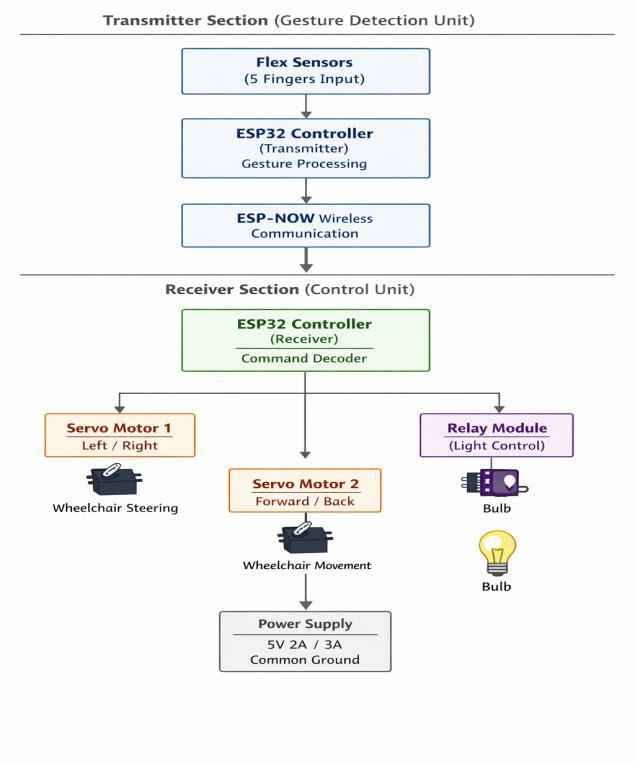
Fig-2: SystemArchitectureofaproposedsystem.
In the system architecture, the transmitter ESP32 sends command packets that contain the interpreted gesture information. The receiver ESP32 listens for these packets and processes them immediately upon arrival. The use of ESP-NOWensuresminimalcommunicationdelay,whichis essentialforresponsivewheelchairmovementandreal-time control.Thereceivermoduleismountedonthewheelchair platformandactsasthecontrolcenterfortheentiresystem. ItconsistsofanotherESP32microcontroller,servomotors for movement control, and a relay module for home applianceswitching.
The receiver ESP32 continuously monitors incoming wirelessmessagesfromthetransmitter.Onceacommandis received, the controller decodes the instruction and determinestheappropriateaction.
Forwheelchairmovement,theESP32sendscontrolsignals totwoSG90servomotors.Oneservomotorisresponsible forsteeringcontrol,enablingthewheelchairtomoveleftor right. The second servo motor handles the forward and backward movement mechanisms. When the receiver interpretsadirectionalcommand,itrotatestheappropriate servo motor to produce the desired movement. This mechanismallowsthewheelchairtoresponddirectlytothe user’shandgestures.Allcomponentsarepoweredusinga5V power supply, and a common ground connection is maintainedtoensurestableoperationoftheESP32,servo motors,andrelaymodule.
International Research Journal of Engineering and Technology (IRJET) e-ISSN: 2395-0056
Volume: 13 Issue: 04 | Apr 2026 www.irjet.net p-ISSN: 2395-0072
Overall, the system allows a user to control wheelchair movementandhomeappliancesusingsimplehandgestures, makingitespeciallyusefulforassistingpeoplewithmobility disabilities.
TheimplementationoftheGestureControlWheelchairwith Smart Home Automation involves the integration of hardwarecomponentsandembeddedsoftwaretocreatea functionalassistivesystem.Thesystemisdevelopedusing two ESP32 microcontrollers that communicate wirelessly using the ESP-NOW protocol. The overall implementation includes the setup of the gesture detection unit, wireless communication configuration, actuator control, and home automationswitching.Thehardwareportionofthesystemis dividedintotwomainsections:thetransmitterunitandthe receiverunit.
The transmitter unit is responsible for detecting hand gesturesandgeneratingcontrolcommands.Inthisunit,five flexsensorsareattachedtothefingersofaglovesothateach sensor corresponds to a specific finger movement. The ESP32 continuously reads the analog signals from the sensorsandprocessesthevaluestodeterminethegesture beingperformed.Basedonpredefinedthresholdvalues,the systemidentifiesthecorrespondingcommandsuchasleft, right,forward,backward,orlightcontrol.Afteridentifying thegesture,theESP32preparesacommandmessagethat willbetransmittedtothereceivermodule.
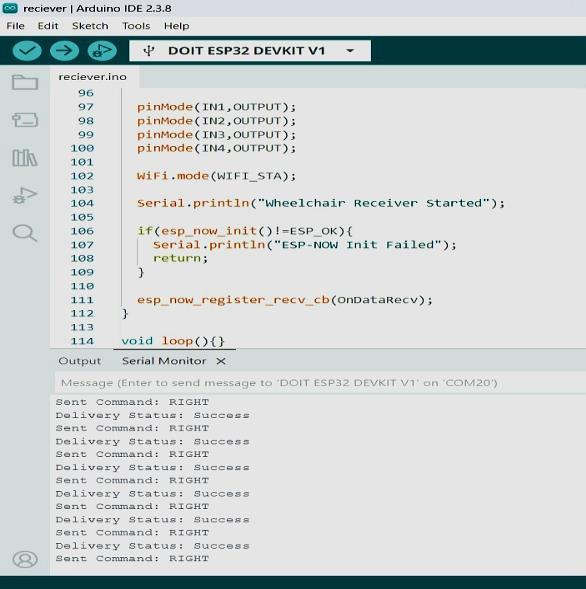
Thereceiverunitisinstalledonthewheelchairplatformand isresponsibleforexecutingthecommandsreceivedfromthe transmitter. It consists of another ESP32 microcontroller, two SG90 servo motors, and a relay module. The receiver ESP32 operates in listening mode and waits for wireless commands sent from the transmitter ESP32. When a
command is received, the controller interprets the instructionandactivatestheappropriateactuator.
Oneservomotorisusedtocontroltheleftandrightsteering movement, while the second servo motor manages the forward and backward motion. These servo motors are connected to the digital output pins of the ESP32 and are controlled using pulse-width modulation (PWM) signals generatedbythemicrocontroller.Communicationbetween thetransmitterandreceivermodulesisachievedusingthe ESP-NOW protocol, which enables direct wireless communicationbetweenESP32deviceswithoutrequiringa routerorinternetconnection.ThetransmitterESP32sends command packets containing gesture information to the receiver ESP32. The receiver is configured with the transmitter’sMACaddresstoallowsecurecommunication between the two devices. This communication method providesfastdatatransmissionwithminimaldelay,allowing real-time control of the wheelchair system. Gesture recognitionisimplementedthroughthresholdcomparison ofsensorvalues.TheESP32readstheanalogvaluesfromthe flexsensorsand compares them with predefinedlimits to determinewhetherafingerisbentorstraight.
Eachfingergesturecorrespondstoaspecificcommand:
Indexfinger→Moveleft
Littlefinger→Moveright
Ringfinger→Moveforward
Middlefinger→Movebackward
Thumb→TogglelightON/OFF
Volume: 13 Issue: 04 | Apr 2026 www.irjet.net p-ISSN: 2395-0072
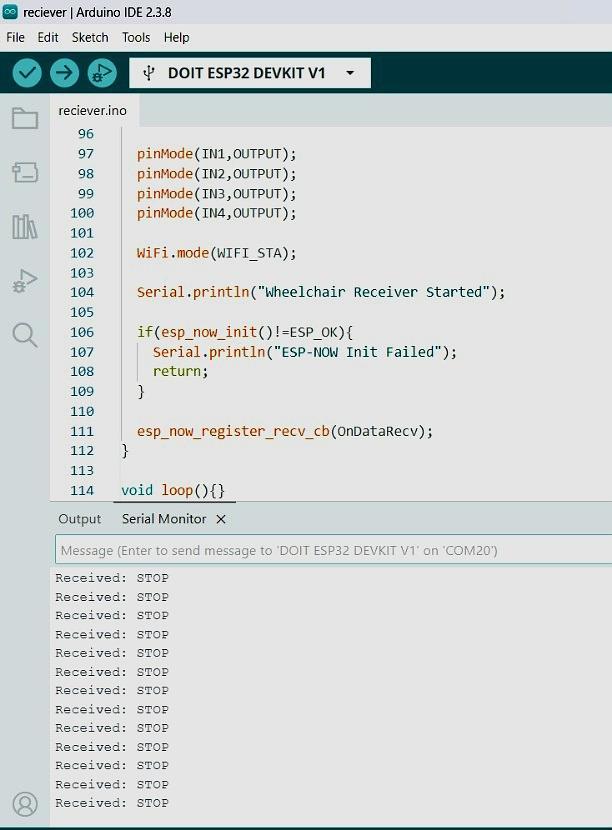
Fig-4:StopCommand(indicationofimplementation)
Whenagestureisdetected,thetransmitterESP32converts the recognized pattern into a command string. This command is then transmitted wirelessly to the receiver ESP32.ThereceiverESP32processesthereceivedcommand andcontrolstheservomotorsaccordingly.
Whenaleftcommandisreceived,thesteeringservo rotatesintheleftdirection.
When a right command is received, the steering servorotatesintherightdirection.
When a forward command is detected, the movement servo rotates to produce forward motion.
When a backward command is received, the movementservorotatesintheoppositedirectionto producereversemovement.
This motor control mechanism enables the wheelchair to move according to the user’s hand gestures. The home automation functionality is implemented using a relay moduleconnectedtothereceiverESP32.Therelayactsasan electricallyoperatedswitchthatcontrolsthepowersupply toanexternalACdevice.Whentheuserperformsthethumb gesture,thetransmittersendsacommandtotoggletherelay state.ThereceiverESP32thenactivatesordeactivatesthe relay,switchingtheconnectedbulbONorOFF.Thisfeature demonstrates the ability to control household appliances usingsimplehandgestures. Allcomponentsinthesystem arepoweredusinga5VDCadapterwithacurrentcapacity of2Aor3A.Thispowersupplyprovidessufficientcurrentto operatetheESP32modules,servomotors,andrelaymodule simultaneously.
The results are monitored through the Arduino IDE serial monitor, where transmitted and received commands are displayed. Successful command transmission and correct actuator response confirm that the system functions as intended.
After completing the hardware assembly and software programming, the gesture control wheelchair system was testedtoevaluateitsperformanceandreliability.Thesystem consisted of two ESP32 microcontrollers configured as transmitterandreceivermodules.Thetransmitterunitwas connectedtofiveflexsensorsmountedonaglove,whilethe receiverunitwasconnectedtotwoSG90servomotorsanda relaymodulecontrollingademonstrationbulb.Thepower supply was provided using a 5V adapter capable of deliveringsufficientcurrenttooperatetheESP32modules, servo motors, and relay simultaneously. All components were connected with a common ground to ensure stable electricaloperation.

The Arduino IDE serial monitor was used to observe the communication between the transmitter and receiver modulesandtoverifythatgesturecommandswerecorrectly transmitted and executed. During testing, the flex sensors successfully detected finger bending movements and produced measurable variations in analog voltage values. TheESP32transmittercontinuouslymonitoredthesevalues and compared them with predefined threshold levels to identifyspecificgestures.
Eachfingermovementwasmappedtoauniquecommand. Whenafingerwasbentbeyondthedefinedthreshold,the corresponding command was generated and prepared for wirelesstransmission.Thesystemdemonstratedconsistent gesture detection when the sensors were properly positionedontheglove.
Examplecommunicationoutputobservedduringtesting:
Transmitter Output:
SentCommand:LEFT_FORWARDDeliveryStatus:Success
Receiver Output:
ReceivedCommand:LEFT_FORWARD
Testing showed that directional commands such as left, right,forward,andbackwardwereexecutedreliablywhen gestures were clearly performed. The relay module connectedtothereceiverESP32wastestedusingthethumb gesture assigned for appliance control. When the thumb gesture was detected, the transmitter sent a command to toggletherelaystate.
Uponreceivingthiscommand,thereceiverESP32activated ordeactivatedtherelay,switchingtheconnectedbulbonor off.Theswitchingoperationoccurredimmediatelyafterthe gesture command was received, demonstrating that the systemcouldeffectivelycontrolexternalelectricaldevices.
Overall, the results confirm that the proposed system successfullydemonstratestheconceptofgesture-controlled
International Research Journal of Engineering and Technology (IRJET) e-ISSN: 2395-0056
Volume: 13 Issue: 04 | Apr 2026 www.irjet.net p-ISSN: 2395-0072
wheelchair operation combined with basic smart home automationfeatures.
The Gesture Control Wheelchair with Smart Home Automationprojectdemonstratesapracticalapproachfor assisting individuals with limited mobility by enabling wheelchair control through simple hand gestures. The system integrates flex sensors, ESP32 microcontrollers, wireless communication technology, and actuator componentstocreateanintuitiveandresponsiveassistive device.
Inthisproject,flexsensorsmountedonawearablegloveare used to detect finger bending movements. These sensor readings are processed by the ESP32 transmitter, which interprets the gestures and converts them into control commands.Thecommandsarethentransmittedwirelessly usingtheESP-NOWprotocoltoareceiverESP32locatedon the wheelchair control unit. The receiver processes the incomingdataandactivatesthecorrespondingservomotors to control the direction of movement such as left, right, forward,orbackward.
The system also incorporates a basic home automation feature by integrating a relay module that controls an externalelectricaldevice.
Overall, the developed system provides a simple, costeffective, and user-friendly solution for gesture-based wheelchair control combined with basic smart home functionality. By allowing users to control movement and appliancesusingnaturalhandgestures,thesystemhasthe potential to improve convenience and independence for individualswithmobilitychallenges.
Although the current prototype demonstrates the core conceptsuccessfully,furtherenhancementssuchasobstacle detection, speed regulation, and advanced gesture recognition techniques could improve safety and functionality.Withadditionaldevelopment,thistechnology could be adapted for real-world assistive mobility applications and integrated with more advanced smart environments.
[1] Rajesh Kannan Megalingam, Ramesh Nammily Nair, “Automated Voice based Home Navigation System for the Elderly and the Physically Challenged”Feb.13~16,2011
[2] J.S.Kim,C.S.Lee,K.J.Song,B.Min,Z.Bien,“Real-time handgesturerecognitionforavatarmotioncontrol”
ProceedingsofHCI'97, pp.96-101,February1997
[3] R.Wang,J.Popovic“Real-timehand-trackingwitha colorglove,”ACMTransactionsonGraphics,vol.28, pp461-482,2009
[4] “Vision Based Hand Gesture Recognition For Computer Interaction A Survey” By Anupam Agarwal And Siddharth S.Rautaray In Springer ScienceBusinessMediaDordrecht2012
[5] “AnApproachToGlove-BasedGestureRecognition” Farid Parvini, Dennis Mc leod , Cyrus Shahabi, Bahareh Navai, Baharak Zali, Shahram Ghandeharizadeh Computer Science Department University Of Southern California Los Angeles, California90089-0781[Fparvini,Mcleod,Cshahabi, Navai,Bzali,Shahram]
[6] Lu Tao, Yuan Kui and Zhu Haibing, "Current Situation and Trend of Intelligent Wheelchair Research",RobotTechnologyandApplication,Vol.2, pp:1-5,2008.
[7] P.Jia, H.Hu, T.Lu and K.Yuan, "Head gesture recognitionforhands-freecontrolofanintelligent wheelchair", Journal of Industrial Robot,Vol.34,No.1,pp:60-68,2007
[8] YiZhang,JiaoZhang,YuanLuo,"ANovelIntelligent WheelchairControlSystemBasedOnHandGesture Recognition",Proceedingsofthe2011IEEE/ICME International Conference on Complex Medical Engineering, May 2225,Harbin,China,pp:334339,2011.
[9] Takeshi Saitoh, Noriyuki Takahashi and Ryosuke Konishi "Oral Motion Controlled Intelligent Wheelchair", SICE Annual Conference, Kagawa University,Japan,pp.
[10]Hill,Jim(12September2015)."Thesmarthome:a glossaryguidefortheperplexed".T3.Retrieved27 March2017.
[11]Home Automation & Wiring (1 ed.). New York: McGraw-Hill/TAB Electronics. 1999-03-31. ISBN 978-0-07-024674-4.
[12]Rye,Dave(October1999)."MyLifeatX10".AVand AutomationIndustryeMagazine.Archivedfromthe originalonSeptember30,2014.RetrievedOctober 8,2014.
[13]"1.5MillionHomeAutomationSystemsInstalledin the US This Year". ABI Research. November 19, 2012.Retrieved2016-11-22.
[14]"Smart Home – United States | Statista Market Forecast".Statista.Retrieved2019-11-07.