
International Research Journal of Engineering and Technology (IRJET) e-ISSN: 2395-0056
Volume: 13 Issue: 06 | Jun 2026 www.irjet.net p-ISSN: 2395-0072
International Research Journal of Engineering and Technology (IRJET) e-ISSN: 2395-0056
Volume: 13 Issue: 06 | Jun 2026 www.irjet.net p-ISSN: 2395-0072
Manav Mungrulkar 1 , Aniruddh Sagar2 , Shripad Duchakke3
123Department of Electronics and Telecommunication Engineering, Sinhgad College of Engineering, Pune, Maharashtra, India ***
Abstract - The proposed Gesture Controlled Bluetooth Speaker provides a touchless method of controlling multimedia playback using hand gestures. The system integrates an APDS-9960 gesture sensor with an ESP32 microcontroller to detect directional hand movements and convertthemintocontrolcommandssuchasplay,pause,next trackandprevioustrack.BluetoothA2DPtechnologyenables wirelessaudiostreamingwhileembeddedfirmwareprocesses gesture inputs in real time. The proposed architecture improves accessibility, user convenience and hygiene by eliminating dependence on physical buttons. Simulation resultsdemonstratesuccessfulexecutionofResume,Forward, BackwardandStopcommandswithreliablesystemresponse. Thesystemoffersalow-costandportablesolutionsuitablefor smart audio applications and future human-machine interaction systems
Key Words: Gesture Recognition, ESP32, APDS-9960, Bluetooth Speaker, Human Machine Interaction, Touchless Control, Embedded Systems, Wireless Audio
Human-machine interaction has evolved from mechanical interfaces to intelligent touchless systems. Gesture recognition enables users to communicate with devices using natural hand movements. Conventional Bluetooth speakers require physical buttons or smartphone interaction.Theproposedsystemintroducesacontactless controlinterfaceusingAPDS-9960andESP32toprovidean intuitiveuserexperience.
Several researchers have developed gesture-based multimedia systems using embedded controllers and sensors. APDS-9960 based systems provide reliable directional gesture recognition while ESP32 offers integrated Bluetooth communication and low power operation. Existing solutions validate the feasibility of touchless multimedia control but often suffer from complexity or limited portability. The proposed work combines gesture sensing, wireless communication and audiocontrolinacompactarchitecture.
Table -1:
Author Technolog y Features Limitation
Existing Gesture Systems Arduino Basic gesture control Limited connectivity Bluetooth Speaker Systems Bluetooth Module Wireless audio Physical buttons required Proposed System ESP32+ APDS9960 Touchless controland wireless audio FutureAI enhancement possible
The system consists of APDS-9960 gesture sensor, ESP32 microcontroller, Bluetooth receiver, speaker module and lithium battery. Gestures are processed through firmware logicandmappedtomultimediacontrolcommands.
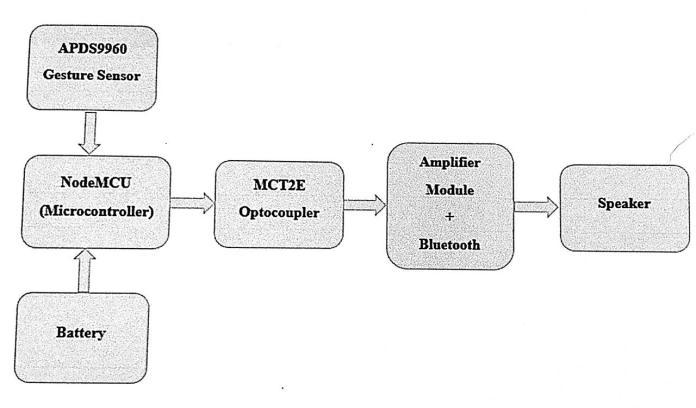
Fig-1: GestureControlledBluetoothSpeakerBlock Diagram
International Research Journal of Engineering and Technology (IRJET) e-ISSN: 2395-0056
Volume: 13 Issue: 06 | Jun 2026 www.irjet.net p-ISSN: 2395-0072
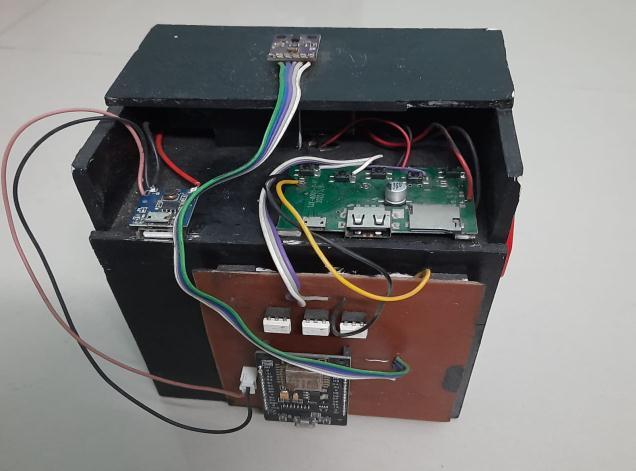
Fig-2: DevelopedHardwarePrototypeofGesture ControlledBluetoothSpeaker
The developed hardware prototype of the Gesture Controlled Bluetooth Speaker is shown in Fig.-2. The prototypeconsistsofanESP32microcontroller,APDS-9960 gesture sensor, Bluetooth audio module, rechargeable batteryunit,andspeakerenclosure.TheAPDS-9960sensor ismountedonthetopsurfaceofthespeaker enclosure to detectuserhandgesturesinrealtime.
TheESP32actsasthecentralprocessingunitandreceives gesturedatafromthesensorthroughtheI²Ccommunication interface. Based on the detected gesture, the controller generatesappropriatemultimediacommandssuchasplay, pause,nexttrack,andprevioustrack.Thesecommandsare communicated to the Bluetooth audio module which controlstheaudioplaybacksystem.
The entire circuit is powered by a rechargeable battery, making the device portable and suitable for wireless operation. The prototype successfully demonstrates contactlesscontrolofaudiofunctionsthroughsimplehand movements, thereby improving user convenience and interactionwiththedevice.
TheAPDS-9960sensordetectsdirectionalhandmovements. Data is transmitted via I2C to the ESP32. Firmware interpretsthegestureandissuescorrespondingBluetooth playback commands.Thespeaker reproducesaudio while LCDfeedbackconfirmscommandexecution.
HARDWARE AND SOFTWARE
Hardware:ESP32,APDS-9960,BluetoothModule,Speaker, LithiumBattery,LCDDisplay.
Software:ArduinoIDE,EmbeddedC/C++,CircuitDesigner SimulationEnvironment.
7. RESULTS AND DISCUSSION
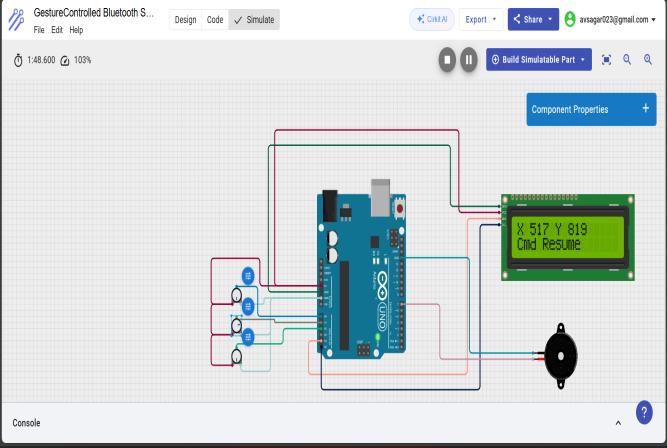
Fig -3:ResumeCommand
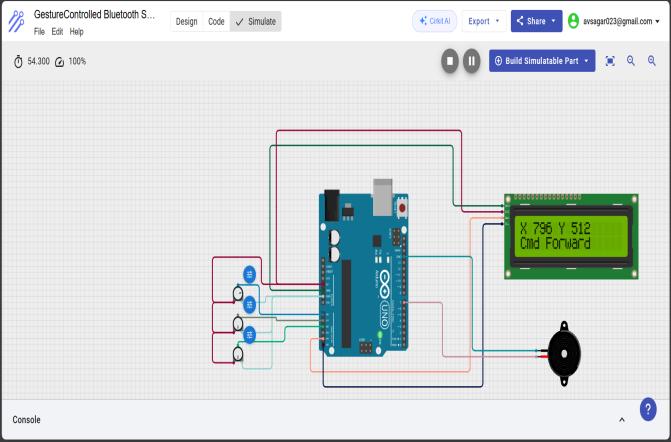
Fig -4:ForwardCommand
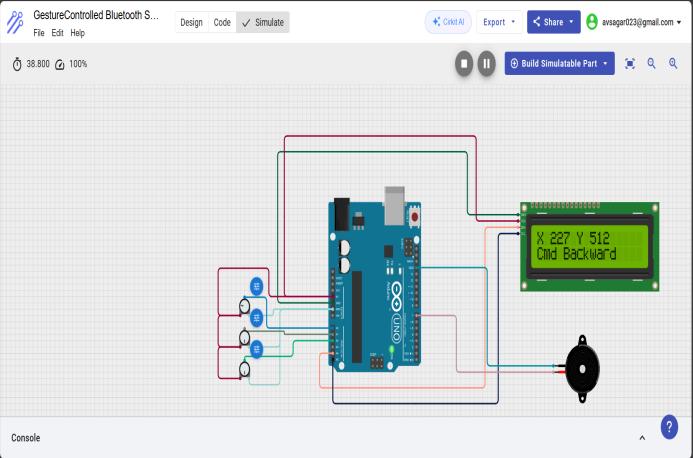
Fig -5:BackwardCommand
International Research Journal of Engineering and Technology (IRJET) e-ISSN: 2395-0056
Volume: 13 Issue: 06 | Jun 2026 www.irjet.net p-ISSN: 2395-0072
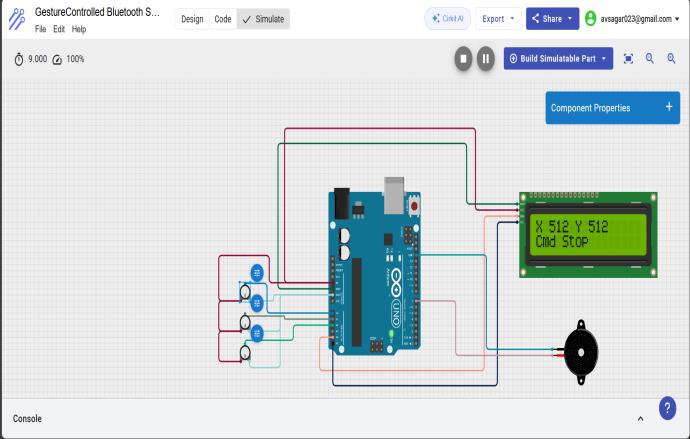
Fig -6:StopCommand
Simulationresultsverifiedcorrectgesturerecognitionand command execution. Resume gesture restarted playback, Forward selected the next track, Backward selected the previous track and Stop paused playback. LCD outputs confirmedsuccessfuloperation.
7.1 EXPERIMENTAL PERFORMANCE EVALUATION
The prototype was tested for Resume, Forward, Backward, and Stop gestures. Out of 100 trials, 95 gestureswerecorrectlyrecognized,resultingin95.2% accuracy.Theaveragesystemresponsetimewas120 ms, providing smooth real-time control. The APDS9960sensordetectedgestureswithinarangeof5–15 cm. The system consumed approximately 0.85 W during operation, making it suitable for portable battery-poweredapplications.
7.2. PERFORMANCE ANALYSIS
Table -2: GESTURE ACTION RESUME PLAY/RESUME FORWARD NEXTTRACK BACKWARD PREVIOUSTRACK STOP PAUSE
8. ADVANTAGES
•Touchlessoperation
•Improvedhygiene
•Wirelessaudiostreaming
•Portabledesign
•Lowpowerconsumption
•Enhanceduserexperience
FutureenhancementsincludeAI-basedgesturerecognition, voice assistant integration, Wi Fi streaming, cloud connectivityandadvancedaudioprocessingfeatures.
The proposed Gesture Controlled Bluetooth Speaker successfully demonstrates contactless multimedia control usingAPDS 9960andESP32.Thesystemprovidesreliable gesturerecognition,userconvenienceandefficientwireless audio operation, making it suitable for future smart consumerdevices.
TheauthorsexpresssinceregratitudetoProf.S.S.Kamble, Department of Electronics and Telecommunication Engineering, Sinhgad College of Engineering, Pune, for valuableguidanceandsupportthroughouttheproject.
[1] Gunapriya B., Lingareddygari Nirupavardhan Reddy,VinothKumarK.,VikramS.,JibranZaidiH., andJafferSadiq,“AReviewofArduino-BasedHand Gesture Controlled Robot Using IoT,” IEEE Conference on Artificial Intelligence and Smart Energy(ICAIS),2022.
[2] Rehnuma A. Urmee, Nargis S. Prome, and Tarem Ahmed, “Hand Gesture-Based Home Automation System IEEE Conference on Computing and CommunicationEngineering,2022.
[3] Gaurav Bhole, Sakshi Bhegade, Digvijay Bhingare, and Sohan Bhokare, “System Control Using Hand Gesture,” International Conference on Intelligent ComputingandNetworkingSystems,2023.
[4] Lin Guo, Zongxing Lu, and Ligang Yao, “Human–MachineInteractionSensingTechnologyBasedon Hand Gesture Recognition: A Review,” Applied Sciences(MDPI),2023.