
International Research Journal of Engineering and Technology (IRJET) e-ISSN: 2395-0056
Volume: 12 Issue: 09 | Sep 2025 www.irjet.net p-ISSN: 2395-0072
International Research Journal of Engineering and Technology (IRJET) e-ISSN: 2395-0056
Volume: 12 Issue: 09 | Sep 2025 www.irjet.net p-ISSN: 2395-0072
Shatayu Khante1 , Keshav Mundhe2 , Ganesh Malleshe3 , Vartika Shivankar4 ,Yashwani Rao5
12345Department of Computer Science and Engineering, Gurunanak Institute of Engineering and Technology, Nagpur, India
Abstract - Local retailers face challenges in competing with large e-commerce platforms due to limited digital presence, reliance on offline methods, and lack of affordabledigitaltools.Theseconstraintsreducecustomer reach, efficiency, and long-term sustainability. To address this, we propose a Full-Stack E-Commerce Platform for Local Retailer using the MERN stack (MongoDB, Express.js, React.js, Node.js). The platform enables an individual shopkeeper to digitise operations through inventory management, online order processing, and a responsive storefront. Customers can browse products, place orders, and interact with the retailer in a seamless digital environment. The system emphasizes costeffectiveness, scalability, and accessibility, making it suitable even for non-technical vendors. By bridging the gap between offline and online commerce, the proposed solutionsupports Digital India’s vision while empowering small businesses to expand their reach. Futureextensions include multi-vendor support, secure payment gateway integration,andanalytics-driveninsights.
Key Words: E-Commerce, Local Retailers, MERN Stack, Digital Transformation, Inventory Management, Online Orders,WebApplication
In the rapidly evolving digital economy, small and local businesses face growing challenges in competing with large-scale e-commerce platforms. While online shopping has become mainstream, many shopkeepers continue to rely on traditional offline practices. This limits their visibility, restricts scalability, and prevents them from meeting changing customer expectations. Digitization is no longer optional but a necessity for business survival andgrowth.
The proposed project, titled “Full-Stack E-Commerce Platform for Local Retailer,” aims to bridge this digital divide by providing a cost-effective and scalable web application tailored for individual vendors. Developed using the MERN stack (MongoDB, Express.js, React.js, Node.js), the platform enables shopkeepers to manage product inventories, process customer orders, and maintain an online storefront. Customers can browse products, place orders, and interact with the retailer throughamodernandintuitiveinterface.
Local retailers play a vital role in the economy by supplying essential goods, generating employment, and sustaining communities. However, they face constraints suchas:
• Limitedreachbeyondtheirimmediatelocality.
• Lack of online ordering and inventory tracking mechanisms.
• Insufficient technical knowledge and resources to adoptdigitaltools.
Byofferinganeasy-to-useplatform,thisprojectempowers local retailers to expand their customer base, automate routine operations, and align with the broader vision of Digital India. The system contributes to inclusive growth by providing underrepresented vendors with digital accessibility, thereby helping them thrive in today’s competitivee-commerceenvironment.
E-commerceplatformshaveevolvedsignificantlyoverthe last decade, ranging from global marketplaces to smallscale retail solutions. The literature broadly categorizes these solutions into large-scale platforms, SME-focused platforms,andresearchprototypes.
PlatformssuchasAmazon,Flipkart,andShopifydominate thee-commercelandscapeduetotheiradvancedfeatures, scalability, and robust payment systems [1][2]. They providefunctionalitieslikerecommendationengines,realtime inventory management, and analytics dashboards. However, studies by Sharma [3] and Kumar & Patel [4] highlight that these platforms are often costly, complex, and not tailored for local or small retailers, who require simplerandlow-maintenancesolutions.
Severalsmall-scalee-commercesolutionstargetSMEsand local shops. Platforms like Wix e-commerce, Zoho Commerce, and OpenCart provide customizable online storefronts with basic inventory and order management [5][6].Whiletheseplatformsreducethetechnicalbarrier, research indicates that they lack AI integration for personalized recommendations, sales prediction, or automated inventory tracking, limiting their efficiency for growinglocalbusinesses[7].
International Research Journal of Engineering and Technology (IRJET) e-ISSN: 2395-0056
Volume: 12 Issue: 09 | Sep 2025 www.irjet.net p-ISSN: 2395-0072
Recent studies have explored AI and machine learning to enhance e-commerce functionality for SMEs [8][9]. For example,Singhetal.[8]developedaprototypeintegrating predictive analytics for inventory optimization, while Reddy&Joshi[9]proposedalightweightrecommendation system tailored for small-scale retailers. Despite these efforts, most prototypes are not production-ready, and practicaldeploymentremainslimited.
Given the limitations of existing solutions, the current project aims to develop a scalable, AI-integrated ecommerce platform tailored for local retailers. The platform emphasizes user-friendliness, efficient inventory management, and automated customer order handling, thereby enabling digital transformation and improved operationalefficiency[10].
The proposed Full-Stack E-Commerce Platform for Local Retailer follows a structured design methodology to ensure scalability, usability, and maintainability. The methodology focuses on translating traditional offline workflowsofshopkeepersintoareliableanduser-friendly digitalplatform.Themajorstagesareasfollows:
3.1RequirementGathering
• Interacted with local shopkeepers to understand theirdailyworkflowsandchallenges.
• Defined functional requirements such as product listing, order placement, vendor dashboard, and inventorymanagement.
• Identified non-functional requirements including scalability, mobile responsiveness, security, and easeofusefornon-technicalvendors.
3.2SystemPlanningandDesign
• Developed wireframes and mockups for customer andvendorinterfaces.
• Designed RESTful APIs for authentication, product management,andorderhandling.
• Defined MongoDB schemas for users, products, orders,andinventoryrecords.
• Ensured modular architecture for seamless MERN stackintegration.
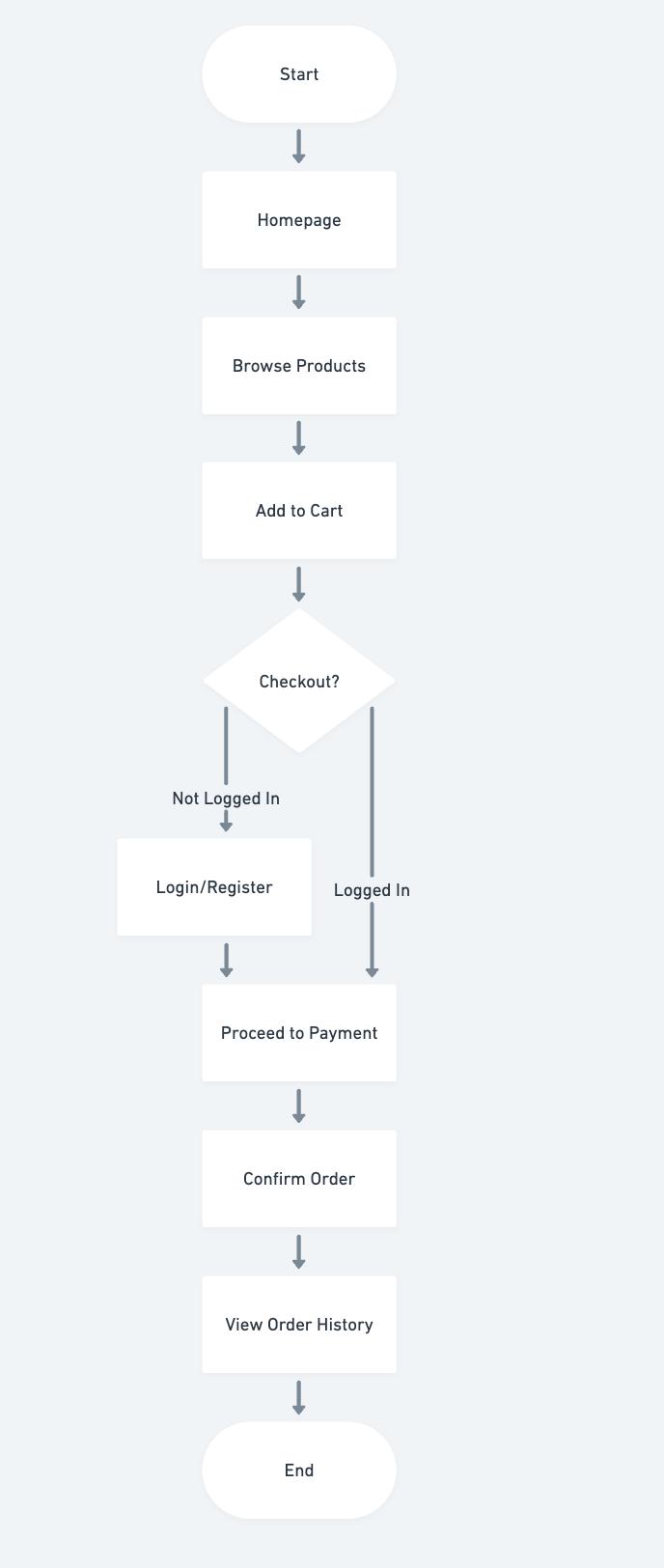
Fig-1:FlowchartoftheProposedE-CommercePlatform 3.3ModuleDevelopment
• Authentication Module: Secure vendor and customer login/signup using JSON Web Tokens (JWT).
• ProductManagementModule:Add,edit,anddelete productswithreal-timestockupdates.
• Customer Interaction Module: Product browsing, searching,cartmanagement,andcheckout.
International Research Journal of Engineering and Technology (IRJET) e-ISSN: 2395-0056
Volume: 12 Issue: 09 | Sep 2025 www.irjet.net p-ISSN: 2395-0072
• Order Management Module: Order placement, confirmation,deliverytracking,andhistory.
• Inventory Module: Auto-update of stock after purchaseandalertsforlowstock.
• Vendor Dashboard: Unified interface formanaging products,customers,andorders.
3.4TestingandDeployment
• Iterative testing after each development sprint to ensurefunctionalityandresponsiveness.
• Optimized the platform for multiple devices (desktop,tablet,mobile).
• Deployed frontend using Vercel and backend on Railway/Renderforcloudhosting.
• Ensured secure database handling and high availabilitythroughclouddeployment.
3.5SystemFlowandArchitecture
Thecustomerinteractionflowisshownintheflowchart (Fig -1), which illustrates the sequence of product browsing, cart management, authentication, and order confirmation. The block diagram (Fig -2) represents the overall MERN architecture, showing the interaction between the user interface, vendor dashboard, admin panel,backendservices,andtheMongoDBdatabase.
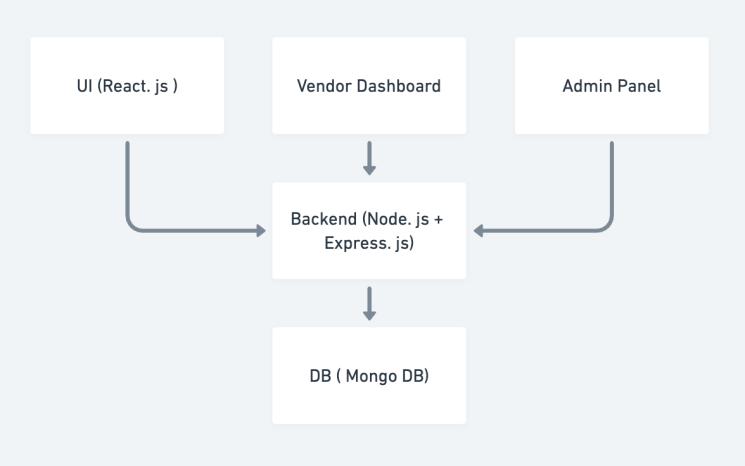
Fig-2:BlockDiagramofMERNArchitectureforthe ProposedSystem
The proposed Full-Stack E-Commerce Platform for Local Retailer was implemented using the MERN stack. The development focused on ensuring modularity, scalability, anduser-friendlinessforbothcustomersandvendors.The
system currently includes the following implemented modules:
4.1HomepageandUserInterface
The homepage serves as the primary entry point for customers. It features a modern hero section, category navigation, and product highlights. A demo shop, named WearHouse, was created to simulate a local clothing retailer. The homepage layout has been customized with uniquevisualsandbrandingtodistinguishitfromgeneric templates. This interface allows customers to browse products, explore categories (Men, Women, Bestsellers), andproceedtowardcartandcheckoutfunctionality.

Fig-3:HomepageoftheWearHouseE-CommercePlatform
4.2VendorDashboard(Planned)
The vendor dashboard is designed to allow shopkeeperstomanageproducts,inventory,andcustomer orders in real time. It includes features such as product addition/editing, low-stock alerts, and order history tracking.Whiledevelopmentofthismoduleisongoing,its designfollowstheplannedsystemarchitectureandwillbe integratedseamlesslywiththebackendAPIs.
The backend has been structured using Node.js and Express.jstohandleauthentication, product management, and order processing. MongoDB serves as the primary database for storing product details, user profiles, and transaction data. Secure authentication is achieved through JWT, ensuring both customer and vendor data privacy.
The platform is intended for deployment on cloudbasedenvironments(Vercelforfrontend,Railway/Render forbackend).Thisensuresaccessibilityacrossdevicesand supportshighavailability.Ademodeploymentlinkwillbe providedforevaluationuponcompletion.
International Research Journal of Engineering and Technology (IRJET) e-ISSN: 2395-0056
Volume: 12 Issue: 09 | Sep 2025 www.irjet.net p-ISSN: 2395-0072
The proposed Full-Stack E-Commerce Platform for Local Retailer addresses the digital gap faced by small shopkeepers by offering a scalable, affordable, and userfriendly online solution. Built using the MERN stack, the system enables retailers to digitize essential operations such as inventory management, order processing, and productdisplaythrougharesponsivewebapplication.The initial implementation with the demo shop WearHouse demonstrates the feasibility of creating modern digital storefrontstailoredtolocalvendors.
Byproviding features such as product browsing, category navigation, and secure backend integration, the platform empowers retailers to expand their market reach, automate manual processes, and align with the goals of Digital India. The modular architecture also ensures maintainability and adaptability across different retail domains.
Future scope includes the integration of multi-vendor participation, secure payment gateways, analytics-driven insights,andsupportforoffline-firstarchitecturestoserve regions with limited connectivity. Additionally, tying up with real-world local businesses will validate the platform’spracticalityandenhanceitsimpact.
In the long run, this platform can evolve into a comprehensive digital ecosystem for small vendors by incorporating artificial intelligence for personalized recommendations, predictive inventory restocking, and dynamic pricing. It can also support regional language interfaces and voice-based ordering systems to make digital commerce accessible to non-technical users. Furthermore, partnerships with logistics providers and digital payment solutions can transform the application intoacompletesupplychainmanagementsystemforlocal businesses.
Thus,theprojectnotonly bridgesthegapbetweenoffline andonlineretailbutalsoprovidesastrongfoundationfor futureinnovationinempoweringlocalbusinessesthrough digitaltransformation.
1. Sharma,R.(2023).ChallengesandOpportunitiesinECommerce Platforms for Local Retailers. Journal of RetailTechnology,12(3).
2. Kumar, S., & Patel, M.(2022). E-Commerce Platforms: A Comparative Study of Global and Local Solutions. InternationalJournalofE-CommerceResearch,18(2).
3. Sharma,R.(2023).ChallengesandOpportunitiesinECommerce Platforms for Local Retailers. Journal of RetailTechnology,12(3).
4. Kumar, S., & Patel, M.(2022). E-Commerce Platforms: A Comparative Study of Global and Local Solutions. InternationalJournalofE-CommerceResearch,18(2).
5. Wix eCommerce Honest Review. (2025). Retrieved from https://www.youtube.com/watch?v=Kgu_JArXBAo
6. Zoho Commerce Review 2025: Features, Pros and Cons. (2024). Forbes.Retrieved from https://www.forbes.com/advisor/business/software /zoho-commerce-review/
7. AI in E-Commerce: How Small Businesses Can Compete. (2025). Tecknexus. Retrieved from https://tecknexus.com/ai-in-e-commerce-how-smallbusinesses-can-compete-with-giants/
8. Singh, A., & Joshi, P. (2024). AI-Driven Inventory Management in Small E-Commerce Platforms. Journal ofArtificialIntelligenceinRetail,7(1),22-34.
9. Reddy, V., & Joshi, P. (2024). Lightweight Recommendation Systems for Small-Scale Retailers International Journal of E-Commerce Innovations, 9(4),56-70.
10. Sharma,R.(2023).ChallengesandOpportunitiesinECommerce Platforms for Local Retailers. Journal of RetailTechnology,12(3),45-58.